On 20 August 2026, the Union Cabinet chaired by Prime Minister Narendra Modi approved a permanent bench of the High Court of Jammu & Kashmir and Ladakh in the Union Territory of Ladakh, as announced by Union Home Minister Amit Shah. President Droupadi Murmu followed this with Regulation No. 10 of 2026 on 27 August 2026 to enable judges of the common High Court to sit in Ladakh. The move aims to bring higher judiciary closer to people in Ladakh’s remote and high altitude regions and cut the time and travel needed to access legal services.
What Did the Union Cabinet Approve?
The Union Cabinet decided to establish a bench of the High Court of Jammu & Kashmir and Ladakh in the Union Territory of Ladakh. The decision was announced on 20 August 2026 by Union Home Minister Amit Shah, who said the Cabinet acted under the leadership of Prime Minister Narendra Modi.
The stated objective is to significantly enhance access to justice for citizens living in Ladakh’s remote and geographically difficult areas by reducing the time required to avail legal services. The government linked the decision to its broader commitment to the all round development of Ladakh and to ensuring constitutional safeguards for the region.
This is not the creation of a separate High Court for Ladakh. Ladakh will continue to share the common High Court with the Union Territory of Jammu and Kashmir, but the court will now have a sitting location inside Ladakh itself. At present, the High Court has its principal seats at Jammu and Srinagar. With this approval, Ladakh becomes the third judicial location of the same court.
Officials said the bench addresses a long standing demand from Ladakh. Since Ladakh was formed as a separate Union Territory on 31 October 2019 after the Jammu and Kashmir Reorganisation Act, 2019, residents have had to travel outside the UT for High Court matters. The new bench seeks to close that gap.
How Is the Ladakh Bench Being Given Legal Effect?
The Cabinet approval has been followed by a formal legal instrument. On 27 August 2026, the Ministry of Law and Justice notified the Union Territory of Ladakh (Sitting of Bench of the High Court of Jammu and Kashmir, and Ladakh in Ladakh) Regulation, 2026, numbered as Regulation No. 10 of 2026.
President Droupadi Murmu promulgated the regulation under Article 240 of the Constitution, read with Section 58(2) of the Jammu and Kashmir Reorganisation Act, 2019. Article 240 empowers the President to make regulations for the peace, progress and good government of certain Union Territories. For Ladakh, this power is made applicable through Section 58(2) of the 2019 Reorganisation Act, even though Ladakh is not named directly in the original text of Article 240.
Key features of the regulation are that it extends to the whole of the Union Territory of Ladakh, the principal seat of the common High Court will continue at the place where it was located immediately before the regulation comes into force, that is, Jammu and Srinagar, Judges and Division Courts of the High Court may sit at a place or places within Ladakh with such sittings arranged by the Chief Justice with the approval of the Lieutenant Governor of Ladakh, and the Chief Justice will have discretion to direct that any case or class of cases arising in Ladakh be heard at Srinagar or Jammu if circumstances require.
The regulation will come into force on a date to be appointed by the Administrator of Ladakh through a notification in the Official Gazette. Until that date is notified, the bench is approved and legally enabled but not yet operational. Temporary arrangements, such as beginning hearings from the Alternative Dispute Resolution Centre in Leh before a permanent complex is built, have been mentioned in official discussions.
What Is a Permanent Bench and How Does It Differ from a Circuit Bench?
A bench of a High Court is a location away from its principal seat where judges of that same High Court hear cases. Understanding the types of bench is important because search queries like what is permanent bench and permanent bench vs circuit bench are common.
A permanent bench sits continuously at a fixed location. Judges are posted there, a registry functions throughout the year, and cases arising from the specified territory are normally filed and heard there. A circuit bench, on the other hand, sits periodically. Judges travel from the principal seat for a fixed number of days or weeks in a year to hear cases at that station, and then return.
In both cases, the bench is not a new High Court. The identity, jurisdiction, and authority remain that of the parent High Court. Orders passed at a bench are orders of the High Court of Jammu & Kashmir and Ladakh itself. The change is geographic, not constitutional.
| Feature | Permanent Bench | Circuit Bench |
|---|---|---|
| Sitting pattern | Regular and continuous at that town | Periodic, for fixed periods |
| Judges | Posted to the bench | Travel from principal seat |
| Registry | Permanent registry with filing, listing and record sections | Temporary or limited registry, often supported from principal seat |
| Litigant experience | Predictable hearings without travel to principal seat | Access improves during circuit period but travel may still be needed at other times |
For Ladakh, the Cabinet announcement uses the term permanent bench, while the Presidential regulation enables a sitting of the High Court in Ladakh. In practice, the aim is to provide regular sittings rather than occasional circuit hearings, with a permanent registry and support staff once infrastructure is ready.
High Court vs Supreme Court at a Glance
High Court and Supreme Court are often compared, but they operate at different levels and under different articles.
| Aspect | High Court | Supreme Court |
|---|---|---|
| Position | Highest court in a State or for shared States and UTs | Apex court of India |
| Constitutional basis | Articles 214 to 231, also Articles 230 and 231 for UTs and common High Courts | Articles 124 to 147 |
| Writ powers | Article 226 for enforcement of fundamental rights and for any other purpose | Article 32 mainly for enforcement of fundamental rights |
| Appointment | President after consultation with Chief Justice of India, Governor and Chief Justice of High Court | President after consultation with Chief Justice of India and collegium process |
| Can it declare a law unconstitutional | Yes, within its jurisdiction under judicial review | Yes, as final interpreter of the Constitution |
| Can one overrule the other | High Court cannot overrule the Supreme Court, Supreme Court can overrule a High Court | Binding on all courts in India |
Both High Courts and the Supreme Court are courts of record and have power to punish for contempt. A High Court is not subordinate to the Supreme Court in its administration, but its decisions are subject to appeal before the Supreme Court.
Why Is a Bench in Ladakh Significant?
Ladakh covers 59,146 square kilometres, making it the largest Union Territory by area and the second least populous with about 2.74 lakh people as per the 2011 Census. Its capital functions are shared between Leh and Kargil, and after notifications in April 2026, the number of districts rose from two to seven with the addition of Zanskar, Drass, Sham, Nubra and Changthang. This vast, high altitude geography is central to the access to justice concern.
Geography and Access Barriers
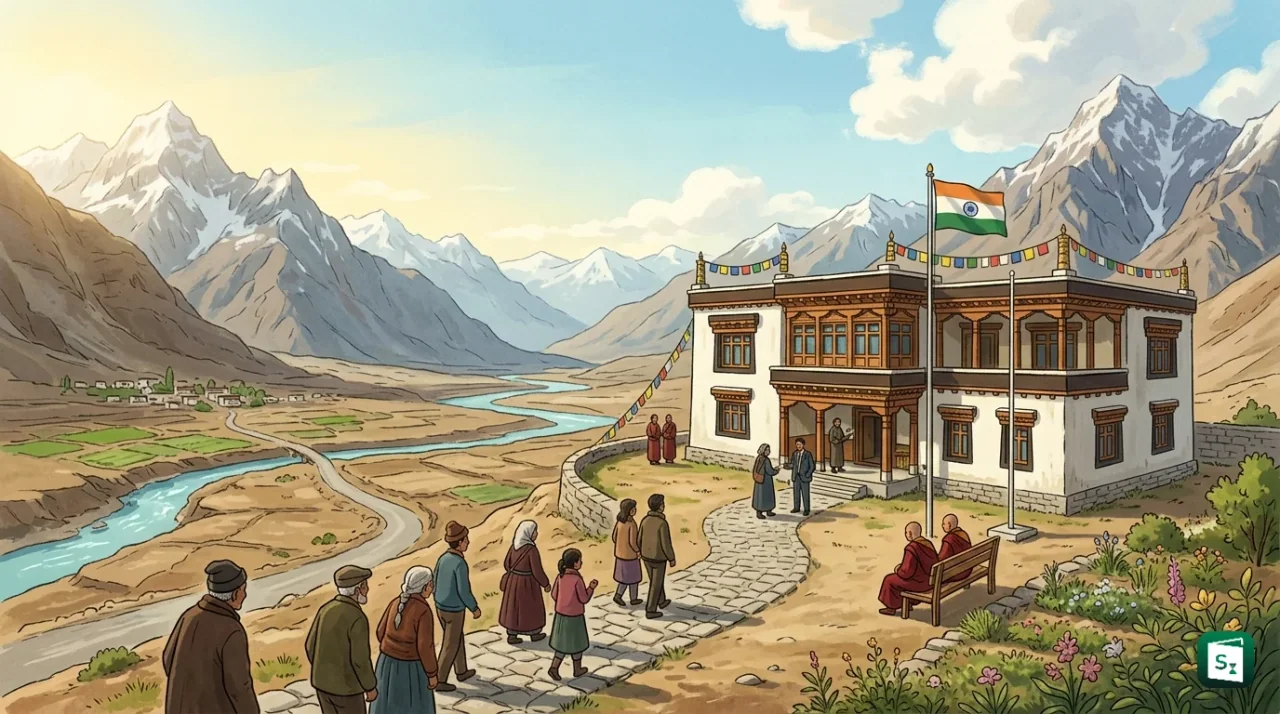
Ladakh is a high altitude plateau with most habitations above 3,000 metres. It is bounded by China in the north and east and Pakistan in the northwest, and is cut by the Indus River basin. Temperatures dip sharply in winter, passes close due to snow and landslides, and road travel can become impossible for months. Flash floods, cloudbursts and high seismic risk in Zone IV add to vulnerability.
Before the bench, cases from Leh district were heard at the Jammu wing and those from Kargil district at the Srinagar wing. For a litigant from Nubra, Zanskar, Changthang or Drass, reaching either city meant long road journeys, limited flight options and high costs for transport, lodging and legal representation. Women, elderly persons, persons with disabilities and low income litigants were most affected, and repeated adjournments due to travel or weather increased both cost and delay.
Pending Cases and Court Infrastructure Gap
The bench is expected to reduce travel related adjournments, but the wider judicial picture shows deeper gaps. About 500 cases relating to Ladakh were pending before the two wings of the common High Court around the time of the announcement. Parliamentary data as of 30 July 2026 showed 44,557 pending cases before the High Court of Jammu & Kashmir and Ladakh as a whole, including 6,106 cases pending for more than ten years. A reply in the Lok Sabha in August 2025 reported that only five of Ladakh’s ten subdivisions had functional court infrastructure, at Zanskar, Sankoo, Khaltsi, Nubra and Drass, while five subdivisions remained without functional facilities.
High Court access is only part of the chain. Most disputes start in subordinate courts. When trial courts, legal aid centres and basic infrastructure are missing at the subdivision level, litigants must first travel within Ladakh for lower court work and then again outside for High Court appeals. The imbalance highlights why a High Court bench needs to be supported by stronger district judiciary, legal aid and digital services to make timely justice under Article 21 and equal justice under Article 39A a practical reality.
The High Court of Jammu & Kashmir and Ladakh: Background
The High Court of Jammu & Kashmir and Ladakh is the common High Court for the Union Territory of Jammu and Kashmir and the Union Territory of Ladakh. It traces its origin to 26 March 1928, when Maharaja Hari Singh established the High Court of Judicature for the then princely state by Order No. 1. Lala Kanwar Sain was appointed the first Chief Justice, with Lala Bodh Raj Sawhney and Khan Sahib Aga Syed Hussain as puisne judges. The Maharaja conferred Letters Patent on the court on 10 September 1943.
After Independence, the jurisdiction of the Supreme Court was extended to the state through the Constitution Application Order of 1954, and the High Court received power under Article 32(2A) to issue writs for enforcement of fundamental rights.
The present structure was shaped by the Jammu and Kashmir Reorganisation Act, 2019. The Act reorganised the former state into two Union Territories from 31 October 2019. Under Section 75 of the Act, the existing High Court of Jammu and Kashmir became the common High Court for both Union Territories. Its name was updated to the High Court of Jammu & Kashmir and Ladakh, while judges continued in the common court.
Key facts about the court today are that its jurisdiction covers both UTs and is permitted for Union Territories through Articles 230 and 231, its principal seats function at Jammu in winter and Srinagar in summer with court sections at both wings working through the year, judges are appointed by the President of India under Article 217 after consultation with the Chief Justice of India, the Governors concerned and the Chief Justice of the High Court with eligibility requiring citizenship of India and at least ten years as a judicial officer or as an advocate of a High Court, the sanctioned strength has been reported at 25 positions including permanent and additional judges with the actual working strength varying, and as a court of record under Article 215 its records have evidentiary value and it has power to punish for contempt while under Article 226 it can issue writs including habeas corpus, mandamus, prohibition, certiorari and quo warranto for enforcement of fundamental rights and for any other purpose and under Article 227 it exercises superintendence over all courts and tribunals within its jurisdiction except Armed Forces tribunals.
Constitutional Framework for High Courts in Union Territories
High Courts operate within a clear constitutional design set out in Part VI of the Constitution under Articles 214 to 231. Article 214 provides that there shall be a High Court for each State. Article 230 allows Parliament to extend or exclude the jurisdiction of a High Court to or from any Union Territory. Article 231 permits Parliament to establish a common High Court for two or more States, or for two or more States and a Union Territory, and the High Court of Jammu & Kashmir and Ladakh is an example of this model. Article 241 separately provides that Parliament may by law constitute a High Court for a Union Territory or declare any court in a territory to be the High Court for that Union Territory.
For Ladakh specifically, two provisions interact. Section 75 of the 2019 Reorganisation Act makes the High Court common to Jammu and Kashmir and Ladakh, while Section 58(2) read with Article 240 allows the President to make regulations for Ladakh’s peace, progress and good government. The 2026 regulation creating a sitting in Ladakh flows from this second route. Ladakh remains a Union Territory without a legislature, and its administration is headed by the Lieutenant Governor, currently Vinai Kumar Saxena who assumed office on 13 March 2026.
On appointment and governance of High Courts, Article 216 states that every High Court consists of a Chief Justice and other judges as the President deems necessary, Article 217 deals with appointment and age of retirement at 62 years, Article 222 provides for transfer of judges after consultation with the Chief Justice of India, and Article 224 provides for appointment of additional and acting judges to handle arrears.
What Happens Next?
The regulation now needs practical implementation. The Administrator of Ladakh must notify the date on which it comes into force. After that, the High Court administration in consultation with the Union Government and the Ladakh administration will need to decide the exact place of sitting, likely at Leh with outreach to Kargil, define territorial jurisdiction and rosters, and provide judges, registrars, staff, courtrooms and records management.
The Union Territory administration will be expected to provide land, buildings, logistics and support services, while judicial functions including allocation of cases remain with the Chief Justice to preserve judicial independence. Reports suggest that hearings could begin temporarily from the Alternative Dispute Resolution Centre in Leh before shifting to a permanent complex.
Success will depend on more than a building. Indicators to watch include reduction in travel distance and cost for litigants, availability of filing and registry services inside Ladakh, frequency and predictability of sittings, disposal of the backlog including the roughly 500 Ladakh matters and the older cases, and extension of subordinate court infrastructure to the five subdivisions that currently lack functional facilities. Investment in e Courts tools such as e filing, video conferencing and digital case records, along with District Legal Services Authority outreach, will be critical in a region where connectivity is fragile and distances are large.
The decision also comes amid ongoing dialogue about Ladakh’s political and constitutional future. Groups such as the Leh Apex Body and the Kargil Democratic Alliance have been seeking stronger safeguards for land, employment, culture and political representation, and submitted a memorandum on non negotiable demands to the administration in mid August 2026 ahead of fresh talks with the Ministry of Home Affairs. The government has reiterated that the bench is part of its commitment to Ladakh’s all round development and constitutional safeguards.
Key Takeaways
- The Union Cabinet approved on 20 August 2026 a permanent bench of the High Court of Jammu & Kashmir and Ladakh in the Union Territory of Ladakh, announced by Home Minister Amit Shah.
- President Droupadi Murmu promulgated the Union Territory of Ladakh (Sitting of Bench) Regulation, 2026 as Regulation No. 10 of 2026 on 27 August 2026 under Article 240 read with Section 58(2) of the Jammu and Kashmir Reorganisation Act, 2019.
- The bench is a sitting of the existing common High Court whose principal seats remain at Jammu and Srinagar, not a separate High Court for Ladakh, with sittings arranged by the Chief Justice with approval of the Lieutenant Governor.
- A permanent bench sits continuously with posted judges and a permanent registry, while a circuit bench sits periodically with judges travelling from the principal seat.
- The common High Court traces to 26 March 1928 when Maharaja Hari Singh established it by Order No. 1, with Lala Kanwar Sain as first Chief Justice and Letters Patent on 10 September 1943.
- Ladakh spans 59,146 square kilometres and became a separate Union Territory on 31 October 2019, with about 44,557 cases pending before the common High Court as of July 2026 and only five of ten subdivisions having functional court infrastructure in August 2025.