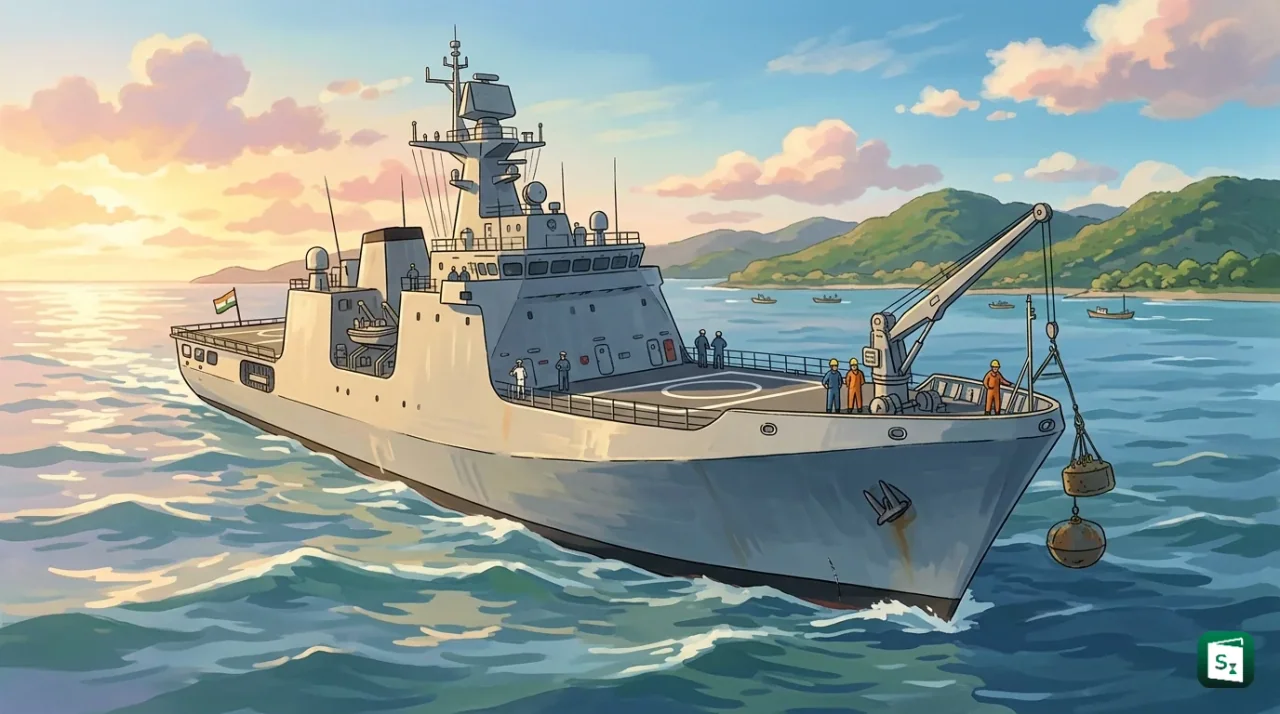
Larsen & Toubro Ltd delivered Samarthak, the first indigenous Multi-Purpose Vessel (MPV) built for the Indian Navy, on 27 August 2026 at its Kattupalli Shipyard near Chennai in Tamil Nadu. The vessel, built with more than 75% indigenous content, is the first of two Samarthak-class ships ordered under a self-reliance push. It will act as a flexible trial and evaluation platform for next-generation weapons and sensors while also supporting surveillance, rescue and humanitarian missions.
What Is Samarthak and What Does the Name Mean?
Samarthak means Supporter in Sanskrit, a name chosen to reflect the vessel’s multi-dimensional supporting role for the fleet. It is the lead ship of the Samarthak-class, a new category of Multi-Purpose Vessel (MPV) for the Indian Navy. An MPV is not a frontline combatant like a frigate or destroyer but a versatile support platform designed to perform many different tasks through one hull, offering a cost-effective alternative to deploying multiple specialised ships.
The ship was designed and built entirely in-house by Larsen & Toubro (L&T) at Kattupalli Shipyard, located at Ennore, about 45 km north of Chennai. The yard was laid down on 20 March 2023 and launched on 14 October 2024 at Kattupalli. The launch ceremony was presided over by Chief of the Naval Staff Admiral Dinesh K Tripathi and the vessel was launched by Shashi Tripathi, President of the Navy Wives Welfare Association (NWWA). The programme is the first time the Indian Navy has ordered warships to be constructed by L&T at Kattupalli.
The phrase Samarthak meaning is a frequent search, but in naval usage the name specifically denotes its function as an enabler for trials, training and fleet support rather than a linguistic exercise alone.
The Contract and Project Timeline
The two-ship MPV project began with a contract signed on 25 March 2022 between the Ministry of Defence and Larsen & Toubro. The total cost for both vessels is ₹887 crore (about ₹940 crore in 2023 prices). The contract was concluded under the Make in India and Atmanirbhar Bharat (Self-Reliant India) initiatives.
| Milestone | Date | Details |
|---|---|---|
| Contract signed | 25 March 2022 | Ministry of Defence with L&T for two MPVs |
| Keel laying | 20 March 2023 | Yards 18001 (Samarthak) and 18002 (Utkarsh) at Kattupalli, presided over by Vice Admiral Sandeep Naithani, Chief of Materiel |
| Launch of Samarthak | 14 October 2024 | Launched at Kattupalli by NWWA President Shashi Tripathi |
| Keel laying of second ship | 13 January 2025 | Yard 18002, named Utkarsh |
| Delivery of Samarthak | 27 August 2026 | First MPV delivered to the Indian Navy |
The second ship of the class is Utkarsh (Yard 18002), which was laid down in January 2025 and remains under construction. The class overall is planned for two ships, both building at Kattupalli.
Larsen & Toubro Ltd itself was founded in 1938 and is headquartered in Mumbai. Its Precision Engineering and Systems vertical, headed by figures such as A T Ramchandani, handles warship design and defence construction. The Kattupalli facility has steadily expanded from commercial shipbuilding to complex naval platforms, a shift that the Samarthak delivery now confirms.
Design, Specifications and Key Systems
Samarthak is a medium-sized vessel tailored for endurance and flexibility rather than high speed. Its modular layout allows rapid reconfiguration for different mission payloads, from towed targets to unmanned systems.
| Feature | Specification |
|---|---|
| Class | Samarthak-class Multi-Purpose Vessel |
| Builder | Larsen & Toubro, Kattupalli Shipyard, Tamil Nadu |
| Displacement | About 3,750 tonnes |
| Length | 107 metres |
| Beam (width) | 18.6 metres |
| Propulsion | Combined Diesel and Diesel (CODAD) with 2 diesel engines |
| Maximum speed | 15 knots (about 28 km per hour) |
| Range | 4,500 nautical miles (about 8,300 km) |
| Crew | 116 persons, including 8 officers |
| Aviation facility | Helipad for 1 HAL Dhruv Mk-III helicopter |
| Electronic warfare | SANKET MkIII system and Kavach anti-missile decoy system |
| Sensors and communication | Navigation radar, surface search radar, LINK II tactical datalink, satellite communication (SATCOM) through Rukmini |
| Armament (for self-defence and training) | 76 mm Oto Melara naval gun, 2 CRN-91 30 mm autocannons, 12.7 mm SRCG guns, twin 533 mm torpedo launcher for Varunastra heavyweight torpedo, triple 324 mm launcher for Advanced Light Torpedo Shyena, and RBU-6000 anti-submarine rocket launcher |
The vessel’s sensor suite and LINK II datalink allow it to share tactical data with other fleet units in real time, while SATCOM links to GSAT-7 Rukmini, the Navy’s dedicated communication satellite launched in 2013, ensure connectivity far from the coast. The SANKET MkIII is an indigenous electronic warfare system that detects and jams hostile radars, and Kavach deploys chaff to divert incoming missiles. These systems give a non-combatant support ship a credible self-protection capability.
Unlike a dedicated destroyer, Samarthak’s weapons are intended mainly for self-defence and for training exercises, such as firing trials and gunnery practice, rather than fleet combat.
What Will Samarthak Do? Roles of a Multi-Purpose Vessel
The Ministry of Defence described Samarthak as a trial and evaluation platform, and that is its primary purpose. However, the design covers a wide set of roles that make the ship useful across peacetime, training and operational scenarios.
One key role is as a trial platform for weapons and sensors. Samarthak will host developmental naval weapons, sensors and systems for testing at sea before they are fitted on frontline warships. This reduces risk and cost by allowing trials on a dedicated, reconfigurable hull instead of an active destroyer or frigate.
A second role is target launch and recovery. The vessel can launch and recover aerial, surface and underwater targets and expendable torpedoes for gunnery and anti-submarine warfare (ASW) exercises. Fleet firing practice thus becomes more efficient.
A third role is maritime surveillance and patrol. Equipped with radars and datalinks, the ship can undertake offshore patrolling, surveillance and reconnaissance in the Indian Ocean Region.
A fourth role is support for unmanned systems. It is designed to operate autonomous, remotely operated and unmanned aerial, surface and underwater vehicles, aligning with the Navy’s growing focus on unmanned warfare.
A fifth role is towing and salvage support. The MPV can tow ships, support intermediate support vessel (ISV) and salvage operations, and provide logistics support to island territories such as Andaman and Nicobar and Lakshadweep.
A sixth role is Humanitarian Assistance and Disaster Relief (HADR) and pollution control. The ship has limited hospital facilities for HADR missions, can respond to natural disasters, and is equipped to combat sea pollution, including oil spills.
Together, these roles allow one platform to replace several older, single-role auxiliaries, improving availability of combat ships for their core missions.
Why More Than 75% Indigenous Content Matters
The more than 75% indigenous content figure is central to the story. Under the Defence Acquisition Procedure (DAP) 2020, categories such as Buy (Indian-IDDM), which means Indian-Indigenously Designed, Developed and Manufactured, require at least 50% indigenous content, while Buy (Indian) requires 60%. Samarthak’s level comfortably exceeds these thresholds, signalling deep domestic value addition in hull steel, equipment, sensors and integration.
This aligns with a broader naval trajectory. The Navy classifies warship systems into three categories: Float (hull and structure), Move (propulsion and machinery) and Fight (weapons and sensors). Recent official data indicates indigenisation of about 95% in Float, 60 to 65% in Move, and 50% in Fight, with a stated goal of moving towards 90% across all three by the next decade. The government’s broader roadmap also aims for an Atmanirbhar (self-reliant) Navy by 2047, the centenary of independence.
Samarthak contributes directly to this ecosystem. High indigenous content means orders flow to Indian MSMEs (Micro, Small and Medium Enterprises), steel producers, electronics firms, sensor developers and software providers. Shipbuilding has a high multiplier effect, stimulating employment in precision engineering, logistics and skilled trades. For a private shipyard like L&T Kattupalli to deliver a Navy warship with this level of domestic content also demonstrates that private sector yards can complement traditional public sector builders such as Mazagon Dock Shipbuilders Limited (MDL) in Mumbai, Garden Reach Shipbuilders and Engineers (GRSE) in Kolkata, Goa Shipyard Limited (GSL) and Cochin Shipyard Limited (CSL) in Kochi.
On 26 August 2025, Defence Minister Rajnath Singh announced at Visakhapatnam during the commissioning of INS Udaygiri and INS Himgiri, the Project 17A stealth frigates, that India would henceforth build all future warships domestically. Samarthak’s delivery a year later reinforces that policy direction.
Samarthak in the Larger Fleet Expansion Plan
Samarthak arrives at a time of rapid fleet growth. Chief of the Naval Staff Admiral Dinesh K Tripathi, addressing the Defence Services Staff College, Wellington on 30 March 2026, outlined a roadmap to induct more than 155 indigenous warships by 2030 and more than 200 by 2035. The Navy has noted that recent commissionings have averaged one new vessel every 40 days, with more than 50 platforms currently under construction across Indian yards.
Within this plan, MPVs fill a gap. Unlike capital ships such as the aircraft carrier INS Vikrant, commissioned in 2022 and built by Cochin Shipyard, or the Project 17A Nilgiri-class frigates and Project 15B Visakhapatnam-class destroyers, Samarthak is not designed for sea battle. Instead, it ensures that frontline combatants are not diverted for trials, target services or pollution response. Its ability to test Varunastra and Shyena torpedoes, RBU-6000 rockets and future directed-energy or unmanned systems makes it a floating laboratory for the Navy’s Warship Design Bureau (WDB), which has designed more than 100 warships indigenously.
The vessel also complements other specialised auxiliaries such as diving support vessels, survey vessels like INS Ikshak and INS Malvan, and the growing unmanned vessel fleet, creating a more balanced and self-sufficient support structure for prolonged Indian Ocean operations.
Strategic Significance and the Way Forward
The Indian Ocean Region is India’s primary area of maritime interest, stretching from the Strait of Hormuz in the west to the Strait of Malacca in the east. A versatile support ship that can conduct surveillance, test new systems and respond quickly to humanitarian crises adds flexibility without adding the cost of multiple hulls. The ability to combat sea pollution also matters as shipping traffic and offshore exploration increase.
Looking ahead, the successful delivery of Samarthak sets a benchmark for Utkarsh and for any follow-on MPVs the Navy may order. It validates L&T’s in-house warship design capability, achieved despite global supply chain disruptions noted at the time of launch. If the model proves efficient, similar multi-role support concepts could be extended to other support categories, reducing lifecycle costs and dependency on imported auxiliary vessels.
For now, Samarthak will undergo induction formalities and integration with fleet commands after delivery. Its commissioning into active service will follow sea trials and acceptance checks, after which it will begin its dual life as a test bed for future weapons and a workhorse for everyday naval tasks.
Key Takeaways
- Samarthak, the first indigenous Multi-Purpose Vessel (MPV), was delivered to the Indian Navy on 27 August 2026 by Larsen & Toubro at Kattupalli Shipyard near Chennai.
- The project stems from a ₹887 crore contract signed on 25 March 2022 for two Samarthak-class ships, with Samarthak (Yard 18001) and Utkarsh (Yard 18002) as the two vessels.
- The vessel has more than 75% indigenous content and was designed and built in-house by L&T, aligning with Make in India and Atmanirbhar Bharat.
- With 3,750 tonnes displacement, 107 metres length and 15 knots speed, Samarthak carries 116 crew and can operate a HAL Dhruv Mk-III helicopter.
- Its primary role is as a trial and evaluation platform for next-generation weapons and sensors, with additional roles including target launch and recovery, maritime surveillance, operation of unmanned systems, towing, salvage, HADR and sea pollution control.
- The ship is equipped with SANKET MkIII, Kavach, LINK II datalink and SATCOM to Rukmini, and self-defence armament including a 76 mm Oto Melara gun and Varunastra and Shyena torpedo launchers.