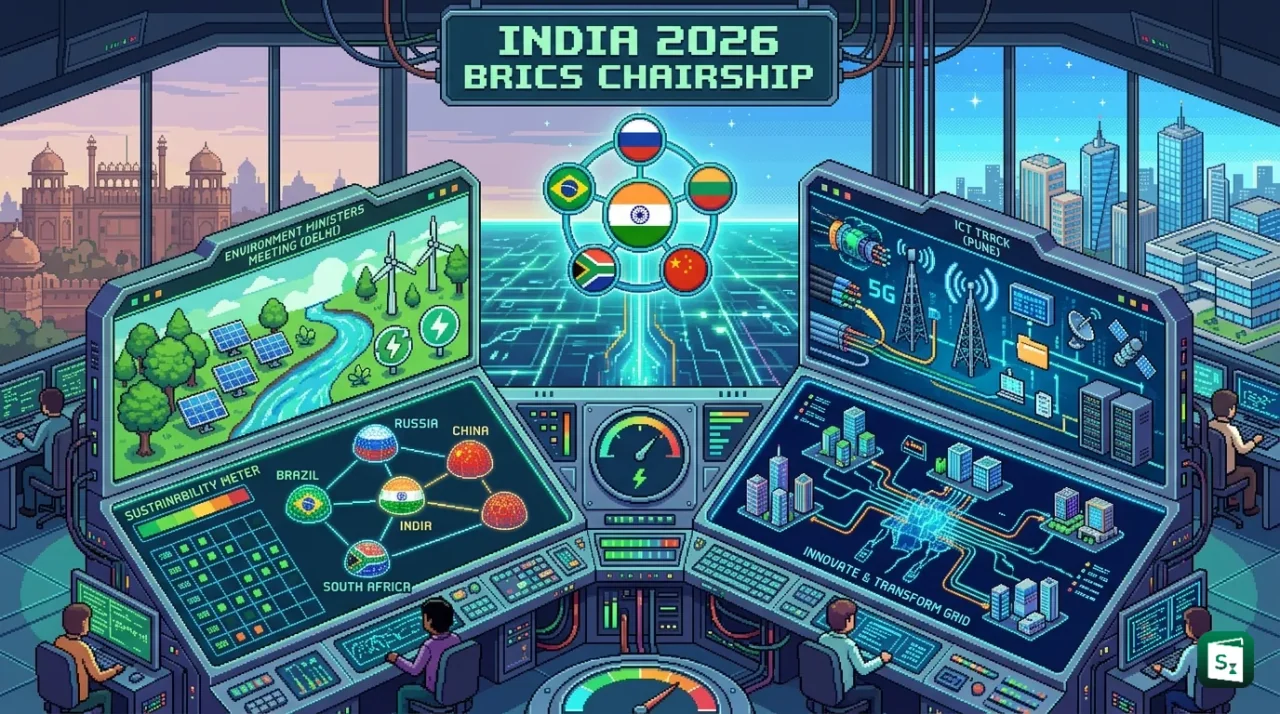
India under its BRICS 2026 Chairship hosted two key ministerial tracks in August 2026, the 12th BRICS Environment Ministers Meeting in New Delhi on 18 August and the five-day BRICS Information and Communication Technologies (ICT) Track in Pune from 17 to 21 August. The environment meeting at Bharat Mandapam was chaired by Union Minister Bhupender Yadav while the ICT track was organized by the Department of Telecommunications (DoT) under the Ministry of Communications under the theme Innovate, Cooperate and Transform (ICT) for a Resilient Future. Together the two tracks advanced India’s overarching chairship theme Building for Resilience, Innovation, Cooperation and Sustainability ahead of the 18th BRICS Summit scheduled in New Delhi on 12 and 13 September 2026.
What Is BRICS and Why Does the 2026 Chairship Matter?
BRICS stands for Brazil, Russia, India, China and South Africa, the five original members of a grouping that now describes itself as a platform of emerging economies seeking greater voice in global governance. The term BRIC was first coined in 2001 by economist Jim O’Neill of Goldman Sachs to describe four fast growing economies. The leaders met for the first formal BRIC summit in Yekaterinburg, Russia in 2009, and South Africa joined in December 2010, making it BRICS. The grouping has no permanent secretariat or headquarters, it works through an annual rotating chairship and summit.
India assumed the BRICS Chairship for 2026 on 1 January 2026, succeeding Brazil which chaired in 2025. It is India’s fourth chairship after 2012, 2016 and 2021. Under this chairship India will host the 18th BRICS Summit on 12 and 13 September 2026 at Bharat Mandapam in New Delhi. The summit will gather leaders of member and partner countries and outreach invitees, and China is scheduled to take over as chair in 2027.
For 2026 India has defined the overarching theme as Building for Resilience, Innovation, Cooperation and Sustainability, presented as Building Resilience and Innovation for Cooperation and Sustainability in ministerial meetings. External Affairs Minister S. Jaishankar unveiled the theme, logo and website on 13 January 2026. The logo is based on the lotus flower with a Namaste gesture at its centre, accompanied by the theme tagline, and was chosen through an open contest on the government’s citizen engagement platform. The concept is guided by Prime Minister Narendra Modi’s vision of a people-centric and Humanity First approach, with a stated focus on placing the concerns of the Global South at the centre of the agenda.
The year also marks 20 years since the BRICS formation process began, and the grouping has expanded well beyond its original five. After the 15th Summit in Johannesburg in 2023 invited new members, the current membership stands at 11 countries, including Brazil, Russia, India, China, South Africa, Egypt, Ethiopia, Iran, United Arab Emirates and Indonesia, with new partner country arrangements being developed to widen cooperation without full membership. Together members account for nearly half of world population and about two fifths of global GDP, which gives BRICS weight in discussions on trade, finance, climate and technology.
12th BRICS Environment Ministers Meeting in New Delhi: What Happened?
The 12th BRICS Environment Ministers Meeting was held on 18 August 2026 at Bharat Mandapam, New Delhi under India’s chairship. It was chaired by Bhupender Yadav, Union Minister for Environment, Forest and Climate Change (MoEFCC). The ministerial session was preceded on 17 August by a Senior Officers’ Meeting of the BRICS Environment Working Group (EWG) and the Contact Group on Climate Change and Sustainable Development (CGCCSD), which had held virtual consultations, webinars and concept note exchanges from March to July 2026 to build consensus.
In his keynote address Yadav redefined BRICS as Building Resilience and Innovation for Cooperation and Sustainability and said India’s chairship will keep the concerns of the Global South at the forefront, with a people-centric and Humanity First spirit. He highlighted growing challenges of climate change, biodiversity loss, pollution and disaster risks, and noted that environmental vulnerability in developing countries is closely linked to development priorities.
Four Priorities of India’s Environment Chairship
Working with the EWG and CGCCSD, India structured cooperation around four interconnected priorities:
| Priority | Focus Area |
|---|---|
| 1. Promoting Sustainable Lifestyles | Mindful consumption, behavioural change, environmental education, and community practices linked to Mission LiFE (Lifestyle for Environment) and initiatives like Ek Ped Maa Ke Naam |
| 2. Afforestation, Forest Fire Management and Disaster Resilience | Landscape based greening, ecosystem restoration, wildfire prevention, early warning, early action and post-fire recovery |
| 3. Circular Economy | Resource efficiency, Extended Producer Responsibility (EPR) frameworks, waste to wealth models and green business practices |
| 4. Adaptation | People-centric and community based adaptation, use of traditional knowledge, and building climate resilience |
Yadav also called for stronger BRICS cooperation on forest fire prevention, preparedness, early warning, response and post-fire recovery, with emphasis on climate finance, adaptation and empowering local communities.
Four Knowledge Compendiums and Joint Statement
A central outcome was the launch of four knowledge compendiums prepared by the Environment Working Group, unveiled by Yadav along with heads of delegations. These are the Compendium on National Experiences, Leading Practices and Success Stories on Promoting Sustainable Lifestyles, the Compendium on Best Practices and Innovative Approaches for Integrated Fire Management, the Compendium on Integrated Landscape-Based Greening Approaches and the Compendium on Extended Producer Responsibility Frameworks and Leading Circular Economy Practices. The compendiums compile policy innovations, regulatory tools, local knowledge systems and success stories from BRICS members, offering a shared base for technical cooperation, digital traceability solutions and capacity building.
The meeting concluded with the consensual adoption of the Joint Statement of the 12th BRICS Environment Ministers Meeting. The statement contains four outcome documents: creation of a network of BRICS institutions for knowledge sharing and research on sustainable lifestyles, principles for integrated landscape management, a common understanding on forest fire preparedness and response, and principles for climate resilience through people-centric adaptation. The joint statement reaffirmed commitment to the BRICS Memorandum of Understanding on Environmental Cooperation (2015) and its Plan of Implementation 2023 to 2027, and to existing platforms including the BRICS Environmentally Sound Technology Platform (BEST), BRICS Clean Rivers and BRICS Partnership for Urban Environmental Sustainability.
Ministers also noted interconnected challenges of water scarcity, desertification, drought, land degradation, sand and dust storms and wildfires, and stressed integrated approaches over isolated interventions. Delegations from Brazil, China, Egypt, Ethiopia, Indonesia, Iran, Russia, South Africa and the United Arab Emirates participated, and China was welcomed as host of the 13th Environment Ministers Meeting in 2027. Secretary Tanmay Kumar had chaired technical preparations in the working group process.
The four priority areas show continuity with recent BRICS environmental work. The 10th meeting in Nizhny Novgorod in June 2024 had created the Contact Group on Climate Change and Sustainable Development and discussed the BRICS Climate Research Platform, while the 11th meeting in Brazil in April 2025 focused on forests, the Tropical Forest Forever Facility (TFFF) and payment for ecosystem services.
BRICS ICT Track in Pune: Innovate, Cooperate and Transform for a Resilient Future
The BRICS Information and Communication Technologies (ICT) Track was organized by the Department of Telecommunications (DoT) under the Ministry of Communications in Pune, Maharashtra, from 17 to 21 August 2026 as a five-day programme under India’s BRICS Chairship. It brought together communications ministers, senior officials and ICT experts from BRICS members to advance cooperation on secure, inclusive and resilient digital ecosystems.
Inaugurating the track, Secretary (Telecom) Amit Agrawal outlined the ICT specific theme Innovate, Cooperate and Transform (ICT) for a Resilient Future, which sits within the overarching chairship theme of Building for Resilience, Innovation, Cooperation and Sustainability. He noted the track built on months of preparatory work since India assumed the ICT chair, including successive working group meetings, thematic webinars, concept notes and expert exchanges.
Three Major Events Under the ICT Track
| Event | Dates | Details |
|---|---|---|
| 7th BRICS Working Group for Cooperation in ICTs | 17 to 19 August | Deliberations on the Issues Note, survey responses from members and priorities under each pillar |
| Digital BRICS Forum and Expo | 20 August | Thematic discussions and exhibition of telecom and digital solutions by domestic and international enterprises, including cybersecurity and child online protection |
| 12th BRICS Communications Ministers Meeting | 21 August | Chaired by Union Minister Jyotiraditya M. Scindia, Minister for Communications and Development of North Eastern Region. Review of ICT Track priorities and future cooperation agenda |
The Pune programme also included meetings of the Council of the BRICS Institute of Future Networks (BIFN), the Focus Group on Digital Public Infrastructure (DPI) and the Digital BRICS Task Force.
Delegates discussed artificial intelligence (AI), next generation communications, Industry 4.0, Internet applications in Industry 4.0, electromagnetic field (EMF) exposure, satellite communications (SATCOM), cloud computing and digital ecosystem integration. The BIFN Council reviewed activities of national branches and updates from its four study groups on AI, next generation communications, Industry 4.0 applications and EMF exposure. Study groups focus on key technologies, standards, algorithms and application scenarios, and work through joint research, white papers, testbeds, labs and standardisation proposals.
Four Pillars of ICT Cooperation
The ICT Track rests on four pillars, as highlighted by both Agrawal and Scindia. The first is sustainable and resilient digital and ICT ecosystems, including universal, meaningful, affordable, sustainable and resilient connectivity and resilient public infrastructure. The second is cybersecurity and trustworthy ICT, covering trusted, secure and human-centric digital environments, child online protection and secure networks. The third is digital skills and capacity development, including digital skilling, capacity building and scaling of digital access. The fourth is innovation, startups and entrepreneurship, covering AI and future network technologies, Digital Public Infrastructure, startup ecosystems, innovation networks and entrepreneurship support
At the 12th Communications Ministers Meeting on 21 August, Jyotiraditya Scindia said innovation must remain secure, inclusive, sustainable and people-centric, and noted that BRICS represents half of humanity and two fifths of the world economy, giving the grouping a growing role in global digital governance. He outlined eight priority areas for future ICT cooperation: universal and meaningful connectivity, resilient public infrastructure, trusted, secure and people-centric ecosystems, Digital Public Infrastructure, artificial intelligence and future network technologies, innovation and startups and entrepreneurship, digital skilling and enhanced cooperation among BRICS countries.
The Forum and Expo showcased resilient ICT ecosystem solutions and emerging technologies, reinforcing India’s push to use the chairship to promote technology cooperation, digital public goods and inclusive growth across the grouping.
How BRICS Works: Institutions, Platforms and the New Development Bank
Understanding BRICS helps make sense of the two tracks hosted by India. BRICS is not a treaty based organisation with a charter like the United Nations. It functions as a consultative grouping coordinated through the annual summit, ministerial meetings and working groups. The rotating chair sets the calendar, drafts the agenda and hosts more than 300 sectoral meetings across host cities during the year, covering political and security, economic and financial, and cultural and people to people pillars.
Key Institutional Mechanisms
The grouping has created working structures to give substance to cooperation. The BRICS Environment Working Group (EWG), established in 2015 in Moscow at the 1st Environment Ministers Meeting, is the platform for environmental dialogue. It oversees the Memorandum of Understanding on Environmental Cooperation and its Plan of Implementation 2023 to 2027, and is supported by the Contact Group on Climate Change and Sustainable Development. The BRICS Environmentally Sound Technology Platform (BEST), BRICS Clean Rivers and BRICS Partnership for Urban Environmental Sustainability serve as dedicated cooperation platforms for technology sharing, river conservation and urban sustainability. Digital cooperation is anchored by the BRICS Working Group for Cooperation in ICTs and the BRICS Institute of Future Networks (BIFN). BIFN was proposed in the ICT Development Agenda and Action Plan at Bengaluru in 2016, pursued through Hangzhou in 2017 and formally approved at the 4th Communications Ministers Meeting in Durban in 2018. It operates on a council mechanism chaired by the rotating presidency, with a secretariat provided by the chair country and national branches that act as focal points. Its council reviews study groups and work plans and reports to communications ministers. Other tracks under the 2026 calendar have included Foreign Ministers, Agriculture Ministers, Energy Ministers, Employment Working Group, Culture Working Group, Health Working Group, Women Working Group, Tourism Working Group, Business Forum and Business Council, Youth Summit and Disaster Risk Reduction meetings.
The New Development Bank (NDB) and Financial Architecture
A frequent search query is what is BRICS bank. The answer is the New Development Bank (NDB), earlier called the BRICS Development Bank. The idea was proposed by India at the 4th BRICS Summit in New Delhi in 2012, agreed at the 5th Summit in Durban in 2013, and the Agreement on the NDB was signed at the 6th Summit in Fortaleza, Brazil on 15 July 2014. It entered into force in July 2015 and is headquartered in Shanghai, China. Its first regional office opened in Johannesburg, South Africa in 2016, with subsequent offices in Sao Paulo, Moscow and Ahmedabad, India.
The bank mobilises resources for infrastructure and sustainable development projects in emerging markets and developing countries. The initial authorised capital was $100 billion, with $50 billion in subscribed capital including $10 billion in paid-in capital equally contributed by the five founders ( $10 billion each from Brazil, Russia, India, China and South Africa). The Contingent Reserve Arrangement (CRA) of $100 billion complements the NDB as an emergency balance of payments mechanism, with China contributing $41 billion, Brazil, India and Russia $18 billion each, and South Africa $5 billion.
By 2023 to 2024 the NDB had approved more than $32 billion to $34 billion for about 96 projects across members. Membership has been expanding. In 2021 Bangladesh, Egypt, United Arab Emirates and Uruguay were admitted, followed by Algeria in 2024, and applications from Ethiopia, Angola, Colombia and Uzbekistan have moved through stages. The current President is Dilma Rousseff, former President of Brazil. The bank is now described as having 14 members including founding and new members, with operating language English.
Talk of a BRICS currency, BRICS Pay and de-dollarisation surfaces regularly. BRICS leaders have discussed settlements in local currencies, payment system cooperation and alternatives to SWIFT, but no common currency has been launched. The NDB continues to settle and lend in both US dollars and local currencies while studying mechanisms for more local currency use.
BRICS vs G7, G20, SCO and SAARC: How It Compares
Public interest is strong in comparisons such as BRICS vs G7, BRICS vs G20, BRICS vs NATO, BRICS vs SCO and BRICS vs SAARC. Each grouping has a different purpose and membership:
| Grouping | Full Form and Members | Nature and Focus |
|---|---|---|
| BRICS | Brazil, Russia, India, China, South Africa plus new members including Egypt, Ethiopia, Iran, UAE, Indonesia. 11 members in 2026 | Emerging economies platform for economic, financial, environment and technology cooperation. Seeks multipolarity and greater voice for the Global South. Chair rotates annually, summit driven |
| G7 | Group of Seven: US, UK, Japan, Germany, France, Italy, Canada plus EU as participant | Forum of advanced economies focusing on economic policy, security and climate. Smaller, homogeneous, founded in 1975 |
| G20 | Group of Twenty: 19 countries plus EU and African Union including all BRICS founders and G7 members | Premier forum for international economic cooperation. Includes both advanced and emerging economies. Summit presidency rotates, India chaired in 2023 |
| SCO | Shanghai Cooperation Organisation: China, Russia, India, Pakistan, Iran, Kazakhstan, Uzbekistan, Kyrgyzstan, Tajikistan, Belarus | Regional security and economic grouping focused on Eurasia, counter-terrorism and connectivity. Secretariat in Beijing, founded in 2001 |
| SAARC | South Asian Association for Regional Cooperation: Afghanistan, Bangladesh, Bhutan, India, Maldives, Nepal, Pakistan, Sri Lanka | South Asian regional integration for economic and social cooperation. Secretariat in Kathmandu, founded in 1985. Summit process stalled since 2014 |
In simple terms, G7 is a club of advanced economies, G20 is a mixed economy steering group, SCO is a Eurasian security bloc and SAARC is a South Asian regional body, while BRICS is a cross-regional grouping of emerging economies aiming to reform global governance and promote South-South cooperation. Comparisons of BRICS vs G7 GDP often note that BRICS now accounts for a larger share of global GDP on a purchasing power parity basis, while G7 remains dominant on a nominal GDP basis. Militarily, unlike NATO which is a collective defence alliance, BRICS is not a military bloc and has no mutual defence clause.
Why BRICS Matters for India and the Global South
India’s dual track hosting shows the practical use it seeks from BRICS during 2026. For India, BRICS offers four direct benefits: a platform to project the Global South agenda, a channel to advance climate and environment priorities without binding treaty commitments, a market for digital public goods and startup partnerships, and access to alternative development finance through the NDB.
On environment, the four priorities match India’s domestic programmes. Sustainable lifestyles links to LiFE, circular economy links to EPR rules for plastic and e-waste, and forest and fire cooperation is relevant as India manages forest cover of about 21.7 percent of its geography and frequent forest fire seasons. The emphasis on landscape based greening and community based adaptation also reflects Indian approaches rooted in local knowledge.
On digital cooperation, India has an advantage to share Digital Public Infrastructure such as Aadhaar, UPI and ONDC, and to learn from partners on AI governance, next generation networks and Industry 4.0. The BRICS Institute of Future Networks gives Indian research institutes, startups and small firms a joint innovation window, while the focus on cybersecurity and trustworthy ICT addresses shared concerns about data protection and child online safety.
For the Global South, the value lies in South-South cooperation on adaptation finance, technology on mutually agreed terms, and resilient supply chains as global trade faces disruptions. By framing BRICS as Building Resilience and Innovation for Cooperation and Sustainability, India is positioning the grouping as a problem solving network rather than an anti-west bloc, working alongside G20 and UN processes on climate, disaster risk reduction and energy security.
The Way Forward: Towards the 18th BRICS Summit 2026
The outcomes from the two tracks will feed directly into the 18th BRICS Summit in New Delhi on 12 and 13 September 2026. The Joint Statement on Environment with its four outcome documents and the priorities agreed under the ICT Track are expected to form part of the summit declaration that ministers will negotiate in remaining working group meetings.
According to the chairship calendar, more than 350 BRICS meetings are being organised across Indian cities in 2026 across the three pillars of political and security, economic and financial, and people to people cooperation. The Ministry of External Affairs has indicated that leaders will discuss trade and finance cooperation, technology and AI governance, health and agriculture innovation, energy and climate resilience, and cultural exchanges. The expanded membership means India must balance diverse interests while ensuring that deliverables remain implementation oriented rather than purely declaratory.
If the summit adopts clear mechanisms on knowledge networks for sustainable lifestyles, interoperable early warning systems for wildfires, principles for circular economy cooperation and a roadmap for resilient digital infrastructure, the 2026 chairship will be seen as having converted months of technical exchanges into institutional capability. The formal handover to China for the 2027 chairship will then test whether that momentum continues.
Key Takeaways
- The 12th BRICS Environment Ministers Meeting was held on 18 August 2026 at Bharat Mandapam, New Delhi, chaired by Bhupender Yadav under India’s BRICS 2026 Chairship.
- The BRICS ICT Track was organized by the Department of Telecommunications (DoT) under the Ministry of Communications in Pune from 17 to 21 August 2026 under the theme Innovate, Cooperate and Transform (ICT) for a Resilient Future.
- India’s BRICS Chairship theme for 2026 is Building for Resilience, Innovation, Cooperation and Sustainability, with the 18th BRICS Summit scheduled in New Delhi on 12 and 13 September 2026 at Bharat Mandapam.
- The environment meeting launched four knowledge compendiums on sustainable lifestyles, integrated fire management, landscape-based greening and circular economy with EPR frameworks, and adopted a Joint Statement with four outcome documents.
- The ICT Track included the 7th ICT Working Group Meeting, Digital BRICS Forum and Expo on 20 August, and 12th Communications Ministers Meeting on 21 August chaired by Jyotiraditya M. Scindia with four pillars including resilient ecosystems and cybersecurity.
- The New Development Bank (NDB), the BRICS Bank headquartered in Shanghai, was established by agreement signed on 15 July 2014 in Fortaleza and entered into force in July 2015 with $100 billion authorized capital.