General Dhiraj Seth, Chief of Army Staff (COAS) of the Indian Army, visited Nepal from 16 to 19 August 2026 at the invitation of his counterpart General Ashok Raj Sigdel to strengthen bilateral defence cooperation. On 17 August, President Ramchandra Paudel conferred on him the honorary rank of General of the Nepali Army at an investiture ceremony at Sheetal Niwas, the presidential residence in Kathmandu. The honour continues a unique 75-year-old reciprocal tradition that began in 1950 and remains the most distinctive symbol of trust between the two armies.
What Happened During the Army Chief’s Nepal Visit?
General Dhiraj Seth undertook his first official foreign visit after assuming office as the 31st Chief of Army Staff (COAS) on 30 June 2026. He arrived in Kathmandu on 16 August 2026 and was received by senior officers of the Nepali Army and officials of the Embassy of India. The visit was held at the invitation of General Ashok Raj Sigdel, Chief of Army Staff of the Nepali Army, with the stated aim of deepening defence cooperation and military-to-military ties.
On the morning of 17 August, General Seth laid a wreath at the Army Pavilion in Tundikhel, the central memorial in Kathmandu, and paid homage to soldiers who died in service. He then visited the Nepali Army Headquarters where he received and inspected a ceremonial Guard of Honour. He planted a sapling on the premises as a mark of enduring friendship. Later that day he called on General Sigdel and was briefed by the Director General of Military Operations (DGMO) of the Nepali Army on matters of mutual interest. Both sides discussed ways to expand bilateral cooperation, including training, equipment support and coordination on regional security.
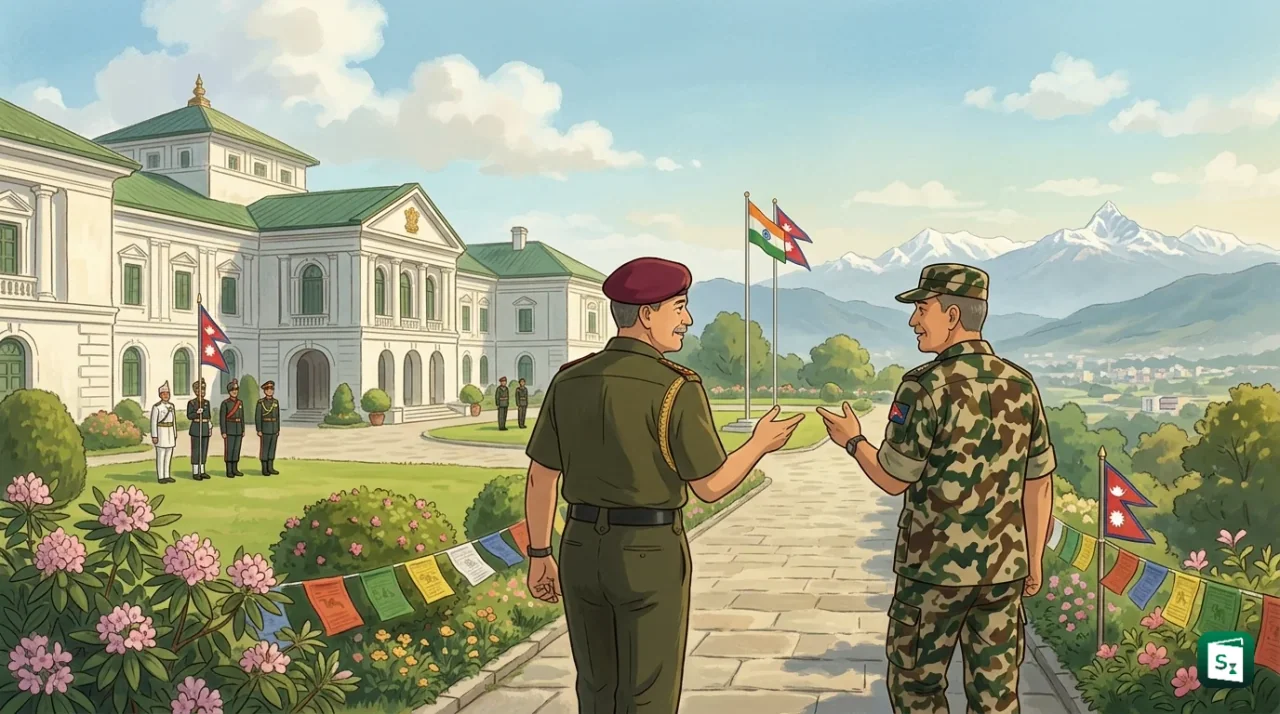
The centrepiece of the day was the investiture ceremony at Sheetal Niwas, the official residence of the President of Nepal, also referred to as Rashtrapati Bhawan. President Ramchandra Paudel conferred on General Seth the honorary rank of General of the Nepali Army and presented him with a sword, insignia and certificate of conferment. Vice President Ram Sahaya Prasad Yadav, Foreign Minister Shisir Khanal, India’s Ambassador to Nepal Naveen Srivastava, and senior civil and military officials of Nepal were present. The Indian Army described the conferment as more than a ceremonial honour, calling it an institutional expression of mutual trust and professional camaraderie that has been sustained across successive generations of leadership.
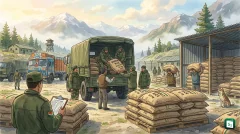
During the visit, General Seth also handed over an electric bus and medical equipment for disaster relief operations to the Nepali Army on behalf of the Government of India. On 18 August, he addressed student officers at the Nepali Army Command and Staff College in Shivapuri, speaking on the evolving dynamics of modern warfare, technology, information operations and the role of junior leadership. He held an interactive session with the officers and interacted with instructors and foreign student officers. The same day he called on Prime Minister Balendra Shah, who also holds the defence portfolio, and discussed bilateral interests and ways to strengthen military relations.
On the final day, 19 August, General Seth attended an ex-servicemen rally in Pokhara, a city with a large community of retired Gorkha soldiers. He interacted with Indian Army veterans of Nepali origin, felicitated Veer Naris (war widows) and gallantry award winners, and acknowledged their long service. He returned to India later that day, concluding the four-day engagement.
Who Are the Key Personalities in This Visit?
General Dhiraj Seth, Chief of Army Staff (COAS), Indian Army, is the professional head of the Indian Army. Chief of Army Staff is the highest ranking officer of the Indian Army and is responsible for overall operational and administrative leadership of the force. General Seth assumed charge as the 31st COAS on 30 June 2026, succeeding General Upendra Dwivedi who retired on the same day. His visit to Nepal was his first official foreign tour as Army Chief. He is a decorated officer and a recipient of the Param Vishisht Seva Medal (PVSM), Uttam Yudh Seva Medal (UYSM) and Ati Vishisht Seva Medal (AVSM), awards given for distinguished service of a high order.
General Ashok Raj Sigdel, Chief of Army Staff, Nepali Army, is the head of Nepal’s land forces. He assumed office on 9 September 2024 after taking oath from President Paudel, succeeding General Prabhu Ram Sharma. Born on 1 February 1967 in Rupandehi, he was commissioned into the Nepali Army in 1987. His career includes appointments as Director of Military Operations, Director General of Staff Duties, Policy and Plans, Master General of Ordnance and Chief of General Staff. He has served in United Nations peacekeeping missions in former Yugoslavia, Tajikistan and Liberia, and is an alumnus of the Army Command and Staff College, Shivapuri, the Army War College, the Defence Management Course in India and the National Defence University in China. He holds master’s degrees in strategic studies and political science. On 12 December 2024, he was conferred the honorary rank of General of the Indian Army by President Droupadi Murmu at Rashtrapati Bhavan in New Delhi, the reciprocal honour to the one now given to General Seth.
Ramchandra Paudel, President of Nepal, is the ceremonial head of state of the Federal Democratic Republic of Nepal and the supreme commander of the Nepali Army. He was elected as the third President of Nepal on 9 March 2023 and assumed office on 13 March 2023 at Sheetal Niwas in Kathmandu, which serves as the official residence and office of the President. In Nepal’s parliamentary system, the President confers ranks and honours and hosts investiture ceremonies for foreign dignitaries.
The ceremony was also attended by Vice President Ram Sahaya Prasad Yadav, Foreign Minister Shisir Khanal and India’s Ambassador to Nepal Naveen Srivastava, underlining the diplomatic weight of the military engagement.
What Is the Honorary General Tradition Between India and Nepal?
The honorary rank of General is a ceremonial distinction, not a functional command. When an Army Chief receives this honour, he does not gain any authority over the other country’s army. It is a symbolic title that signals exceptional closeness between two militaries. In the global context, such a reciprocal exchange of the highest rank between two sovereign armies is extremely rare.
The tradition began in 1950. The first Indian officer to receive the honour was General K. M. Cariappa, the first Indian Commander-in-Chief of the Indian Army after independence, who was conferred the honorary rank of General of the Nepali Army in 1950. Later that year, Nepal’s Army Chief General Shumsher Jung Bahadur Rana was made an Honorary General of the Indian Army. Since then, every serving Army Chief of both countries has received the reciprocal honour during an official visit.
The backdrop was the Treaty of Peace and Friendship between India and Nepal signed on 31 July 1950 in Kathmandu. The treaty, signed by Nepal’s last Rana Prime Minister Mohan Shumsher Jung Bahadur Rana and India’s Ambassador Chandreshwar Prasad Narayan Singh, provided for everlasting peace, mutual respect for sovereignty and close cooperation on defence and foreign policy. It also allowed free movement of people and goods. Within this framework of trust, the honorary generalship became an institutional ritual.
Over more than seven decades, the practice has continued without interruption, even when political relations have faced strain, such as during the trade and transit difficulties of 1989 to 1990. The military channel has often acted as a stabilising link. Recent conferments illustrate the continuity:
| Year | Indian Chief Honoured in Nepal | Nepali Chief Honoured in India |
|---|---|---|
| 2022 | General Manoj Pande by President Bidya Devi Bhandari on 5 September 2022 at Sheetal Niwas | General Prabhu Ram Sharma by President Ram Nath Kovind in November 2021 |
| 2024 | General Upendra Dwivedi by President Ramchandra Paudel in November 2024 | General Ashok Raj Sigdel by President Droupadi Murmu on 12 December 2024 at Rashtrapati Bhavan, New Delhi |
| 2026 | General Dhiraj Seth by President Ramchandra Paudel on 17 August 2026 at Sheetal Niwas | - |
During each investiture, the host President presents a sword, insignia and certificate of conferment. The new honorary general’s rank plate is symbolically updated. Both armies describe the practice as an expression of mutual trust, professional respect and military camaraderie that has been sustained across generations of leadership. For India, the honour also acknowledges the historic contribution of Gorkha soldiers from Nepal who serve in the Indian Army.
Why Does a Ceremonial Rank Matter?
The value is institutional, not personal. First, it publicly reaffirms that the two armies see each other as privileged partners. Second, it creates a regular high-level visit that allows Chiefs to discuss substantive cooperation. Third, it sends a message of stability to the region at a time when the Himalayan neighbourhood is witnessing growing strategic competition.
Why Is Nepal Important for India and Why Does This Visit Matter?
Nepal occupies a central place in India’s neighbourhood policy for geography, history and security. The two countries share an open border of about 1,850 kilometres and deep ties often described as Roti-Beti Ka Rishta, referring to shared food and family relations, along with religious links between Janakpur and Ayodhya and Lumbini and Bodhgaya. The open border allows visa-free movement of citizens, which creates unique opportunities for people-to-people contact but also requires close coordination on border management, crime and disaster response.
Strategically, Nepal is located between India and China in the Himalayas. Stability in Nepal directly affects security in India’s northern states of Uttarakhand, Uttar Pradesh, Bihar, West Bengal and Sikkim. Cooperation with the Nepali Army therefore helps India monitor Himalayan security, respond to natural disasters such as earthquakes and floods, and maintain peace along a sensitive frontier. The 1950 Treaty of Peace and Friendship still provides the broad framework, while specific defence ties have expanded far beyond it.
For the current visit, three aspects make the timing notable. First, General Seth’s tour is the first senior Indian official visit since the formation of the government led by Prime Minister Balendra Shah on 27 March 2026, so it carries diplomatic signalling. Second, the visit reaffirms army-to-army ties at a moment when recruitment of Nepali youth into the Indian Army’s Gorkha regiments has been paused since 2019 after India introduced the Agnipath scheme for short-term recruitment. The issue has been a point of public discussion in Nepal. Third, the visit took place alongside engagements on modern warfare, disaster relief and equipment support, showing that the relationship is moving from ceremony to capability building. The handover of non-lethal assistance such as an electric bus and medical stores, and the focus on humanitarian assistance and disaster relief, reflects this practical dimension.
How Has India-Nepal Defence Cooperation Evolved?
India-Nepal military ties are among the oldest and most institutionalised in South Asia. Their roots go back to the Treaty of Sugauli of 1816 which ended the Anglo-Nepal War and opened the way for recruitment of Gorkha soldiers by the British. Even earlier, Maharaja Ranjit Singh recruited Gorkhas in 1809 after being impressed by their fighting skills during the Kangra confrontation. After independence, the 1947 Tripartite Agreement between India, Nepal and Britain formalised the division of Gorkha regiments. Today the Indian Army is estimated to employ about 32,000 to 34,000 Gorkha soldiers from Nepal, with a much larger community of veterans and families who receive pensions in Nepal. This human link is a unique foundation for defence ties.
Since 1950, cooperation has expanded into training, equipment, joint exercises, disaster relief and high-level exchanges. Many Nepali Army officers attend courses at Indian Army institutions, and India has supplied vehicles, training equipment and medical stores to help modernise the Nepali Army.
The Joint Exercise Surya Kiran and Other Pillars of Military Ties
The most visible annual engagement is Exercise Surya Kiran, a bilateral joint military exercise conducted since 2011. The exercise was first held at Vairengte in Mizoram and is now hosted alternately in India and Nepal. From platoon-level in the first two editions, it has become a battalion-level exercise lasting up to 14 days. Its core aim is to rehearse sub-conventional operations under Chapter VII of the United Nations Charter, with a focus on jungle warfare, counter-terrorism in mountainous terrain, humanitarian assistance and disaster relief (HADR), medical response and integrated ground and aviation operations.
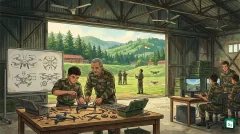
The 19th edition, Surya Kiran XIX, was held from 25 November to 8 December 2025 at Pithoragarh in Uttarakhand at the Foreign Training Node. Troops from the Assam Regiment of the Indian Army and the Devi Datta Regiment of the Nepali Army participated, with 334 personnel from each side. The 2025 edition placed special emphasis on niche technologies such as Unmanned Aerial Systems for intelligence and surveillance, drone-based targeting, AI-enabled decision tools, unmanned logistics platforms and secure battlefield communications. Earlier editions have similarly rotated, with the 18th edition from 31 December 2024 to 13 January 2025 at Shaljhandi in Nepal.
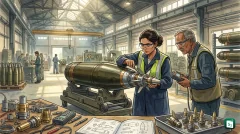
Other pillars include training and education at staff colleges such as the Command and Staff College at Shivapuri, where General Seth delivered a lecture in 2026 on modern warfare and junior leadership. Another pillar is humanitarian assistance, notably Operation Maitri launched by India after the devastating earthquake in Nepal in April 2015, when the Indian Army, Indian Air Force, National Disaster Response Force and medical teams carried out large-scale relief. Equipment and capability support forms a third pillar, including target practice drones, field hospital stores, light vehicles and, in 2026, an electric bus for the Nepali Army. Finally, regular high-level visits by Chiefs, Directors General of Military Operations and defence officials, often involving meetings with the Chief of Defence Staff, National Security Adviser and Foreign Secretary in New Delhi, keep the dialogue continuous.
| Area of Cooperation | Example |
|---|---|
| Human Resources | Gorkha recruitment under 1947 Tripartite Agreement, about 32,000 serving, veterans in Pokhara and across Nepal |
| Joint Training | Surya Kiran since 2011, alternating venues, battalion level, UN peacekeeping focus |
| Disaster Relief | Operation Maitri 2015, joint HADR drills within Surya Kiran |
| Capacity Building | Training slots in Indian institutions, supply of vehicles, medical and engineering equipment |
| Strategic Dialogue | Reciprocal honorary general conferments, DGMO briefings, CDS and NSA level talks |
Together, these strands make defence cooperation a durable part of India-Nepal relations, often described as stable even when political ties experience fluctuations.
The Way Forward
The visit of General Seth points to three concrete next steps for the bilateral military relationship. First, both armies are expected to keep Surya Kiran as the main interoperability tool, with greater integration of drones, artificial intelligence tools and unmanned logistics, as shown in the 2025 edition. The forthcoming editions will likely deepen this technology focus and add modules on disaster response in the Himalayas.
Second, the dialogue on Gorkha recruitment and the Agnipath scheme will need careful handling. Restoring a mutually acceptable recruitment pathway is seen as important for sustaining the human link that underpins the entire partnership. Any solution will have to balance India’s new personnel policy with Nepal’s domestic expectations.
Third, the regular exchange of honorary ranks, staff talks and DGMO-level briefings provides a predictable channel to discuss border management, defence industry cooperation and regional security. India’s offer of training equipment and medical support indicates a move towards capacity building rather than only ceremonial ties. If this momentum is maintained, the army-to-army channel will continue to act as a steady anchor for the wider India-Nepal relationship, including trade, energy and connectivity.
Key Takeaways
- General Dhiraj Seth, the 31st Chief of Army Staff of the Indian Army who took charge on 30 June 2026, visited Nepal from 16 to 19 August 2026 at the invitation of Nepali COAS General Ashok Raj Sigdel.
- President Ramchandra Paudel conferred the honorary rank of General of the Nepali Army on General Seth on 17 August 2026 at an investiture ceremony at Sheetal Niwas (Rashtrapati Bhawan) in Kathmandu.
- The reciprocal honorary general tradition began in 1950 with General K. M. Cariappa and General Shumsher Jung Bahadur Rana and is linked to the 1950 Treaty of Peace and Friendship.
- General Seth’s visit included a wreath laying at Tundikhel, a Guard of Honour at Nepali Army Headquarters, a DGMO briefing, a lecture at the Command and Staff College, Shivapuri, and an ex-servicemen rally at Pokhara on 19 August.
- General Ashok Raj Sigdel, who assumed office on 9 September 2024, was conferred the honorary rank of General of the Indian Army by President Droupadi Murmu on 12 December 2024 at Rashtrapati Bhavan, New Delhi.
- The bilateral Exercise Surya Kiran, held since 2011, reached its 19th edition from 25 November to 8 December 2025 at Pithoragarh, Uttarakhand, with 334 troops each from the Assam Regiment and Devi Datta Regiment.