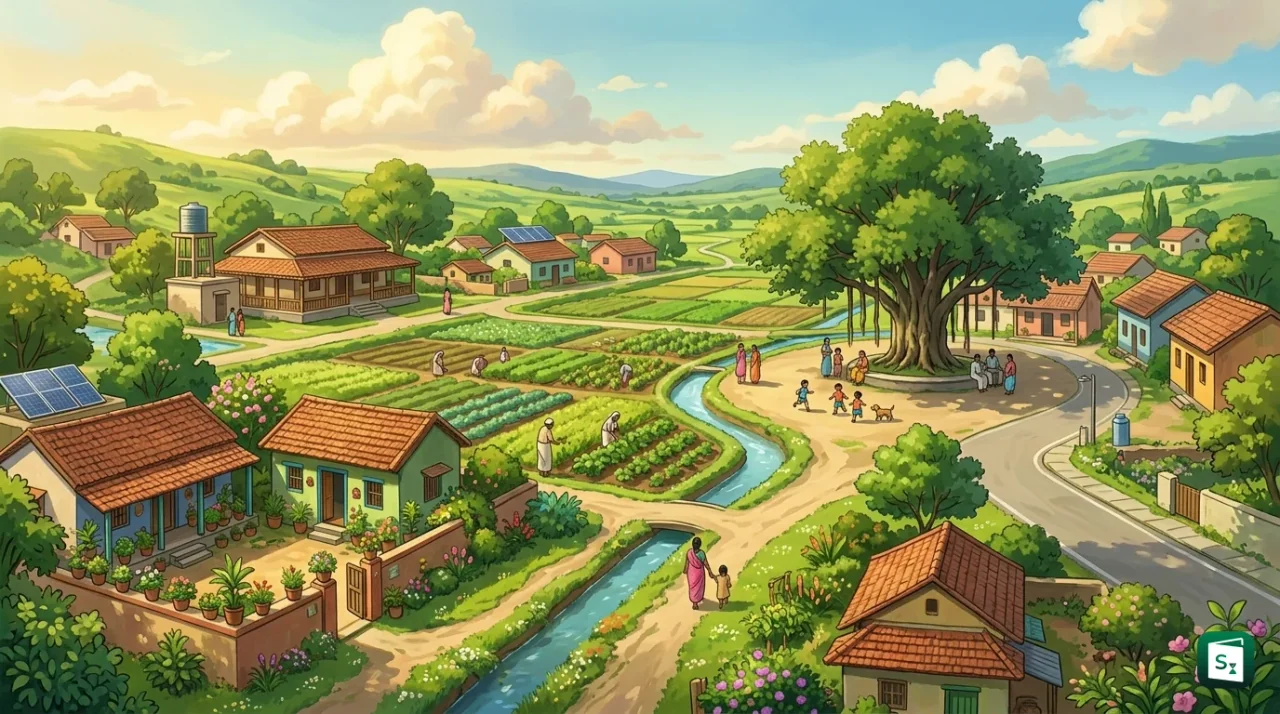
Union Minister for Rural Development Shivraj Singh Chouhan launched Mission Samriddh Gaon at Krishi Bhawan in New Delhi on August 25, 2026, marking a fresh push to convert India’s villages into self-reliant, economically vibrant units. The mission, anchored in the Ministry of Rural Development (MoRD), is designed around a simple but ambitious idea: rather than launch yet another standalone scheme, pool the Centre’s existing rural programmes and deliver them in a coordinated manner at the household, Gram Panchayat, and block levels. A pilot of this convergence model is now running in two blocks of Madhya Pradesh, with the most successful elements intended for national replication.
What Is Mission Samriddh Gaon?
Mission Samriddh Gaon (literally, “Prosperous Village Mission”) is an integrated rural transformation framework under which existing Central and State welfare schemes are coordinated at the village level rather than run as separate silos. The mission’s stated goal is to develop villages where every family has access to a sustainable livelihood, basic amenities are universally available, and people do not have to migrate out of compulsion in search of work.
At its heart, the mission is built around three pillars: poverty reduction, employment generation, and universal access to basic amenities such as housing, drinking water, sanitation, health, education, and rural connectivity. Crucially, the Ministry has clarified that Samriddh Gaon is not a new centrally sponsored scheme with a fresh financial outlay. It is a convergence mission, meaning it rearranges how existing schemes are delivered so that a single family or Gram Panchayat receives the full bundle of benefits it is eligible for, instead of piecemeal assistance from different departments.
The Office of the Rural Development Minister has positioned the mission as a foundational building block of the Prime Minister’s Viksit Bharat 2047 vision, with the explicit argument that a developed India cannot be built on weakened villages.
The Architecture: Convergence, Not a New Scheme
The defining feature of Mission Samriddh Gaon is its reliance on convergence. Convergence, in the rural development context, refers to the deliberate coordination of multiple Central and State schemes at the level of the household, Gram Panchayat, and block, so that benefits reach the same family in a planned, sequenced manner instead of through disconnected, overlapping, or missed touchpoints.
Family-Level Saturation as the Core Unit
The Minister has repeatedly stressed that the family is the smallest unit of rural development under the mission. Each rural family is to be assessed against its eligibility for various schemes in agriculture, housing, employment, skills, health, education, and social security, and then linked to all relevant programmes in one go. This saturation approach is meant to plug the leakages that occur when families receive only one or two benefits and remain deprived of the rest simply because no single line department took the responsibility of mapping their full entitlement.
The Three-Tier Planning Framework
The convergence is operationalised through development plans prepared at three administrative layers. At the top sits the family-level plan, which identifies every eligible scheme for each household. These plans feed into Gram Panchayat Development Plans (GPDPs), which aggregate family-level needs into village-wide priorities. The GPDP framework was institutionalised under the 73rd Constitutional Amendment Act, 1992, which gave constitutional status to Panchayati Raj Institutions and listed 29 subjects in the Eleventh Schedule, including rural housing, drinking water, roads, and poverty alleviation. At the block level, plans align resources across multiple Gram Panchayats for shared infrastructure such as warehouses, food processing units, cold chains, and skill training centres.
Under this framework, the Minister has called for coordinated action among the government, Panchayati Raj Institutions (PRIs), civil society organisations, banks, NGOs, and the private sector, with the explicit aim of presenting a fresh model of rural development to the country.
The Pilot in Madhya Pradesh
The first ground-level test of the mission is being conducted in two blocks of Madhya Pradesh: Budni block in Sehore district and Khategaon block in Dewas district. Both blocks lie in central Madhya Pradesh, a region dominated by small and marginal farmers, and have been chosen to test whether multiple Central and State schemes can be stitched together at the household and Gram Panchayat level to deliver visible improvements in a short time.
In Budni and Khategaon, an integrated development framework is being prepared that maps each family to every Central and State scheme it is eligible for. Agriculture, health, education, employment, livelihoods, and basic amenities are all being brought under one delivery architecture. The Minister has also flagged a specific focus on women farmers, with plans to identify them, provide agricultural advice, and connect them with livelihood opportunities beyond crop cultivation.
A second thrust of the pilot is diversification of rural incomes. The Minister has argued that farmers with small land holdings should not remain restricted to grain production. Instead, they should be linked to fruit and vegetable cultivation, fisheries, goat rearing, animal husbandry, poultry, and beekeeping. The pilot is also intended to promote warehousing, food processing, and other production-based activities so that value addition happens inside the village rather than being captured by distant middlemen.
The Madhya Pradesh experiment is being treated as a working laboratory. Successful models are to be showcased, evaluated, and then replicated in other districts and States. The choice of Madhya Pradesh is not incidental. The State has a long history of executing flagship rural schemes and is also where the launching Minister built his political career as a four-time Chief Minister, factors that the government argues will ease coordination between Centre and State.
Who Is Shivraj Singh Chouhan?
Shivraj Singh Chouhan (born March 5, 1959, in Jait village, Sehore district, Madhya Pradesh) is the 32nd Union Minister of Agriculture and Farmers’ Welfare and the 23rd Union Minister of Rural Development in the Government of India, both portfolios he has held since June 9, 2024. He is a senior leader of the Bharatiya Janata Party (BJP) and a six-time Member of Parliament from Vidisha in Madhya Pradesh, a seat he has held across the 10th, 11th, 12th, 13th, 14th, and 18th Lok Sabha.
Before moving to the Union Council of Ministers, Chouhan was the longest-serving Chief Minister of Madhya Pradesh, holding office from November 2005 to December 2018 and again from March 2020 to December 2023. Across his four terms, he developed a strong reputation for grassroots engagement, particularly with farmers, and earned the popular nickname “Mama” (maternal uncle) in Madhya Pradesh politics. He is a gold medalist in M.A. Philosophy from Barkatullah University, Bhopal, and entered public life through the Rashtriya Swayamsevak Sangh (RSS) and the Akhil Bharatiya Vidyarthi Parishad (ABVP) before joining the BJP.
Within the BJP, Chouhan has held several organisational posts, including National President of the Bharatiya Janata Yuva Morcha (BJYM) from 2000 to 2002, National Vice President of the BJP from 2019 to 2020, and General Secretary and President of the party’s Madhya Pradesh unit. The dual portfolio of Agriculture and Rural Development, combined with his personal familiarity with rural Madhya Pradesh, makes him a central figure in the rollout of the Samriddh Gaon framework.
The Ministry of Rural Development: Institutional Anchor
Mission Samriddh Gaon is anchored in the Ministry of Rural Development (MoRD), the central ministry responsible for accelerating the socio-economic development of rural India. MoRD oversees a large portfolio covering rural employment, housing, roads, livelihoods, skill development, and social assistance.
Origin and Structure
The Department of Rural Development was first created in October 1974 as part of the then Ministry of Food and Agriculture. It was elevated to a full Ministry called the Ministry of Rural Reconstruction on August 18, 1979, renamed the Ministry of Rural Development on January 23, 1982, and has since been reorganised multiple times. It was renamed the Ministry of Rural Areas and Employment in March 1995 before reverting to the Ministry of Rural Development in 1999.
The Ministry currently consists of two departments: the Department of Rural Development and the Department of Land Resources. Its headquarters are in Krishi Bhawan, New Delhi, the same building where Mission Samriddh Gaon was launched on August 25, 2026.
Existing Portfolio of Schemes
MoRD already administers some of India’s largest rural welfare programmes, and Samriddh Gaon is essentially a meta-framework that draws from them. The major schemes under the Department of Rural Development are summarised below.
| Scheme | Year | Core Purpose |
|---|---|---|
| Mahatma Gandhi National Rural Employment Guarantee Act (MGNREGA) | 2005 | Guarantees 100 days of unskilled wage employment per rural household per financial year |
| Pradhan Mantri Gram Sadak Yojana (PMGSY) | 2000 | All-weather road connectivity to unconnected rural habitations |
| Pradhan Mantri Awas Yojana, Gramin (PMAY-G) | 2016 | Pucca houses with basic amenities for rural houseless and kutcha-house households |
| Deendayal Antyodaya Yojana, National Rural Livelihoods Mission (DAY-NRLM) | 2011 | Self-Help Groups, financial inclusion, and sustainable livelihoods for rural poor |
| Deen Dayal Upadhyaya Grameen Kaushalya Yojana (DDU-GKY) | 2014 | Placement-linked skilling of rural poor youth |
| National Social Assistance Programme (NSAP) | 1995 | Pensions for elderly, widows, and persons with disabilities |
| Saansad Adarsh Gram Yojana (SAGY) | 2014 | Each MP adopts villages for holistic model village development |
| Mission Antyodaya | 2017 to 2019 | Convergence and accountability framework for rural development |
The cumulative annual outflow through these schemes exceeds ₹2 lakh crore, which is why MoRD believes that convergence, not fresh allocation, is the missing link.
How Samriddh Gaon Fits Into Existing Flagship Schemes
Mission Samriddh Gaon does not replace any existing scheme. Instead, it coordinates their delivery. A typical convergence map for a single village under the mission would look like this.
- Housing: A family without a pucca house is linked to PMAY-G, which has cumulatively sanctioned over 3.48 crore houses since its launch in 2016.
- Employment and wages: An adult seeking work is linked to MGNREGA, which provides up to 100 days of guaranteed wage employment every year.
- Skill training: Rural youth are routed to DDU-GKY for placement-linked skilling, and to Rural Self Employment Training Institutes (RSETIs) for entrepreneurship preparation.
- Livelihoods and women’s collectives: Women are organised into Self-Help Groups under DAY-NRLM, which as of January 2025 had mobilised about 10.05 crore households into roughly 90.90 lakh SHGs across 7,144 blocks in 28 States and 6 UTs.
- Social security: Elderly, widows, and persons with disabilities are enrolled under the National Social Assistance Programme (NSAP).
- Connectivity: Villages are linked through all-weather roads built under PMGSY.
- Drinking water and sanitation: Tap connections are extended under the Jal Jeevan Mission, and sanitation facilities are dovetailed with Swachh Bharat Mission, Gramin (SBM-G).
The novelty of Samriddh Gaon lies not in any of these individual schemes but in the delivery discipline that requires a Gram Panchayat to identify, in advance, every family and every scheme it is eligible for, and to ensure that no eligible household is missed.
Significance and the Viksit Bharat 2047 Linkage
The choice of the word “Samriddh” (prosperous) is deliberate. The mission signals that the government’s rural agenda has shifted from a welfare-led approach to an aspiration-led one, where a village is not just a recipient of subsidies but an engine of growth. By tying the mission to Viksit Bharat 2047, the government’s stated objective of making India a developed nation by the centenary of its independence, the Centre has framed rural transformation as the central, not peripheral, requirement for the larger goal.
The mission also attempts to address one of India’s most persistent development challenges: distress rural-to-urban migration. By making villages economically viable through diversified livelihoods, assured employment, and basic amenities, the government hopes to reduce the pressure on cities that arises when rural families are forced to migrate in search of work. As the 2011 Census recorded, around 68.8% of India’s population and over 72.4% of its workforce live in rural areas, which means the success or failure of any Viksit Bharat ambition will be largely decided in India’s villages.
The mission’s longer-term contribution may also be institutional. If the pilot in Madhya Pradesh demonstrates that saturation-based delivery at the household level can be reliably executed, the framework could become a template for similar convergence efforts in other sectors, such as urban poverty, tribal development, and aspirational districts, where the NITI Aayog’s Aspirational Districts Programme (launched in January 2018, covering 112 districts) already uses a similar convergence, collaboration, and competition model.
That said, the mission is not without open questions. It does not yet define an operational “poverty-free” threshold against which a village can be evaluated, nor does it declare a fresh financial outlay. Pilot selection in two blocks of the launching Minister’s home state, while administratively convenient, has also raised early questions about whether the model will be tested across diverse agro-climatic and administrative contexts before being scaled nationally. Whether these design choices strengthen or constrain the mission’s outcomes will become clearer as the pilot matures.
Key Takeaways
- Mission Samriddh Gaon was launched on August 25, 2026 at Krishi Bhawan, New Delhi by Union Minister Shivraj Singh Chouhan, who holds both the Rural Development and Agriculture and Farmers’ Welfare portfolios.
- The mission is a convergence framework, not a new centrally sponsored scheme with a fresh financial outlay. It coordinates existing Central and State programmes at the household, Gram Panchayat, and block levels.
- The pilot is being implemented in Budni block of Sehore district and Khategaon block of Dewas district, both in Madhya Pradesh, with successful models intended for national replication.
- The three stated pillars of the mission are poverty reduction, employment generation, and universal access to basic amenities, with the family treated as the smallest unit of development.
- The Ministry of Rural Development (MoRD) is the nodal ministry. It was first created in 1974 as a department under the Ministry of Food and Agriculture and was elevated to a full Ministry on August 18, 1979.
- The flagship schemes being converged include MGNREGA (2005), PMGSY (2000), PMAY-G (2016), DAY-NRLM (2011), DDU-GKY (2014), NSAP (1995), and SAGY (2014).
- Mission Samriddh Gaon is positioned as a foundational pillar of the Viksit Bharat 2047 vision, with the argument that 68.8% of India’s population and over 72.4% of its workforce (as per the 2011 Census) live in rural areas and must be central to the country’s development trajectory.
- Shivraj Singh Chouhan is a six-time MP from Vidisha, Madhya Pradesh, and the longest-serving Chief Minister of that state, holding office from 2005 to 2018 and again from 2020 to 2023.