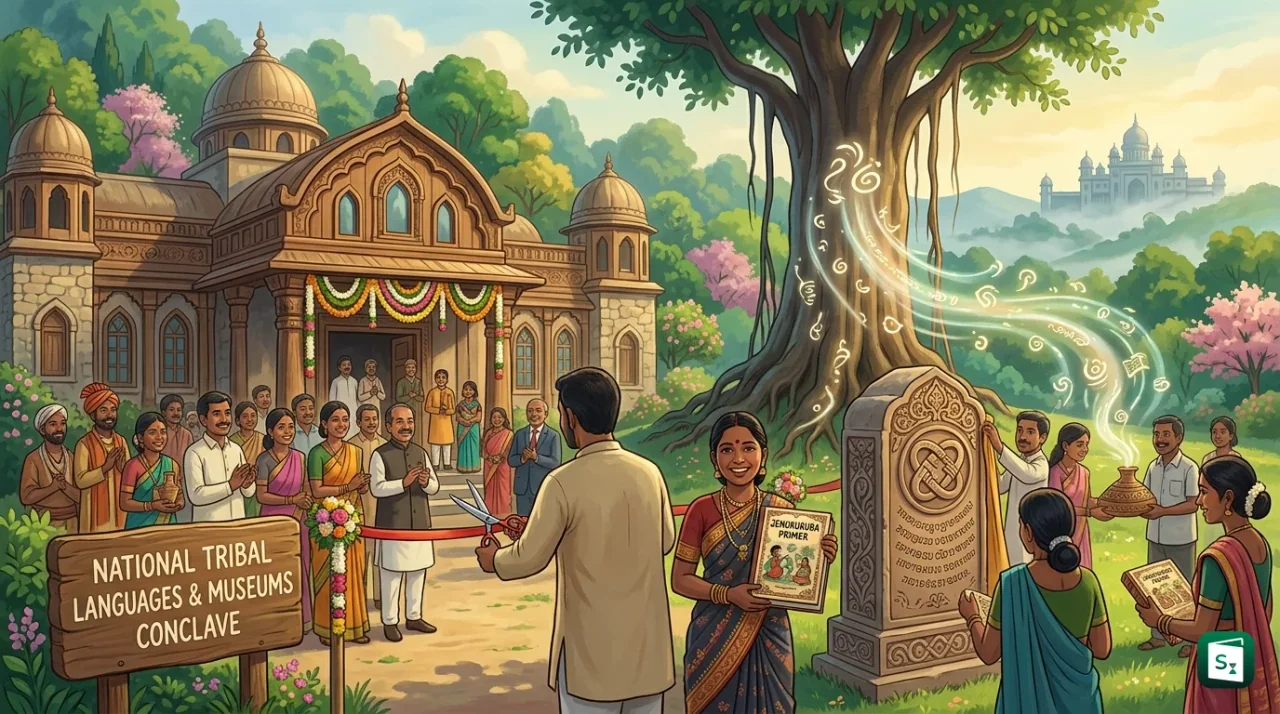
The Ministry of Tribal Affairs (MoTA) hosted the three-day National Conclave on Tribal Languages & Museums in Mysuru, Karnataka, from August 24 to 26, 2026, bringing together policymakers, linguists, technologists and tribal community representatives around a single goal, which is to document, preserve and revitalise India’s endangered tribal languages. Union Minister of State for Tribal Affairs Durgadas Uikey inaugurated the event, signed the Mysuru Declaration on tribal heritage, and unveiled a major upgrade to the Adi Vaani AI translation platform alongside a new conversational assistant named Jago. The conclave also saw the release of the Jenukuruba Class 1 primer and an MoU with the Central Institute of Indian Languages (CIIL) to pool linguistic data for tribal-language development.
What Happened at the Mysuru Conclave
The conclave was held at Hotel Southern Star on Vinoba Road in Mysuru, organised by MoTA in collaboration with the Karnataka State Tribal Research Institute (KSTRI) and the Central Institute of Indian Languages. More than 150 participants attended the opening day, including senior officials from the central and state governments, linguists from premier academic institutions, technologists, and community representatives from tribal groups across the country.
The inaugural session was attended by Durgadas Uikey, Karnataka Tribal Welfare Minister T. Raghumurthy, Member of Parliament from Mysuru Yaduveer Krishnadatta Chamaraja Wadiyar, MoTA Joint Secretary Anant Prakash Pandey, Karnataka Tribal Welfare Department Secretary Kanagavalli, and CIIL Director Prof. Basavaraja Kodagunti. The proceedings opened with the National Song, National Anthem and Naadageethe, followed by the ceremonial lamp-lighting. Tribal community members from the region welcomed the dignitaries with a traditional dance.
The conclave ran two parallel tracks over its three days. The first focused on tribal-language documentation, endangerment mapping, community-led revitalisation, technology adoption, and multilingual education. The second track deliberated on strengthening Tribal Museums and the growing network of Tribal Freedom Fighter Museums (TFFMs) across the country. Four Tribal Research Institutes from Kerala, Odisha, Sikkim and Jharkhand made presentations on best practices in language preservation and ongoing documentation projects. Three technical sessions on the opening day covered documentation and community-led revitalisation, technology for tribal languages, and multilingual pedagogy for tribal students.
What Is the Adi Vaani Platform
Adi Vaani is India’s first AI-powered translation platform dedicated to tribal languages, developed by MoTA as a foundation for a future large language model focused on low-resource Indic languages. The beta version was launched on September 1, 2025, under the Janjatiya Gaurav Varsh, the year-long celebration marking the 150th birth anniversary of tribal folk hero Bhagwan Birsa Munda. At launch, the platform supported four languages, including Santali (Odisha), Bhili (Madhya Pradesh), Mundari (Jharkhand) and Gondi (Chhattisgarh).
The Mysuru upgrade, announced on August 24, 2026, expanded the platform in four significant ways. The new version added an iOS application (alongside the existing Android app and web platform), brought in five additional tribal languages, launched a fresh logo, and rolled out a set of expanded features. The addition takes the total to 15 supported languages, which now include Santali, Gondi, Bhili, Mundari, Ho, Kui, Kuvi, Betta Kuruba, Garo, Koya, Kokborok, Katkari, Chodri, Tangkhul and Thadou Kuki, with each language mapped to a specific state or region of primary speakers.
Technical Capabilities
The platform offers a layered set of AI tools rather than a single translation feature. These include text-to-text and speech-to-speech translation between Hindi, English and tribal languages, automatic speech recognition (ASR) and text-to-speech (TTS) engines for low-resource languages, optical character recognition (OCR) for digitising old manuscripts and primers, bilingual dictionaries, curated repositories, and neural subtitling for videos and broadcasts. The underlying models are based on Meta’s No Language Left Behind (NLLB) framework and AI4Bharat’s IndicTrans2, both adapted for tribal-language corpora.
Who Built It
The project is led by a national consortium of premier academic institutions. IIT Delhi serves as the lead technical partner, with BITS Pilani, IIIT Hyderabad and IIIT Nava Raipur as co-developers. Tribal Research Institutes in Jharkhand, Odisha, Madhya Pradesh, Chhattisgarh and Meghalaya contributed ground-level data, native speakers, and language experts. The IIIT Hyderabad team used a transformer-based sequence-to-sequence architecture to build the four initial machine translation systems, with parallel corpora assembled with help from the Odisha TRI.
Jago: MoTA’s AI Conversational Assistant
Jago is the official AI conversational assistant of the Ministry of Tribal Affairs, launched on August 24, 2026, at the Mysuru conclave. The name doubles as the ministry’s official mascot, which was also released on the same day. The chatbot is designed to serve as a single-window interface where citizens, field officers, and community members can ask plain-language questions and get instant, verified answers on tribal welfare schemes, programmes, guidelines, and official documents.
The assistant currently functions in English and Hindi. Its content is sourced from MoTA’s own repository of schemes and guidelines, covering flagship programmes such as PM-JANMAN (Pradhan Mantri Janjatiya Adivasi Nyaya Maha Abhiyan), Dharti Aaba Janjatiya Gram Utkarsh Abhiyan, the Forest Rights Act (FRA), scholarships for tribal students, and Eklavya Model Residential Schools (EMRS). Officials have confirmed that the nine tribal languages available on Adi Vaani will be progressively integrated into Jago, allowing users to query welfare information in their own mother tongue through both text and voice.
What Jago Changes
For decades, tribal communities have struggled to access information on government schemes because most official content is published in English or Hindi. Field staff often act as informal translators, which leads to delays and inconsistencies. Jago aims to remove that gap by combining scheme data with conversational AI, a layer that other government chatbots rarely offer. It also marks a deliberate shift from a passive information portal to an interactive interface, where the user’s question, and not the website menu, drives the experience.
The MoTA-CIIL MoU: Two Language Mandates, One Data Pipeline
Alongside the technology launches, MoTA and the Central Institute of Indian Languages signed a Memorandum of Understanding for the systematic documentation of tribal languages and the building of linguistic corpora. The MoU creates a formal data pipeline in which CIIL will share its existing language data, dictionaries, primers, and field recordings with the ministry, while MoTA will feed in community-level inputs and scheme-related content that requires translation.
About CIIL
The Central Institute of Indian Languages was established on July 17, 1969, and is headquartered in Mysuru, Karnataka. It operates under the Ministry of Education as part of the Language Bureau and runs seven Regional Language Centres at Bhubaneswar, Guwahati, Lucknow, Mysuru, Patiala, Pune, and Solan. Its core mandate covers language analysis, language pedagogy, language technology, and language use. CIIL also runs the Scheme for Protection and Preservation of Endangered Languages (SPPEL), launched in 2013, which has so far identified 117 endangered languages in India and is working toward documenting close to 500 lesser-known languages.
CIIL’s work covers 17 Scheduled Languages and over 100 non-scheduled languages, and its Sanchika platform serves as a centralised digital repository of dictionaries, primers, storybooks and multimedia resources for both scheduled and tribal languages. That existing repository is what now feeds the Adi Vaani pipeline. The MoU essentially allows MoTA to draw on five decades of academic fieldwork, while giving CIIL’s data a direct path into consumer-facing AI applications.
The Jenukuruba Primer and Tribal-Language Learning Materials
In a parallel release at the conclave, the Karnataka Tribal Welfare Department and KSTRI unveiled the Jenukuruba Class 1 primer covering Kannada, Mathematics and Environmental Studies. Alongside the primer, the department released supporting learning aids named Sannivesha, Pragiti Nota and Thattegalu flashcards. Together, these form Karnataka’s first structured attempt to deliver mother-tongue-based early learning for a particularly vulnerable tribal community living within the state.
Who Are the Jenukuruba
The Jenu Kuruba (also called Jenukuruba) are a Particularly Vulnerable Tribal Group (PVTG) primarily found in Karnataka, with smaller populations in the border forests of Tamil Nadu, Kerala, and Andhra Pradesh. The word Jenu means honey in Kannada, which refers to their traditional occupation of honey collection in the forests of the Western Ghats. The 2011 Census recorded a population of 36,076 in Karnataka, with around 70% of them concentrated in H.D. Kote, Hunsur and Piriyapatna taluks of Mysuru district, Gundlupet taluk of Chamarajanagar district, and Virajpet, Somavarpet and Madikeri taluks of Kodagu district.
The community speaks Jenu Kurumba (or Jenukuruba Bhashe), a Southern Dravidian language of the Tamil-Kannada subgroup that is sometimes treated as a dialect of Kannada and sometimes as a separate language. Ethnologue classifies it as a separate language with around 100,000 native speakers. The community uses the Kannada script, since Jenu Kurumba does not have its own writing system, and they call their tongue naŋɡa jenukuruba base, meaning our language. The government of Karnataka has identified the Jenu Kuruba as one of only two PVTGs in the state, the other being the Koraga of Udupi and Dakshina Kannada.
Why a Mother-Tongue Primer Matters
A large body of research shows that tribal children drop out of formal schooling when the medium of instruction is a language they do not speak at home. In Karnataka, Jenukuruba children often enter Class 1 without prior exposure to standard Kannada, and textbooks designed for general schools make no reference to their forest-based life. The Jenukuruba primer is built around the idea of mother-tongue-based multilingual education, a model that aligns with the National Education Policy 2020, which emphasises teaching young children in their home language before transitioning to regional and national languages.
The Mysuru Declaration and the Tribal Freedom Fighter Museum Track
The Mysuru Declaration, adopted and signed on the second day of the conclave, is a formal statement of intent that brings together policymakers, researchers and tribal representatives on a common roadmap for language documentation, revitalisation, and multilingual education. The declaration captures the expected outcomes of the three-day deliberation, including a consolidated national picture of tribal-language documentation, a shortlist of community-led revitalisation models identified for scaling, a working approach to multilingual education in tribal schools, and a shared national vision for Tribal Museums.
Running in parallel was a dedicated track on Tribal Freedom Fighter Museums. The Ministry of Tribal Affairs has so far sanctioned 11 TFFMs across 10 states, of which four have been inaugurated. The most prominent is the Bhagwan Birsa Munda Memorial Freedom Fighter Museum in Ranchi, Jharkhand, which was inaugurated by Prime Minister Narendra Modi on November 15, 2021, at a sanctioned cost of ₹34.22 crore. Other sanctioned TFFMs include those at Lambasingi in Alluri Sitharama Raju district of Andhra Pradesh (commemorating Alluri Sitarama Raju), Garudeshwar near Rajpipla in Gujarat, Raipur in Chhattisgarh, Kozhikode in Kerala, Chhindwara in Madhya Pradesh, Hyderabad in Telangana, Tamenglong in Manipur, Kelsih in Mizoram, and Ponda in Goa.
The conclave treated these museums as institutions of contemporary curation, storytelling and community-rooted heritage representation, not merely as archives. Speakers emphasised that the museum track should not be seen as separate from the language track, because both are responding to the same gap, the absence of formal documentation of tribal life, language, and contribution to the Indian national story.
India’s Endangered Tribal Languages: The Bigger Picture
The urgency behind Adi Vaani, Jago, and the Mysuru Declaration is best understood against the scale of linguistic loss the country faces. The 2011 Census recorded 461 languages spoken by Scheduled Tribes and 71 distinct tribal mother tongues in India. Of these, 81 are classified as vulnerable and 42 are critically endangered. CIIL’s SPPEL has identified 117 endangered languages across the country, defined as those spoken by fewer than 10,000 speakers or those not previously studied linguistically.
The underlying challenge is that most tribal languages have never had a written tradition in their own script. Speakers have historically borrowed the script of the nearest mainstream language, which means much of the vocabulary, folklore and oral history exists only in spoken form. The 1961 Census recorded 1,652 mother tongues, which expanded to 2,843 by 2011. Of these, 1,369 were classified as recognised languages and 1,474 remained unclassified.
Languages in the Adi Vaani Ecosystem
| Language | State of Primary Speakers | Approx. Speakers (2011) | Family |
|---|---|---|---|
| Santali | Jharkhand, West Bengal, Odisha | 73.68 lakh | Austroasiatic (Munda) |
| Gondi | Chhattisgarh, MP, Maharashtra, Telangana | 29.84 lakh | Dravidian (South-Central) |
| Bhili | MP, Rajasthan, Maharashtra, Gujarat | 1.04 crore | Indo-Aryan |
| Mundari | Jharkhand, Odisha | 11.28 lakh | Austroasiatic (Munda) |
| Ho | Jharkhand, Odisha | 10 lakh+ | Austroasiatic (Munda) |
| Kui | Odisha | 9.41 lakh | Dravidian |
| Garo | Meghalaya, Assam | 11.45 lakh | Tibeto-Burman |
| Kokborok | Tripura | 8.80 lakh+ | Tibeto-Burman |
| Koya | Andhra Pradesh, Telangana | 4.07 lakh | Dravidian |
| Betta Kuruba | Karnataka | 57,000 | Dravidian |
Constitutional Anchor
The Eighth Schedule to the Constitution of India currently lists 22 Scheduled Languages, the most recent additions being Bodo, Dogri, Maithili and Santhali in 2003 through the 92nd Amendment Act. Santhali is the only tribal language in the Schedule and is also an additional official language of Jharkhand and West Bengal. The rest of the world of tribal languages, including Gondi, Mundari, Ho, Bhili, Kui, Garo and Kurukh, sits outside the constitutional list, which is why programmes like Adi Vaani, SPPEL, and the new Mysuru roadmap are administratively significant. They are the practical instruments through which India is extending documentation, recognition, and digital presence to languages the Constitution does not yet formally list.
Key Takeaways
- The National Conclave on Tribal Languages & Museums was held in Mysuru, Karnataka, from August 24 to 26, 2026, and was inaugurated by Union Minister of State for Tribal Affairs Durgadas Uikey.
- The upgraded Adi Vaani AI translation platform was launched with a new iOS application, a new logo, and five additional tribal languages, taking the total to 15 supported languages.
- Jago, the official AI conversational assistant of the Ministry of Tribal Affairs, was launched along with its mascot to provide scheme-related information in English and Hindi, with the nine Adi Vaani languages to be added progressively.
- MoTA and the Central Institute of Indian Languages (CIIL) signed an MoU for tribal-language documentation and corpus building. CIIL was established on July 17, 1969, and runs the Scheme for Protection and Preservation of Endangered Languages (SPPEL).
- The Jenukuruba Class 1 primer covering Kannada, Mathematics and Environmental Studies was released for the Jenu Kuruba PVTG, which has a population of 36,076 in Karnataka as per the 2011 Census, concentrated in Mysuru, Chamarajanagar and Kodagu districts.
- The Mysuru Declaration was adopted on the second day to formalise a national roadmap for tribal-language documentation, revitalisation, and multilingual education.
- The Ministry has sanctioned 11 Tribal Freedom Fighter Museums across 10 states, of which 4 have been inaugurated, including the Bhagwan Birsa Munda Museum in Ranchi (opened on November 15, 2021).
- According to the 2011 Census, India has 461 tribal languages and 71 distinct tribal mother tongues, of which 81 are vulnerable and 42 are critically endangered. Santhali, added to the Eighth Schedule via the 92nd Amendment in 2003, is the only Scheduled tribal language.