Hyderabad-based startup incubator T-Hub signed a partnership with the Central Command of the Indian Army on 25 August 2026 to give defence startups a direct route into live military problem statements. Under the agreement, T-Hub will receive active operational requirements from the Army, identify suitable startups, and shepherd their solutions through development, validation and field deployment. The MoU makes T-Hub one of the very few organisations in India to hold direct Command-level relationships with the Indian Army, on top of its existing role as the country’s largest incubator under the Ministry of Defence’s iDEX scheme.
T-Hub and Central Command Sign a Defence Startup Partnership
The MoU was signed in Hyderabad between T-Hub CEO Kavikrut and Lieutenant General C.J. Jayachandran, the Chief of Staff of Headquarters Central Command. The agreement formalises a long-standing intent on both sides: defence startups need direct access to military end users, and the Army needs a structured pipeline of indigenous solutions for its operational challenges.
Central Command, headquartered in Lucknow, is one of the seven operational commands of the Indian Army and covers an enormous territorial footprint of eight states, namely Uttar Pradesh, Uttarakhand, Himachal Pradesh, Madhya Pradesh, Chhattisgarh, Bihar, Jharkhand and Odisha. It guards the central sector of the Line of Actual Control (LAC) with China and portions of the western border with Pakistan, and houses nearly half of India’s 62 cantonments along with 18 regimental centres.
The new partnership gives T-Hub a direct window into the operational problems of this vast theatre. In return, the Army gains a structured channel to the most promising deep-tech startups working in fields such as unmanned systems, surveillance, communications, artificial intelligence and soldier modernisation.
What Is T-Hub? Hyderabad’s Startup Powerhouse
T-Hub, which stands for Technology Hub, is a Hyderabad-based innovation ecosystem enabler that bills itself as the world’s largest startup incubator. It was incorporated in 2015 as a Section 8 not-for-profit company, the same year that Telangana was carved out as India’s newest state, and was inaugurated on 5 November 2015 by Ratan Tata, then Chairman Emeritus of Tata Sons, along with Telangana’s then-Governor E.S.L. Narasimhan.
T-Hub was conceived as a public-private partnership between the Government of Telangana, three Hyderabad-based academic institutions (IIIT-Hyderabad, the Indian School of Business and NALSAR University of Law), and a clutch of private sector partners. The state contributed the capital expenditure, while a board of industrialists and entrepreneurs was given full operational autonomy to run the incubator free of government interference.
The Two Phases and the Push to Phase 3.0
T-Hub 1.0, branded as CatalysT, opened on the IIIT-Hyderabad campus at Gachibowli with a 70,000 square foot co-working space. T-Hub 2.0, a far larger 5.72 lakh square foot T-shaped building in the Madhapur-Raidurg area, is roughly 1.5 times the size of Station F in Paris and twice the size of Guanghua SOHO II in Beijing, making it the largest dedicated startup facility anywhere in the world. It can host more than 1,000 startups at a time.
T-Hub 3.0, currently in the works, will add a hardware incubator called T-Works and the upcoming IMAGE Towers (Innovation in Multimedia, Animation, Gaming and Entertainment) to the ecosystem. The current CEO Kavikrut, a former senior executive at OYO, is the fourth chief executive of the organisation, following Jay Krishnan, Mahankali Srinivas Rao and Srinivas Kollipara.
Scale of the Operation
T-Hub has so far worked with more than 2,000 startups, 600 corporates and 100 investors. It anchors several national programmes, including the AIC T-Hub Foundation (part of the Atal Innovation Mission network supported by NITI Aayog), MATH (India’s leading Centre of Excellence for AI and ML, supported by the Department of Science and Technology), and India’s first Google for Startups Hub. It also runs Lab32, a product innovation lab that takes a small equity stake in the startups it accelerates.
Of particular relevance to the new Army partnership, T-Hub is already the largest incubator for the Ministry of Defence’s iDEX scheme, having worked with over 100 defence startups and hosted more than 70 iDEX challenges. Startups that have gone through its defence programmes have received commercial orders worth more than ₹250 crore, supported by over ₹4.2 crore in grants and ₹9 crore in proof-of-concept (PoC) projects.
What Is iDEX? The Defence Innovation Engine Behind the Partnership
The Innovations for Defence Excellence (iDEX) framework is the central government scheme that channels grant funding and mentorship to Indian defence startups. It was launched by the Prime Minister in 2018 at DefExpo and is implemented by the Defence Innovation Organisation (DIO), a Section 8 not-for-profit company set up under the aegis of the Department of Defence Production in the Ministry of Defence.
DIO itself was founded by two defence public sector undertakings, Hindustan Aeronautics Limited (HAL) and Bharat Electronics Limited (BEL), which act as the permanent institutional anchors. The latest iDEX scheme cycle, running from 2021-22 to 2025-26, has a budgetary allocation of ₹498.78 crore and targets support for around 300 startups, MSMEs and individual innovators, as well as roughly 20 partner incubators.
The Three Challenge Tracks
iDEX runs its innovation programmes through three main challenge categories, each with a different grant ceiling:
| Challenge | Grant Support | Focus |
|---|---|---|
| Defence India Startup Challenge (DISC) | Up to ₹1.5 crore | Problem statements sourced from the Armed Forces, DPSUs and other agencies |
| iDEX ADITI | Up to ₹25 crore | Critical and strategic technologies with longer development cycles |
| iDEX Open Challenge (OC) | Up to ₹1.5 crore | Rolling, open-window challenge for suo-moto proposals from innovators |
| iDEX PRIME | Up to ₹10 crore | Procurement of mature technologies nearing field readiness |
Funding flows through a mechanism called SPARK (Support for Prototype and Research Kickstart in Defence), which is given as a grant-in-aid, meaning DIO does not take any equity or ownership stake in the participating startup. The 14th edition of DISC, for instance, was launched with 82 problem statements from the Indian Army, Indian Navy, Indian Air Force and Indian Coast Guard.
T-Hub is one of only 28 organisations selected by the Ministry of Defence to implement iDEX on the ground, and the largest among them. This dual identity, as a private-public startup hub and as a formal iDEX incubator, is what gives the new Central Command MoU its weight.
How the Partnership Will Work: From Problem Statement to Field Deployment
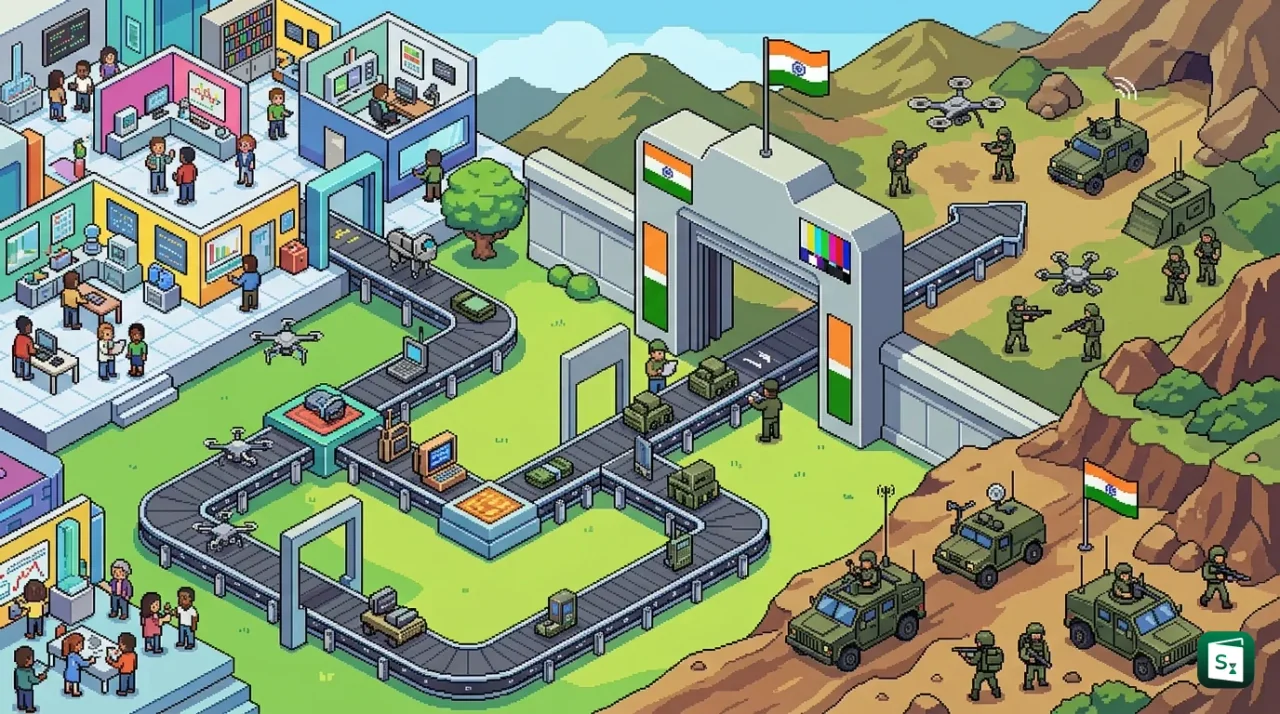
The architecture of the MoU mirrors the standard iDEX DISC cycle, but with a direct, Command-level problem source. The Central Command will provide active operational problem statements based on what its formations actually need on the ground. T-Hub will then identify and shortlist suitable startups, both from its own pool and from the wider Indian defence innovation ecosystem, and back them through product development, validation and market readiness.
A joint oversight committee, comprising officials from T-Hub and stakeholders from the Indian Army, will supervise the entire programme. Its key job is to coordinate direct field engagements between the founders and military end users, so that the feedback loop is fast and the technology is shaped by real operational conditions rather than by assumptions made in a lab. The Indian Army has described the collaboration as a way to “gain access to startups and young founders who are building technologies for on-ground needs,” reflecting a clear push to absorb frontline innovation.
The wider objective is to move defence startups beyond the prototype stage. T-Hub will work with Army stakeholders to incorporate operational feedback and meet deployment requirements, with the explicit goal of taking viable solutions from development to actual field use.
Building on the Western Command Tie-Up
The Central Command MoU is not T-Hub’s first brush with the Indian Army. The incubator already runs an active partnership with the Western Command, and the Central Command agreement effectively doubles its footprint at the operational level. T-Hub has noted that this makes it “one of the select few entities nationally with standing, direct relationships at the Command level,” a position very few incubators in India can claim.
The Western Command engagement served as a working template. It gave T-Hub a chance to test how startup solutions could be matched to live operational requirements, how problem statements could be curated, and how a joint oversight mechanism could keep the programme accountable. The Central Command partnership simply extends that model to a much larger and more strategically diverse theatre, covering the central sector of the LAC, the hinterland, and key logistics nodes that connect almost every other Indian Army command.
The cumulative effect, T-Hub believes, is a national-level defence innovation corridor in which a startup incubated in Hyderabad can be tested, validated and deployed across multiple Army commands without having to renegotiate access each time.
Strategic Stakes: Why Central Command, Why Now
The choice of Central Command as the second Army partner is no accident. Geographically and strategically, the Lucknow-based command is the backbone of India’s land defence. It sits at the centre of the Army’s operational map and shares a boundary with every other operational command. Its Area of Responsibility spans eight states, includes the central sector of the LAC with China, the central sector of the western border with Pakistan, and almost half of India’s cantonments.
This central position also means that Central Command is the Army’s primary strategic reserve and logistics hub. It controls crucial training establishments, regimental centres, and supply routes that connect the northern, western, eastern and southern theatres. Innovations that succeed in this theatre, whether in surveillance, communications, autonomous systems, cold-weather logistics, or counter-insurgency technology, can quickly be scaled across the rest of the Army.
The timing of the MoU is equally significant. The visit of General Dhiraj Seth, the Chief of the Army Staff, to Headquarters Central Command in Lucknow on 4-5 August 2026, just weeks before the partnership was signed, made self-reliance and a technologically empowered force the bedrock of military effectiveness. Within that larger push, the T-Hub partnership is one of the more visible civilian-military bridges, and it aligns directly with the government’s Atmanirbhar Bharat agenda in defence manufacturing, which is being driven by the Department of Defence Production and supported through the iDEX ecosystem.
The Way Forward
The Central Command MoU sets the stage for a more durable pipeline between India’s defence startup ecosystem and the Indian Army’s operational needs. By stitching together problem sourcing from the Command, startup selection and incubation by T-Hub, and field validation by Army stakeholders, the model attempts to compress the typical defence procurement cycle, which has historically been measured in years, into something closer to the speed of a startup sprint.
In the near term, the focus will be on converting the existing Western Command learnings into a Central Command playbook, running the first set of problem statements, and identifying the first cohort of startups. Over the medium term, the model could be replicated across the remaining operational commands, including the Northern, Eastern, Southern and South-Western Commands, and the Army Training Command. The eventual goal, shared by the Ministry of Defence and T-Hub, is to ensure that for every critical operational requirement, there is a credible Indian startup that can be tasked, funded and fielded without the Army having to look outside the country.
Key Takeaways
- T-Hub signed an MoU with the Central Command of the Indian Army on 25 August 2026, formalising a direct pathway for defence startups to receive live military problem statements and deploy solutions.
- The agreement was signed by T-Hub CEO Kavikrut and Lieutenant General C.J. Jayachandran, the Chief of Staff of Headquarters Central Command in Lucknow.
- T-Hub was incorporated in 2015 as a Section 8 not-for-profit, inaugurated on 5 November 2015 by Ratan Tata, and operates from a 5.72 lakh square foot building in Hyderabad, billed as the world’s largest startup facility.
- T-Hub is one of 28 organisations selected to implement iDEX (Innovations for Defence Excellence), the Ministry of Defence’s flagship startup funding scheme, and is its largest incubator, having engaged 100+ defence startups and hosted 70+ challenges.
- iDEX was launched by the Prime Minister in 2018 at DefExpo and is implemented by the Defence Innovation Organisation (DIO), a Section 8 company founded by HAL and BEL under the Department of Defence Production.
- Startups under T-Hub’s defence programmes have secured over ₹250 crore in commercial defence orders, ₹4.2 crore+ in grants, and ₹9 crore in PoC deliveries.
- The Central Command of the Indian Army was re-established on 1 May 1963 after the 1962 Sino-Indian War, is headquartered in Lucknow, and covers eight states (UP, Uttarakhand, Himachal Pradesh, MP, Chhattisgarh, Bihar, Jharkhand, Odisha).
- The Indian Army has seven operational commands; the new T-Hub MoU follows its existing partnership with the Western Command and is supervised by a joint oversight committee comprising T-Hub officials and Army stakeholders.