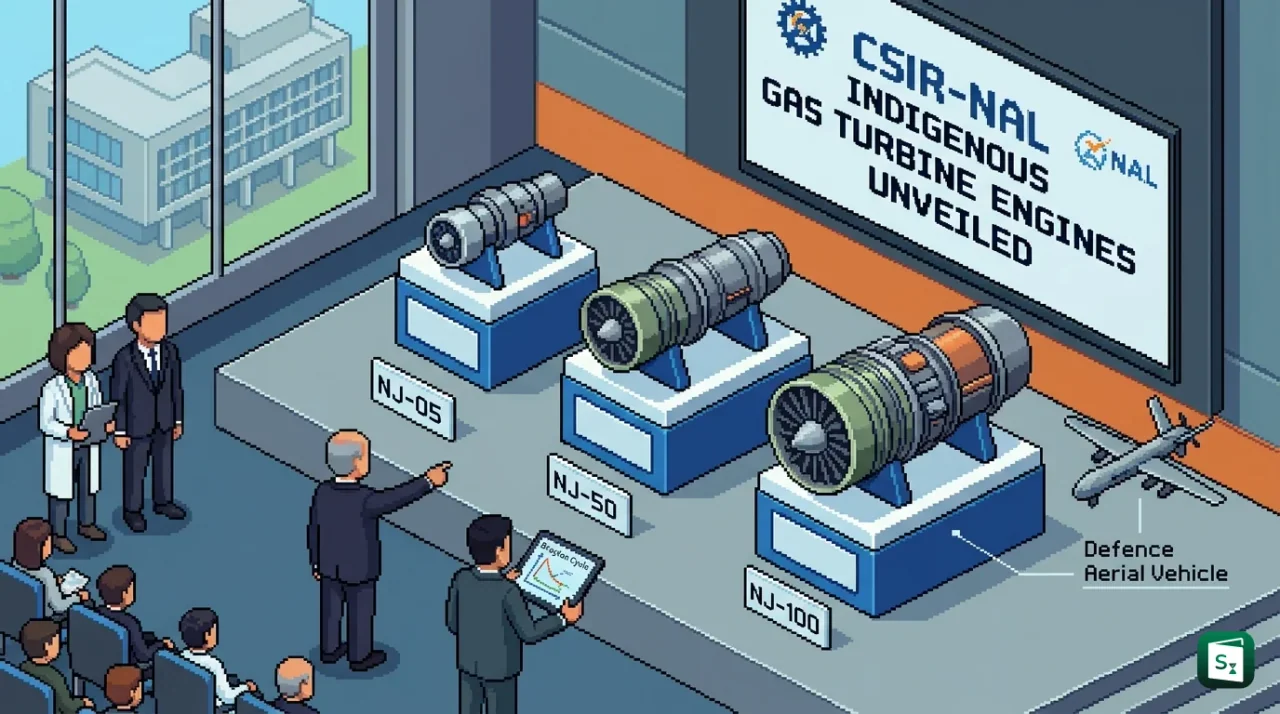
India’s CSIR-National Aerospace Laboratories (CSIR-NAL) unveiled three home-built micro and small gas turbine engines, the NJ-05, NJ-50, and NJ-100, at the SSB Auditorium of CSIR Headquarters in New Delhi on 25 August 2026. The engines are designed for tactical Unmanned Aerial Vehicles (UAVs), drone interceptors, and compact missile systems, with thrust capacities of 5 kg, 50 kg, and 100 kg respectively. All three operate on the Brayton cycle, the same thermodynamic principle that powers jet engines worldwide.
CSIR-NAL Unveils Three Indigenous Gas Turbine Engines: NJ-05, NJ-50, and NJ-100
The three engines were formally unveiled at a ceremony held at the SSB Auditorium inside CSIR Headquarters in New Delhi. Air Marshal Tejinder Singh, the Chief of Integrated Defence Staff to the Chairman Chiefs of Staff Committee (CISC), attended the event as the chief guest. Senior officials from India’s defence and scientific establishments were also present.
Dr Abhay A. Pashilkar, Director of CSIR-NAL, used the occasion to highlight the laboratory’s evolving role as a multi-stage integrator for India’s drone ecosystem. He noted that Indian industry, including the rapidly expanding aerospace start-up ecosystem, has the potential to manufacture these engines at scale to meet the requirements of the Indian defence sector.
Dr N. Kalaiselvi, Director General of CSIR and Secretary of the Department of Scientific and Industrial Research (DSIR), commended the project team. She described the indigenous development of these highly specialised aerospace subsystems as an important milestone in advancing the country’s Atmanirbhar Bharat initiative, the national mission for self-reliance. The scientific team behind the engines, led by R. Prathapanayaka, made a detailed technical presentation highlighting advances in high-RPM turbomachinery and high-temperature combustion technologies.
The NJ Engine Family and Thrust Classifications
The NJ series covers a clear thrust ladder that maps neatly onto different categories of unmanned platforms. All three engines operate on the Brayton cycle, the same constant-pressure thermodynamic cycle used in jet engines globally.
| Engine | Thrust Capacity | Intended Platform Class |
|---|---|---|
| NJ-05 | 5 kg | Small drones, loitering munitions, micro missiles |
| NJ-50 | 50 kg | Tactical UAVs, drone interceptors |
| NJ-100 | 100 kg | Larger tactical UAVs, compact cruise missiles |
The family has been developed progressively. The NJ-5, an early micro gas turbine developed earlier by CSIR-NAL, served as a technology demonstrator. It validated core capabilities like high-speed turbomachinery, micro-scale compressor and turbine design, combustor miniaturisation, and bearings and lubrication in extreme RPM regimes. The NJ-100 builds on those flight-tested foundations, pushing thrust to approximately 1,000 N, enough force to lift a motorcycle off the ground, while focusing on a high thrust-to-weight ratio, compact design, and fuel efficiency.
What Is a Gas Turbine Engine?
A gas turbine engine is a device that converts the chemical energy stored in a fuel into mechanical energy, and finally into thrust or rotational power, by compressing air, mixing it with fuel, burning the mixture, and then expanding the hot gases through a turbine. It is an internal combustion engine that uses a gas (usually air) as its working fluid.
All gas turbine engines, whether they power large commercial airliners, military fighters, naval ships, tanks, or small drones, share three core components:
- Compressor: Draws in and pressurises incoming air, increasing both its pressure and temperature.
- Combustion chamber (combustor): Fuel is injected and ignited, raising the temperature of the compressed air at constant pressure.
- Turbine: Extracts energy from the hot, expanding gases. Part of this energy drives the compressor, while the remainder produces useful work, either shaft power or jet thrust.
In jet propulsion, most of the energy is converted into thrust through an exhaust nozzle rather than shaft power. Different layouts include turbojets, where all the gas passes through the core; turbofans, where a large fan bypasses some air around the core; turboprops, where a propeller is driven through a gearbox; and turboshafts, used in helicopters.
For small unmanned platforms like the ones the NJ series will power, the most common configuration is the micro turbojet, prized for its high thrust-to-weight ratio, compact size, and ability to operate at high altitudes and speeds. The NJ-05, NJ-50, and NJ-100 fall into this category of micro and small turbojet engines.
The Brayton Cycle: The Thermodynamic Heart of Gas Turbines
The Brayton cycle, also known as the Joule cycle, is the thermodynamic cycle that mathematically describes how gas turbine engines operate. It characterises heat engines that use air or another gas as their working fluid, defined by isentropic compression and expansion (no heat transfer during these stages) combined with isobaric (constant-pressure) heat addition and rejection.
The most widely used application of the Brayton cycle today is in air-breathing jet engines and gas turbine engines, which is precisely why the NJ-05, NJ-50, and NJ-100 are described as Brayton cycle engines.
The Four Process of the Ideal Brayton Cycle
In an ideal Brayton cycle, the working fluid passes through four distinct processes:
| Process | Stage | Thermodynamic Process | What Happens |
|---|---|---|---|
| 1 to 2 | Compressor | Isentropic compression | Ambient air is drawn in and pressurised |
| 2 to 3 | Combustion chamber | Isobaric heat addition | Fuel is burned at constant pressure, raising temperature |
| 3 to 4 | Turbine | Isentropic expansion | Hot gases expand through the turbine, releasing energy |
| 4 to 1 | Exhaust | Isobaric heat rejection | Remaining heat is expelled to the atmosphere |
A key insight from cycle analysis is that thermal efficiency increases with the pressure ratio across the compressor. Most modern gas turbines operate at pressure ratios between 11 and 16. However, this efficiency is constrained by metallurgical limits on the maximum turbine inlet temperature. In practical engines, neither compression nor expansion can be truly isentropic, so designers use techniques like intercooling, reheating, and regeneration to improve performance.
George Brayton and the Origin of the Cycle
The cycle takes its name from George Brayton (1830 to 1892), an American engineer who developed the Brayton Ready Motor in 1872, using a piston compressor and piston expander. However, an engine using the same thermodynamic principle was originally patented by Englishman John Barber in 1791, using a reciprocating compressor and a turbine expander. Modern Brayton engines are almost always turbine-based, even though Brayton himself only built piston engines.
Open vs. Closed Brayton Cycle
The Brayton cycle exists in two main forms:
- Open cycle: Air is drawn from the atmosphere, passes through the engine, and is expelled back to the atmosphere. This is the configuration used in jet engines, and therefore the configuration of the NJ-05, NJ-50, and NJ-100.
- Closed cycle: The working gas stays sealed inside the engine. Heat is added and removed through heat exchangers rather than an internal combustor. This configuration is used in space power generation and some specialised industrial applications.
Technical Innovations Behind the NJ Series
Building a small gas turbine is one of the toughest engineering challenges in aerospace. Unlike large engines where size can absorb design compromises, micro engines must deliver extreme performance in a tightly constrained volume. The CSIR-NAL team highlighted several breakthrough areas during the unveiling presentation:
- High-RPM turbomachinery: The NJ series engines spin their compressors and turbines at extremely high rotational speeds, reportedly spinning around 250 times faster than the blades of a ceiling fan. Mastering such speeds requires precision bearings, lubrication systems, and rotor dynamics that can withstand enormous centripetal forces.
- Micro-scale compressor and turbine design: At the 5 kg thrust level of the NJ-05, the compressor and turbine wheels are tiny, but must still achieve aerodynamic efficiency. Designing blade profiles, clearances, and flow paths at this scale is fundamentally different from large engines.
- High-temperature combustion technology: Burning fuel efficiently in a miniaturised combustion chamber, where wall losses dominate, demands innovative cooling, swirler, and fuel injection designs to keep the combustor stable and reliable.
- System integration in compact volumes: All subsystems, fuel delivery, ignition, lubrication, and control electronics, must fit into a tight envelope while remaining accessible for maintenance.
These innovations collectively represent the kind of dual-use capability that has civil applications as well. Beyond defence, compact gas turbines can power small generators, remote energy units, and educational training systems.
CSIR-NAL and CSIR: Institutional Background
CSIR-NAL stands for the Council of Scientific and Industrial Research, National Aerospace Laboratories. It is the only government aerospace research and development laboratory in India’s civilian sector. Originally established on 1 June 1959 in Delhi as the National Aeronautical Research Laboratory (NARL) under Dr P. Nilakantan, the lab moved to Bengaluru in March 1960, setting up its first office in the stables of the Maharaja of Mysore’s Palace on Jayamahal Road. The first Executive Council was chaired by JRD Tata, with members including Prof. Satish Dhawan and aircraft designer Dr V.M. Ghatge. It was renamed the National Aerospace Laboratories (NAL) in April 1993 to reflect its expanding role in space and multidisciplinary research.
CSIR-NAL is headquartered on HAL Airport Road, Bengaluru, Karnataka, and is the largest laboratory under CSIR, the Council of Scientific and Industrial Research, which was established in 1942 and is headquartered in New Delhi. The Prime Minister of India is the President of CSIR, while the Union Minister for Science and Technology serves as its Vice President. CSIR-NAL works closely with the Defence Research and Development Organisation (DRDO), Hindustan Aeronautics Limited (HAL), and the Indian Space Research Organisation (ISRO).
Strategic Significance for India’s Defence Ecosystem
The unveiling of the NJ-05, NJ-50, and NJ-100 carries strategic weight well beyond the laboratory demonstration. Modern warfare is increasingly unmanned, and the global race is on to develop loitering munitions, swarm drones, drone interceptors, and compact cruise missiles. Until now, India has depended heavily on imported propulsion systems for these classes of weapons, which creates supply chain vulnerabilities, foreign-policy leverage for adversaries, and high costs.
By developing these engines domestically, CSIR-NAL is laying the foundation for an indigenous ecosystem for designing, developing, and manufacturing miniaturised gas turbine propulsion systems. The intended applications cover a wide operational spectrum:
- Tactical UAVs: Long-endurance surveillance and strike drones.
- Drone interceptors: Counter-UAV systems designed to neutralise enemy drones.
- Compact missile systems: Including loitering munitions and cruise-type platforms that require small but powerful jet propulsion.
The development is also expected to support Indian private-sector companies and aerospace start-ups, giving them a domestic propulsion option to integrate into locally developed UAVs and other defence systems, an outcome that aligns directly with the Atmanirbhar Bharat mission.
India’s Broader Aero-Engine Ecosystem
The NJ series fills an important gap in India’s wider aero-engine landscape. Other key institutions working on indigenous propulsion include:
| Organisation | Role | Notable Programme |
|---|---|---|
| DRDO, Gas Turbine Research Establishment (GTRE), Bengaluru | DRDO laboratory dedicated to aero-engine development | Kaveri engine programme for the Light Combat Aircraft; future AMCA engine |
| Hindustan Aeronautics Limited (HAL), Engine Division, Bengaluru/Koraput | Manufacturing and overhaul of aero engines | Production and MRO of existing engines for military aircraft |
| DRDO Scramjet programme | Hypersonic propulsion research | Ground testing of scramjet engines for hypersonic missiles |
The NJ series complements these larger programmes by addressing the small-thrust segment, a category that is increasingly vital for unmanned and missile applications. Together, these efforts aim to reduce India’s dependence on foreign engine suppliers and position the country as a credible exporter of unmanned propulsion technology in the longer term.
Looking Ahead: Industrialisation and the Path to Atmanirbhar Bharat
The NJ-05, NJ-50, and NJ-100 are presently at the technology demonstrator stage, having completed ground and flight-test validation of core competencies. The next phase will focus on industrialisation, transitioning these engines from laboratory prototypes into reliable, mass-produced units that can be integrated into operational platforms by the Indian armed forces.
CSIR-NAL has signalled that it will work closely with Indian industry and aerospace start-ups to scale up production. This manufacturing hand-off is crucial because defence orders typically require engines in quantities that no single research laboratory can produce alone. The lab is positioning itself as a multi-stage integrator, meaning it will continue to develop advanced engine technologies while partnering with industry for serial production.
The strategic implications extend beyond propulsion. Developing small gas turbines at home strengthens India’s entire aerospace supply chain, from precision manufacturing and control systems to testing infrastructure and high-temperature materials. These capabilities have direct spin-off value for civil aviation, power generation, and even space launch systems.
In the words of the unveiling statement, the NJ engines mark a step towards building a domestic ecosystem where miniaturised gas turbine propulsion systems can be designed, developed, and manufactured entirely within India. As India’s UAV, loitering munition, and compact missile programmes accelerate in the coming years, the availability of a home-grown engine family across the 5 kg to 100 kg thrust range will be a quiet but decisive enabler of operational self-reliance.
Key Takeaways
- CSIR-NAL unveiled three indigenous gas turbine engines, the NJ-05, NJ-50, and NJ-100, at CSIR Headquarters in New Delhi on 25 August 2026.
- The engines deliver thrust of 5 kg, 50 kg, and 100 kg respectively, covering a wide range of unmanned and missile-class platforms.
- All three operate on the Brayton cycle, also called the Joule cycle, which is the standard thermodynamic cycle for gas turbine and jet engines.
- The ideal Brayton cycle has four processes: isentropic compression, isobaric heat addition, isentropic expansion, and isobaric heat rejection.
- The cycle is named after George Brayton (1830 to 1892), the American engineer who built the Brayton Ready Motor in 1872.
- CSIR-NAL stands for Council of Scientific and Industrial Research, National Aerospace Laboratories, established on 1 June 1959 and headquartered in Bengaluru, Karnataka.
- CSIR-NAL is the largest laboratory under CSIR, which was set up in 1942 and is headquartered in New Delhi.
- The Prime Minister of India is the President of CSIR, and the Union Minister for Science and Technology is its Vice President.
- Air Marshal Tejinder Singh, Chief of Integrated Defence Staff to the Chairman Chiefs of Staff Committee (CISC), was the chief guest at the unveiling event.
- The engines are intended for tactical UAVs, drone interceptors, and compact missile systems, supporting India’s Atmanirbhar Bharat initiative in defence propulsion.