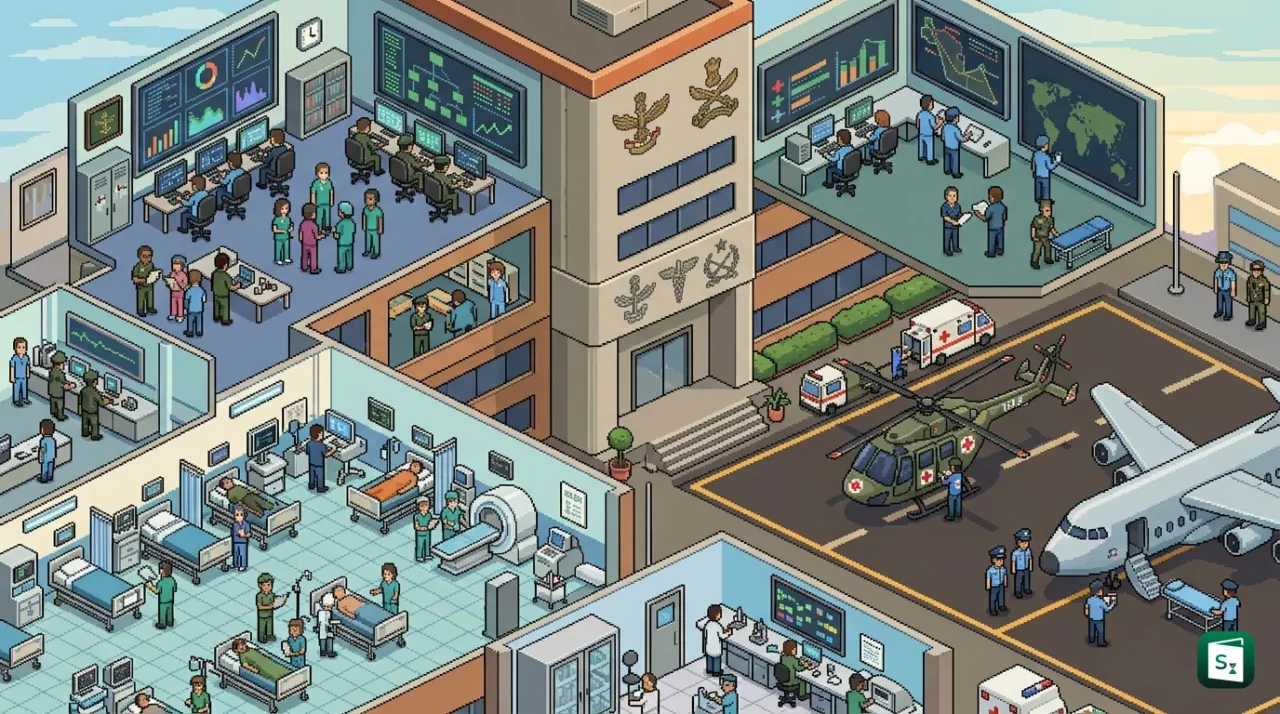
Air Marshal Sandeep Thareja assumed charge as the 47th Director General Armed Forces Medical Services (DGAFMS) on September 1, 2026, taking over the apex medical command of India’s tri-service military healthcare organisation. On the same day, Air Marshal Vivek Hande took over as the Director General Medical Services (Air), or DGMS (Air), on permanent secondment to the Indian Air Force (IAF). The back-to-back leadership change at the top of the Armed Forces Medical Services (AFMS) and the IAF’s medical branch places two specialist physicians, both trained in gastroenterology at the All India Institute of Medical Sciences (AIIMS), New Delhi, at the helm of the country’s military medicine system.
Who Is the New DGAFMS: Air Marshal Sandeep Thareja
Air Marshal Sandeep Thareja, a specialist physician and gastroenterologist from Meerut, became the 47th Director General Armed Forces Medical Services on September 1, 2026. The government had earlier announced, on July 31, 2026, that he would take charge upon the retirement of the incumbent DGAFMS, Surgeon Vice Admiral Arti Sarin, who stepped down after 41 years of distinguished service.
Vice Admiral Arti Sarin’s tenure was a milestone in itself: she was the first woman to lead the AFMS, having assumed charge as the 46th DGAFMS on October 1, 2024. Thareja succeeds her as only the fourth officer from the Indian Air Force to occupy this chair, out of 47 holders so far.
Air Marshal Thareja carries the post-nominals SM, VSM & Bar, reflecting his awards of the Sena Medal (SM) and the Vishisht Seva Medal (VSM) twice, once with a Bar (meaning the medal has been awarded to him a second time).
Before taking charge, he paid homage at the National War Memorial in New Delhi. As DGAFMS, he now heads the AFMS, which provides comprehensive medical support to over 14 million serving personnel, veterans, and their dependents through a network of 133 Military Hospitals and 90 Field Hospitals across the country.
Profile and Career Trajectory of Air Marshal Sandeep Thareja
Air Marshal Thareja is an alumnus of the Armed Forces Medical College (AFMC), Pune, the premier training institution of the AFMS. He was commissioned into the Army Medical Corps in December 1986, beginning a career that now spans nearly four decades across clinical, academic, operational, and administrative domains.
His academic credentials are unusually strong for a serving military officer. He completed his MD in Medicine in 1997 and later earned a DM in Gastroenterology from AIIMS, New Delhi, in 2005, where he was awarded the Best DM Student Award. He is also an alumnus of the National Defence College and has secured an ‘A’ grading in all his military courses, a distinction rarely achieved.
Thareja has held several of the most coveted appointments in the AFMS, including:
- Senior Consultant (Medicine) at the Office of the DGAFMS in New Delhi
- Commandant, Military Hospital, Pathankot
- Commandant, Command Hospital, Lucknow (from June 2021 to September 2022)
- Director and Commandant, AFMC, Pune
- DGMS (Air), his immediate prior role, where he steered medical preparedness for the Gaganyaan Human Spaceflight Mission and led the operationalisation of the BHISHM Cube, a rapidly deployable mobile hospital unit designed for operational and humanitarian missions
He is also an accomplished academician, having guided numerous postgraduate and super-speciality students and authored over 50 scientific publications in reputed national and international medical journals.
The New DGMS (Air): Air Marshal Vivek Hande
Air Marshal Vivek Hande, who carries the honours AVSM and VSM, took over as the Director General Medical Services (Air) on September 1, 2026, on permanent secondment to the Indian Air Force. This makes him the senior medical officer of the IAF, responsible for healthcare delivery, medical preparedness, and operational medical support across the air force.
Hande is also an alumnus of AFMC, Pune, and additionally trained at the Tata Memorial Hospital, Mumbai, India’s premier cancer treatment and research centre, and the National Defence College, New Delhi. He was commissioned into the Army Medical Corps in December 1988, making him a contemporary of Thareja within the same generation of AFMS officers.
His career has been unusually wide-ranging, spanning all three defence services:
- Indian Army Medical Corps: Early service as a medical officer
- Indian Navy: He was elevated to the rank of Surgeon Vice Admiral and commanded INHS Asvini, the Indian Naval Hospital Ship at Mumbai, one of the Navy’s largest and oldest military hospitals, and later served as Senior Consultant (Medicine)
- AFMS Headquarters: On February 2, 2026, he assumed the appointment of Director General (Organisation & Personnel) in the Office of the DGAFMS, a key staff role in the apex tri-service medical organisation
- Indian Air Force: From September 1, 2026, as DGMS (Air), the top medical position in the IAF
This tri-service trajectory is rare and highlights the “jointness” that the AFMS has been pushing since its inception in 1948. Hande is a gastroenterologist of national repute and brings decades of specialist, clinical, and administrative experience to the IAF’s medical branch.
Understanding the Armed Forces Medical Services (AFMS)
The Armed Forces Medical Services (AFMS) is the integrated, tri-service medical organisation of the Indian Armed Forces. It was formally created in September 1948 by merging the medical branches of the then-Royal Indian Navy, the Indian Army, and the Royal Indian Air Force.
The AFMS draws its institutional shape from a landmark report submitted in March 1947 by the Armed Forces Medical Services and Research Integration Committee, chaired by Dr Bidhan Chandra Roy, the legendary physician who later became Chief Minister of West Bengal until 1962. The Roy Committee recommended that the three services’ medical arms be brought under a single apex controller, the DGAFMS, holding the rank of Lieutenant General, Vice Admiral, or Air Marshal.
Today, the AFMS operates a country-wide network of medical facilities:
| Facility Type | Approximate Number |
|---|---|
| Military Hospitals (Army, Navy, Air Force combined) | 133 |
| Field Hospitals (deployed in operational areas) | 90 |
| Armed Forces Medical Stores Depots | 4 |
| Primary training institution | AFMC, Pune |
It serves roughly 63 lakh (6.3 million) serving personnel and their families, including those deployed on international missions, and provides medical relief during natural calamities and disasters. Since April 2003, the AFMS has also assumed responsibility for treating ex-servicemen and their dependents under the Ex-servicemen Contributory Health Scheme (ECHS).
How the AFMS Is Organised: DGAFMS and the Three Service DGsMS
The AFMS is an inter-services organisation functioning directly under the Department of Defence in the Ministry of Defence, headed by the Defence Secretary. It does not report to the Chief of Defence Staff (CDS) or the Department of Military Affairs, a distinction that is often misunderstood.
At the top sits the DGAFMS, a three-star officer (Lieutenant General, Vice Admiral, or Air Marshal). Below the DGAFMS are the Directors General Medical Services (DGsMS) for each of the three services, Army, Navy, and Air Force, who oversee the hospitals and medical units of their respective service and act as medical advisers to their respective Service Chiefs.
| Appointment | Current Holder (as of Sep 1, 2026) | Reports To |
|---|---|---|
| Director General Armed Forces Medical Services (DGAFMS) | Air Marshal Sandeep Thareja (47th) | Ministry of Defence |
| Director General Medical Services (Army) | Lieutenant General C.G. Muralidharan | Chief of Army Staff |
| Director General Medical Services (Navy) | Surgeon Vice Admiral Shankar Subramanian | Chief of Naval Staff |
| Director General Medical Services (Air) | Air Marshal Vivek Hande | Chief of Air Staff |
| Director General (Organisation & Personnel) | Surgeon Vice Admiral Vivek Hande (predecessor appointment) | DGAFMS |
| Director General Dental Services | Lieutenant General Balakrishnan Jayan | DGAFMS |
| Additional Director General, Military Nursing Service | Major General Thomas | DGAFMS |
The AFMS is staffed by three constituent cadres: the Army Medical Corps (AMC) (including non-technical officers), the Army Dental Corps (AD Corps), and the Military Nursing Service (MNS). As of December 2011, the AMC had a manpower of around 57,590 officers and personnel, up from roughly 40,000 in 1962. Of the 47 DGAFMS holders so far, 38 have come from the Indian Army, 5 from the Indian Navy, and 3 from the Indian Air Force.
What Is Permanent Secondment to the Indian Air Force?
A striking detail in Air Marshal Hande’s appointment is the phrase “on permanent secondment to the Indian Air Force.” This is a distinctive feature of India’s tri-service medical management.
Secondment, in military terms, is the temporary or permanent assignment of a service member to an organisation or branch other than his own parent service. In the AFMS context, an officer is typically commissioned into the Army Medical Corps but may, over the course of a long career, serve substantial tenures with the Navy or the Air Force while remaining an Army officer on its rolls.
In permanent secondment, the officer is transferred out of his parent service altogether and formally becomes part of the receiving service for the remainder of his career. This is precisely what has happened to Air Marshal Hande. Although commissioned into the Army Medical Corps in December 1988 and having served for years with the Navy (where he rose to Surgeon Vice Admiral and commanded INHS Asvini), his appointment as DGMS (Air) places him within the Indian Air Force on a permanent basis.
This mechanism exists because the DGMS (Air) post is a service-specific appointment under the Chief of Air Staff, even though the underlying AFMS is tri-service. The Air Force’s medical branch, including facilities such as the Command Hospital Air Force, Bangalore, the Air Force Central Medical Establishment, and various IAF Medical Centres, requires senior leadership that operates fully within the IAF chain of command. Permanent secondment makes this leadership integration seamless, without leaving the appointee split between two services for the rest of his career.
Key Gallantry and Service Awards in the Indian Armed Forces
The post-nominal letters after a military officer’s name carry precise meaning and are frequently tested. Both newly appointed officers are decorated with several of India’s peacetime and operational awards.
| Award | Full Form | Purpose |
|---|---|---|
| PVSM | Param Vishisht Seva Medal | Highest peacetime distinguished service award |
| AVSM | Ati Vishisht Seva Medal | Awarded for distinguished service of an exceptional order (higher than VSM) |
| VSM | Vishisht Seva Medal | Awarded for distinguished service of a high order |
| SM | Sena Medal (Army) | Awarded for acts of exceptional courage or leadership in combat |
| NM | Nau Sena Medal (Navy) | Equivalent of Sena Medal for naval officers |
| VSM & Bar | Vishisht Seva Medal with Bar | Indicates the medal has been awarded twice |
When an officer receives the same medal again, a small metallic Bar is added to the ribbon, and the post-nominal carries the suffix “& Bar.” Air Marshal Thareja’s “SM, VSM & Bar” means he has been awarded the Sena Medal once and the Vishisht Seva Medal twice. Air Marshal Hande’s “AVSM, VSM” reflects the Ati Vishisht Seva Medal and Vishisht Seva Medal.
Retired DGAFMS Arti Sarin’s post-nominals, PVSM, AVSM, VSM, indicate that she held the highest peacetime distinguished service award, plus both the Ati and Vishisht Seva Medals. The ranks of Surgeon Vice Admiral and Air Marshal used for these designations correspond to a three-star rank in the Indian military.
Why These Appointments Matter
These leadership changes come at a time when the AFMS is undergoing significant transformation, with renewed focus on operational medical preparedness, jointness across services, modernisation of military healthcare, digital health adoption, medical research and innovation, and human resource development. Air Marshal Thareja has publicly committed to continuing this push while ensuring the delivery of high-quality healthcare to serving personnel, veterans, and their dependents.
Two institutional points stand out. First, Air Marshal Thareja brings direct experience of leading the IAF medical branch’s support to the Gaganyaan human spaceflight programme and the operationalisation of the BHISHM Cube, a rapidly deployable mobile hospital. This indicates that the AFMS under his leadership is likely to deepen its role in aerospace medicine and human performance optimisation for combat aviators and astronauts, a relatively niche but growing domain in Indian military medicine.
Second, Air Marshal Hande’s appointment underscores how the tri-service character of the AFMS is becoming more visible at the top. The Indian Navy has had only five DGAFMS holders and the Air Force only three, but the DGMS (Air) post is now going to an officer whose long career has spanned the Army, Navy, and Air Force. This is a concrete illustration of the “jointness” that the Roy Committee envisaged in 1947 and that successive governments have tried to embed in India’s military medical administration.
Key Takeaways
- Air Marshal Sandeep Thareja assumed charge as the 47th Director General Armed Forces Medical Services (DGAFMS) on September 1, 2026, succeeding Surgeon Vice Admiral Arti Sarin, the first woman to lead the AFMS.
- Air Marshal Vivek Hande, AVSM, VSM, took over as the Director General Medical Services (Air) [DGMS (Air)] on the same day, on permanent secondment to the Indian Air Force (IAF).
- The Armed Forces Medical Services (AFMS) was created in 1948 on the recommendation of the Roy Committee (1947) headed by Dr Bidhan Chandra Roy, integrating the medical branches of the Army, Navy, and Air Force under a single apex body.
- The DGAFMS is a three-star officer (Lieutenant General, Vice Admiral, or Air Marshal) who heads the entire AFMS and reports directly to the Department of Defence under the Ministry of Defence.
- The AFMS operates 133 Military Hospitals and 90 Field Hospitals, serving roughly 63 lakh serving personnel and their families.
- Of the 47 DGAFMS holders so far, 38 have come from the Indian Army, 5 from the Indian Navy, and 3 from the Indian Air Force.
- Permanent secondment is the mechanism by which an officer commissioned into the Army Medical Corps is transferred permanently to another service for the remainder of his career, used here to make Hande a permanent part of the IAF.
- The Armed Forces Medical College (AFMC), Pune, established in May 1948, is the premier training institution of the AFMS; both Thareja and Hande are AFMC alumni.
- Air Marshal Thareja led the medical preparedness for the Gaganyaan human spaceflight mission and the operationalisation of the BHISHM Cube as DGMS (Air).
- Key peacetime awards in this article include the Param Vishisht Seva Medal (PVSM), Ati Vishisht Seva Medal (AVSM), Vishisht Seva Medal (VSM), and Sena Medal (SM); “& Bar” after a medal denotes it has been awarded twice.
tags:
- “AFMS”
- “DGAFMS”
- “IAF”
- “Hande”
- “Thareja” image: “2026/September/3/new-appointments-armed-forces-dgafms-dgms-air-2026.webp” imageAlt: “Air Marshal Sandeep Thareja assuming charge as the 47th DGAFMS at the office in New Delhi” importance: 2 category: “APPOINTMENTS” publishedDate: 2026-09-03 lastUpdated: 2026-09-03 estimatedReadingTime: 5 hasQuiz: true