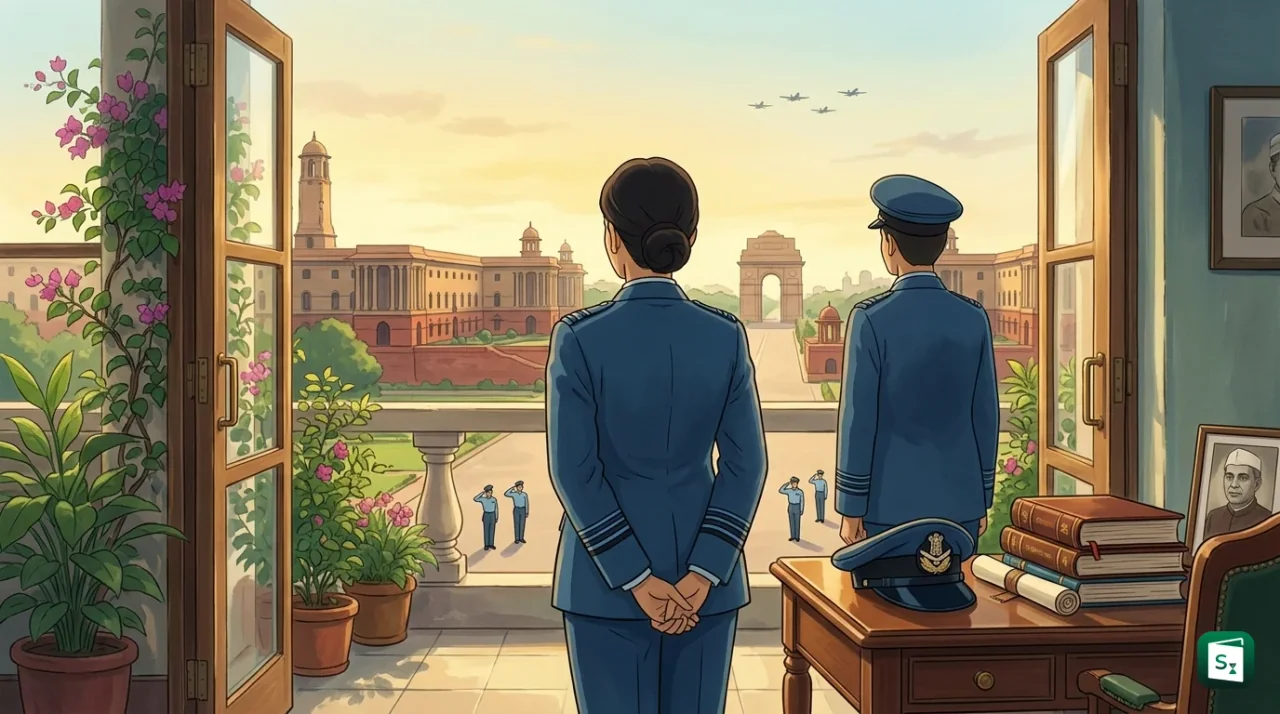
Air Vice Marshal Shakti Sharma became the first woman officer from a non-medical branch in the Indian Defence Forces to attain the rank of Air Vice Marshal (AVM) on 1 September 2026. On the same day, she assumed charge as the Assistant Chief of the Air Staff (Education), or ACAS (Edn), at the Air Headquarters in New Delhi. Commissioned into the Indian Air Force’s Education Branch in 1994, Sharma now heads one of the service’s most important portfolios for training, doctrine, and academic collaboration.
Who Is Air Vice Marshal Shakti Sharma?
Air Vice Marshal Shakti Sharma is a serving officer of the Indian Air Force (IAF) whose career has spanned more than three decades and three distinct command landscapes: training establishments, field stations, and headquarters appointments. She was commissioned into the IAF’s Education Branch on 18 June 1994, one of the streams through which officers enter the non-flying, non-technical side of the Air Force.
Over the years, she has served at training institutions, air stations across commands, Command Headquarters, and the Air Headquarters at Vayu Bhawan on Rafi Marg in New Delhi. This combination of postings has given her a rounded view of how the IAF recruits, trains, and develops its human capital.
What sets her apart from most of her contemporaries is a string of historic firsts. Before becoming the first woman non-medical officer to be promoted to Air Vice Marshal, she had already become the first woman Group Captain in the IAF outside the medical branch. Earlier still, she had created history as the first woman officer from the tri-services (the Army, Navy, and Air Force combined) to command a Sainik School, when she took over as Principal of Sainik School Kapurthala in Punjab. Across her career, she has also spearheaded the establishment of IAF Chairs of Excellence at the Indian Institute of Technology (IIT) Kanpur and at Pune University, two flagship academic bridges between the armed forces and India’s research institutions.
What Exactly Happened on 1 September 2026?
On 1 September 2026, Air Vice Marshal Shakti Sharma formally took charge as the Assistant Chief of the Air Staff (Education) at the Air Headquarters in New Delhi. The appointment came along with her elevation to the two-star rank of Air Vice Marshal, the third-highest active rank in the Indian Air Force.
The Ministry of Defence described the promotion as a “historic milestone” for the IAF and said it marked a new chapter in the journey of women officers in the Indian Defence Forces. The official statement emphasised that the elevation was significant because Sharma had reached the rank through the non-medical, or “regular,” stream of the armed forces, not through the medical branch that had earlier produced women flag officers.
Until her promotion, Sharma held the one-star rank of Air Commodore. Her immediate predecessor in the Air Vice Marshal rank was also from within the IAF, and her elevation maintains the IAF’s long-standing practice of filling the ACAS (Education) post at the level of Air Vice Marshal. Other major appointments made by the IAF on the same day included the appointment of Air Marshal K.A.A. Sanjeeb as the Air Officer-in-Charge Maintenance, signalling a coordinated reshuffle at the top of the service.
A Look at the Air Vice Marshal Rank in the IAF
The Air Vice Marshal (AVM) is a two-star flag rank in the Indian Air Force and the third-highest active rank in the service, sitting just below Air Marshal and above Air Commodore. It is part of the Air Officer cadre, the senior-most grouping of IAF commissioned officers who carry the Ashoka Lion Capital, the national emblem, on their shoulder insignia, signifying that their authority is delegated by the President of India, who is the Supreme Commander of the Armed Forces.
An Air Vice Marshal typically heads large functional directorates at Air Headquarters, serves as a Senior Air Staff Officer (SASO) at one of the IAF’s operational commands, or commands major air force stations and training institutions. The rank corresponds to Level 14 of the Pay Matrix and carries a maximum admissible age of 58 years for the serving officer.
The rank insignia of an Air Vice Marshal features the national emblem above a crossed sword and baton within a laurel wreath, with two stars above the wreath. The personal flag of an Air Vice Marshal is sky blue, bearing the IAF roundel surmounted by the eagle from the IAF badge, with two yellow stars in the fly. Officers of this rank also wear blue gorget patches embossed with two white stars on their collars.
Equivalence with Other Services
Across the Indian Armed Forces, an Air Vice Marshal is equivalent in status and pay to a Major General in the Indian Army and a Rear Admiral in the Indian Navy. The same equivalence holds at every other rank level, allowing seamless inter-service coordination at the flag level.
| Service | Two-Star Rank | Equivalent Rank |
|---|---|---|
| Indian Air Force | Air Vice Marshal | Two-star |
| Indian Army | Major General | Two-star |
| Indian Navy | Rear Admiral | Two-star |
The IAF’s rank pyramid above Air Vice Marshal has only two further tiers: Air Marshal (three stars) and Air Chief Marshal (four stars), the rank held by the Chief of Air Staff. The ceremonial five-star rank of Marshal of the Indian Air Force has been conferred only once, on the late Arjan Singh in 2002.
The Education Branch and the ACAS (Education) Role
The Education Branch is one of the IAF’s non-flying, non-technical branches. Officers of this branch manage the service’s human resource development functions, including curriculum design, professional military education, instructional standards at training establishments, recruitment testing, and academic partnerships with civilian universities. They are the cadre that turns a freshly commissioned pilot or technician into a fully trained Air Force officer.
The branch has grown in importance as the IAF has modernised. Today, Education Branch officers manage computer-based testing systems for induction into the officer cadre, run the service’s schools and libraries network, and coordinate accreditation of IAF training programmes under the National Credit Framework of the Ministry of Skill Development and Entrepreneurship.
At the apex of the branch sits the Assistant Chief of the Air Staff (Education), a position held at the rank of Air Vice Marshal. As ACAS (Edn), Shakti Sharma now serves as the principal advisor to the Chief of the Air Staff on all matters relating to education, training, and skilling across the IAF. Her portfolio covers more than 130 schools affiliated with the Air Force, over 200 libraries, and the national-level examination systems used to test candidates seeking induction into the officer cadre. The role also coordinates the IAF’s academic chairs at institutions such as the IITs, the University of Pune, and other partner universities, making it one of the most institutionally influential appointments in the service.
Key Milestones in Shakti Sharma’s Career
Sharma’s career offers a useful template of how an officer rises through a non-flying branch of the IAF. Each stage of her service has opened a door that had been closed to women officers before her.
| Year | Milestone |
|---|---|
| 18 June 1994 | Commissioned into the IAF’s Education Branch |
| During 2000s | Served across training establishments, field stations, and Command Headquarters |
| Earlier tenure | First woman Group Captain in the IAF from outside the medical branch |
| During earlier posting | First woman officer from the tri-services to command a Sainik School, as Principal of Sainik School, Kapurthala |
| During earlier tenure | Established IAF Chairs of Excellence at IIT Kanpur and Pune University |
| Held rank | Air Commodore, prior to elevation |
| 1 September 2026 | Promoted to Air Vice Marshal and appointed Assistant Chief of the Air Staff (Education) at Air Headquarters |
Her posting at Sainik School Kapurthala, an institution run by the Ministry of Defence under the Sainik Schools Society to prepare students for entry into the National Defence Academy (NDA), was particularly notable. Sainik Schools have traditionally been headed by male officers from the armed forces, and her appointment as Principal was the first time a woman officer from any of the three services had taken charge of one. This was preceded and followed by academic collaborations that gave the IAF a permanent presence in two of India’s leading universities, IIT Kanpur and the Savitribai Phule Pune University.
Her promotion to Air Vice Marshal also makes her only the second woman officer from the Indian Armed Forces, after Air Marshal Padma Bandopadhyay, to hold a two-star rank. The crucial difference is that Bandopadhyay rose through the medical stream as an aviation medicine specialist. Sharma is the first to do so from the regular, non-medical stream.
Women in the IAF: A Broader Pattern of Firsts
Sharma’s elevation sits within a longer arc of women breaking into the senior leadership of India’s armed forces. The trajectory began in 1976, when Major General Gertrude Alice Ram of the Military Nursing Service became the first Indian woman to hold flag rank in the military. In the Air Force, the medical stream produced the early pathbreakers.
Air Marshal Padma Bandopadhyay (born 4 November 1944), an aviation medicine specialist commissioned through the Armed Forces Medical College, Pune, became the first woman Air Vice Marshal in 2002 and, in 2004, the first woman Air Marshal. She was also the first Indian woman to conduct research at the North Pole and the first woman officer to complete the Defence Services Staff College course. She was awarded the Padma Shri in 2020.
In the Army, Lieutenant General Punita Arora became the first woman three-star officer, while in the Navy, Surgeon Vice Admiral rank was attained by women medical officers earlier than in the other services. In 2024, Air Marshal Sadhna Saxena Nair became the third woman three-star officer in the Indian Armed Forces and the second woman Air Marshal after Bandopadhyay.
The combat and flying side has had its own milestones. In 2016, the IAF inducted its first batch of women fighter pilots under an experimental scheme, and in 2018, Flying Officer Avani Chaturvedi became the first Indian woman to fly a fighter aircraft solo. Bhawana Kanth, Mohana Singh, and Sarla Thakral (who flew in the 1930s) are part of the same trailblazing lineage. The fighter stream was made permanent for women in 2022, and the Supreme Court, in 2021, paved the way for women to enter the National Defence Academy (NDA) at Khadakwasla, near Pune.
The Journey So Far: From 1993 Induction to the 2026 Milestone
The institutional opening for women in the IAF dates back to 1992, when the Government of India decided to induct women officers into certain non-flying branches on an experimental basis. The first women were commissioned into the IAF in 1993 in the Administration, Education, and Aeronautical Engineering branches. Over the next three decades, women were progressively inducted into more streams, including, in 2015, the fighter stream.
In parallel, the judiciary pushed the doors open further. The Delhi High Court in the Babita Puniya case (judgment of 12 March 2010) directed that women Short Service Commissioned Officers (SSCOs) in the Air Force and the Army be considered for Permanent Commission (PC) at par with their male counterparts. The Supreme Court upheld this position in Secretary, Ministry of Defence v. Babita Puniya (judgment of 17 February 2020), holding that absolute bars on women seeking criteria or command appointments would not comport with the guarantee of equality under Article 14 of the Constitution. The court rejected sex-stereotyped arguments and extended the right of PC to all eligible women SSCOs.
In 2024, the Supreme Court followed this up in a batch of cases concerning women SSCOs of the IAF, again invoking the equality guarantee and ordering pensionary benefits for women officers whose chance to be considered for PC had been procedurally blocked.
Sharma’s promotion to Air Vice Marshal is the latest, and possibly the most visible, marker that this institutional opening is now translating into real career outcomes at the flag level. Yet the milestone also underlines how much ground remains. No woman from a non-medical branch has yet reached the three-star rank of Air Marshal, and no woman has yet held a major operational command in the IAF. The combat arms of the Army also remain closed to women, although the debate over opening them continues.
What This Promotion Means for the Armed Forces
The significance of Air Vice Marshal Shakti Sharma’s promotion goes well beyond a personal achievement. It is the first time the IAF has shown, with a real career outcome, that a woman commissioned into a non-flying, non-medical branch can rise to a two-star rank on the strength of her professional record. Until now, every woman flag officer in the IAF had come through the medical stream, and outside the IAF, every woman three-star officer in the armed forces has done the same.
For the IAF as an institution, the appointment also embeds a woman officer at the heart of its training and doctrine architecture. The ACAS (Education) portfolio controls how the service prepares its future pilots, engineers, logisticians, and administrators. Placing a long-serving Education Branch officer at its head, one with direct experience of running a Sainik School and building university partnerships, is a signal that the IAF is willing to use its most senior talent, regardless of gender.
For the broader debate on women in the armed forces, the promotion shifts the conversation. Previous milestones, such as the first woman fighter pilot, the first woman NDA cadet, or the grant of permanent commission, dealt with the entry and mid-career progression of women. Sharma’s elevation is about the top of the pyramid. It demonstrates that the pipeline that was opened in 1992 and widened by the Supreme Court in 2010 and 2020 can now produce flag-rank women officers outside the medical services.
It is also a reminder that the work is incomplete. The Army’s combat arms remain closed to women, the criteria for promotion at the highest levels still differ along gender lines, and disputes over these differences continue to reach the Armed Forces Tribunal and the higher courts. Sharma’s appointment is a milestone, not a destination.
Key Takeaways
- Air Vice Marshal Shakti Sharma became the first woman officer from a non-medical branch in the Indian Defence Forces to attain the rank of Air Vice Marshal (AVM) on 1 September 2026.
- She assumed charge as the Assistant Chief of the Air Staff (Education) at the Air Headquarters in Vayu Bhawan, New Delhi, on the same day.
- Sharma was commissioned into the IAF’s Education Branch on 18 June 1994 and has served more than 30 years across training establishments, field stations, Command Headquarters, and Air Headquarters.
- She was previously the first woman Group Captain in the IAF outside the medical branch and the first woman officer from the tri-services to command a Sainik School, serving as Principal of Sainik School Kapurthala.
- Air Vice Marshal is a two-star rank in the Indian Air Force, equivalent to Major General in the Indian Army and Rear Admiral in the Indian Navy, and is the third-highest active rank in the IAF.
- Air Marshal Padma Bandopadhyay was the first woman Air Vice Marshal in the IAF in 2002 and later the first woman Air Marshal; she rose through the medical stream as an aviation medicine specialist.
- The Supreme Court, in Secretary, Ministry of Defence v. Babita Puniya (17 February 2020), upheld the grant of Permanent Commission to women Short Service Commissioned Officers in the Army and the Air Force on the basis of Article 14 equality.
- The Indian Air Force was founded on 8 October 1932, with its motto “Nabhah Sprsam Diptam” (“Touch the Sky with Glory”), drawn from the Bhagavad Gita (11.24).