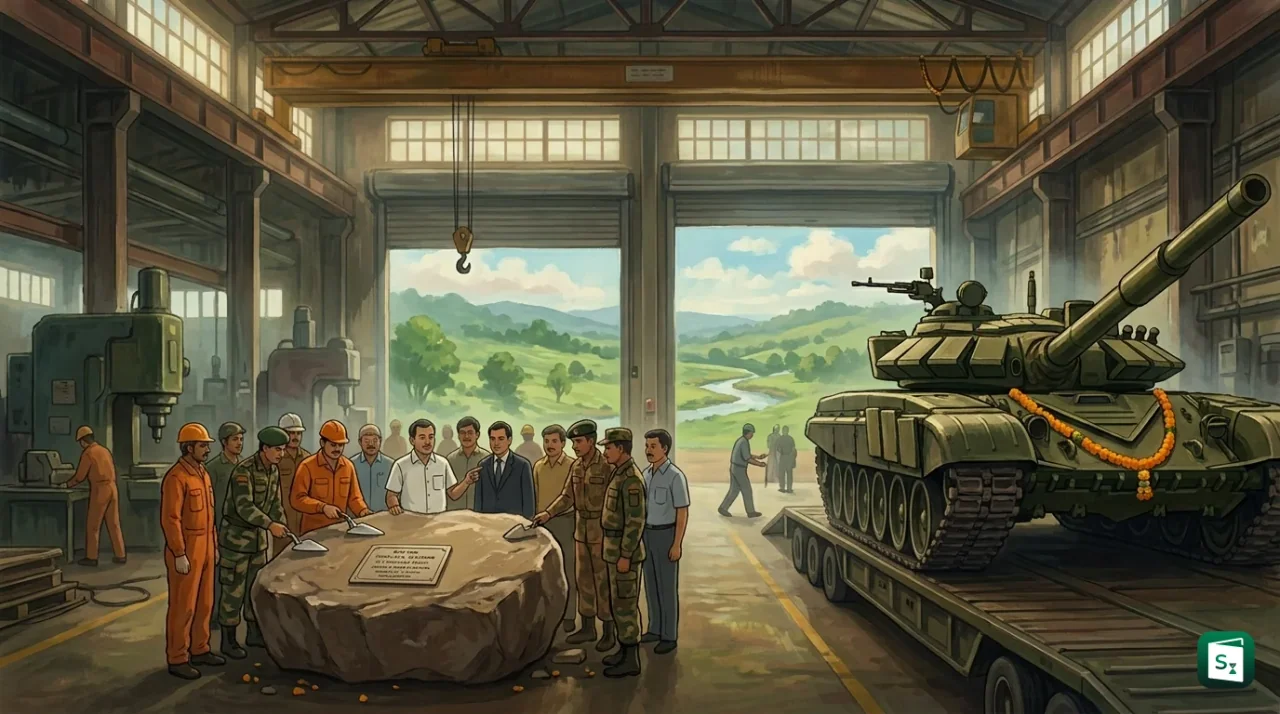
Defence Minister Rajnath Singh, alongside Madhya Pradesh Chief Minister Mohan Yadav, performed the Bhoomi Pujan for a ₹472 crore T-72 and T-90 Tank Overhaul Project at the Vehicle Factory Jabalpur (VFJ) on 27 August 2026. The new facility, to be built inside this 57-year-old ordnance unit in Madhya Pradesh, will overhaul 80 main battle tanks every year, plugging the gap between the Indian Army’s annual requirement of 230 overhauls and the 150 already handled by the Heavy Vehicles Factory (HVF) in Avadi, Tamil Nadu. With this, Jabalpur will become the country’s second dedicated tank-overhaul hub and a centrepiece of India’s push to sustain its Russian-origin armoured fleet under the Aatmanirbhar Bharat framework.
Inside the ₹472 Crore Tank Overhaul Project at Jabalpur
The Tank Overhaul Project is being set up inside the 57-year-old Vehicle Factory Jabalpur (VFJ), a military motor vehicle plant that began operations in 1969 and now operates under the Armoured Vehicles Nigam Limited (AVNL). AVNL, a Mini Ratna defence public sector undertaking, is the corporate entity carved out of the erstwhile Ordnance Factory Board in 2021 to focus on armoured and military logistics platforms.
The ₹472 crore outlay covers dedicated overhaul lines, testing bays and supporting infrastructure designed to take a Russian-origin main battle tank through a complete life-cycle refresh. T-72 Ajeya and T-90 Bhishma tanks returning from field regiments will be stripped down to their sub-assemblies, inspected, fitted with fresh mechanical, electrical and hydraulic components, and reassembled to factory-fresh standard before being handed back to the Army.
The project has been engineered around a single capacity number: 80 overhauls a year. Once the new line stabilises, India’s annual tank-overhaul capacity will rise to 230, exactly matching the Indian Army’s stated requirement and eliminating a shortfall that has been widening as the armoured fleet ages. Calling main battle tanks an “iron wall” on the country’s borders, Rajnath Singh underlined that the new facility would strengthen India’s indigenous defence maintenance base and open avenues for local micro, small and medium enterprises (MSMEs) to feed into the supply chain of mechanical, electrical and hydraulic components.
What Is a Tank Overhaul and Why Does It Matter?
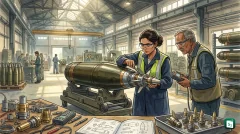
An overhaul in military engineering is a comprehensive, scheduled refurbishment in which a vehicle is dismantled to its smallest assemblies, each component is inspected, repaired or replaced, and the platform is reassembled to near-new condition. For a main battle tank, this goes far beyond routine servicing. It covers the engine, transmission, running gear, fire-control systems, optics, electronics, hydraulics and the 125 mm gun system, along with upgradation of sub-systems where needed.
Overhauls are essential because tanks operate under extreme stress, including cross-country mobility at high altitude, deep fording, blast loads from mines and improvised explosive devices, and continuous firing cycles. Without periodic overhaul, mechanical wear, fatigue and obsolescence of electronics erode combat reliability.
The Numbers Behind the Overhaul Gap
The mismatch between demand and supply has been a long-standing concern for the Indian Army’s armoured corps. The headline numbers from the foundation ceremony capture the gap clearly.
| Parameter | Detail |
|---|---|
| Army’s annual overhaul requirement | 230 tanks |
| Existing capacity at HVF Avadi | 150 tanks |
| New capacity at Vehicle Factory Jabalpur | 80 tanks |
| Total capacity after the project is operational | 230 tanks |
| Combined cost of the project | ₹472 crore |
| Existing T-72 Ajeya fleet strength | 2,400 to 2,500 tanks (first inducted in late 1970s) |
| Planned T-90 Bhishma fleet | 1,657 tanks (around 1,300 in active service) |
With the T-72 expected to remain in service well beyond its originally intended life and a replacement programme still stuck in delays, the new facility is essentially buying the Army time. By ensuring that more tanks return from overhaul within required timelines, the project directly improves the operational readiness of the armoured corps along both the western and northern borders.
Vehicle Factory Jabalpur: From Ordnance Outpost to AVNL Hub
Vehicle Factory Jabalpur (VFJ), located in Jabalpur district of Madhya Pradesh, was set up in 1969 to manufacture military transport vehicles for the armed forces. Production originally began with the Shaktiman 3-tonne truck in collaboration with MAN of Germany, the Nissan 1-tonne vehicle and the Jonga light utility vehicle in collaboration with Nissan Motors of Japan. All three have since been retired.
Today, VFJ manufactures armoured light vehicles, mine-protected vehicles, bullet-proofing for light commercial vehicles, and a wide range of military transport vehicles, including water bowsers, kitchen containers, mobile offices, battery command posts and recovery vehicles. The factory area spans 330 acres, with an additional 600 acres of estate, and it holds ISO 9001-2000 certification, with NABL-accredited laboratories.
VFJ was part of the Ordnance Factory Board (OFB) until 2021. When the government restructured the over-two-century-old OFB into seven separate defence public sector undertakings (DPSUs), VFJ was placed under the newly formed Armoured Vehicles Nigam Limited (AVNL), which was incorporated on 14 August 2021 and commenced operations on 1 October 2021. Prime Minister Narendra Modi dedicated AVNL to the nation on 15 October 2021, coinciding with Vijaya Dashami. AVNL brings together five factories: HVF Avadi, Engine Factory Avadi, Vehicle Factory Jabalpur, Ordnance Factory Medak, and Machine Tool Prototype Factory Ambernath, along with three learning institutes.
For more than 25 years, AVNL units have been overhauling T-72 and T-90 variants, and the Defence Minister used the foundation ceremony to remind the workforce that the new facility should set higher benchmarks in quality, productivity and innovation. Heavy Vehicles Factory Avadi alone has supplied around 4,400 tanks to the Army over the past four decades, underscoring the depth of experience now available inside AVNL.
The Backbone: T-72 Ajeya and T-90 Bhishma
The new overhaul facility at Jabalpur is purpose-built for the two platforms that form the bulk of India’s armoured fleet: the T-72 Ajeya and the T-90 Bhishma. Both are Russian-origin main battle tanks, both fire the same 125 mm smoothbore gun family, and both were selected by India after detailed comparative trials.
T-72 Ajeya: The Indigenised Workhorse
The T-72M1, adopted by the Indian Army as the Ajeya (meaning “invincible”), entered service in the early 1980s after exhaustive trials that pitted it against the French AMX-40 and the British Chieftain 800. A procurement contract for 2,418 T-72s was signed, with production taken up at HVF Avadi under licence from the Soviet Union. The first Ajeya rolled out of HVF in 1984.
Key specifications of the T-72 Ajeya include a combat weight of around 41.5 tonnes, length of 9.53 m (gun forward), a 780 hp V-84MS multi-fuel diesel engine offering roughly 19 horsepower per tonne, a maximum road speed of 60 km/h, and a three-person crew. The main armament is the 125 mm 2A46 smoothbore gun with a carousel autoloader carrying 24 ready rounds (44 in total), supplemented by a 7.62 mm coaxial machine gun and a 12.7 mm NSV anti-aircraft machine gun on the commander’s cupola.
Over time, DRDO-led upgrades under Project Rhino produced the Combat Improved Ajeya, fitted with a Polish SKO-1T fire control system, DRDO-developed explosive reactive armour (ERA), an indigenous Integrated Fire Detection and Suppression System (IFDSS), GPS navigation, laser warning receivers and smoke grenade launchers. The Ajeya Mk-2 variant further added ERA bricks and banks of six smoke grenade launchers on each side of the turret. About 1,900 T-72M1 Ajeya were produced at HVF Avadi, and the total Ajeya inventory is estimated at around 2,400 to 2,500 tanks, including upgrades.
T-90 Bhishma: The Modern Spearhead
The T-90S Bhishma, named after the legendary Mahabharata warrior, was ordered by India after Pakistan acquired the T-80UD from Ukraine. An inter-governmental agreement was signed in October 2000, followed by a contract in February 2001 for 310 T-90S tanks, valued between $650 million and $750 million, including complete technology transfer. Of these, 124 were completed in Russia and the rest supplied in knocked-down form for final assembly in India. The first indigenous Bhishma rolled out of HVF in 2009.
The T-90S Bhishma has a combat weight of 46.5 tonnes, length of 9.53 m, width of 3.78 m, height of 2.865 m, and the same three-person crew. It is powered by a 1,000 hp V-92S2 V-12 diesel engine giving a power-to-weight ratio of 21.5 hp/tonne, with a maximum road speed of 60 km/h. The main gun is the 125 mm 2A46M smoothbore, two-axis stabilised with a thermal sleeve, capable of firing armour-piercing fin-stabilised discarding sabot (APFSDS), high-explosive anti-tank (HEAT) and high-explosive fragmentation rounds, as well as the laser-guided 9M119 Refleks anti-tank guided missile with a range of up to 5 km. A total of 42 rounds are carried, supported by a 7.62 mm coaxial machine gun and a 12.7 mm anti-aircraft machine gun.
The T-90 was later upgraded to the Bhishma Mk-3 standard, with around 83 per cent indigenous content, a fully indigenous engine delivering 1,130 hp, a combat weight of 50.7 tonnes, a range of 550 km, advanced thermal imaging, an improved fire-control system and a remotely controlled anti-aircraft machine gun option. AVNL plans to induct about 1,657 T-90s, with roughly 1,300 already in active service, and the more advanced 957 tanks are scheduled to receive a retrofitted mid-wave infrared (MWIR) commander sight.
How the Two Tank Programmes Compare
The T-72 and T-90 share the same 125 mm gun family and many automotive components, which is precisely why a single overhaul line can service both. Yet they sit at different points on the technological curve and play complementary roles in the Indian Army’s armoured doctrine.
| Parameter | T-72 Ajeya (M1) | T-90S Bhishma |
|---|---|---|
| Year inducted in Indian service | 1984 | 2001 (first contract); indigenous rollout 2009 |
| Combat weight | 41.5 tonnes | 46.5 tonnes (50.7 tonnes for Mk-3) |
| Engine | V-84MS, 780 hp | V-92S2, 1,000 hp (1,130 hp in Mk-3) |
| Power-to-weight ratio | About 19 hp/tonne | 21.5 hp/tonne |
| Main gun | 125 mm 2A46 | 125 mm 2A46M |
| Autoloader capacity | 24 ready rounds (44 total) | 22 in autoloader (42 total) |
| ATGM capability | After upgrade, 9M119 Refleks (5 km) | 9M119 Refleks from inception (up to 5 km) |
| Production site | HVF Avadi | HVF Avadi (also Medak for early batches) |
| Indigenous variant | Combat Improved Ajeya, Ajeya Mk-2 | Bhishma, Bhishma Mk-3 |
| Fleet size | 2,400 to 2,500 | 1,657 planned; around 1,300 in active service |
| Role | Workhorse of the armoured fleet | Spearhead and high-intensity strike platform |
While the T-90 brings modern thermal sights, the Refleks missile and a more powerful engine, the T-72’s lower profile, lighter weight and rugged mechanical simplicity make it well-suited to operations across the varied terrain of India’s northern borders. The two platforms together account for nearly 4,000 of the main battle tanks in the Indian Army’s fleet, with a smaller number of indigenous Arjun tanks rounding out the order of battle.
Bridging the 80-Tank Gap: Capacity, Capability and Industry Impact
The headline figure of 80 additional overhauls a year is only the most visible part of the project’s significance. The wider impact runs through three channels: operational readiness, industrial capacity and the local defence ecosystem.
Operationally, the gap between the Army’s 230-tank annual overhaul requirement and the 150-tank capacity at HVF Avadi had been forcing the service to either extend intervals between overhauls or accept a degraded fleet readiness. Once the Jabalpur facility reaches full operational tempo, India will be able to overhaul its full annual quota, meaning more tanks in the armoured regiments at any given moment and faster turnaround when tanks return from the field.
Industrially, the ₹472 crore investment will create dedicated capacity for high-precision work: laser cutting, plasma cutting, water-jet cutting, armour welding, heat treatment, surface treatment, gear manufacturing and the assembly of transmission components, all capabilities already present at VFJ. This positions Jabalpur as a hub for tank life-cycle support on par with Avadi and gives AVNL a geographically distributed overhaul base, which is important for resilience in any contingency.
Economically, the project is expected to generate sustained demand for mechanical, electrical and hydraulic assemblies, creating direct and indirect employment in and around Jabalpur, including for local MSMEs, farmers’ children, workers, youth and small entrepreneurs. By pulling in local suppliers, the project dovetails into the Aatmanirbhar Bharat (Self-Reliant India) initiative and the broader push to make India a global defence manufacturing and export hub. Rajnath Singh made this link explicit at the ceremony, urging AVNL to use its 25 years of experience to set new benchmarks for global competitiveness.
The Way Forward for India’s Armoured Fleet
The T-Series overhaul project is one piece of a much larger effort to keep India’s tank fleet battle-ready. The Defence Acquisition Council has already accorded Acceptance of Necessity for the Future Ready Combat Vehicle (FRCV) programme, intended to deliver around 1,770 next-generation main battle tanks to replace the T-72. Estimated costs range between ₹57,000 crore and ₹60,000 crore, but the programme has been through repeated false starts since 2015 and bids are yet to be finalised.
In the interim, the T-72 Ajeya must soldier on well beyond its originally intended service life, and the T-90 Bhishma fleet is being progressively upgraded to the Mk-3 standard with deep indigenous content. The complementary Arjun programme, with DRDO-led Arjun Mk-1A and the planned Arjun Mk-2, addresses the heavy end of the fleet, while the Futuristic Infantry Combat Vehicle (FICV) programme targets the infantry combat vehicle segment. Alongside these, the parallel Future Infantry Combat Vehicle effort aims to replace the ageing BMP-2 fleet.
In this context, the Jabalpur overhaul facility is a near-term capacity bridge. It buys time for the FRCV to mature, sustains a domestic industrial base for tank-grade mechanical and electronic work, and signals that India’s defence public sector undertakings are being repositioned as specialised, accountable, export-oriented companies. As Rajnath Singh put it, India’s soldiers must have both modern tanks and drones operating in close coordination. The Jabalpur facility ensures the tanks continue to be there.
Key Takeaways
- Defence Minister Rajnath Singh performed the Bhoomi Pujan for a ₹472 crore T-72 and T-90 Tank Overhaul Project at Vehicle Factory Jabalpur (VFJ) in Madhya Pradesh on 27 August 2026.
- The new facility will overhaul 80 main battle tanks a year, raising India’s annual tank-overhaul capacity to 230, exactly matching the Indian Army’s stated requirement.
- VFJ, established in 1969, is a unit of Armoured Vehicles Nigam Limited (AVNL), a Mini Ratna defence PSU incorporated on 14 August 2021 after the restructuring of the Ordnance Factory Board.
- The T-72 Ajeya (41.5 tonnes, 780 hp, 125 mm 2A46 gun) and the T-90 Bhishma (46.5 tonnes, 1,000 hp V-92S2 engine, 125 mm 2A46M gun) together account for nearly 4,000 tanks in the Army’s fleet.
- The T-72 Ajeya entered Indian service in 1984 under a contract for 2,418 tanks; the T-90 Bhishma was inducted in 2001 (first indigenous rollout 2009), with 1,657 tanks planned and around 1,300 in active service.
- The T-90 Bhishma Mk-3 variant achieves around 83 per cent indigenous content with a fully indigenous 1,130 hp engine and can fire the 9M119 Refleks anti-tank guided missile at ranges up to 5 km.
- Heavy Vehicles Factory, Avadi currently handles 150 tank overhauls a year and has supplied around 4,400 tanks to the Army over the past four decades.
- The project is part of the Aatmanirbhar Bharat push for self-reliance in defence manufacturing and is expected to generate demand for local MSMEs supplying mechanical, electrical and hydraulic components.