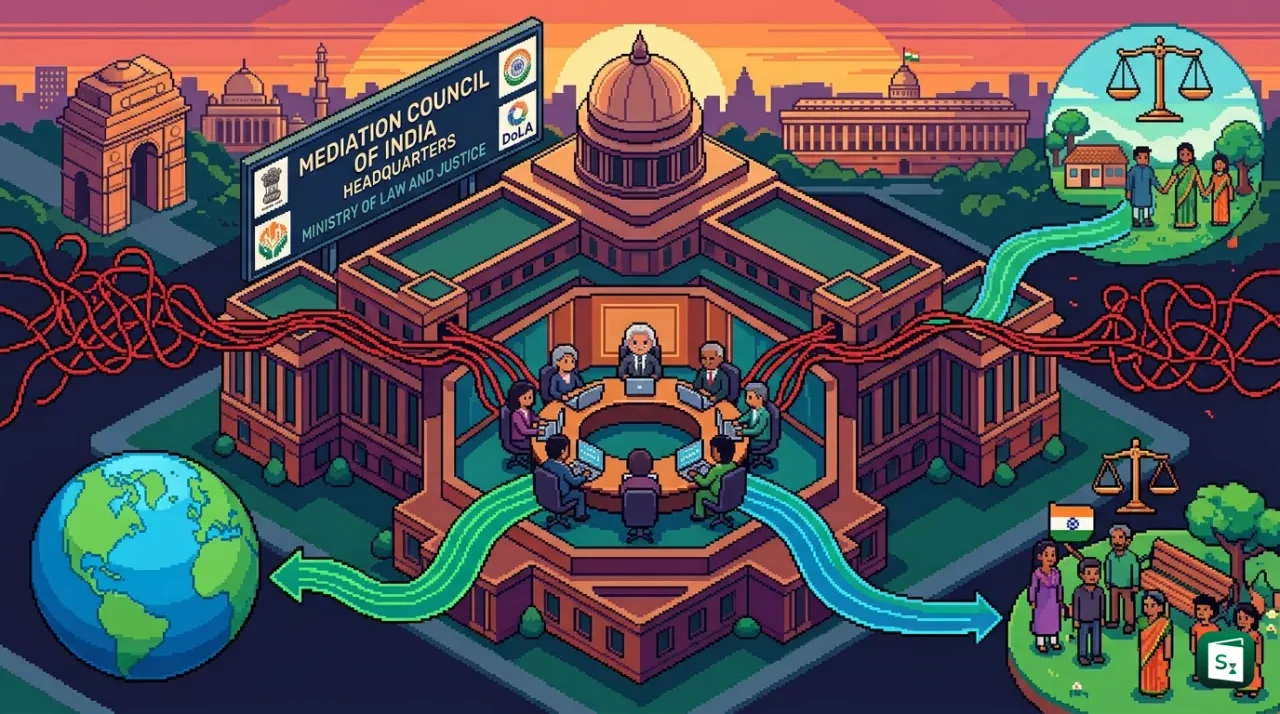
The Department of Legal Affairs (DoLA) under the Ministry of Law and Justice notified the establishment of the Mediation Council of India (MCI) on 27 August 2026, with its headquarters in New Delhi. Constituted under Section 31(1) of the Mediation Act, 2023, the MCI is a body corporate tasked with promoting mediation as a credible, cost-effective alternative to traditional litigation across India and abroad. The notification activates a key statutory provision that had been waiting since the Act received Presidential assent in September 2023, marking the formal beginning of a national-level regulator for mediation in India.
What Is Mediation and Why It Matters for India
Mediation is a voluntary method of dispute resolution in which a neutral third person, called a mediator, helps two or more parties identify issues, clarify priorities, explore possible solutions and try to reach a settlement they all accept. The mediator has no authority to impose a decision on the parties, which makes mediation fundamentally different from arbitration or litigation.
The concept is not new to India. Traditional community-based dispute settlement through village elders, caste panchayats and nyaya panchayats has long reflected the spirit of mediation. The modern legal form, however, requires institutional backing, trained mediators and a clear framework for enforcement of settlements. This is what the Mediation Act, 2023 was enacted to provide.
The need for structured mediation in India is closely tied to the state of the country’s courts. As of early 2025, more than 5.2 crore cases were pending across the district courts, High Courts and the Supreme Court. Over 85% of these sit in district courts, and more than 1.8 lakh cases have been pending for over 30 years. The Central Government itself accounts for roughly half of all pending cases, making it the single largest litigant. In such a system, mediation offers a faster, cheaper and less adversarial path to resolving both civil and commercial disputes.
The Mediation Act, 2023: The Parent Legislation
The Mediation Council of India is a creature of the Mediation Act, 2023 (Act No. 32 of 2023), so its scope and powers cannot be understood without first looking at the parent law.
The Mediation Bill, 2021 was introduced in the Rajya Sabha on 20 December 2021 and referred to the Parliamentary Standing Committee on Personnel, Public Grievances, Law and Justice. The Committee submitted its report on 13 July 2022, after which the Union Cabinet cleared a revised version on 19 July 2023. The Rajya Sabha passed the Bill on 1 August 2023, the Lok Sabha on 7 August 2023, and the Act received the President’s assent on 14 September 2023. It was notified in the Gazette of India on 15 September 2023.
The long title spells out the purpose clearly: to promote and facilitate mediation, especially institutional mediation, for resolving commercial or other disputes, to enforce mediated settlement agreements, to provide a body for registration of mediators, to encourage community mediation and to make online mediation an acceptable and cost-effective process. The Act applies to the whole of India and, in defined cases, to international mediations conducted within Indian territory.
The Act is administered by the Department of Legal Affairs under the Ministry of Law and Justice, the same department that has now notified the Council. It replaces the scattered mediation provisions that earlier existed under the Code of Civil Procedure, 1908 (Section 89), the Arbitration and Conciliation Act, 1996, the Legal Services Authorities Act, 1987, and several sector-specific statutes, bringing everything under a single comprehensive law.
Only certain groups of sections were brought into force in October 2023, covering definitions, the legal shell of the Council, the Mediation Fund and a few savings clauses. The remaining provisions, including those relating to pre-litigation mediation, the role and timeline of mediators, and the enforceability of mediated settlement agreements as court decrees, were notified in stages thereafter.
Establishment of the Mediation Council of India
The notification that brought the MCI into existence was issued on 27 August 2026 by the Department of Legal Affairs and published in the Gazette of India, Extraordinary, under Part II, Section 3, Sub-section (ii), as notification S.O. 4781(E). The operative part of the notification reads that, in exercise of the powers conferred by sub-section (1) of Section 31 of the Mediation Act, 2023, the Central Government “hereby establishes a Council for the said Act, to be called as the Mediation Council of India, which shall have its head office at Delhi”.
The notification was narrow in scope. It contained only the single provision formally creating the Council and naming Delhi as its headquarters. The Ministry has indicated that the composition, including the appointment of the Chairperson and Members, will be notified separately once the formal selection process is complete. Until those appointments are made, the body exists as a statutory entity without an active governing board.
The legal form of the Council is clearly set out in Section 31(2) of the Act. The MCI is a body corporate with a common seal, perpetual succession and the power to acquire, hold and dispose of property, both movable and immovable. It can enter into contracts and, by the name “Mediation Council of India”, sue or be sued. While its head office must be in Delhi (or any other place the Central Government may later notify), the Council may, in consultation with the Centre, establish additional offices at other places in India and abroad.
The MCI is, in effect, the apex regulator and promoter of mediation in India, occupying a position analogous to the Bar Council of India for lawyers, the Medical Council of India for doctors, or the Insurance Regulatory and Development Authority of India (IRDAI) for insurance companies.
Composition of the Council: Chairperson, Members and Tenure
Section 32 of the Mediation Act, 2023 fixes the structure of the MCI. The Council consists of a Chairperson and other Members, with a mix of full-time, ex-officio and part-time positions to balance legal expertise, administrative experience and industry representation.
Detailed Breakdown of Members
| S.No. | Position | Category | Appointed By |
|---|---|---|---|
| 1 | Chairperson | Full-time/Part-time | Central Government |
| 2 | Member (legal expertise in mediation/ADR) | Full-time/Part-time | Central Government |
| 3 | Member (research or teaching in mediation/ADR) | Full-time/Part-time | Central Government |
| 4 | Secretary, Department of Legal Affairs, Ministry of Law and Justice (or representative not below Joint Secretary rank) | Ex-officio Member | By virtue of office |
| 5 | Secretary, Department of Expenditure, Ministry of Finance (or representative not below Joint Secretary rank) | Ex-officio Member | By virtue of office |
| 6 | Chief Executive Officer of the Council | Ex-officio Member-Secretary | By virtue of office |
| 7 | One representative of a recognised body of commerce and industry | Part-time Member | Central Government |
In total, the Council has seven Members, of whom three are ex-officio and one is part-time. The Chairperson must be a person of ability, integrity and standing with adequate knowledge and professional experience, or demonstrated capacity, in law, alternative dispute resolution (preferably mediation), public affairs or administration. If the Chairperson is appointed on a part-time basis, the Act requires that at least one of the Members under clauses (b) or (c) must be a full-time Member, ensuring there is always a senior full-time functionary available.
Tenure, Age Limits and Eligibility
The Members of the Council, other than the ex-officio Members, hold office for a term of four years from the date they assume charge, and are eligible for reappointment. The upper age limits are different for the Chairperson and other Members:
| Position | Maximum Age Limit |
|---|---|
| Chairperson | 70 years |
| Other Members | 67 years |
Salaries, allowances and other terms of service for non-ex-officio Members are fixed by rules made by the Central Government, while the part-time Member is entitled only to travelling and other allowances as prescribed. Resignation, removal and vacancies are also governed by the Act. A Member may resign by giving written notice to the Central Government, and continues to hold office for up to three months until the notice period runs out, a successor takes charge, or the term expires, whichever is earlier. Removal can happen on grounds such as insolvency, taking up paid employment without permission, conviction for an offence involving moral turpitude, acquiring a prejudicial financial interest, abusing position, or physical or mental incapacity. The Member concerned must, however, be informed of the charges and given a chance to be heard.
Importantly, vacancies or defects in the constitution of the Council do not invalidate its proceedings, ensuring continuity of work even if a position falls vacant mid-term.
Powers and Functions of the MCI
Section 38 of the Mediation Act, 2023 gives the Council a wide and detailed mandate. It is not just a recommending body; it will actively set standards, register mediators, recognise institutions and promote mediation in India and abroad.
The Council’s duties and functions can be grouped into four broad roles:
1. Promotion of mediation as a mode of dispute resolution
- Endeavour to promote domestic and international mediation in India through appropriate guidelines.
- Endeavour to develop India into a robust centre for domestic and international mediation.
- Hold trainings, workshops and courses in collaboration with mediation service providers, law firms, universities and other stakeholders, both Indian and international.
- Enter into memoranda of understanding or agreements with domestic and international bodies, organisations and institutions.
- Publish information, data, research studies and other relevant material.
2. Regulation of mediators and mediation institutes
- Lay down guidelines for the continuous education, certification and assessment of mediators by recognised mediation institutes.
- Provide for the manner of registration of mediators, and the renewal, withdrawal, suspension or cancellation of such registration.
- Specify criteria for recognition of mediation institutes and mediation service providers.
- Recognise mediation institutes and mediation service providers, and renew, withdraw, suspend or cancel such recognition.
- Call for any information or record from mediation institutes and mediation service providers.
3. Setting professional and ethical standards
- Provide for the manner of conduct of mediation proceedings under Section 15(1).
- Lay down standards for the professional and ethical conduct of mediators under Section 15(3).
- Lay down standards for the professional and ethical conduct of mediation institutes and mediation service providers.
4. Building the institutional knowledge base
- Maintain an electronic depository of mediated settlement agreements made in India and other related records, in the manner specified.
- Perform any other function that may be assigned to it by the Central Government.
The Council will also be supported by a Secretariat headed by a Chief Executive Officer (Section 37), who will act as Member-Secretary of the Council. The Central Government will provide the initial staff until regulations are framed for recruitment. The Council is required to prepare an annual report on the implementation of the Act and forward it to the Central Government, which may then take additional measures to strengthen its functioning.
A unique feature is the Mediation Fund (Section 45), which will be administered by the Council and used to promote, facilitate and encourage mediation. The accounts of the Council are to be maintained in consultation with the Comptroller and Auditor General of India (CAG) and audited by the CAG, giving the body a strong public-accountability framework from the very start.
Why the MCI Notification Matters: Significance and the Road Ahead
The notification of the Mediation Council of India is, in effect, the long-awaited missing piece of India’s mediation framework. The Mediation Act, 2023 has been on the statute book since September 2023, but without an operational regulator, several of its core provisions, including registration of mediators, recognition of mediation institutes and laying down of standards, had no institutional home. The MCI fills that gap.
The significance of the move can be read at three levels.
For India’s judicial system, the Council is the first dedicated national regulator that can mainstream mediation as a credible alternative to litigation. With over 5.2 crore pending cases and a large number of undertrial prisoners (around 76% of the total prison population as of 2025), a functional MCI is expected to push structured mediation, especially pre-litigation mediation under Section 5 of the Act and court-referred mediation under Section 7, into everyday practice.
For the mediation profession, the Council will act as a single point of accreditation. Until now, mediators were empanelled by multiple bodies, including court-annexed mediation centres, Legal Services Authorities under the National Legal Services Authority (NALSA), and ad hoc mediation service providers, leading to uneven standards. The MCI will centralise the criteria for certification, continuous education and ethical conduct, giving the profession a uniform identity.
For India’s global standing, the MCI positions the country to project itself as a credible hub for international commercial mediation. India signed the United Nations Convention on International Settlement Agreements resulting from Mediation, also known as the Singapore Convention on Mediation, in 2019. The Convention provides a uniform cross-border framework for enforcing mediated settlement agreements, similar to how the New York Convention, 1958 works for foreign arbitral awards. However, India is yet to ratify the Convention. The MCI is expected to lay the domestic groundwork, in terms of trained, accredited mediators and reliable institutional mechanisms, before ratification is taken up. Countries such as Turkey and Sri Lanka, which have already ratified the Convention, are competing for international mediation business. A strong MCI will help India stay in that race.
Looking ahead, the next steps are clear. The Central Government will need to appoint the Chairperson, Members, and the Chief Executive Officer of the Council. Draft regulations will have to be framed under Section 52 covering recognition criteria for mediation institutes and service providers, mediator registration, fees, and the code of conduct. Once these are in place, the MCI can begin work on a national register of mediators, the electronic depository of mediated settlement agreements, and the formal criteria for recognising institutions such as the Supreme Court Mediation Centre, the Delhi Mediation and Conciliation Centre, and other court-annexed centres across India.
In the longer term, the MCI’s effectiveness will be judged by how well it converts the legal promise of the Mediation Act, 2023 into a lived reality on the ground, getting cases diverted from court dockets into mediation rooms, and helping India move from being the world’s largest litigation hub to becoming a credible global mediation hub.
Key Takeaways
- The Mediation Council of India (MCI) was notified on 27 August 2026 by the Department of Legal Affairs, Ministry of Law and Justice, under Section 31(1) of the Mediation Act, 2023, with its head office in New Delhi.
- The MCI is a body corporate with perpetual succession and a common seal, capable of holding property, entering contracts and suing or being sued in its own name.
- The Council comprises seven Members: a Chairperson, two Members, three ex-officio Members (Secretaries of the Department of Legal Affairs and the Department of Expenditure, and the CEO as Member-Secretary), and one part-time Member representing a recognised commerce and industry body.
- Non-ex-officio Members are appointed for a four-year term and are eligible for reappointment. The age limit is 70 years for the Chairperson and 67 years for other Members.
- The Mediation Act, 2023 (Act No. 32 of 2023) received Presidential assent on 14 September 2023 and was notified in the Gazette on 15 September 2023, administered by the Department of Legal Affairs.
- The MCI will register mediators, recognise mediation institutes and service providers, lay down professional and ethical standards, maintain an electronic depository of mediated settlement agreements, and promote both domestic and international mediation in India.
- The Council will administer the Mediation Fund (Section 45) and prepare annual reports for the Central Government, with accounts audited by the Comptroller and Auditor General of India.
- India signed the Singapore Convention on Mediation in 2019 but is yet to ratify it; the MCI is expected to build the domestic framework needed before ratification can be taken up.