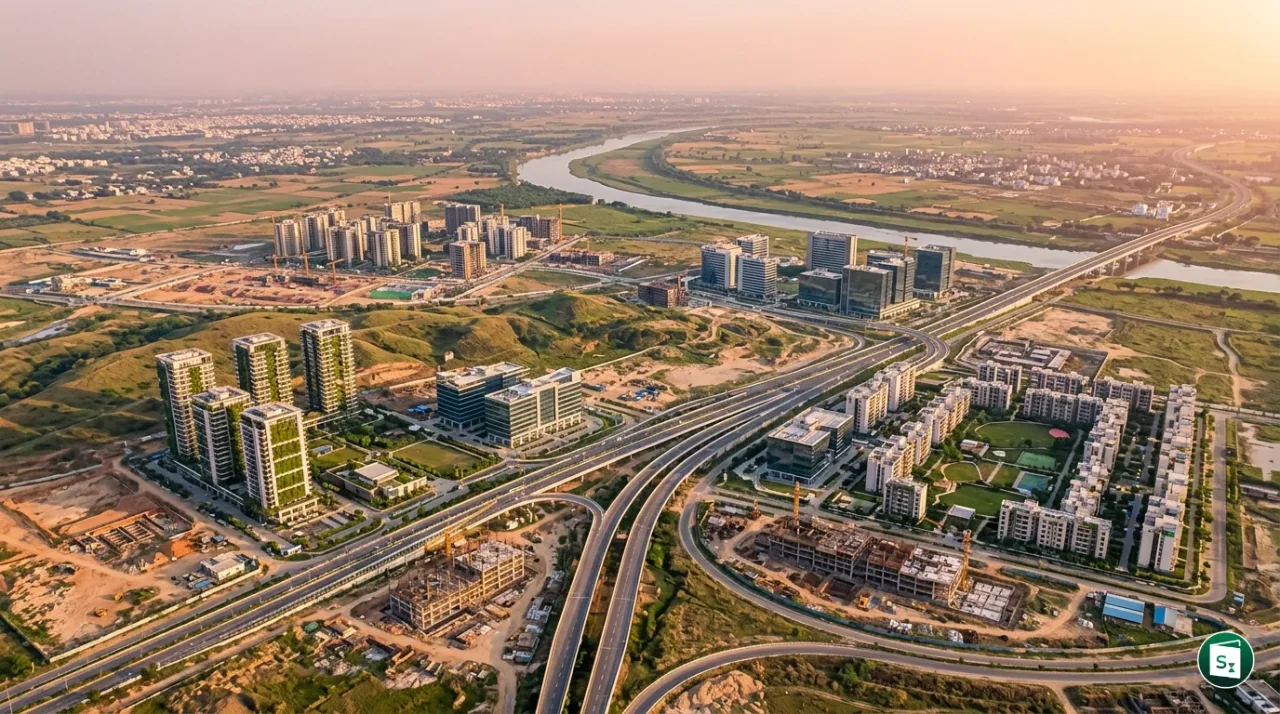
The National Capital Region Planning Board approved a proposal to develop four greenfield cities, branded as Namo Cities, across Delhi, Haryana, Uttar Pradesh, and Rajasthan. Chaired by Union Minister Manohar Lal Khattar, the project is sanctioned under the Regional Plan 2041 to address the rapidly growing population of the region. The central government has allocated 5,000 crore rupees to fund the initiative, which will be implemented over a five-year period.
What Are Namo Cities?
The planned Namo Cities, also referred to as Namo Nodes, represent a new urban development model designed to decentralize growth away from the heavily congested core of the national capital. These will be developed as greenfield cities, which refers to new urban centers built on previously undeveloped or agricultural land, rather than expanding existing towns. Under this initiative, one such city will be established in each of the four participating states and territories of the National Capital Region, which are Delhi, Haryana, Uttar Pradesh, and Rajasthan.
These cities will utilize a Transit-Oriented Development model, an urban planning approach that concentrates housing, commercial spaces, and public services within walking distance of high-capacity transport systems. This model encourages higher floor space index and promotes mixed-use land development, enabling residents to access work and amenities without relying heavily on private vehicles. By focusing on compact, walkable communities, the project aims to accommodate the massive influx of people expected in the region.
Strategic Integration with the RRTS Network
A crucial element of the new cities is their placement along the Regional Rapid Transit System corridors. Branded as Namo Bharat, this high-speed commuter rail network is designed and implemented by the National Capital Region Transport Corporation. The trains are designed to reach a top speed of 180 km/h and run at a maximum operational speed of 160 km/h, with an average speed of about 100 km/h. By building these new urban hubs along these corridors, the government aims to establish a seamless transit network that links the outer edges of the region to the center.
This integration directly supports the 30-Minute NCR concept, a key objective of the regional plan that aims to enable travel between major urban centers within half an hour. The development will leverage priority transit routes, including the fully operational Delhi-Ghaziabad-Meerut corridor, as well as the proposed Delhi-Gurugram-SNB-Alwar and Delhi-Panipat lines. Utilizing these high-speed links will ensure that the new cities are highly accessible, reducing the need for long road commutes and shifting passenger traffic to sustainable rail transit.
Role of the National Capital Region Planning Board
The National Capital Region Planning Board is the statutory body responsible for overseeing the balanced development of the region. Established under the National Capital Region Planning Board Act, 1985, the board operates under the Ministry of Housing and Urban Affairs and is headquartered in New Delhi. Its primary mandate is to coordinate urban planning, infrastructure creation, and land-use policies across state boundaries to prevent unplanned growth.
During its recent meeting, the board decided to retain the existing geographical boundaries of the region, rejecting proposals from participating states to exclude certain districts. Instead of reducing the region’s size, the board chose to address population pressures by focusing on high-density nodes. The board oversees the implementation of the regional development framework, ensuring that the development of the new greenfield projects aligns with inter-state transit corridors and environmental policies.
Funding and the Selection Mechanism
The development of the four greenfield cities is backed by a budget of 5,000 crore rupees allocated by the central government. This financial support will be distributed over a five-year period to assist the states in land acquisition, initial infrastructure setup, and transit integration. The funding is intended to act as seed capital to attract further public-private partnerships and private sector investments in real estate, commerce, and industrial zones within the cities.
To select the final locations for these cities, the board has introduced a challenge-based competitive process. Under this system, each of the four participating states and territories is required to submit three potential site proposals. The board will evaluate these proposals based on specific parameters, such as connectivity to the transit network, availability of encumbrance-free land, and environmental feasibility. The location that scores the highest in each state will be selected for development, ensuring transparency and optimal resource utilization.
The Broader Vision of Regional Plan 2041
The development of these greenfield cities is a major component of the Regional Plan 2041, which serves as a long-term strategic blueprint for the region. The plan is designed to accommodate the rapid urbanization of the region, where the population is projected to reach approximately 15 crore by the year 2041. By shifting from a single, Delhi-centric growth model to a multi-nodal urban economy, the plan aims to distribute economic activity and urban services more evenly across the participating states.
In addition to urban expansion, the plan emphasizes environmental sustainability and pollution control. It introduces concepts like green canopy credits to incentivize forest and tree cover, along with circular economy models for waste and water management. To finalize the plan, a dedicated sub-committee of senior officials has been formed to submit a final report by August 15, 2026. Following this submission, the plan will be forwarded to the Ministry of Housing and Urban Affairs for final approval and official notification.
Key Takeaways
- The National Capital Region Planning Board was established under the National Capital Region Planning Board Act, 1985, to coordinate development in the region.
- The board approved the development of four greenfield cities, branded as Namo Cities, across Delhi, Haryana, Uttar Pradesh, and Rajasthan.
- The project will receive 5,000 crore rupees from the central government over a five-year period for implementation.
- Locations for the new cities will be chosen using a challenge-based competitive process, with each participating state submitting three proposals.
- The cities will be built along high-speed corridors of the Regional Rapid Transit System, also known as Namo Bharat, to leverage Transit-Oriented Development.
- The Regional Plan 2041 aims to accommodate an expected population of 15 crore in the region through decentralized, multi-nodal growth.