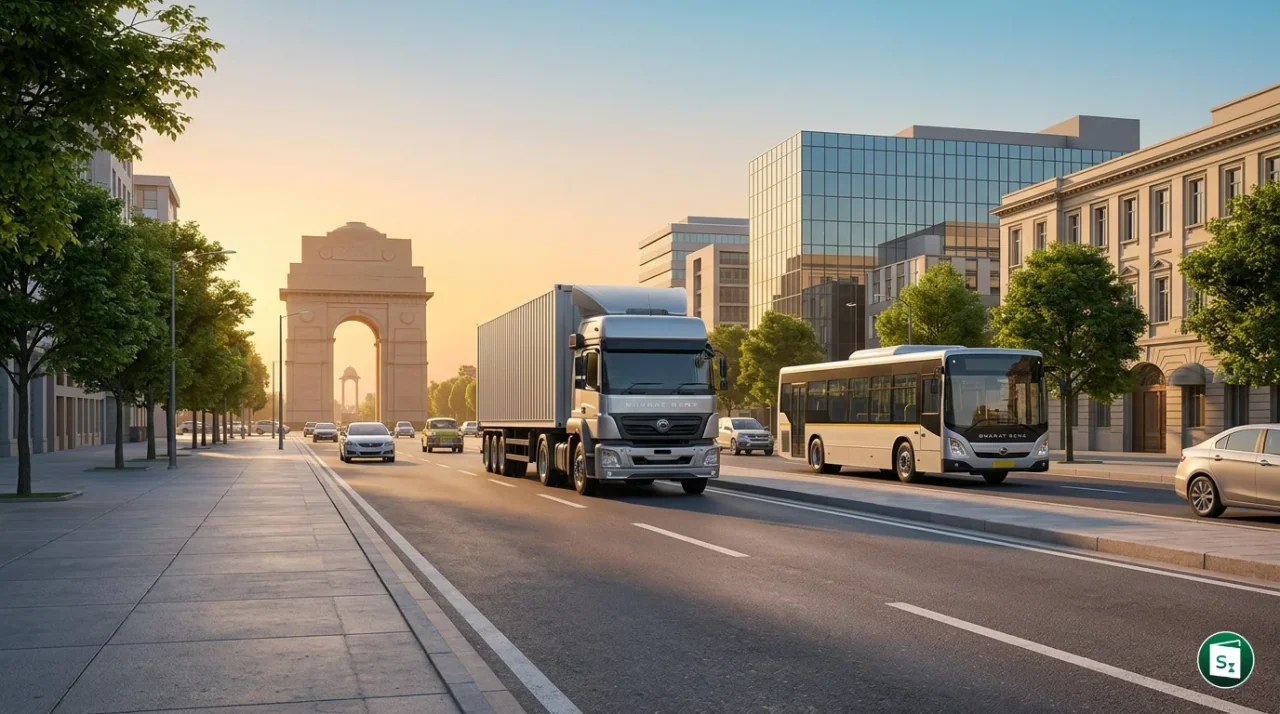
The Ministry of Road Transport and Highways (MoRTH) signed a Memorandum of Understanding with Daimler India Commercial Vehicles (DICV), the owner of the BharatBenz brand, to participate in the central government’s vehicle replacement scheme for the Delhi-NCR region. Under the agreement, DICV will offer an 8% discount on the ex-showroom price of eligible trucks and buses to owners replacing their old vehicles. DICV joins five other major commercial vehicle manufacturers that have already signed similar pacts, together covering about 85% of India’s truck and bus market.
Background: India’s Vehicle Scrappage Policy
The government’s push for commercial fleet modernisation is rooted in the Voluntary Vehicle-Fleet Modernisation Programme (V-VMP), commonly called the Vehicle Scrappage Policy. Announced by Finance Minister Nirmala Sitharaman in the Union Budget 2021-22 and formally launched by Prime Minister Narendra Modi in August 2021, the policy aims to phase out unfit and polluting vehicles from Indian roads.
Under the V-VMP, commercial vehicles must undergo automated fitness testing after 15 years from their initial registration, while private vehicles require testing after 20 years. Vehicles that fail the fitness test are classified as End-of-Life Vehicles and must be scrapped at Registered Vehicle Scrapping Facilities (RVSFs). The policy is implemented through a network of RVSFs and Automated Testing Stations (ATSs) set up across the country.
The policy serves three broad objectives: improving road safety by removing unfit vehicles, reducing air pollution from ageing engines, and creating a circular economy by recycling scrap metal and other materials from end-of-life vehicles. The government estimated that the policy would cover over 1 crore vehicles and attract investments of around ₹10,000 crore, generating about 50,000 jobs.
The Delhi-NCR Clean Mobility Scheme
Building on the national scrappage framework, the Union Cabinet approved a dedicated ₹9,585-crore scheme on 3 June 2026 specifically targeting old trucks and buses in the Delhi-NCR region. The scheme is funded through the National Capital Region Planning Board (NCRPB), a statutory body constituted in 1985 under the NCRPB Act, 1985, functioning under the Ministry of Housing and Urban Affairs (MoHUA). Implementation is jointly handled by MoRTH and the Ministry of Petroleum and Natural Gas (MoPNG). The two-year programme is designed to tackle the acute air pollution problem in the region, where the transport sector is a major contributor to particulate matter and nitrogen oxide emissions.
Scheme Coverage and Targets
The scheme aims to replace approximately 2.07 lakh commercial vehicles registered in Delhi-NCR. This includes 1.91 lakh trucks and 16,329 buses that currently operate under BS-IV or earlier emission norms. The programme covers vehicles registered across Delhi and the NCR districts of Haryana, Rajasthan, and Uttar Pradesh.
| Category | Number of Vehicles |
|---|---|
| Trucks | 1.91 lakh |
| Buses | 16,329 |
| Total | 2.07 lakh |
Replacement and Scrappage Rules
The scheme sets clear rules for vehicle disposal and replacement. BS-III and older vehicles must be mandatorily scrapped at authorised Registered Vehicle Scrapping Facilities (RVSFs). BS-IV vehicles have two options: they can be scrapped at an RVSF or sold and transferred outside the NCR to areas not covered under the National Clean Air Programme (NCAP).
All replacement vehicles must be BS-VI compliant or electric and must be registered within the NCR region. In Delhi, stricter rules apply: light goods vehicles purchased under the scheme must be electric, while buses must run on BS-VI CNG technology or be fully electric. Government-owned vehicles are excluded from the scheme’s benefits.
DICV Signs MoU with MoRTH
Daimler India Commercial Vehicles (DICV) signed the MoU with MoRTH in June 2026, becoming the sixth major commercial vehicle manufacturer to join the scheme. DICV is a 100% subsidiary of the German Daimler Truck AG and manufactures trucks and buses under the BharatBenz brand. The company’s manufacturing plant is located at Oragadam, near Chennai, Tamil Nadu, and its corporate headquarters is in Chennai.
The brand was launched in India in February 2011 and rolled out its first truck in September 2012. BharatBenz offers a range of trucks from 9 to 55 tonnes and has sold over 1.25 lakh vehicles domestically since its entry into the Indian market.
Terms of the MoU
Under the agreement, DICV will provide an 8% discount on the ex-showroom price of eligible BharatBenz trucks and buses purchased by beneficiaries of the vehicle replacement scheme. For electric vehicles, the discount will be capped at the level applicable to an Internal Combustion Engine (ICE) vehicle of the equivalent Gross Vehicle Weight (GVW) category.
The other OEMs that signed MoUs earlier include Ashok Leyland, Switch Mobility, Tata Motors, Mahindra and Mahindra, and SML Mahindra. Together with DICV, these manufacturers control approximately 85% of the Indian truck and bus market, ensuring broad coverage for the scheme’s implementation.
Incentive Structure for Vehicle Owners
The scheme offers a multi-layered incentive package combining central government support, state-level tax benefits, and manufacturer discounts. This layered approach is designed to make fleet modernisation financially viable for truck and bus operators.
Central Government Benefits
The central government has allocated ₹5,041 crore for direct incentives under the scheme. Beneficiaries will receive a 5% interest subvention on commercial vehicle loans for five years. They will also get fixed monthly fuel vouchers of up to ₹4,800, depending on vehicle category, for the same period.
Additional lump-sum incentives are available for electric vehicle purchases. Owners can also benefit from trading Certificates of Deposit (CoD) generated under the vehicle scrappage framework.
Central government benefits will continue for five years from the date of registration of the replacement vehicle, providing sustained support beyond the scheme’s two-year enrolment window.
State Government Benefits
Participating states Delhi, Haryana, Rajasthan, and Uttar Pradesh will provide tax concessions worth an estimated ₹1,601 crore. These include:
| Benefit | Details |
|---|---|
| Registration fee | Full waiver |
| Motor vehicle tax | Up to 100% concession for new vehicles |
| Motor vehicle tax (used) | 50% concession for certified used replacements |
| Pending liabilities | Full waiver on old vehicles enrolled in the scheme |
OEM Discounts
In addition to government incentives, participating manufacturers like DICV offer an 8% discount on the ex-showroom price. The OEM discount is in addition to the scrap value that owners receive from RVSFs for their old vehicles, which is typically 4% to 6% of the new vehicle’s ex-showroom price.
Significance and Expected Impact
Delhi-NCR suffers from some of the worst air pollution levels in the world, and the transport sector is a major source. According to estimates, a single 15-year-old legacy commercial vehicle emits 11 times higher particulate matter (PM) and 6 times higher nitrogen oxide (NOx) than a modern BS-VI compliant diesel vehicle. An old BS-I heavy-duty truck can emit up to 35 times more PM than a new BS-VI vehicle.
The scheme’s impact on air quality is expected to be substantial. By targeting 2.07 lakh of the most polluting commercial vehicles, the programme directly addresses the oldest and dirtiest portion of the region’s fleet. The transition from BS-IV to BS-VI technology brings with it advanced emission control systems such as Diesel Particulate Filters (DPF) and Selective Catalytic Reduction (SCR), which are absent in older vehicles.
The scheme also supports India’s broader climate commitments. The Bureau of Energy Efficiency (BEE) under the Ministry of Power is simultaneously rolling out the Carbon Credit Trading Scheme (CCTS) for industrial sectors. Cleaner commercial vehicles contribute to the overall reduction in the country’s emission intensity, in line with India’s Nationally Determined Contributions (NDCs) under the Paris Agreement.
Logistics Cost Reduction
Union Minister for Road Transport and Highways Nitin Gadkari has projected that India’s logistics cost, currently estimated at 13% to 14% of GDP, could drop to 9% with continued road infrastructure development and fleet modernisation. Replacing old, inefficient trucks with modern BS-VI vehicles improves fuel efficiency and reduces maintenance downtime, directly benefiting the logistics sector.
Digital Implementation
The scheme will be implemented through a fully digital integrated portal that enables real-time eligibility verification, automated interest subvention claims, monthly fuel voucher credits, and monitoring of pollution reduction outcomes. An Empowered Committee chaired by the Cabinet Secretary will oversee the scheme, while District Collectors and District Magistrates will handle local implementation.
Key Takeaways
- Daimler India Commercial Vehicles (DICV), owner of the BharatBenz brand, signed an MoU with MoRTH in June 2026 to join the Delhi-NCR vehicle replacement scheme.
- DICV will offer an 8% discount on the ex-showroom price of eligible trucks and buses under the scheme.
- The ₹9,585-crore Delhi-NCR Clean Mobility Scheme was approved by the Union Cabinet on 3 June 2026 to replace 2.07 lakh old commercial vehicles.
- The scheme covers 1.91 lakh trucks and 16,329 buses registered in Delhi-NCR that comply with BS-IV or earlier emission norms.
- The central government provides 5% interest subvention on loans and monthly fuel vouchers up to ₹4,800 for five years, while states offer up to 100% motor vehicle tax concession for ten years.
- Participating OEMs including Tata Motors, Ashok Leyland, Mahindra, Switch Mobility, SML Mahindra, and now DICV together control 85% of India’s truck and bus market.
- An old commercial vehicle can emit 11 times more PM and 6 times more NOx than a modern BS-VI compliant vehicle.