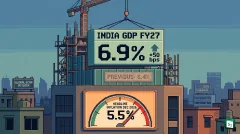
S&P Global Ratings revised India’s real GDP growth forecast for the financial year 2026-27 to 6.6% , down from the 7.7% expansion recorded in FY26. In its latest “Economic Outlook Asia-Pacific Q3 2026” report, the ratings agency also projected India’s Consumer Price Index (CPI) inflation to rise to 5.1% in the current fiscal, driven by higher energy costs, a sub-par monsoon, and slowing global growth. The revision aligns with the Reserve Bank of India’s own growth estimate of 6.6% for FY27, signalling a broad consensus among forecasters about the economic headwinds ahead.
What the S&P Report Says
S&P Global Ratings is one of the world’s three leading credit rating agencies, alongside Moody’s and Fitch. Founded in 1860 and headquartered in New York City, the agency provides independent credit ratings, research, and economic analysis on sovereign nations, corporations, and financial instruments. Its Asia-Pacific quarterly outlook is closely tracked by policymakers and investors for its assessment of regional economic trends.
The report, titled “Economic Outlook Asia-Pacific Q3 2026: AI-Exposed Markets to Outperform”, presents a mixed picture for the region. For India, S&P has pared its growth projection from earlier estimates, bringing it in line with the RBI’s revised forecast announced during the June 2026 monetary policy review. The agency noted that India’s economy grew 7.7% in FY26 and 7.1% in FY25, but the momentum is expected to moderate this year.
On inflation, S&P said consumer prices would be 0.5 to 0.6 percentage points higher in the third quarter alone, as manufacturers pass on rising energy costs to consumers. Recent increases in administered prices of petrol, diesel, and cooking gas have already begun feeding into the inflation trajectory.
Why Growth Is Expected to Slow
S&P has identified three primary factors driving the moderation in India’s growth.
Energy Stress from the West Asia Conflict
The most significant headwind is the sharp rise in energy costs resulting from the ongoing conflict in West Asia. India imports 88% of its crude oil requirements, making it highly vulnerable to global price spikes. The S&P report noted that the impact of energy stress is already visible across the industrial sector, with companies facing a substantial rise in input costs and longer supplier delivery times. Higher fertiliser prices are adding to the strain, raising input costs for farmers and potentially affecting food production.
Sub-Par Monsoon and El Nino Impact
Weather conditions have emerged as another major concern. The impact of El Nino has weakened the southwest monsoon, with the rainfall deficit widening to 43% as of June 22. A deficient monsoon directly affects kharif crop output, rural incomes, and food inflation. The government has drawn up state-wise contingency plans recommending alternative crops suited to deficient rainfall conditions, but the broader economic impact remains a worry.
Slowing Global Growth
Weaker external demand, driven by global economic uncertainty and trade disruptions, is expected to weigh on India’s export performance. While India’s domestic demand has been resilient, the slowdown in major trading partners and disruptions to key trade routes are creating headwinds for the external sector.
Inflation and Monetary Policy Implications
S&P has projected CPI inflation at 5.1% for FY27, a sharp rise from the unusually low levels seen last year. India’s retail inflation had fallen to multi-year lows during FY26, touching 0.25% in October 2025, driven by a sharp correction in food prices. However, the situation has reversed since the West Asia conflict pushed crude oil prices higher.
The agency expects that rising input costs will be passed on to consumers, keeping price pressures elevated. Higher fertiliser prices are also expected to weigh on food production and push up food prices further.
| Indicator | FY25 (Actual) | FY26 (Actual) | FY27 (S&P Projection) |
|---|---|---|---|
| Real GDP Growth | 7.1% | 7.7% | 6.6% |
| CPI Inflation | Varied | ~2% (low) | 5.1% |
Given the inflation outlook, S&P has flagged the likelihood of a policy rate hike in the second half of FY27. This would mark a reversal from the easing cycle that saw the RBI cut the repo rate by a cumulative 125 basis points from 6.5% to 5.25% since February 2025. In its June 2026 monetary policy review, the RBI kept the repo rate unchanged at 5.25% with a neutral stance, while revising its own FY27 CPI inflation forecast to 5.1% from its earlier estimate of 4.6%.
The RBI has also taken steps to attract foreign capital amid a widening current account deficit and rupee depreciation pressures. These measures include easier investment norms for foreign investors and expanded access to government securities, aimed at supporting the domestic currency.
Asia-Pacific Outlook
The broader Asia-Pacific region presents a contrasting picture. S&P noted that the region’s outlook is shaped by three forces: resilient global activity, energy market stress, and an AI-driven technology export boom.
Economies with strong exposure to artificial intelligence-related exports, including Taiwan, South Korea, Vietnam, Singapore, Malaysia, Thailand, Japan, and mainland China, are expected to benefit from the ongoing tech export cycle. For comparison, S&P projects China’s GDP growth at 4.3% in 2025 and 4.0% in 2026, highlighting India’s continued position as the fastest-growing major economy despite the moderation.
However, the agency warned that elevated energy prices remain a common challenge across the region, particularly for economies dependent on energy imports from West Asia. While governments have limited the pass-through of higher global fuel prices, rising production costs continue to add to inflationary pressures across the region.
Key Takeaways
- S&P Global Ratings revised India’s FY27 real GDP growth forecast to 6.6% , down from the 7.7% recorded in FY26.
- The agency projected India’s CPI inflation to rise to 5.1% in FY27, driven by higher energy costs and administered fuel price increases.
- S&P expects the RBI to raise policy rates in the second half of FY27 in response to inflationary pressures.
- Three factors driving the slowdown are: energy stress from the West Asia conflict, a sub-par monsoon with a 43% rainfall deficit, and slowing global growth.
- India imports 88% of its crude oil requirements, making the economy acutely vulnerable to global energy price shocks.
- S&P Global Ratings, founded in 1860 and headquartered in New York, is one of the world’s three major credit rating agencies.