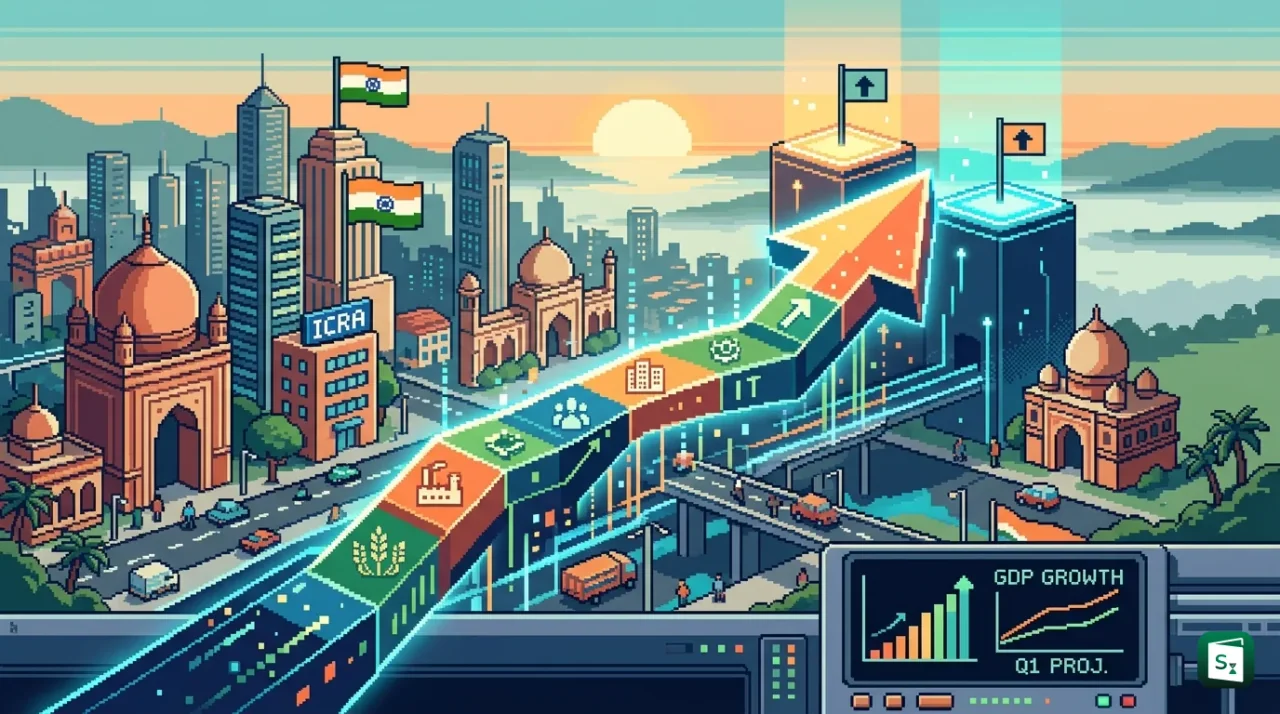
ICRA Ltd has projected India’s real GDP growth for the first quarter of financial year 2026-27 (Q1 FY27) at 6.4-6.6%, down from 7.7% recorded in the preceding quarter. The projection comes from the rating agency’s Business Activity Monitor (BAM), which showed economic activity hitting a 32-month high in June 2026. The moderation in GDP growth reflects the impact of rising energy prices and elevated input costs on corporate profitability across sectors.
What the ICRA Report Says
ICRA’s Business Activity Monitor (BAM), a composite index of 16 high-frequency indicators, grew 12% year-on-year in June 2026, up from 9.4% in May. This was the strongest expansion in nearly three years, driven by broad-based gains across most indicators. Thirteen of the 16 constituent indicators registered faster growth during the month.
The strongest contributors came from the automobile sector. Passenger vehicle output rose 17.6% year-on-year, two-wheeler production surged 28.1%, and vehicle registrations increased 23.2%. Non-oil merchandise exports grew 16.5%, GST e-way bill generation expanded 14.5%, mining output rose 7.7%, and port cargo traffic increased 9.4%. Petrol and diesel consumption grew 7.5% and 6.2% respectively, while bank deposits and non-food credit continued their healthy expansion.
Despite this strong activity data, ICRA maintained that GDP growth in Q1 FY27 would moderate. The agency attributed this divergence to rising input costs, which are expected to compress corporate margins and weigh on Gross Value Added (GVA) across sectors. GVA measures the value of goods and services produced in an economy and is closely linked to corporate profitability.
ICRA’s chief economist Aditi Nayar noted that the duration and intensity of the renewed conflict in West Asia and its implications for crude oil prices remain key risks to India’s macroeconomic outlook. She flagged downside risks to ICRA’s full-year GDP growth forecast of 6.7% for FY27.
Among indicators that softened in June, domestic airline passenger traffic contracted 1% year-on-year after growing 9.5% in May. Finished steel consumption growth eased to 7.8% from 9.7%, while electricity generation growth slowed marginally to 9.8%. The all-India unemployment rate remained elevated at 5.5%, with urban unemployment edging up to 6.6%.
ICRA Limited: A Profile
ICRA Limited is one of India’s leading credit rating agencies. It was established in 1991 and was originally known as the Investment Information and Credit Rating Agency of India Limited (IICRA India). The company was promoted by leading financial institutions, commercial banks, and financial services companies.
ICRA is an affiliate of Moody’s Corporation, one of the Big Three credit rating agencies globally. As of December 2024, Moody’s held a 51.86% majority stake in ICRA. The company is headquartered in Gurgaon, Haryana, and is listed on both the Bombay Stock Exchange (BSE) and the National Stock Exchange (NSE).
ICRA is registered with the Securities and Exchange Board of India (SEBI) as a credit rating agency. It is one of seven SEBI-registered credit rating agencies in India, which include CRISIL, CARE Ratings, India Ratings and Research, Brickwork Ratings, SMERA, and Infomerics Valuation. Beyond credit ratings, ICRA provides industry research, financial consulting, and economic analysis through its research division. The company’s industry research covers more than 60 sectors and is powered by over 250 analysts. Aditi Nayar serves as its Chief Economist and Head of Research and Outreach.
India’s GDP Growth Trajectory
India’s economy has been one of the fastest-growing major economies in the world in recent years. The country recorded real GDP growth of 7.1% in FY24 and 7.7% in FY25-26, according to provisional estimates released by the Ministry of Statistics and Programme Implementation (MoSPI). The fourth quarter of FY26 grew at 7.8%, comfortably surpassing expectations despite global headwinds from the West Asia crisis.
The services sector continues to be the largest contributor to India’s GDP, accounting for approximately 55% of economic output. Industry contributes roughly 30%, while agriculture and allied activities make up about 15%. This structural composition means that India’s growth trajectory is heavily influenced by services activity, domestic consumption, and private investment.
The International Monetary Fund (IMF), in its July 2026 World Economic Outlook Update, projected India’s GDP growth at 6.4% for FY27 and 6.7% for FY28, reaffirming India’s status as the fastest-growing major economy. The OECD, in its June 2026 Economic Outlook, projected India’s FY27 growth at 6.3%, with FY28 at 6.4%, citing the impact of energy price shocks. The Reserve Bank of India (RBI) has maintained its repo rate at 5.25% with a neutral stance, balancing the need to support growth while keeping inflation within its target band of 4% ± 2%.
Why Growth Is Expected to Moderate
Energy Prices and the West Asia Factor
The most significant headwind to India’s growth outlook comes from the volatile energy landscape in West Asia. India is heavily dependent on imports for its energy needs, with crude oil accounting for nearly 46% of total imports in 2024. The US-Iran conflict and associated disruptions have pushed crude prices sharply higher in recent months, raising India’s import bill and worsening the current account deficit.
ICRA’s June data reflected this volatility. The temporary ceasefire between the US and Iran contributed to the strong activity seen in June. However, with the renewal of hostilities, downside risks have re-emerged. Higher crude oil prices increase production costs across manufacturing, transport, and power generation sectors. They also add to inflationary pressures, reducing households’ real purchasing power and dampening private consumption.
Corporate Margin Pressures
ICRA’s central argument for the moderation lies in corporate profit margins. While high-frequency indicators like automobile sales and GST e-way bills reflect strong demand-side activity, the supply side tells a different story. Higher input costs, particularly for energy, chemicals, and metals, are squeezing operating margins across manufacturing and services sectors.
Gross Value Added, which is calculated by subtracting input costs from output value, is expected to grow slower than gross output. This margin compression directly feeds into GDP growth because corporate profits are a component of national income. ICRA noted that weak margins would compress GDP growth despite strong volume-driven activity indicators.
Monsoon and Agricultural Uncertainty
A delayed and deficient monsoon has added another layer of risk. June 2026 recorded a 40% rainfall deficit, which prolonged construction and mining activity but raised concerns for kharif sowing. As of July 17, the area sown under kharif crops was 658.19 lakh hectares, 6.04% lower than the 700.47 lakh hectares recorded a year earlier.
A weak monsoon affects the Indian economy through multiple channels. Lower agricultural output reduces rural incomes, which in turn dampens demand for consumer goods, tractors, and two-wheelers in rural markets. It also puts upward pressure on food prices, which account for a significant weight in the Consumer Price Index (CPI). ICRA cautioned that the distribution of monsoon rainfall during the remainder of July and August would be crucial for agricultural output and containing food inflation.
The Broader Economic Picture
India’s macroeconomic landscape is facing a multi-front challenge. Headline inflation has picked up since early 2026, driven primarily by food prices and imported energy costs. The rupee depreciated roughly 7% against the US dollar since the beginning of 2026, adding to imported inflation by raising the cost of fuel, fertilisers, and other tradable goods.
The RBI responded by projecting a temporary increase in the policy rate of around 25 basis points by the end of the first quarter of FY27 to help maintain inflation within the target band. This tightening could further moderate credit growth and investment activity in the near term.
On the fiscal front, the government has taken steps to cushion the impact of energy price shocks. Reductions in excise duties on petrol and diesel, removal of import duties on selected petrochemical inputs, and export levies on refined products have helped contain the pass-through from international prices to domestic inflation. However, these measures have fiscal costs. The FY27 budget had targeted a fiscal deficit of 4.3% of GDP, but energy support measures are expected to widen the deficit by around 0.4% of GDP relative to the budgeted path.
A notable bright spot has been the reduction in US import tariffs, which lowered the average effective tariff rate on India by 23 percentage points, providing some relief to exporting sectors. Non-oil merchandise exports grew 16.5% in June, reflecting this benefit.
The Way Forward
India’s growth outlook remains resilient by global standards, but the near-term path is clouded by uncertainties. The trajectory of crude oil prices, dependent on geopolitical developments in West Asia, will be the single most important external variable shaping macroeconomic outcomes in the coming months.
Domestically, the progress of the monsoon and its impact on agricultural output and rural demand will be critical. Early indicators for July present a mixed picture, with electricity demand expanding 12.2% year-on-year (driven by higher temperatures and deficient rainfall) while vehicle registrations slowed to about 5%, considerably lower than June’s pace of over 23%.
The OECD has noted that streamlining regulations, expanding single-window clearance systems, and accelerating renewable energy deployment would strengthen India’s energy security and reduce vulnerability to global oil price shocks. Expanding solar and wind capacity, strengthening grid infrastructure, and increasing battery storage would not only lower carbon emissions but also reduce India’s dependence on imported energy.
ICRA has flagged downside risks to its full-year FY27 GDP growth forecast of 6.7%. If energy disruptions persist and monsoon performance remains below normal, growth could come in lower than current projections. Conversely, a durable de-escalation in West Asia and a strong revival of monsoon rains could improve both corporate margins and rural demand, supporting faster growth in the remaining quarters of FY27.
Key Takeaways
- ICRA Ltd has projected India’s Q1 FY27 real GDP growth at 6.4-6.6%, down from 7.7% in Q4 FY26.
- ICRA’s Business Activity Monitor (BAM) hit a 32-month high in June 2026, with 12% year-on-year growth driven by broad-based gains across high-frequency indicators.
- The moderation in GDP growth is attributed to compressed corporate margins from higher energy and input costs, despite strong volume-driven activity.
- ICRA Limited was established in 1991 (originally IICRA India), is headquartered in Gurgaon, and is an affiliate of Moody’s Corporation.
- India’s full FY26 GDP growth was 7.7%, with the IMF projecting 6.4% and the OECD projecting 6.3% for FY27.
- The repo rate stands at 5.25%, with the RBI expected to raise it by 25 basis points to contain inflationary pressures from energy costs and rupee depreciation.