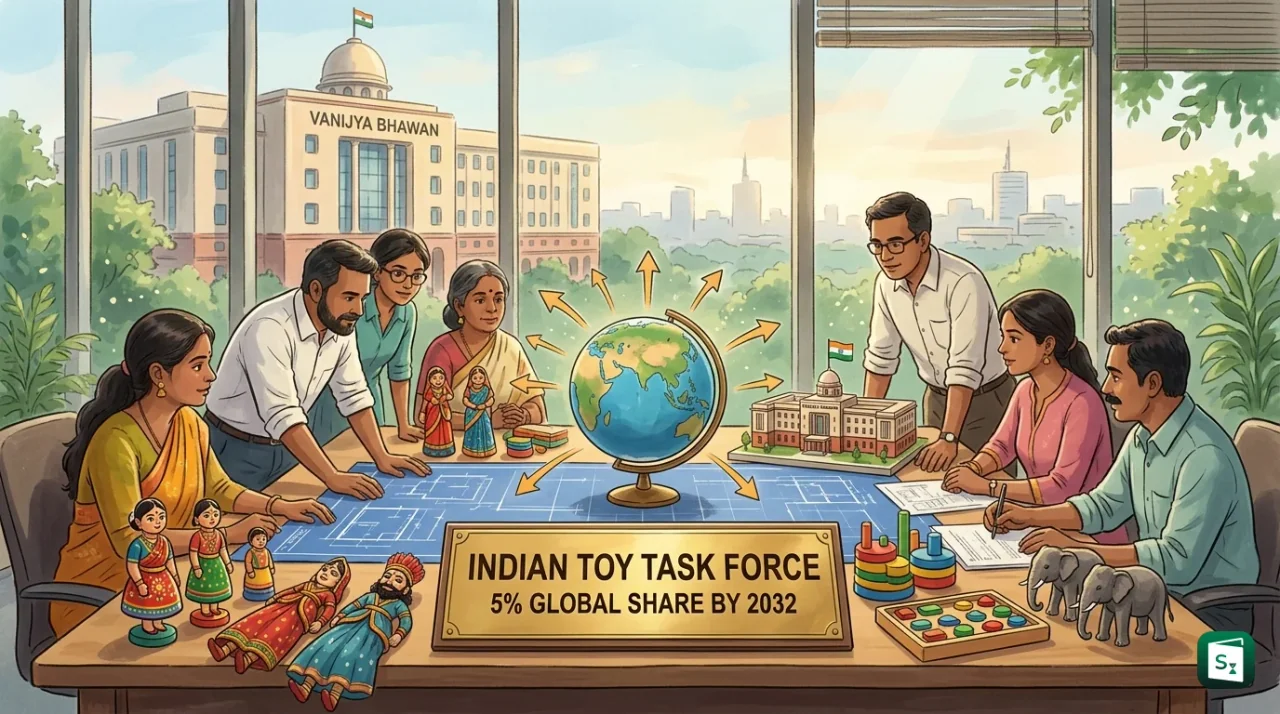
Commerce and Industry Minister Piyush Goyal announced the formation of a dedicated task force for the toy sector during the “Team Up for Toys: Driving SCALE, Innovation and Exports” stakeholder meet organised by the Department for Promotion of Industry and Internal Trade (DPIIT) in New Delhi. The task force will work towards raising India’s share in the global toy market from the current 1.9% to 5% by 2032. The announcement comes at a time when India’s toy exports have grown by over 151% in eight years, and the country has flipped a trade deficit of $213 million into a trade surplus of $152 million.
India’s Current Position in the Global Toy Market
India’s toy ecosystem today comprises more than 21,000 MSMEs, over 770 DPIIT-recognised toy startups, nearly 50 toy clusters, and more than 1,800 BIS licence holders. The domestic toy market was valued at approximately $2.09 billion in 2025 and is projected to reach $4.74 billion by 2034, growing at a compound annual growth rate of 9.53%.
On the export front, India shipped toys worth $384.7 million in 2025-26, up from $152.7 million in 2017-18. The strongest growth came from electronic and non-electronic toys (HSN 9503), where exports rose nearly 160% from $77.35 million to $200.89 million. The United States remained the largest buyer, with shipments rising more than fourfold from $26.7 million to $111.9 million. Other major destinations included the United Kingdom, Poland, the Netherlands, and Germany.
Traditional and educational toy imports declined by 66% during this period, reflecting the success of domestic manufacturing capacity building. This shift has been driven by a combination of quality control measures, tariff revisions, and targeted policy interventions.
Six Objectives of the New Task Force
The task force will pursue six clearly defined objectives to accelerate the sector’s growth:
| Objective | Focus Area |
|---|---|
| Global Value Chain Integration | Connecting Indian manufacturers with international buyers and supply chains |
| Strengthening Manufacturing Capabilities | Scaling production capacity and technology adoption across the ecosystem |
| Resolving Value Chain Bottlenecks | Addressing raw material availability, logistics, and infrastructure gaps |
| Skilled Workforce and Employment | Building a talent pipeline through training and skill development programmes |
| Design and Innovation | Promoting product design, R&D, and intellectual property creation |
| Ease of Doing Business | Simplifying regulatory compliance and reducing transaction costs |
At the same event, Piyush Goyal also launched the Toy Sector Playbook, a comprehensive roadmap designed for manufacturers, startups, MSMEs, investors, and entrepreneurs. The playbook provides actionable guidance on manufacturing ecosystems, value chains, quality standards, skills development, intellectual property protection, export strategies, and emerging market opportunities.
The minister called upon industry stakeholders to build a complete domestic manufacturing ecosystem supported by advanced technologies, globally competitive quality standards, deep localisation, and stronger branding. He emphasised that India must move beyond being a contract manufacturer and develop its own toy brands with distinctive Indian identity.
How India Reversed Its Toy Trade Deficit
The turnaround in India’s toy trade has been remarkable. In 2017-18, India recorded a trade deficit of $213 million in the toy category, with imports far exceeding exports. By 2025-26, this had reversed into a trade surplus of $152 million.
| Indicator | 2017-18 | 2025-26 | Change |
|---|---|---|---|
| Total Toy Exports | $152.7 million | $384.7 million | +151.9% |
| Electronic & Non-Electronic Toys (HSN 9503) | $77.35 million | $200.89 million | +159.7% |
| Video Game Consoles (HSN 9504) | $15.68 million | $46.75 million | +198.2% |
| Festive & Entertainment Articles (HSN 9505) | $59.69 million | $137.03 million | +129.6% |
| Trade Balance | -$213 million (deficit) | +$152 million (surplus) | +$365 million swing |
Exports of video game consoles and related products nearly tripled, with the UAE, Russia, France, and the UK emerging as key buyers. Festive and carnival articles saw strong demand from the US, Germany, the UK, the Netherlands, and Sweden. These figures point to India’s growing presence not just in traditional toys but across the full spectrum of recreational and entertainment products.
The Policy Framework Behind the Transformation
The government has built a multi-layered policy framework over the past six years to support the toy sector. These measures have laid the groundwork for the ambitious 5% global market share target.
National Action Plan for Toys (2020)
The National Action Plan for Toys (NAPT), launched in 2020, is the overarching policy framework guiding the sector’s transformation. It aims to promote toy design based on Indian values, culture, and history while encouraging the use of toys as a learning resource. The plan focuses on monitoring toy quality, restricting imports of sub-standard products, promoting indigenous toy clusters, and incentivising local manufacturers.
NAPT also aligns with the One District, One Product (ODOP) initiative, under which several traditional toy products have been identified for branding and market access support. Traditional Indian toys with Geographical Indication (GI) tags, such as Channapatna toys (Karnataka), Leather Toys of Indore (Madhya Pradesh), and Thanjavur Dolls (Tamil Nadu), have benefited from legal protection and enhanced market visibility.
Quality Control and Tariff Measures
A key pillar of the policy framework is the Quality Control Order (QCO) for Toys, implemented in 2020. It made Bureau of Indian Standards (BIS) certification compulsory for both domestic and foreign manufacturers, mandating compliance with Indian safety standards (IS 9873 / IS 15644). Between 2019 and 2026, imports of unsafe, low-quality toys declined by 71%. As of May 2026, BIS has granted 1,786 licenses to domestic manufacturers and 56 licenses to foreign manufacturers.
On the tariff side, the Most-Favoured Nation (MFN) duty on toys was raised from 20% to 60% in 2020, and further to 70% in 2023. This reduced the price advantage of imported toys and encouraged domestic investment. The GST on toys was also reduced from 12% to 5%, making toys more affordable and stimulating domestic demand.
Artisans registered with the Development Commissioner (Handicrafts), Ministry of Textiles, and GI tag holders are exempted from the QCO, protecting traditional craftspeople from compliance burdens.
Toycathon and Innovation Support
The government launched Toycathon in 2021 to encourage collaborative development of innovative toys by students, teachers, designers, and startups. In 2025, the first Electronic Toy Hackathon (e-Toycathon) was organised to strengthen the electronic toy segment. An e-Toys Lab has been established by the Ministry of Electronics and IT (MeitY) at C-DAC, Noida, providing hands-on training in designing and developing electronic toys, with a structured one-year programme combining research and industry training.
Global Market Opportunity and India’s Target
The global toy market presents a massive opportunity. Valued at approximately $316 billion in 2024, it is projected to reach $445 billion by 2032, growing at a CAGR of roughly 4.3%. Against this backdrop, India’s current 1.9% share translates to about $6 billion in value. Achieving a 5% share by 2032 would mean capturing roughly $22 billion in global toy trade.
| Metric | Current (2025-26) | Target (2032) |
|---|---|---|
| India’s Global Toy Market Share | 1.9% | 5% |
| India’s Toy Exports | $384.7 million | Projected ~$2.2 billion (estimate) |
| Domestic Toy Market Value | ~$2.09 billion | ~$4.74 billion (by 2034) |
China currently dominates the global toy market, accounting for roughly 70% of global toy exports. However, rising labour costs in China and the global push for supply chain diversification have opened a window for countries like India. The government’s strategy leverages this shift by combining quality compliance, tariff protection, and export promotion to position India as a viable alternative manufacturing destination.
India has also signed several Free Trade Agreements (FTAs) that provide zero-duty market access for Indian toys. These include the India-UAE CEPA, India-Australia ECTA, India-EFTA TEPA, and agreements with Oman, New Zealand, and the UK. These trade pacts give Indian toy exporters a competitive edge in partner markets.
The Way Forward
The task force is expected to submit its recommendations within a defined timeframe, detailing specific interventions across manufacturing, design, skilling, and trade facilitation. The focus will be on moving Indian toys up the value chain from simple assembly and contract manufacturing to branded, design-led production.
Key areas that will require sustained attention include strengthening the 53 toy clusters identified across the country, expanding the BIS licensing network to cover more MSMEs, deepening integration with global retail chains, and building a robust intellectual property ecosystem for toy designs. The employment potential is significant. Employment in games and toys (NIC Code 324) more than doubled from 8,685 in 2018-19 to 17,693 in 2023-24, and this number is expected to grow further as the sector scales up.
The success of the 5% target will depend on how effectively the task force can coordinate across multiple ministries, including Commerce and Industry, MSME, Electronics and IT, and Textiles, as well as state governments where toy clusters are located.
Key Takeaways
- The task force aims to raise India’s share in the global toy market from 1.9% to 5% by 2032.
- India’s toy exports grew 151.9% from $152.7 million (2017-18) to $384.7 million (2025-26).
- India recorded a trade surplus of $152 million in toys in 2025-26, reversing a $213 million deficit in 2017-18.
- The National Action Plan for Toys (NAPT) was launched in 2020, and the QCO for Toys made BIS certification compulsory for safety compliance.
- The MFN duty on toys was raised to 70% in 2023, and GST was reduced from 12% to 5%.
- India has more than 21,000 toy MSMEs, 770 DPIIT-recognised toy startups, 50 toy clusters, and 1,800+ BIS licensees.
- Toycathon (launched 2021) and e-Toys Lab at C-DAC, Noida are driving innovation in the sector.