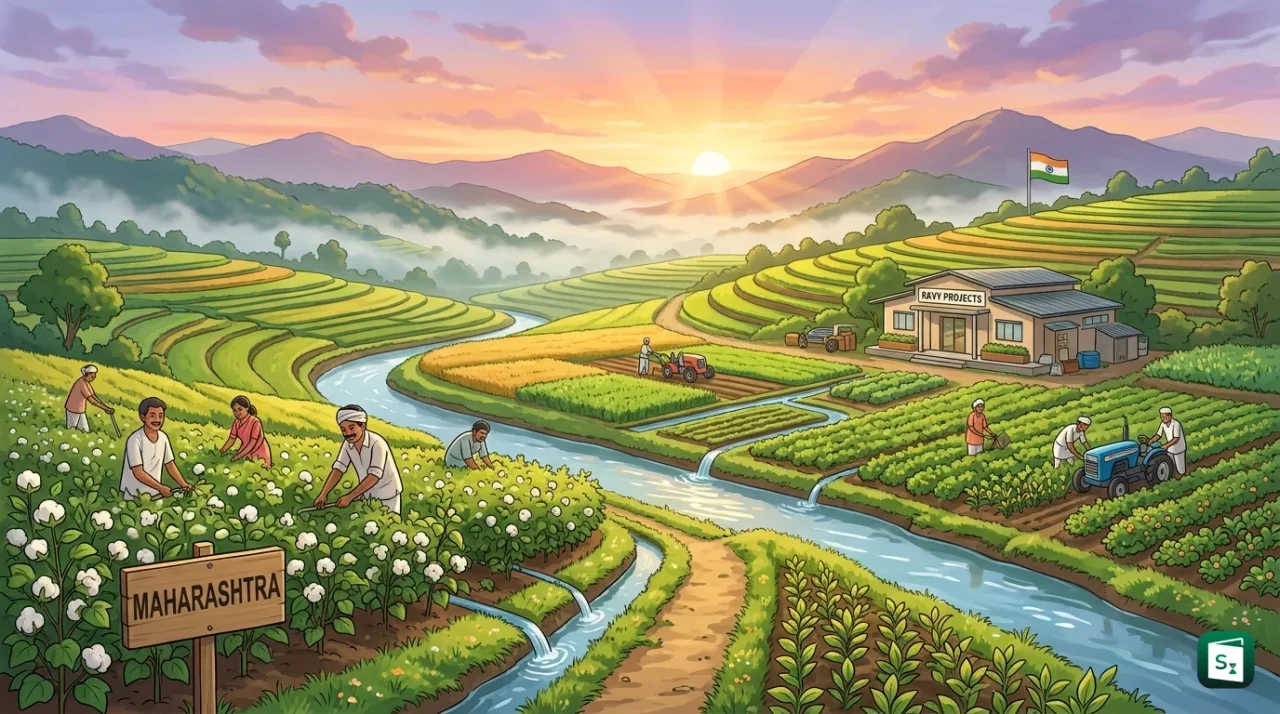
Maharashtra has become the first state in India to qualify for the second installment of funds under the Rashtriya Krishi Vikas Yojana (RKVY). Union Minister for Agriculture and Farmers’ Welfare Shivraj Singh Chouhan chaired a virtual review meeting to assess the state’s fund utilization and cleared the release of the second tranche of ₹335 crore.
What Is the Rashtriya Krishi Vikas Yojana?
The Rashtriya Krishi Vikas Yojana (RKVY) is a flagship centrally sponsored scheme of the Government of India aimed at achieving holistic development of agriculture and allied sectors. It was launched in August 2007 as part of the 11th Five Year Plan under the aegis of the National Development Council (NDC). The scheme was originally conceived to incentivize states to increase their public investment in agriculture and achieve 4% annual growth in the sector.
RKVY is implemented through state governments and operates under the Ministry of Agriculture and Farmers’ Welfare. The scheme gives states the autonomy to draw up plans based on local requirements, geographical conditions, and cropping patterns. This decentralized approach allows states to prioritize activities that best serve their specific agricultural challenges.
PM-RKVY: The 2024 Restructuring
In October 2024, the Union Cabinet approved a major restructuring of RKVY, renaming it as Pradhan Mantri Rashtriya Krishi Vikas Yojana (PM-RKVY). This was part of a broader rationalization exercise that merged seven existing centrally sponsored schemes under one umbrella. The other umbrella scheme created alongside was the Krishonnati Yojana (KY), which focuses on food security and agricultural self-sufficiency.
PM-RKVY was designed as a “cafeteria scheme”, meaning states can choose from a menu of components based on their specific needs. This replaced the earlier practice of having to apply for each scheme separately. The total proposed expenditure for both PM-RKVY and KY together is ₹1,01,321.61 crore, of which PM-RKVY accounts for ₹57,074.72 crore.
Key Components Under PM-RKVY
| Component | Focus Area |
|---|---|
| Soil Health Management | Improving soil fertility and nutrient management |
| Rainfed Area Development | Supporting agriculture in areas with limited irrigation |
| Agro Forestry | Integrating trees and shrubs with crop and livestock systems |
| Paramparagat Krishi Vikas Yojana | Promoting organic farming through traditional knowledge |
| Agricultural Mechanization | Farm machinery and crop residue management |
| Per Drop More Crop | Micro-irrigation and water use efficiency |
| Crop Diversification Programme | Shifting from water-intensive to less water-intensive crops |
| RKVY DPR Component | Detailed Project Reports for state-specific interventions |
| Accelerator Fund for Agri Startups | Supporting innovation and agri-entrepreneurship |
Funding Pattern
Since 2015-16, the funding pattern of RKVY has been in the ratio of 60:40 between the Centre and states. For North Eastern states and Himalayan states, the ratio is 90:10. Union Territories receive 100% central funding. The state share for Maharashtra, being a general category state, is 40% of the total project cost.
How RKVY Funds Are Released
The release of RKVY funds follows a two-installment system. The first installment, typically 50% of the annual allocation, is released after the State Level Sanctioning Committee (SLSC) approves the state’s Annual Action Plan. The second and final installment is released only when specific conditions are met.
The key condition is that the state must have utilized at least 75% of the funds already released (including the unspent balance from previous years and the first installment). This benchmark ensures that funds are not lying idle and that the state has the absorptive capacity to deploy additional money effectively.
Maharashtra’s Achievement
The Government of India had released ₹335 crore as the first installment to Maharashtra under RKVY. During the review meeting, it was found that the state had utilized approximately ₹260 crore, which works out to nearly 78% of the released amount. This comfortably exceeded the mandatory 75% utilization benchmark.
Chouhan congratulated Maharashtra for becoming the first state in the country to qualify for the second installment. The meeting was attended by Dattatray Bharane, Maharashtra’s Minister of State for Agriculture, along with senior officials from the central and state governments.
Review of Specific Components and PMFBY
During the review meeting, Chouhan assessed the progress of various components under RKVY in Maharashtra. He acknowledged satisfactory progress under the Mission for Integrated Development of Horticulture (MIDH) and lauded the state’s implementation efforts.
However, he directed Maharashtra to accelerate expenditure under Digital Agriculture, Agriculture Extension, the National Horticulture Mission (NHM), and components related to Seeds, Oilseeds, and Agroforestry. He also advised that pending liabilities under the Seeds component be booked promptly to improve fund utilization.
Discussion on Pradhan Mantri Fasal Bima Yojana
A separate discussion was held on the implementation of the Pradhan Mantri Fasal Bima Yojana (PMFBY) in the state. The Minister emphasized the need for accurate disclosure of information by farmers while applying for crop insurance. He clarified that both Kisan Credit Card (KCC) holders and non-KCC farmers are eligible for crop insurance benefits. However, concealment of KCC status by applying through another account should be avoided.
Chouhan noted that the central government provides substantial financial support under the KCC scheme through interest subvention and incentives for prompt repayment. Correct disclosure, he said, is essential for ensuring transparency and proper use of public resources.
Maharashtra’s Disaster Response Record
The Union Minister also appreciated Maharashtra’s prompt financial assistance to farmers affected by floods. The state transferred compensation amounting to around ₹14,000 crore directly to farmers’ bank accounts within five days. He also recognized the state’s performance in generating Farmer IDs, which are part of the central government’s push to create a digitized database of farmers across the country.
Key Takeaways
- Maharashtra became the first state in India to qualify for the second installment under the Rashtriya Krishi Vikas Yojana (RKVY).
- The first installment of ₹335 crore was released by the Centre, of which Maharashtra utilized ₹260 crore (approximately 78%), exceeding the mandatory 75% utilization benchmark.
- The RKVY was launched in August 2007 under the 11th Five Year Plan and is implemented by the Ministry of Agriculture and Farmers’ Welfare.
- In October 2024, the scheme was restructured as PM-RKVY, a cafeteria scheme with ₹57,074.72 crore allocation, merging seven existing centrally sponsored schemes.
- The funding pattern for general category states like Maharashtra is 60:40 (Centre:State), while for North Eastern and Himalayan states it is 90:10.
- Union Minister Shivraj Singh Chouhan chaired the review meeting and also discussed the Pradhan Mantri Fasal Bima Yojana (PMFBY) and the Kisan Credit Card (KCC) scheme.