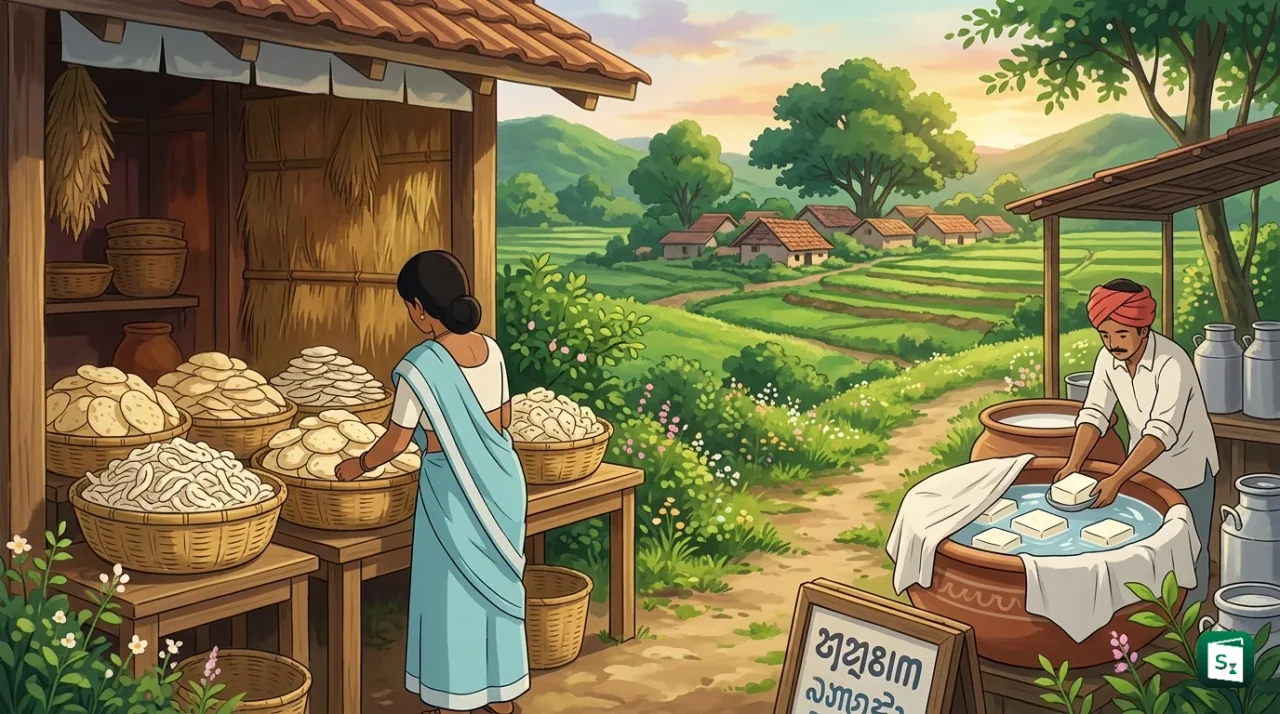
Two state governments have tightened their food safety regimes within days of each other. Tamil Nadu has banned the manufacture, storage, distribution, and sale of artificially coloured appalams, vadams, and fryums, while Maharashtra has imposed a one-year prohibition on analogue, or non-dairy synthetic, paneer. Both orders rest on the same legal foundation, the Food Safety and Standards (FSS) Act, 2006, and together signal a more aggressive approach by states to policing adulterated and misleading food products.
Tamil Nadu’s Ban on Coloured Appalams
The Tamil Nadu Food Safety Department has prohibited the manufacture, storage, distribution, and sale of artificially coloured appalams, vadams, and fryums across the state. These terms describe a family of popular South Indian snacks: appalams are the thin, round, sun-dried lentil discs commonly known as papads, vadams are small deep-fried lentil snacks, and fryums are the puffed, ready-to-fry savoury snacks sold in every supermarket.
The order followed repeated health warnings from the department. In the months before the ban, officials flagged that many brightly coloured versions of these snacks contained artificial colours in quantities far exceeding the legally permitted limits. The state had earlier confiscated about 22 tonnes of artificially coloured papads and fryums stored illegally at a warehouse in Madurai, an incident that underscored how widespread the practice had become.
The Health Concerns
Food safety officials have listed several health risks from the excessive use of synthetic colouring agents in these snacks. Regular consumption can lead to digestive disorders, allergies, and kidney-related complications. Long-term exposure to certain prohibited or excessive colours may also increase the risk of serious illnesses, including cancer. Children are seen as especially vulnerable, with exposure linked to allergic reactions and behavioural issues such as attention-deficit hyperactivity disorder (ADHD).
The department has advised consumers to switch to traditionally prepared appalams made from urad dal (black gram) and rice flour, which use no artificial additives. Enforcement officials have been directed to intensify inspections at markets, tourist destinations, fairs, exhibitions, and roadside stalls.
Not the First Such Action
Tamil Nadu has a track record of acting against unsafe synthetic colours. In February 2024, the state banned cotton candy after laboratory tests found it laced with Rhodamine B, a dye used in textiles that is not permitted in food and is suspected to be carcinogenic. It has also cracked down on coloured gobi manchurian sold on the streets. The current ban on coloured appalams, vadams, and fryums fits into this continuing pattern of enforcement against non-permitted industrial dyes entering the food chain.
Maharashtra’s One-Year Ban on Analogue Paneer
The Maharashtra Food and Drug Administration (FDA) has prohibited the manufacturing, processing, packing, storage, transportation, wholesale and retail sale, distribution, and offering for sale of analogue paneer across the state for a period of one year. The order, issued by the Food Safety Commissioner, was published in the state gazette on 30 July 2026 and took effect immediately.
The ban extends beyond retail shelves. Hotels, restaurants, caterers, cloud kitchens, and roadside eateries have been explicitly barred from using analogue paneer in any dish, and the FDA has said that serving it in place of genuine dairy paneer without disclosure amounts to an unfair trade practice under Section 24 of the FSS Act.
What Is Analogue Paneer?
Analogue paneer is a look-alike product that resembles paneer in appearance and texture but is not made entirely from milk. It is typically produced by blending vegetable oils such as palm oil, vegetable fats such as palm stearin, starches, milk solids, and plant proteins such as soy or pea, along with stabilisers, emulsifiers, and artificial flavours, and then curdling the blend with common acidulants.
It is cheaper to manufacture than conventional paneer and generally contains lower protein levels. Under FSSAI regulations, genuine paneer must be made from milk with no added starch, non-dairy fats, or synthetic elements. Selling analogue paneer is not itself illegal in India, provided it is correctly labelled as an analogue product, but the Maharashtra order found that the rules were being widely flouted.
The Evidence Behind the Ban
The decision rested on a year-long surveillance drive by the FDA, running from April 2025 to March 2026, during which 308 paneer and dairy analogue samples were tested at notified laboratories. Of these, 109 samples, or 35.4 per cent, failed to conform to prescribed standards: 79 were sub-standard and 30 were declared unsafe.
Laboratory analysis showed that in a significant share of the failed samples, the extracted fat had butyro-refractometer readings and iodine values outside the range prescribed for milk fat, indicating that vegetable fat had been added or had replaced milk fat entirely. Inspections also found that analogue paneer was often transported and sold without original packaging, mandatory labels, invoices, batch identification, or traceability documents, making it difficult to establish its source.
The push for the ban had been building in the Maharashtra legislature, where legislators repeatedly demanded action against synthetic paneer. In one high-profile raid at a godown in Pune’s Manjari Khurd, authorities seized about 1,400 kg of fake paneer, along with 1,800 kg of skimmed milk powder, 400 kg of glycerol monostearate powder, and 718 litres of palm oil, all materials used in manufacturing the imitation product.
Penalties for Violation
Depending on the severity of the offence, violators face imprisonment of up to six months and a fine of up to ₹1 lakh under the FSS Act. In cases where the consumption of unsafe food results in death, the law provides for life imprisonment and a minimum fine of ₹10 lakh. Action is drawn from provisions of the FSS Act including Sections 50, 51, 52, 55, and 59, which cover penalties for misleading, sub-standard, and unsafe food.
The Legal Foundation: FSS Act and FSSAI
The Food Safety and Standards Act, 2006 is the umbrella law that governs food safety in India. It was enacted to consolidate and replace a number of older, fragmented food laws, most notably the Prevention of Food Adulteration Act, 1954, and it came fully into force on 5 August 2011. The Act sets out standards for food articles, regulates food additives, and establishes an enforcement machinery running from the central authority down to state-level officials.
The Act established the Food Safety and Standards Authority of India (FSSAI) as the country’s apex food regulator. FSSAI frames science-based standards for food, approves food additives and colours, and lays down licensing and labelling rules for all food business operators. Its headquarters are in New Delhi.
Section 30: The Commissioner’s Prohibition Power
Both state bans draw their legal authority from Section 30(2)(a) of the FSS Act. This provision empowers the Commissioner of Food Safety of a state, in the interest of public health, to prohibit the manufacture, storage, distribution, or sale of any article of food either across the whole state or in any part of it. The prohibition must be notified in the Official Gazette and cannot exceed one year in duration.
This explains the specific one-year window in the Maharashtra order. The Maharashtra FDA explicitly invoked Section 30(2)(a), read with Sections 18 and 29 of the Act. Tamil Nadu’s action follows the same legal route, with the state’s health department citing the identical provision in its notification.
The Role of the State FDA
Under the FSS Act, food safety is enforced jointly by the central FSSAI and the states. Each state appoints a Commissioner of Food Safety who heads the state food safety machinery. In Maharashtra, this function is carried out by the Food and Drug Administration (FDA), which runs inspections, draws samples for laboratory testing, and initiates prosecutions under the Act. The Commissioner can also sanction prosecution for offences punishable with imprisonment.
In Tamil Nadu, the equivalent body is the Tamil Nadu Food Safety Department, which operates under the state’s Health and Family Welfare Department. Its food analysts and safety officers carry out the sampling and inspections that trigger orders such as the current ban.
Food Colours: What Is and Is Not Allowed
India’s rules on synthetic colours in food are laid down in the Food Safety and Standards (Food Products Standards and Food Additives) Regulations, 2011. Under these regulations, only a specified list of permitted synthetic food colours may be used, and only up to a prescribed limit, generally not exceeding 100 mg per kg of the food product.
Permitted and Prohibited Colours
| Type | Examples | Status |
|---|---|---|
| Permitted synthetic colours | Tartrazine (INS 102), Sunset Yellow FCF (INS 110), Allura Red (INS 129), Brilliant Blue FCF (INS 133) | Allowed within prescribed limits in permitted food categories |
| Permitted natural colours | Beta-carotene, curcumin (turmeric), chlorophyll, annatto | Allowed, subject to purity standards |
| Prohibited colours | Rhodamine B, Metanil Yellow, Sudan dyes (I to IV) | Banned in food due to toxicity or carcinogenic risk |
The regulations also mandate how colours must be declared on labels. Packaged food must carry declarations such as “contains permitted synthetic food colour(s)” or “contains permitted natural and synthetic food colours”. The use of a colour that is not on the permitted list, or the use of a permitted colour beyond the legal limit, makes the product non-compliant and liable to action.
The Tamil Nadu order targets exactly this violation: the use of colours beyond permitted limits, and in some cases unapproved colours, in appalams, vadams, and fryums. These snacks, especially the vividly coloured versions popular with children, were found to be among the worst offenders.
Labelling Standards for Paneer
For paneer, the compositional standards are fixed under Regulation 2.1.16 of the same 2011 regulations, as amended in 2019. Genuine paneer and chhana are classified into three categories by milk-fat content, and low and medium-fat variants must be sold only in sealed packages with prescribed labelling.
All paneer and chhana packaging must carry the declarations required under the Food Safety and Standards (Labelling and Display) Regulations, 2020. Products that fail to meet labelling requirements are treated as misbranded under Section 52 of the FSS Act. The Maharashtra order reiterates these standards and notes that analogue paneer, when legally sold, must be clearly labelled as an analogue or non-dairy product so that consumers are not misled.
Significance and the Broader Crackdown
The two orders are not isolated events. They reflect a widening state-level push to enforce food safety rules that national regulators alone cannot police, given the sheer size of India’s unorganised food sector.
A Growing List of States
Maharashtra is the second state, after Chhattisgarh, to impose a ban on analogue paneer. Chhattisgarh banned the sale and use of analogue paneer across the state in July 2026, barring the product from markets, hotels, restaurants, and roadside eateries. The order in Chhattisgarh came after a high-level meeting chaired by the state’s Health Minister, with the Food Department tasked to monitor compliance.
The pattern suggests that other states may follow. Analogue paneer, sold without disclosure, hits vegetarians particularly hard, since many of them rely on paneer as their primary source of protein and may unknowingly consume a low-protein, vegetable-fat-based imitation instead of genuine milk-based paneer.
The Scale of Dairy Fraud
The Maharashtra sampling data is a window into the scale of the problem. A failure rate of 35.4 per cent in tested paneer and dairy analogue samples indicates that a substantial share of what is sold as paneer does not meet prescribed standards. Dairy products are among the most adulterated food categories in India, given their high consumption and the profit margins available to manufacturers who substitute cheap vegetable fats for milk fat.
The FDA’s broader enforcement drive against adulterated dairy, running since May 2026, has already led to multiple raids and seizures across the state, alongside an intensifying crackdown on unhygienic restaurants and hotels in Mumbai and elsewhere.
Why States Are Acting Now
Food safety enforcement in India has historically been reactive, responding to incidents after they occur. State food safety departments, which bear the primary responsibility for on-ground enforcement, are increasingly using their statutory powers under Section 30 to issue prohibitory orders rather than relying only on case-by-case prosecutions. The one-year ceiling on such orders means these bans are renewable: a state can issue a fresh order after the year ends, keeping the prohibition in force through successive gazette notifications.
The Way Forward
The immediate effect of these orders will be felt at two levels. For manufacturers and sellers, the bans introduce a clear compliance test: coloured snacks must either drop artificial colours or exit the Tamil Nadu market, and non-dairy paneer must be either clearly labelled or pulled from Maharashtra kitchens and shelves. FDA inspection teams have been tasked with conducting surprise raids on food businesses, suppliers, and catering outfits, with confiscation and prosecution for those found stocking or serving banned products.
For consumers, the orders underscore the value of checking labels and preferring traditional products. Regulators have repeatedly advised buying uncoloured, traditionally prepared appalams and verifying that dairy products come from licensed sources. The bigger structural question remains whether the FSSAI’s proposed tightening of labelling rules for dairy analogues, which has been under discussion, will bring a uniform national standard that closes the loopholes states are now closing one by one.
Key Takeaways
- The Tamil Nadu Food Safety Department has banned the manufacture, storage, distribution, and sale of artificially coloured appalams, vadams, and fryums across the state.
- The Maharashtra FDA has imposed a one-year ban on analogue (non-dairy synthetic) paneer, published in the state gazette on 30 July 2026.
- Both bans derive their legal authority from Section 30(2)(a) of the Food Safety and Standards Act, 2006, which lets a state’s Commissioner of Food Safety prohibit an article of food for up to one year.
- The Food Safety and Standards Act, 2006 replaced the Prevention of Food Adulteration Act, 1954, came fully into force on 5 August 2011, and established the FSSAI, headquartered in New Delhi.
- Out of 308 paneer samples tested in Maharashtra between April 2025 and March 2026, 109 (35.4 per cent) failed prescribed standards, with 30 declared unsafe.
- Maharashtra is the second state after Chhattisgarh to ban analogue paneer, and Tamil Nadu had earlier banned cotton candy in February 2024 over the carcinogenic dye Rhodamine B.