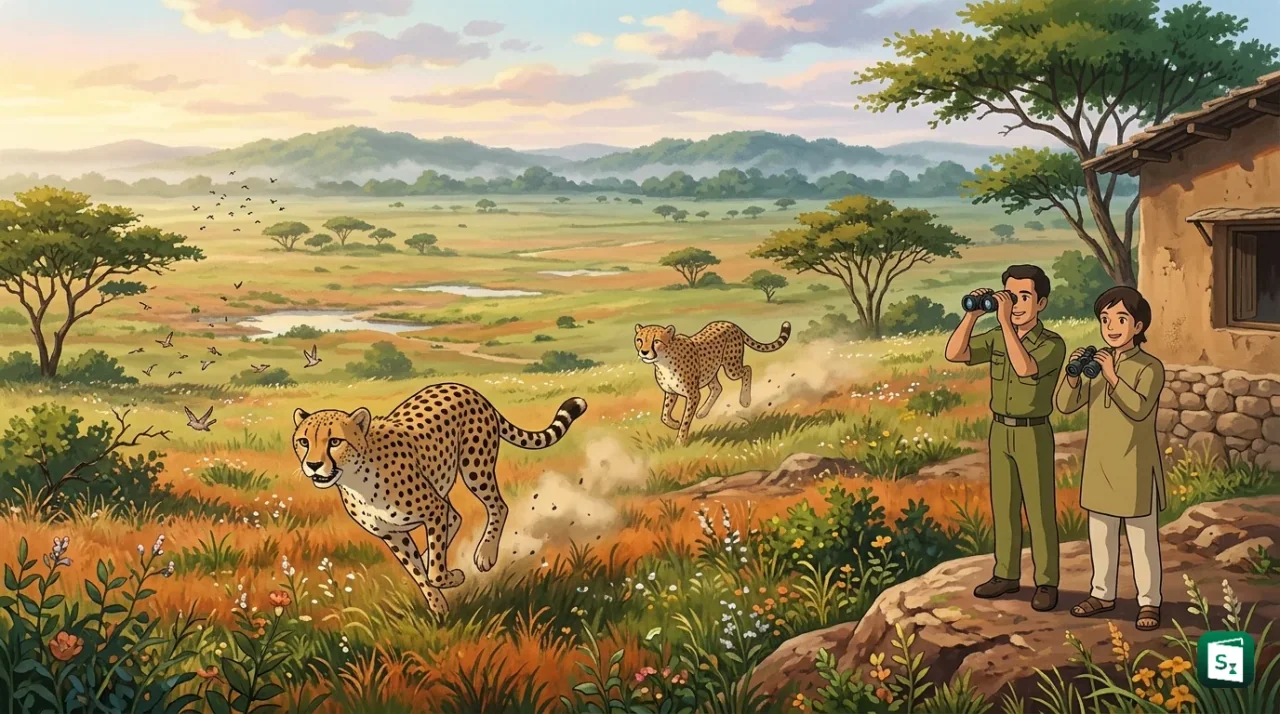
The book Bringing the Cheetah Back to India: How Diplomacy Made Conservation’s Big Mission Possible, written by Prashant Agrawal, an Indian Foreign Service (IFS) officer, has been released. Published by Hachette India, the book offers a first-hand account of the diplomatic manoeuvring behind Project Cheetah, the ambitious programme that brought the world’s fastest land animal back to Indian grasslands after seven decades of absence. It lifts the veil on the negotiations, quarantines and behind-the-scenes work that made the world’s first inter-continental translocation of a large carnivore possible.
About the Book and Its Author
Prashant Agrawal is a career diplomat who joined the Indian Foreign Service in 1998. He served as India’s High Commissioner to Namibia from 2018, where he steered the negotiations that secured the first batch of cheetahs for India. He has held diplomatic postings across three continents, including Paris, Port Louis, Bangkok, Hong Kong and Vientiane, and currently serves as Additional Secretary (South) in the Ministry of External Affairs.
The book, a 224-page paperback, is published by Hachette India and priced at ₹599. It recounts the human story behind the conservation mission, from the high offices of Windhoek to the corridors of power in New Delhi. The blurb describes it as the story of how nations came together to “resurrect a ghost, restore an ecosystem and rewrite the rules of rewilding itself”. The book also documents the critical role of the Cheetah Conservation Fund (CCF), a Namibian organisation dedicated to the survival of the cheetah, whose veterinarians and experts helped select, quarantine and prepare the animals for their journey.
The Story of the Cheetah in India
The Asiatic cheetah (Acinonyx jubatus), a fast, long-legged cat built for the chase, once roamed the grasslands, scrub forests and savannas of the Indian subcontinent. It appears throughout Indian history and lore as a companion of kings, valued for coursing, a hunting sport in which trained cheetahs were used to run down prey.
The species vanished from India through a combination of excessive hunting, poaching and habitat loss as grasslands gave way to agriculture. The last confirmed wild cheetahs in India were shot in 1947 in the forests of Koriya district, in present-day Chhattisgarh. In 1952, the species was officially declared extinct in India.
For decades, the idea of bringing the cheetah back remained dormant. The project faced a stay by the Supreme Court since 2012, and the reintroduction was cleared only in January 2020, weeks before the COVID-19 pandemic froze international negotiations. When Agrawal took charge in Namibia in 2018, the plan had repeatedly hit dead ends, and the country had earlier declined the proposal for its own reasons.
What the Book Reveals About the Mission
Agrawal’s account is the first insider narrative of the diplomatic groundwork behind Project Cheetah. A Memorandum of Understanding (MoU) with Namibia was signed on 20 July 2022, with External Affairs Minister S. Jaishankar and Environment Minister Bhupender Yadav on the Indian side and Namibia’s Deputy Prime Minister and Foreign Minister on the other.
The target date was 15 August 2022, India’s 75th Independence Day. The plan slipped by a month because every selected cheetah had to complete a mandatory 30-day quarantine. Selection itself was fraught: one shortlisted animal died, another was found to be pregnant, and last-minute replacements had to be sourced and cleared. The final animal completed its quarantine on 16 September 2022, and the eight cheetahs arrived in India the next morning, on 17 September, the day the Prime Minister released them at Kuno National Park in Madhya Pradesh.
The book also tackles the scientific debate over subspecies. Critics had argued that African and Asiatic cheetahs were genetically distinct and that Namibian animals would be unsuitable for Indian habitats. Agrawal explains that global cheetah geneticists consider the cheetah one of the least genetically diverse mammals on Earth, the result of an ancient evolutionary bottleneck, which makes such distinctions carry less biological weight than critics suggested.
Kuno: Why This Park Was Chosen
Kuno National Park in Madhya Pradesh was selected as the first reintroduction site after the voluntary relocation of 24 villages (1,545 families), which created nearly 6,258 hectares of inviolate grassland. The choice was deliberate: Kuno offered suitable habitat, an adequate prey base and, crucially, the absence of resident tigers, which could otherwise have caused fatal territorial conflicts with the newly introduced cheetahs. The cheetahs themselves were chosen to balance wild instincts with tolerance of human presence, so they would not panic during transfer yet retain their hunting abilities.
Project Cheetah: The Bigger Picture
Project Cheetah is implemented under the aegis of the Ministry of Environment, Forest and Climate Change (MoEFCC), with the National Tiger Conservation Authority (NTCA) as the nodal agency. Its long-term goal is to establish a self-sustaining metapopulation of 60 to 70 cheetahs across 17,000 sq km of the Kuno-Gandhi Sagar landscape by 2032. The first batch of eight cheetahs arrived from Namibia in September 2022, followed by a second batch of 12 cheetahs from South Africa in February 2023, brought in under an MoU signed in January 2023. The Indian Air Force flew both batches on C-17 Globemaster aircraft.
The cheetah is designated a flagship and umbrella species under the project. Protecting it means conserving the open grasslands and semi-arid landscapes that also support the caracal, the Indian wolf and critically endangered birds such as the Lesser Florican and the Great Indian Bustard. The project also carries a community dimension: more than 450 Cheetah Mitras from local villages serve as conservation ambassadors, and local communities receive eco-tourism revenue sharing and direct employment.
As of mid-2026, India’s cheetah population has grown to 53 animals, of which 33 were born on Indian soil. Of the 49 cubs born since reintroduction, 33 have survived, one of the highest survival rates for comparable cheetah reintroduction programmes anywhere in the world. The second generation confirms that the cats are not merely surviving but adapting to their new home.
Why the Book Matters
The book arrives nearly four years after the launch of Project Cheetah, at a moment when the mission is shedding its earlier critics. In the months around the 2022 translocation, parts of the international press dismissed the project as political spectacle, with some outlets calling it a “vanity project” and pointing out that the cheetahs landed on the Prime Minister’s birthday. The book documents that the original target date was 15 August 2022, the 75th Independence Day, and that the landing on 17 September was the result of the quarantine schedule, not a political calculation.
Agrawal frames the cheetah’s return as more than a conservation win. He describes it as a civilisational obligation that helps “undo the colonial legacy of rampant, indiscriminate hunting”. Restoring an apex predator, he argues, sets off wider ecosystem recovery and creates a win-win situation for wildlife and the forest communities that live alongside it. The book also serves as a record of how conservation and diplomacy can work together, a theme with wider relevance for India’s growing role in global biodiversity negotiations, including its leadership of the International Big Cat Alliance, launched in April 2023 to protect the world’s seven big cat species.
Key Takeaways
- Bringing the Cheetah Back to India is authored by Prashant Agrawal, an Indian Foreign Service (IFS) officer and former High Commissioner to Namibia, and is published by Hachette India.
- The cheetah was officially declared extinct in India in 1952, after the last confirmed wild sightings in 1947 in Koriya district of present-day Chhattisgarh.
- The MoU with Namibia was signed on 20 July 2022, and the first batch of eight cheetahs arrived in India on 17 September 2022, released at Kuno National Park in Madhya Pradesh.
- Project Cheetah is implemented by the Ministry of Environment, Forest and Climate Change with the National Tiger Conservation Authority (NTCA) as the nodal agency.
- The second batch of 12 cheetahs from South Africa arrived in February 2023 under an MoU signed in January 2023.
- As of mid-2026, India has 53 cheetahs, of which 33 were born on Indian soil, with a long-term goal of a 60 to 70 member metapopulation by 2032.