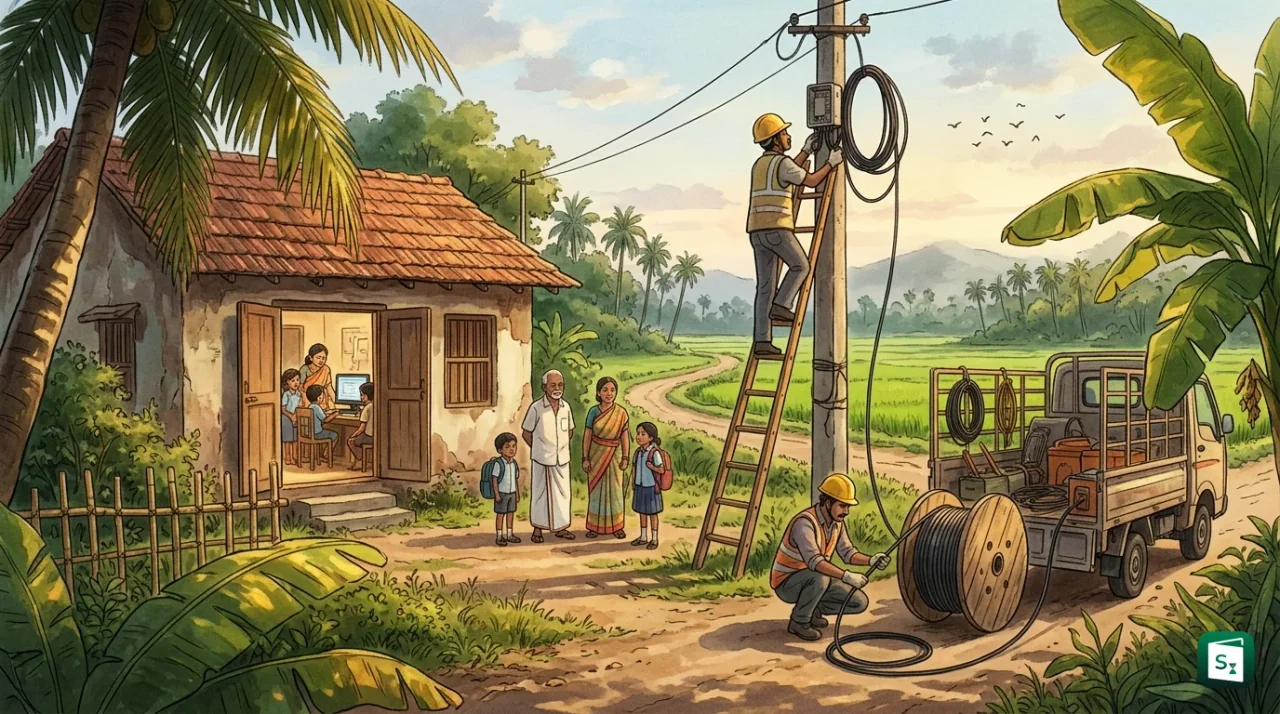
Digital Bharat Nidhi signed a Utilisation Agreement with the Tamil Nadu government and Tamil Nadu FibreNet Corporation on 30 October 2026 at Sanchar Bhawan in New Delhi. The pact brings Tamil Nadu fully under the State led model of the Amended BharatNet Program. Central subsidy support will fund more than five lakh rural home fibre links and on demand connectivity to 4,767 villages.
What Is BharatNet and What Is the Amended BharatNet Program?
BharatNet is the central programme to give high speed broadband to every Gram Panchayat in India through optical fibre cable. A Gram Panchayat is the elected village level local body. The Union Cabinet first approved the project on 25 October 2011 as the National Optical Fibre Network. It was later renamed BharatNet and linked to the Digital India Programme, which was launched in 2015 under the Ministry of Electronics and Information Technology.
The project was planned in phases. Phase 1 aimed to link one lakh Gram Panchayats using fibre of public firms such as Bharat Sanchar Nigam Limited (BSNL), RailTel and PowerGrid. It was completed in December 2017. Phase 2, approved in July 2017, extended coverage to another 1.5 lakh Gram Panchayats using a mix of fibre, radio and satellite, with State led, public firm led and private led models. By early 2026, about 2.14 lakh Gram Panchayats had been made service ready at a cost of about ₹42,000 crore.
The Union Cabinet approved the Amended BharatNet Program (ABP) on 4 August 2023 with an outlay of ₹1,39,579 crore. The programme upgrades the old linear network to ring topology, where fibre runs in a closed loop from the Block office to Gram Panchayats. A loop keeps service running even if one side of the cable is cut. It also moves the network to IP-MPLS, which is a system of routers that moves data packets quickly and safely between Blocks and Panchayats.
The national target under ABP is fibre to 2.64 lakh Gram Panchayats in ring design, plus fibre to about 3.8 lakh non Panchayat villages on demand. The design includes ten years of operation and maintenance, power backup at Blocks and Panchayats, a Remote Fibre Monitoring System (RFMS) at the Block to detect cuts, and a Centralised Network Operating Centre for round the clock monitoring. Payment to the implementing agency is linked to service quality under a Service Level Agreement.
What the Tamil Nadu Utilisation Agreement Provides
The Utilisation Agreement was signed on 30 October 2026 at Sanchar Bhawan, New Delhi, between three parties: Digital Bharat Nidhi (DBN) under the Department of Telecommunications, the Government of Tamil Nadu, and Tamil Nadu FibreNet Corporation (TANFINET). The signing took place in the presence of Shyamal Misra, Administrator of Digital Bharat Nidhi. Atul Anand, Additional Chief Secretary for Information Technology and Digital Services of Tamil Nadu, joined through video link, along with senior officers of the Department of Telecommunications, Digital Bharat Nidhi and BSNL.
The agreement follows the State led model. Under this model, the State agency builds and uses the network while the Centre gives funds and sets standards. The Centre has approved subsidy support for utilisation of the BharatNet network in Tamil Nadu. The support will help provide 5,27,506 rural home fibre connections in the State. In plain terms, more than five lakh rural homes will get Fibre to the Home (FTTH), which means an optical fibre line that runs directly to the house and gives a minimum speed of 25 Mbps.
The agreement also covers 4,767 non Gram Panchayat villages on demand. The rule is simple. If a village shows demand for at least five home fibre links, BSNL and the State partners must start service there. The Centre has separately set aside ₹1,632 crore, excluding tax, for ten years of capital and operating costs for the Amended BharatNet Program in Tamil Nadu, in addition to the per connection subsidy.
Better village fibre will improve daily services. The stated uses include e-governance, online classes, telemedicine, digital payments and citizen services in rural and remote areas. Government offices, schools, health centres, ration shops and small firms can use the same village network.
What Is Digital Bharat Nidhi and How Is It Funded?
Digital Bharat Nidhi (DBN) is the national fund that pays for telecom services in areas where private firms will not invest on their own because income is low or terrain is hard. Digital Bharat Nidhi is an attached office of the Department of Telecommunications under the Ministry of Communications. It is headed by an Administrator appointed by the Central Government. Its office is at Sanchar Bhawan in New Delhi.
Digital Bharat Nidhi was earlier called the Universal Service Obligation Fund (USOF). The Universal Service Support Policy started on 1 April 2002. The fund got legal backing under the Indian Telegraph (Amendment) Act, 2003, and its scope was widened in 2006 to cover mobile services, broadband and fibre. Under the Telecommunications Act, 2023, which received Presidential assent on 24 December 2023, the fund was renamed Digital Bharat Nidhi. The Telecommunications (Administration of Digital Bharat Nidhi) Rules, 2024, notified on 30 August 2024, set rules for projects, selection of agencies, monitoring and dispute settlement.
The mandate is now wider. Digital Bharat Nidhi supports access to telecom services in underserved rural, remote and urban areas. It also supports research and development, pilot projects and the launch of new telecom products and standards. The money comes from a Universal Access Levy of 5 percent of Adjusted Gross Revenue paid by telecom operators. The balance does not lapse at the end of the financial year. By the end of 2024, total collections had crossed ₹1.71 lakh crore, with about ₹85,232 crore disbursed for schemes such as BharatNet, the 4G Saturation Project, mobile coverage in Left Wing Extremism areas, border and Himalayan areas, the Northeast and island links through submarine cable.
Who Is TANFINET and How BharatNet Works in Tamil Nadu
TANFINET stands for Tamil Nadu FibreNet Corporation Limited. It is a Special Purpose Vehicle set up by the Tamil Nadu government to run BharatNet in the State under the State led model. The plan covers 12,525 village panchayats in 38 districts and 388 blocks with at least 1 Gbps bandwidth at each panchayat. TANFINET also plans a Unified Digital Infrastructure that joins BharatNet for villages with TamilNet for towns and cities.
Tamil Nadu chose TANFINET instead of BSNL as the main builder. The State divided work into four packages named A, B, C and D. Packages C and D, covering more than 6,400 panchayats, were awarded to Larsen and Toubro and ITI Limited, with Broadcast Engineering Consultants India Limited as the audit agency. The sanctioned cost for this phase was ₹1,815.32 crore. Chief Minister M. K. Stalin inaugurated cable laying work in June 2022.
Progress by the end of 2025 shows both scale and gap. Out of 12,525 Gram Panchayats planned, 10,869 had been made service ready and 11,118 had been connected by mid 2026. About 55,000 route km of fibre had been laid in the State under BharatNet, as part of 3,08,907 route km laid by all agencies in Tamil Nadu. Yet only 808 FTTH links through BharatNet were active in the State at that stage. That low use is why the new Utilisation Agreement matters. It shifts focus from laying cable to actually selling and maintaining home connections.
Nationally, BharatNet had laid 6,94,605 km of fibre by February 2026, with 2,18,653 Gram Panchayats linked by cable and 2,14,797 service ready. More than 13 lakh FTTH links were active in rural India, served by over 7,700 BharatNet Udyamis working with BSNL.
How Rural Homes Will Get Fibre Through the BharatNet Udyami Model
The last stretch from the panchayat building to the house is called last mile connectivity. Digital Bharat Nidhi funds this stretch through the BharatNet Udyami (BNU) model. A BharatNet Udyami is a local entrepreneur, self help group, small firm, internet provider or even the Gram Panchayat itself. The Udyami lays the short fibre spur, installs the small box at the home called the Optical Network Terminal, and handles repairs.
The money model is built to remove entry barriers. The customer pays no installation charge and only pays the monthly plan, with rural plans starting around ₹259 per month. The Udyami gets a one time capital incentive for each new link and a share of the monthly bill, generally split equally with BSNL. BSNL provides the backbone link to all 7,269 Blocks with leased line capacity, billing software, training and complaint systems. The Udyami handles sales, installation and local service. The Utilisation Agreement with BSNL, signed in April 2025, runs for ten years and aims for 1.5 crore FTTH links across India, with priority for government schools and primary health centres.
Monitoring is now public. The BharatNet Pragati Portal shows live data on blocks, panchayats, fibre laid and daily network uptime for every State, with maps for packages under construction, State led work and Central work. Demand can also be raised online, where a family selects State, district and panchayat and chooses FTTH or dark fibre, which is unused fibre leased to firms for their own use. This demand record helps planners decide which of the 4,767 Tamil Nadu villages to light up first.
Key Takeaways
- The Utilisation Agreement was signed on 30 October 2026 at Sanchar Bhawan, New Delhi, between Digital Bharat Nidhi, Tamil Nadu and TANFINET.
- Central support under the pact will fund more than five lakh rural FTTH links and on demand links to 4,767 villages in Tamil Nadu.
- The Amended BharatNet Program was approved on 4 August 2023 with an outlay of ₹1,39,579 crore for fibre to 2.64 lakh Panchayats in ring topology.
- Digital Bharat Nidhi, earlier the Universal Service Obligation Fund from 1 April 2002, was renamed under the Telecommunications Act, 2023.
- TANFINET is the State vehicle to give 1 Gbps links to 12,525 village panchayats, of which 10,869 were service ready by late 2025.