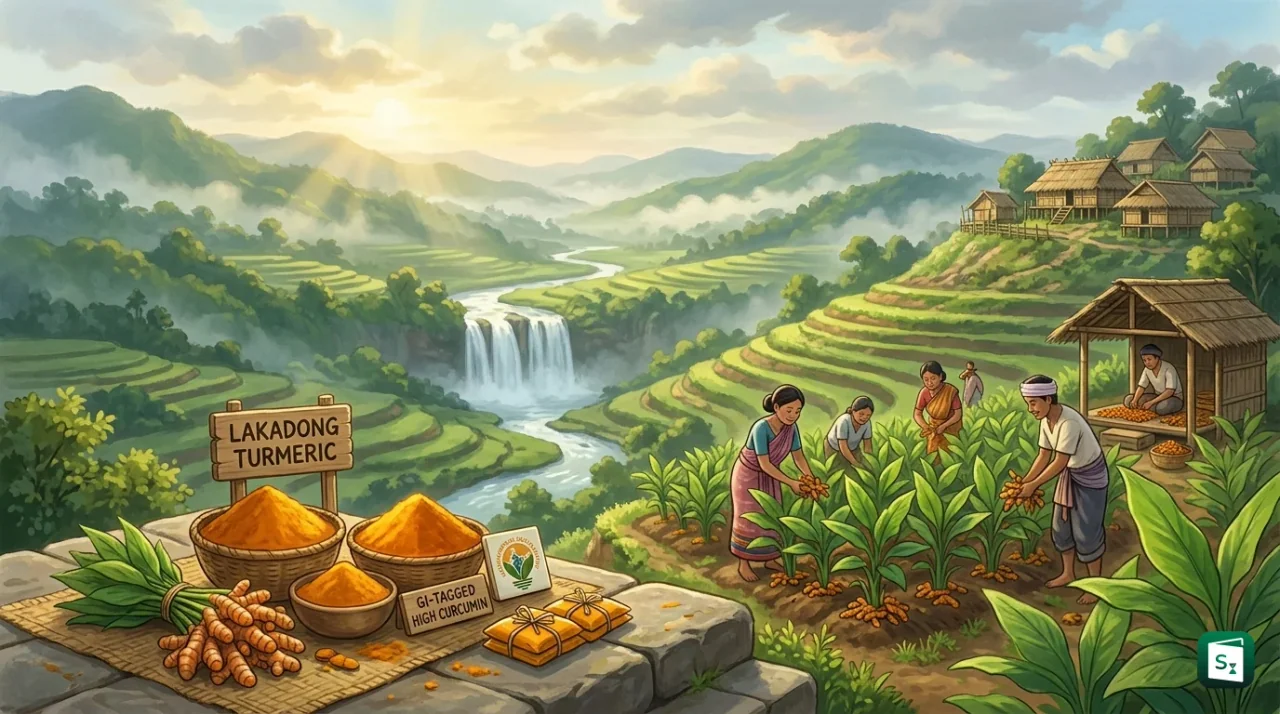
Union Minister for Communications and Development of North Eastern Region Jyotiraditya M Scindia, along with Meghalaya Chief Minister Conrad K Sangma, launched Mission Golden Spice in New Delhi on 21 July 2026. Officially named the Integrated Lakadong Turmeric Value Chain Enhancement Project, the initiative is a ₹175.45 crore, five-year roadmap (2025-2030) to transform Meghalaya’s GI-tagged Lakadong turmeric from a largely raw commodity into a globally recognised premium spice brand. The mission aims to build a complete farm-to-global-market ecosystem that nearly doubles farmers’ incomes while creating thousands of jobs.
What Is Lakadong Turmeric?
Lakadong turmeric is a premium variety of turmeric grown primarily in the Lakadong area of the Jaintia Hills district in Meghalaya. What sets it apart is its exceptionally high curcumin content, which ranges from 7 to 10 percent, compared to just 2 to 4 percent found in regular turmeric varieties. Curcumin is the principal bioactive compound in turmeric responsible for its deep golden colour and medicinal properties.
The variety received the Geographical Indication (GI) tag on 30 March 2024, making it the first turmeric variety from Meghalaya to earn this recognition. The GI tag is governed by the Geographical Indications of Goods (Registration and Protection) Act, 1999, which came into effect on 15 September 2003. The GI Registry, based in Chennai, administers these tags. The tag certifies that Lakadong turmeric possesses distinct qualities rooted in the unique agro-climatic conditions and traditional cultivation practices of the Jaintia Hills region. Notably, attempts to grow Lakadong turmeric saplings outside Meghalaya have consistently resulted in a decline in curcumin content, confirming the soil’s unique contribution.
Currently, about 14,000 farmers from around 43 villages cultivate Lakadong turmeric on approximately 2,500 hectares of land. Women play a dominant role in the entire value chain, from cultivation to processing.
What Is Mission Golden Spice?
Mission Golden Spice is a convergence-led flagship initiative anchored by the Ministry of Development of North Eastern Region (MDoNER) and the North Eastern Council (NEC). It operates under MDoNER’s broader Unlock the Economic Potential of India’s Northeast (USP) initiative, which is part of the government’s Ashtalakshmi strategy for the comprehensive development of India’s eight northeastern states.
The project brings together multiple central ministries and agencies, including the Ministry of Agriculture and Farmers’ Welfare, the Ministry of Food Processing Industries, APEDA, the Spices Board, the National Turmeric Board, ICAR, NABARD, and the Government of Meghalaya. Its core objective is to address the structural gaps that have kept Lakadong turmeric from realising its full market potential: inadequate processing facilities, weak cold chain infrastructure, poor market linkages, lack of commercial-scale value addition, and limited branding.
Two-Phase Implementation
The mission follows a phased approach over five years:
| Phase | Duration | Focus Area |
|---|---|---|
| Phase 1: Value Chain Strengthening | 2025-2027 | Building processing infrastructure, cold chains, post-harvest management, farmer training, and quality certification systems |
| Phase 2: Expansion and Scale-up | 2027-2030 | Scaling cultivation area, establishing the northeast’s largest integrated organic turmeric processing and curcumin extraction facility, export market entry, and global branding |
Key Targets and Projected Impact
Mission Golden Spice sets ambitious quantitative targets that, if achieved, would fundamentally reshape Meghalaya’s turmeric economy.
| Metric | Current Level | Target by 2030 |
|---|---|---|
| Cultivation area | 2,500 hectares | 7,000 hectares |
| Annual production | Limited | 49,400 metric tonnes |
| Farm-gate price | ₹30-40 per kg | ₹80 per kg |
| Farming households engaged | ~14,000 | 17,500+ |
| Women participation in processing | Majority | 99% of workforce |
| Direct and indirect jobs | Minimal | 3,000+ |
| Value-chain economy value | Low | ₹100 crore (by FY 2028-29) |
The mission targets a near doubling of farmers’ remuneration through a combination of productivity gains, quality premium, and value addition. Instead of selling raw or semi-processed turmeric at low prices, farmers will be linked to a structured value chain that processes the crop into high-value products such as packaged turmeric powder, curcumin extracts, oleoresins, and nutraceutical formulations.
Women are at the centre of the mission’s development model. Given that women account for the vast majority of turmeric processing work in Meghalaya, the project plans to place them at the forefront of farmer producer organisations and processing enterprises.
Funding Pattern
The ₹175.45 crore budget for Mission Golden Spice is shared among three stakeholders:
| Contributor | Share | Amount (approx) |
|---|---|---|
| Ministry of DoNER (MDoNER) / NEC | 50% | ₹87.73 crore |
| Ministry of Agriculture and Farmers’ Welfare | 33.1% | ₹58.07 crore |
| Government of Meghalaya | 16.9% | ₹29.65 crore |
MDoNER, which leads the mission along with the North Eastern Council, bears the largest share. MDoNER was established as a full-fledged ministry in 2001 and is headquartered in New Delhi. Its mandate is to coordinate and facilitate the development of the eight northeastern states: Arunachal Pradesh, Assam, Manipur, Meghalaya, Mizoram, Nagaland, Sikkim, and Tripura. The NEC, created in 1971 under the North Eastern Council Act, serves as the regional planning body for these states.
From the G7 Summit to Global Markets
Lakadong turmeric received unprecedented global visibility in June 2026 when Prime Minister Narendra Modi presented it as a gift to world leaders at the 52nd G7 Summit in Evian, France. The gift pack, which also included Ramban Honey from Jammu and Kashmir, Nagauri Ashwagandha from Rajasthan, and Banarasi silk stoles, highlighted India’s rich tradition of GI-tagged wellness and heritage products.
This diplomatic gesture generated significant international interest in the spice, which Mission Golden Spice aims to capitalise on. The mission targets export markets in the United States, the European Union, Japan, and the Gulf region. The inclusion of blockchain traceability tools in the project will help protect the GI status and assure international buyers of the product’s authenticity and origin. This is particularly important given that counterfeit “Lakadong” turmeric has appeared in markets following the variety’s growing fame.
The Way Forward
Mission Golden Spice is part of a larger strategic shift in how the government approaches agricultural development in the northeast. Under the Ashtalakshmi framework, MDoNER has worked with each of the eight states to identify a unique selling proposition and build a replicable development model around it. Meghalaya Chief Minister Conrad Sangma has indicated that the state government plans to replicate the Mission Golden Spice model for other Meghalaya products such as pineapple, ginger, jackfruit, honey, and mushrooms.
For the mission to succeed, several challenges must be addressed: ensuring the purity of planting material to maintain high curcumin levels, building reliable cold chain and logistics infrastructure in Meghalaya’s hilly terrain, and competing with established turmeric brands in global markets. The project’s emphasis on processing infrastructure within the state, including the northeast’s largest integrated organic turmeric processing and curcumin extraction facility, is designed to capture maximum value locally rather than exporting raw spice at low prices.
Key Takeaways
- Mission Golden Spice was launched on 21 July 2026 by Union Minister Jyotiraditya Scindia and Meghalaya CM Conrad Sangma to build a complete value chain for Meghalaya’s Lakadong turmeric.
- The project has a total outlay of ₹175.45 crore and follows a five-year roadmap (2025-2030) in two phases: Value Chain Strengthening followed by Expansion and Scale-up.
- MDoNER contributes 50% of the funding, with the Ministry of Agriculture and Farmers’ Welfare (33.1%) and the Government of Meghalaya (16.9%) sharing the rest.
- Lakadong turmeric contains 7-10% curcumin, nearly four times the global average of 2-4%, and received its GI tag on 30 March 2024 under the Geographical Indications of Goods Act, 1999.
- The mission targets expanding cultivation from 2,500 to 7,000 hectares, raising farm-gate prices from ₹30-40/kg to ₹80/kg, benefiting over 17,500 farming households (99% women), and creating 3,000+ jobs.
- Prime Minister Modi showcased Lakadong turmeric as a diplomatic gift at the 52nd G7 Summit in Evian, France in June 2026, boosting its global visibility.