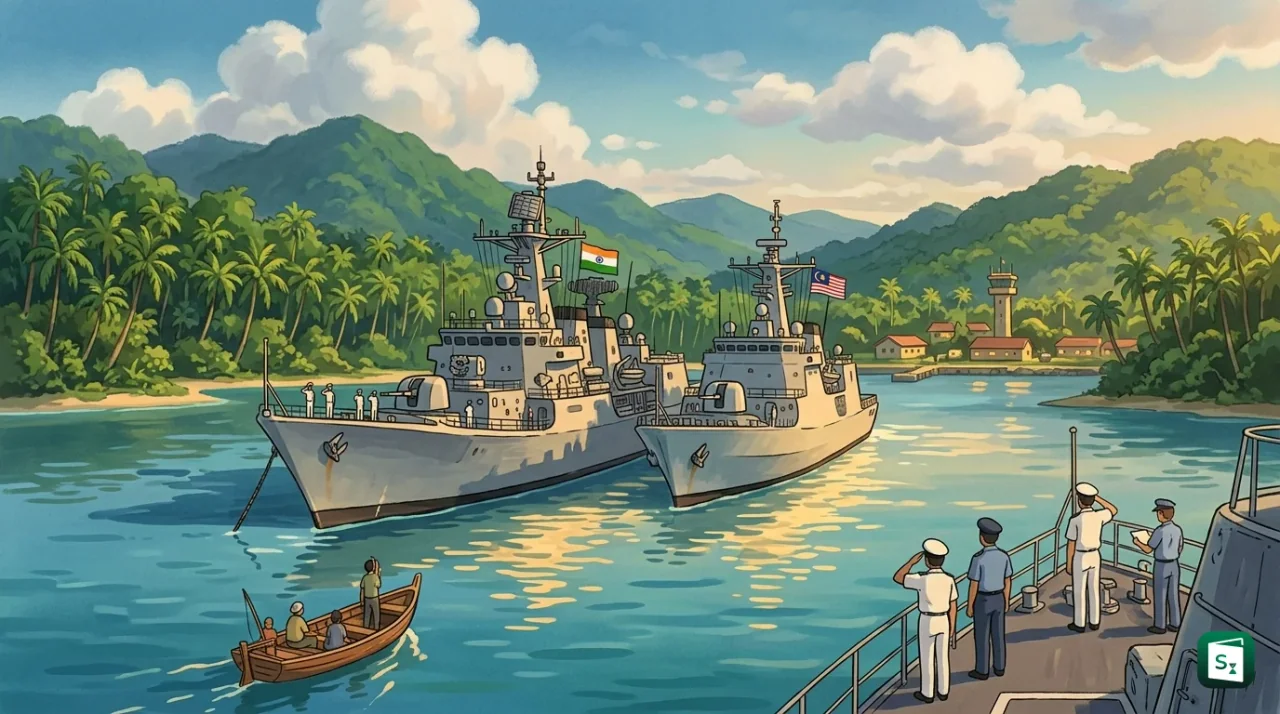
Indian Naval Ship INS Mysore arrived at Lumut Naval Base in Malaysia on 9 September 2026 for the fourth edition of Exercise Samudra Laksamana with the Royal Malaysian Navy. The bilateral naval exercise was held from 9 to 12 September 2026 with Malaysian ships KD Lekir and KD Gagah Samudera. The drill marks another step in India Malaysia maritime cooperation during the ASEAN India Year of Maritime Cooperation 2026.
Samudra Laksamana Exercise Between Which Countries?
Exercise Samudra Laksamana is held between India and Malaysia. The Indian Navy and the Royal Malaysian Navy conduct this bilateral naval exercise to improve interoperability and share operational experience at sea. The fourth edition was held at Lumut Naval Base from 9 to 12 September 2026.
The word Samudra means sea in Sanskrit, while Laksamana means admiral in the Malay language. A bilateral naval exercise is a sea drill conducted by the navies of two countries. A joint naval exercise follows the same idea, but the term bilateral clearly shows that only two navies take part. Exercise Samudra Laksamana is therefore the dedicated navy to navy exercise in the India Malaysia defence partnership.
The fourth edition began with the arrival of INS Mysore at Lumut on 9 September 2026. Personnel of the Royal Malaysian Navy and officials of the High Commission of India in Malaysia received the ship and its crew. An opening ceremony was then held at Lumut Naval Base. First Admiral Ahmad Sapuan Fathi, Deputy Commander of the Western Fleet of the Royal Malaysian Navy, presided over the ceremony. More than 600 personnel from both navies took part in the edition.
The exercise had two clear parts, a harbour phase and a sea phase. The harbour phase included professional exchanges, focused briefings, cross deck visits and sports events. Cross deck visits allow sailors from one navy to board the ship of the other navy to study its equipment and working methods. The sea phase involved coordinated maritime evolutions between INS Mysore, KD Lekir (F26) and KD Gagah Samudera. These evolutions tested joint manoeuvres, communication procedures and operational coordination. The Ministry of Defence later stated that the completion of the exercise reflects the growing depth and maturity of naval cooperation between India and Malaysia.
INS Mysore and the Delhi Class Destroyer Profile
INS Mysore is the Indian Navy participant in Exercise Samudra Laksamana 2026. INS Mysore bears the pennant number D60 and the motto Na Bhibheti Kadaachana, which means Always Fearless in Sanskrit. The ship was built by Mazagon Dock Limited in Mumbai, launched on 4 June 1993 and commissioned on 2 June 1999. It now serves with the Eastern Naval Command, which is headquartered in Visakhapatnam.
INS Mysore is a Delhi class guided missile destroyer. A guided missile destroyer is a large and fast warship designed to attack enemy ships, submarines and aircraft using guided missiles, guns and torpedoes. The Delhi class is also called Project 15. It has three ships, INS Delhi (D61), INS Mysore (D60) and INS Mumbai (D62). These were the largest warships built in India at the time of their commissioning. They were later followed by the more advanced Kolkata class destroyers.
The ship displaces about 6,200 tonnes at full load and is 163 metres long with a beam of 17 metres. It is powered by Zorya Mashproekt gas turbines and can reach speeds of more than 32 knots. Its crew strength is about 350 personnel, including 40 officers. The ship can carry two Sea King helicopters, which help in anti submarine warfare, search and surveillance.
| Feature of INS Mysore | Detail |
|---|---|
| Full name | Indian Naval Ship Mysore, pennant D60 |
| Class | Delhi class guided missile destroyer (Project 15) |
| Builder | Mazagon Dock Limited, Mumbai |
| Commissioned | 2 June 1999 |
| Displacement and size | About 6,200 tonnes, 163 metres long |
| Speed | More than 32 knots |
| Key weapons | BrahMos anti ship missiles, Shtil and Barak surface to air missiles, OTO Melara gun, AK-630 close in weapon systems, torpedo tubes and RBU-6000 anti submarine rockets |
After its mid life refit, INS Mysore carries modern sensors and weapons of Indian, Russian and Western origin. These include surface to surface BrahMos missiles, Shtil medium range air defence missiles and Barak point defence missiles for protection against close range air threats. During the familiarisation visit at Lumut, senior officers of the Royal Malaysian Navy were briefed on these capabilities and key features of the ship.
Royal Malaysian Navy Ships and Lumut Naval Base
The Royal Malaysian Navy joined the fourth edition with two vessels, KD Lekir and KD Gagah Samudera. KD stands for Kapal Di-Raja, which means Royal Ship in the Malay language. All commissioned ships of Malaysia carry this prefix, in the same way Indian naval ships carry the prefix INS, which means Indian Naval Ship.
KD Lekir carries the pennant number F26. It is the second ship of the Kasturi class corvette. A corvette is a small warship used for coastal patrol, escort duties and limited combat. KD Lekir was built by Howaldtswerke Deutsche Werft in Germany, launched in May 1983 and commissioned in August 1984. It serves in the 22nd Corvette Squadron. The ship displaces about 1,880 tonnes at full load, is 98 metres long and can reach 28 knots. It carries a Bofors 57 mm gun, 30 mm cannon, Exocet anti ship missiles and torpedoes, along with the TACTICOS combat management system and sonar for underwater detection.
KD Gagah Samudera is a training ship which can also act as an offshore patrol vessel. An offshore patrol vessel is a ship used for patrolling the exclusive economic zone, which is the sea area up to 200 nautical miles from the coast where a country has special rights over resources. KD Gagah Samudera was built jointly by Daewoo Shipbuilding and Marine Engineering of South Korea and NGV Tech of Malaysia. It was launched in December 2012 and commissioned on 26 April 2018. It belongs to the 27th Training Squadron. The ship displaces about 1,270 tonnes, is 76 metres long and can sail up to 2,500 nautical miles with an endurance of 21 days. It carries a 30 mm cannon and machine guns and has a helicopter landing platform.
The venue for the exercise, Lumut Naval Base, is Malaysia’s largest naval base. It is located at Lumut in the state of Perak, about 160 kilometres from Kuala Lumpur. The base was built in phases from 1973 and became fully operational in the early 1980s. Since 9 September 1984, it has served as the headquarters of the Royal Malaysian Navy and the headquarters of its Western Fleet Command. It also hosts the naval air headquarters, training commands and special forces headquarters. Its large harbour facilities allow easy conduct of harbour interactions followed by a quick move to the open sea for the sea phase.
India Malaysia Exercise Names: Harimau Shakti and Samudra Shakti
Harimau Shakti exercise is held between India and Malaysia. The Indian Army and the Malaysian Army conduct this bilateral army exercise to practise counter terrorism and sub conventional operations under a United Nations mandate. The fifth edition was held at Mahajan Field Firing Range in Rajasthan in December 2025.
These three similar sounding exercise names are often confused. The table below clears the difference.
| Exercise Name | Between Which Countries | Force Involved | Latest Known Edition |
|---|---|---|---|
| Samudra Laksamana | India and Malaysia | Navy | 4th edition at Lumut, September 2026 |
| Harimau Shakti | India and Malaysia | Army | 5th edition in Rajasthan, December 2025 |
| Samudra Shakti | India and Indonesia | Navy | 4th edition in South China Sea, May 2023 |
Harimau Shakti means Tiger Power. Harimau means tiger in Malay and Shakti means power in Sanskrit. The exercise is held every year, alternately in India and Malaysia. The fourth edition was held at Bentong Camp in Pahang in Malaysia in December 2024 with troops of the Mahar Regiment from India and the Royal Malaysian Regiment. The focus remains on cordon and search operations, heliborne missions, casualty evacuation and joint patrolling.
Samudra Shakti is a separate bilateral naval exercise between India and Indonesia. It was conceived in 2018 in line with the Act East Policy, which is India policy to strengthen economic and strategic ties with Southeast Asia. Its fourth edition saw participation by Indian ship INS Kavaratti and Indonesian ship KRI Sultan Iskandar Muda. Other major Indian naval exercises in this calendar include Exercise Malabar with the United States, Japan and Australia, Exercise Varuna with France, Exercise Indra with Russia and the multilateral Exercise Milan hosted by India.
The wider India Malaysia defence architecture supports all these drills. The 12th India Malaysia Sub Committee Meeting on Military Cooperation was held in New Delhi on 1 July 2026. It reviewed military exchanges, joint training, maritime cooperation, defence industry, cyber security and humanitarian assistance and disaster relief. The 11th Indian Navy and Royal Malaysian Navy Staff Talks were held on the same day to plan future naval engagements. Both sides also co chair the ASEAN Defence Ministers Meeting Plus Experts Working Group on Counter Terrorism for the 2024 to 2027 cycle.
Strategic Significance for Maritime Cooperation
The fourth edition carries importance beyond a routine naval drill. The visit of INS Mysore was linked to two larger frameworks. The first is the ASEAN India Year of Maritime Cooperation 2026, declared at the 22nd ASEAN India Summit in Kuala Lumpur in October 2025. The second is the MAHASAGAR vision, which stands for Mutual and Holistic Advancement for Security and Growth Across Regions. MAHASAGAR is the expanded form of the earlier SAGAR vision, which stood for Security and Growth for All in the Region. It calls for collective security, shared growth and regional resilience across the Indian Ocean.
Malaysia holds a central place in this vision because of geography. Malaysia sits beside the Strait of Malacca, one of the busiest shipping routes in the world connecting the Indian Ocean and the Pacific Ocean. A large share of India’s crude oil imports and container trade passes through this strait and the adjoining Andaman Sea. Safe passage through these waters directly affects energy security, trade costs and freedom of navigation, which means the right of ships to move freely under international law.
For India, regular engagement with Malaysia strengthens the Act East Policy and the Indo Pacific Oceans Initiative. For Malaysia, the exercise improves professional skills, exposure to large destroyer operations and coordination with an experienced blue water navy. A blue water navy is a navy capable of operating across deep oceans far from its home coast. The exercise also builds trust for future cooperation in non traditional areas such as search and rescue, anti piracy patrols, disaster relief and marine pollution response.
The Ministry of Defence has described the drill as a sign of the expanding India Malaysia maritime partnership. With the successful conclusion of the harbour and sea phases at Lumut, both navies are expected to plan the next edition with more complex scenarios. These could include anti submarine warfare, air defence and joint humanitarian assistance drills, which would further deepen interoperability, which means the ability of two forces to operate together smoothly.
Key Takeaways
- Exercise Samudra Laksamana is a bilateral naval exercise between India and Malaysia.
- The 4th edition was held at Lumut Naval Base in Malaysia from 9 to 12 September 2026.
- India was represented by INS Mysore (D60), a Delhi class guided missile destroyer commissioned on 2 June 1999.
- Malaysia was represented by KD Lekir (F26), a Kasturi class corvette, and KD Gagah Samudera, a training ship.
- Harimau Shakti is the India Malaysia army exercise, while Samudra Shakti is the India Indonesia naval exercise.
- The drill aligns with the ASEAN India Year of Maritime Cooperation 2026 and the MAHASAGAR vision.