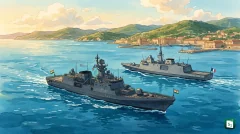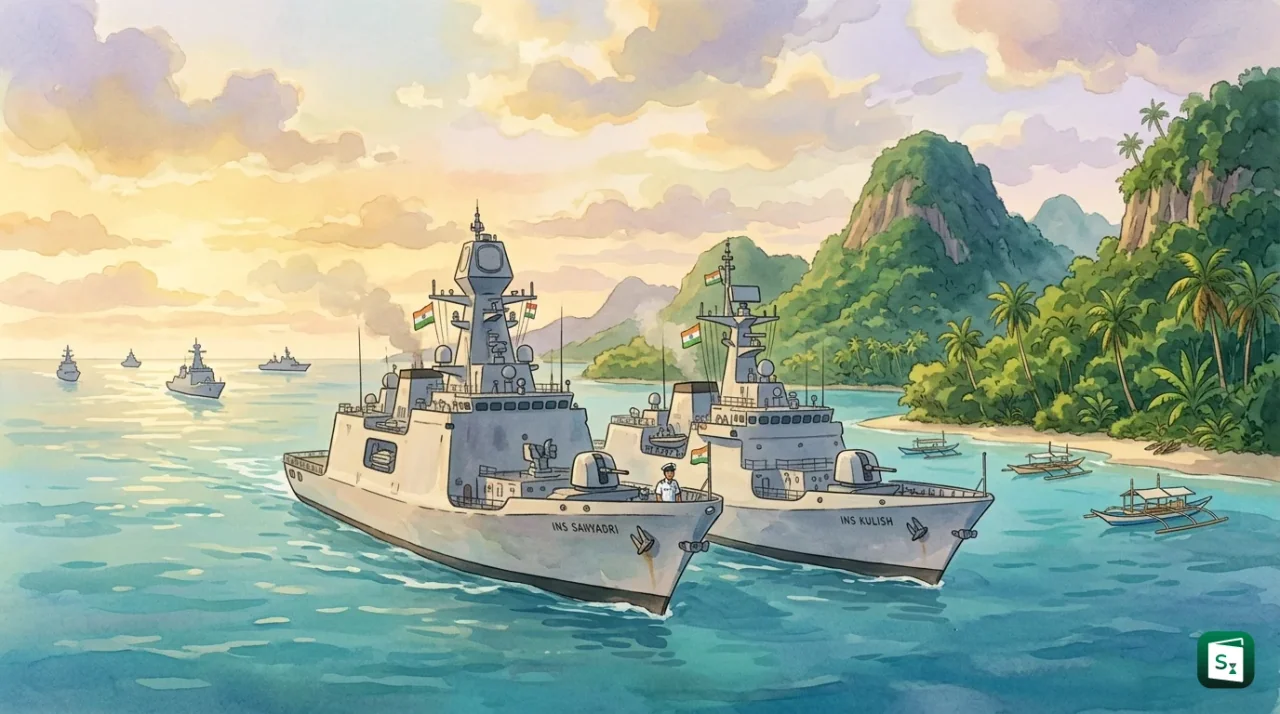
Indian Naval Ships Sahyadri and Kulish concluded their participation in the second ASEAN-India Maritime Exercise (AIME 2026) at Subic Bay in the Philippines. The exercise, which began on 28 September 2026 under the theme Anchored in Trust, United at Sea, brought together maritime forces from India and ASEAN member states for harbour and sea drills. It was held in the ASEAN-India Year of Maritime Cooperation 2026, which gave this edition special diplomatic weight.
What Is AIME 2026 and Where Was It Held?
The ASEAN-India Maritime Exercise 2026 (AIME 2026) is the second joint naval drill between India and the Association of Southeast Asian Nations. It was held at Subic Bay in the Philippines from 28 September 2026 under the theme Anchored in Trust, United at Sea to improve cooperation and interoperability.
The Indian Navy participated with INS Sahyadri and INS Kulish, along with maritime forces from ASEAN member states. The Opening Ceremony at Subic Bay marked the formal start of the exercise. Harsh Kumar Jain, Ambassador of India to the Philippines (as of October 2026), attended as the Guest of Honour and addressed the participating crews.
AIME 2026 was structured in two clear parts. The Harbour Phase focused on professional and social interaction on shore. The Sea Phase then moved the ships out to sea for practical drills and coordinated manoeuvres. This two-part design helps navies first build personal trust and common procedures, then test them in real sailing conditions.
How the Exercise Was Conducted: Harbour Phase and Sea Phase
The Harbour Phase of AIME 2026 combined professional training with social contact. Crews took part in Subject Matter Expert Exchanges, which are classroom style sessions where specialists share skills on specific naval tasks. Key Leaders Engagements brought senior officers together to discuss plans and build working relations. A Table-Top Exercise allowed officers to rehearse sea movements on maps and charts before sailing. This was followed by Operational Synchronisation and a Pre-Sail Brief to align communication methods, safety rules and sailing schedules.
Daily life during the harbour stay also mattered. The programme included sporting events, yoga sessions and community interaction with local residents. Such activities may look informal, but they reduce hesitation between crews who speak different languages and follow different naval traditions. Familiar faces cooperate faster when ships operate close together at sea.
| Phase | Location and Period | Main Activities |
|---|---|---|
| Harbour Phase | Subic Bay, after 28 September 2026 | Expert exchanges, table-top rehearsal, operational synchronisation, pre-sail brief, sports, yoga, community visit |
| Sea Phase | Waters off the Philippines | Coordinated sailing, communication drills and tactical manoeuvres |
The Sea Phase focused on practical cooperation. The ships practised Humanitarian Assistance and Disaster Relief (HADR), which means rapid rescue and relief after floods, cyclones or earthquakes at sea and on coasts. They also practised Visit, Board, Search and Seizure (VBSS), a method to stop, check and if needed seize a suspicious vessel during anti-piracy or anti-smuggling action. Another key drill was Underway Replenishment, in which one ship transfers fuel and supplies to another while both keep moving.
Helicopter work formed a distinct part of the sea drills. Crews carried out cross-deck landings, where a helicopter from one navy lands on the deck of another navy ship. They also practised vertical replenishment, which uses helicopters to lift cargo from ship to ship, and CASEVAC, which is the quick evacuation of an injured person by air for medical care. Together, these drills improved shared understanding, radio coordination and safe joint movement.
Indian Naval Ships at AIME 2026: INS Sahyadri and INS Kulish
The Indian Navy sent two frontline warships from very different classes to AIME 2026. The pairing allowed India to show both long-range frigate capability and agile corvette operations. Both ships belong to the Eastern Fleet, which is based at Visakhapatnam under the Eastern Naval Command and handles deployments toward Southeast Asia and the Pacific.
INS Sahyadri (F49) is a Shivalik-class stealth multi-role frigate. Stealth here means design features that reduce radar, heat and noise signals and make detection harder. The ship was built by Mazagon Dock Shipbuilders Limited in Mumbai and was commissioned on 21 July 2012. It displaces about 6,200 tonnes at full load, measures 142.5 metres in length and can reach 32 knots with its Combined Diesel or Gas propulsion system. The crew strength is about 257 personnel. The frigate can carry two helicopters, such as the Sea King or the indigenous Dhruv, and is armed with Barak and Shtil air defence missiles, Klub or BrahMos cruise missiles, a 76 mm gun, close-in weapon systems and anti-submarine rockets and torpedoes.
INS Kulish (P63) is a Kora-class guided missile corvette. A corvette is a smaller, fast warship suited for coastal patrol, surface attack and picket duties. The ship was built by Garden Reach Shipbuilders and Engineers in Kolkata and was commissioned on 20 August 2001. It displaces about 1,400 tonnes, measures 91.1 metres in length and has a top speed of 25 knots with a crew of 134, including 14 officers. Its main punch comes from 16 Kh-35 Uran-E anti-ship missiles fired from four quad launchers, supported by a 76.2 mm AK-176 gun, two AK-630 close-in guns and shoulder-fired air defence missiles. It can operate one Chetak or Dhruv helicopter.
| Feature | INS Sahyadri (F49) | INS Kulish (P63) |
|---|---|---|
| Class and type | Shivalik-class stealth frigate | Kora-class missile corvette |
| Builder | Mazagon Dock Shipbuilders Limited, Mumbai | Garden Reach Shipbuilders and Engineers, Kolkata |
| Commissioned | 21 July 2012 | 20 August 2001 |
| Displacement | About 6,200 tonnes | About 1,400 tonnes |
| Primary role at AIME 2026 | Long-range multi-role operations, helicopter drills | Fast surface action, VBSS and escort tasks |
Before AIME 2026, both ships had already operated in the same waters. They arrived at Subic Bay on 21 September 2026 and took part in the ASEAN Defence Ministers Meeting Plus Experts Working Group on Maritime Security Joint Cooperation Activity from 21 to 25 September 2026. That activity was hosted by the Philippine Navy and co-chaired by Japan. The back-to-back presence gave Indian crews extra familiarity with local procedures before the AIME harbour phase began.
What Is ASEAN and How Many Countries Are Members?
The Association of Southeast Asian Nations (ASEAN) is a regional group for political, economic and security cooperation in Southeast Asia. It was formed on 8 August 1967 through the Bangkok Declaration. ASEAN has eleven member countries (as of October 2026) and its secretariat is located in Jakarta, Indonesia.
ASEAN began with five founding members. Indonesia, Malaysia, the Philippines, Singapore and Thailand signed the Bangkok Declaration in 1967 to promote peace, economic growth and social progress after a period of confrontation in the region. Brunei joined on 7 January 1984, Vietnam joined on 28 July 1995, Laos and Myanmar joined on 23 July 1997, Cambodia joined on 30 April 1999 and Timor-Leste joined on 26 October 2025. This history explains why the group is often described as moving from five to eleven.
| Member Country | Joined ASEAN |
|---|---|
| Indonesia, Malaysia, Philippines, Singapore, Thailand | 8 August 1967 as founding members |
| Brunei | 7 January 1984 |
| Vietnam | 28 July 1995 |
| Laos, Myanmar | 23 July 1997 |
| Cambodia | 30 April 1999 |
| Timor-Leste | 26 October 2025 |
The ASEAN Way refers to decision making by discussion and consensus without voting or interference in internal affairs. ASEAN Centrality is a related idea. It means ASEAN stays at the centre of wider regional forums and outside powers engage the region through ASEAN-led platforms. India has repeatedly stated support for both principles.
In 2026, the Philippines holds the ASEAN Chairmanship under the theme Navigating Our Future, Together. The 48th ASEAN Summit met in Cebu on 8 May 2026. The 49th ASEAN Summit and Related Meetings are scheduled for 10 to 12 November 2026 in Metro Manila at the Philippine International Convention Center. AIME 2026 in Subic Bay therefore sits inside a larger Philippine-led summit and maritime cooperation calendar.
From AIME 2023 to AIME 2026: History and Evolution
The first ASEAN-India Maritime Exercise was held from 2 to 8 May 2023. The Republic of Singapore Navy and the Indian Navy co-hosted that inaugural edition. Singapore acted in its role as country coordinator for ASEAN-India Dialogue Relations for 2021 to 2024. The idea came out of an informal meeting of ASEAN and Indian defence ministers in Cambodia in November 2022.
AIME 2023 began with a Harbour Phase at Changi Naval Base in Singapore from 2 to 4 May. The Sea Phase followed on 7 and 8 May in the South China Sea, along the transit route toward the Philippines where ships then joined the ASEAN Multilateral Naval Exercise. India sent the guided missile destroyer INS Delhi, the stealth frigate INS Satpura and a P8I maritime patrol aircraft with integral helicopters. Singapore sent the frigate RSS Supreme. In total, the 2023 exercise involved nine ships, six aircraft and more than 1,800 personnel.
The opening ceremony at Changi was jointly officiated by Admiral R Hari Kumar, who was then Chief of the Naval Staff, and Rear Admiral Sean Wat, Chief of the Singapore Navy. Shore teams practised Visit, Board, Search and Seizure and Humanitarian Assistance and Disaster Relief procedures. At sea, crews conducted helicopter cross-deck landings, communication checks, manoeuvring drills and tracking of simulated vessels of interest with support from the Information Fusion Centre in Singapore. They also practised the Code for Unplanned Encounters at Sea, which is a set of safety signals and courtesies to avoid collisions or misunderstanding between warships meeting without warning.
| Feature | AIME 2023 First Edition | AIME 2026 Second Edition |
|---|---|---|
| Venue | Changi Naval Base, Singapore with sea phase in South China Sea | Subic Bay, Philippines |
| Dates | 2 to 8 May 2023 | From 28 September 2026 |
| Indian ships | INS Delhi and INS Satpura plus P8I aircraft | INS Sahyadri and INS Kulish |
| Scale in 2023 | Nine ships, six aircraft, more than 1,800 personnel | Maritime forces from India and ASEAN states in harbour and sea phases |
| Theme | Focus on trust, friendship and confidence | Anchored in Trust, United at Sea |
The shift from Singapore to the Philippines reflects normal rotation of hosting within ASEAN-led engagement. It also places the second edition close to sensitive sea lanes in the western Pacific. For India, the continuity from 2023 to 2026 shows that group-level naval cooperation with ASEAN is becoming a regular practice rather than a one-time event.
Why Is ASEAN Important for India?
ASEAN is important for India because it sits at the heart of New Delhi’s Act East Policy and Indo-Pacific approach. The bloc guards vital sea lanes between the Indian and Pacific Oceans. Closer naval ties help India protect trade, ensure freedom of navigation and support a rules-based maritime order.
The Act East Policy is India’s framework for deeper economic, cultural and security links with Southeast Asia. ASEAN stands as its central pillar. India became a sectoral dialogue partner of ASEAN in 1992 and the relationship has since grown into a Comprehensive Strategic Partnership. The two sides together account for nearly a quarter of the world population and sit astride some of the busiest shipping routes in the world.
Maritime security gives this partnership sharp focus. India supports freedom of navigation and overflight, open sea trade and peaceful settlement of disputes under international law, including the United Nations Convention on the Law of the Sea. Joint drills like AIME allow the Indian Navy and ASEAN navies to refine common procedures for piracy control, smuggling checks, disaster relief and safe encounters at sea. India has often acted as a first responder in the Indian Ocean, including assistance to Filipino seafarers during recent disruptions, and such credibility strengthens trust in wider Indo-Pacific waters.
The timing adds weight. Prime Minister Narendra Modi declared 2026 as the ASEAN-India Year of Maritime Cooperation during the ASEAN-India Summit in October 2025. The year highlights cooperation in maritime security, blue economy, humanitarian relief and sustainable ocean use. AIME 2026 directly serves that agenda. India also links the exercise to the vision of MAHASAGAR, which means Mutual and Holistic Advancement for Security and Growth Across Regions. Announced in 2025, MAHASAGAR extends the earlier SAGAR framework, which means Security and Growth for All in the Region, from the Indian Ocean to all oceans with emphasis on collective responsibility and sustainability.
Bilateral ties with the host add another layer. India and the Philippines raised their relationship to a Strategic Partnership in August 2025. The Indian deployment to Subic Bay therefore supports both the group exercise and closer navy-to-navy links with Manila at a time when the South China Sea remains a zone of competing claims.
Related Naval Exercises and the 2026 Maritime Calendar
A maritime exercise is a planned naval drill to practise joint sailing, communication and rescue tasks. India conducts several recurring exercises, and AIME belongs to the multilateral group that involves many navies at once rather than only two partners.
Exercise MILAN is India’s flagship multilateral naval gathering. It began in 1995 with four navies at Port Blair and has grown into a large event now held at Visakhapatnam. In February 2026, India combined three major events at Visakhapatnam from 15 to 25 February. These were the International Fleet Review 2026, MILAN 2026 and the Indian Ocean Naval Symposium Conclave of Chiefs. The convergence showcased indigenous ships and underlined India’s role as a preferred security partner.
Other bilateral drills fill specific partnerships. The Malabar exercise links India with the United States, Japan and Australia with focus on high-end naval warfare. The Varuna exercise is held with France and the Indra exercise is held with Russia. AIME differs because India trains with ASEAN as a group, which tests interoperability across many different ship types and doctrines in one setting.
| Exercise | Partners | Nature |
|---|---|---|
| AIME 2026 | India and ASEAN navies | Group maritime drill at Subic Bay, harbour plus sea phases |
| ADMM-Plus Maritime Security Activity, September 2026 | ASEAN states plus eight Plus countries, co-chaired by Japan | Professional and operational maritime cooperation at Subic Bay |
| MILAN 2026 with Fleet Review and IONS Conclave | Navies from across the globe at Visakhapatnam | Large multilateral review, drills and chiefs dialogue in February 2026 |
| Malabar, Varuna, Indra | US and partners, France, Russia respectively | Bilateral or quad drills for advanced warfare skills |
The September 2026 ADMM-Plus activity deserves special note. ADMM-Plus means the ASEAN Defence Ministers Meeting Plus, a forum that brings ASEAN states together with eight dialogue partners including India. Sahyadri and Kulish took part in its Experts Working Group on Maritime Security joint activity just days before AIME 2026. The sequence shows how India uses overlapping forums to steadily raise comfort and coordination with the same set of regional navies.
The Way Forward
The lessons from Subic Bay will shape the next cycle of group training. Standard radio drills, common VBSS steps and shared HADR checklists from AIME 2026 can be carried directly into future editions. Regular repetition matters because crews and ships change, but common methods remain.
Policy follow-up is already mapped. The ASEAN-India Year of Maritime Cooperation 2026 will close with the 49th ASEAN Summit and related India meetings in Manila in November 2026. Maritime connectivity, port modernisation, green shipping and supply chain resilience are on the discussion table. Progress on those fronts will decide whether naval trust built at sea also improves trade and logistics on shore.
For the Indian Navy, sustained presence is the clear signal. Back-to-back deployment to ADMM-Plus and AIME, combined with the February 2026 fleet events at home, shows a steady rhythm of eastern engagement under the Act East Policy and MAHASAGAR. If this rhythm holds, group drills with ASEAN can move from confidence building to faster joint response during real crises such as cyclones, collisions or search and rescue tasks.
Key Takeaways
- The second ASEAN-India Maritime Exercise (AIME 2026) began on 28 September 2026 at Subic Bay, Philippines.
- AIME 2026 was conducted under the theme Anchored in Trust, United at Sea with harbour and sea phases.
- India was represented by INS Sahyadri (F49) and INS Kulish (P63) from the Eastern Fleet based at Visakhapatnam.
- ASEAN was established on 8 August 1967 through the Bangkok Declaration and has eleven members with its secretariat in Jakarta.
- The year 2026 is observed as the ASEAN-India Year of Maritime Cooperation, announced at the ASEAN-India Summit in October 2025.
- The first AIME 2023 was co-hosted by India and Singapore from 2 to 8 May 2023 with INS Delhi and INS Satpura.