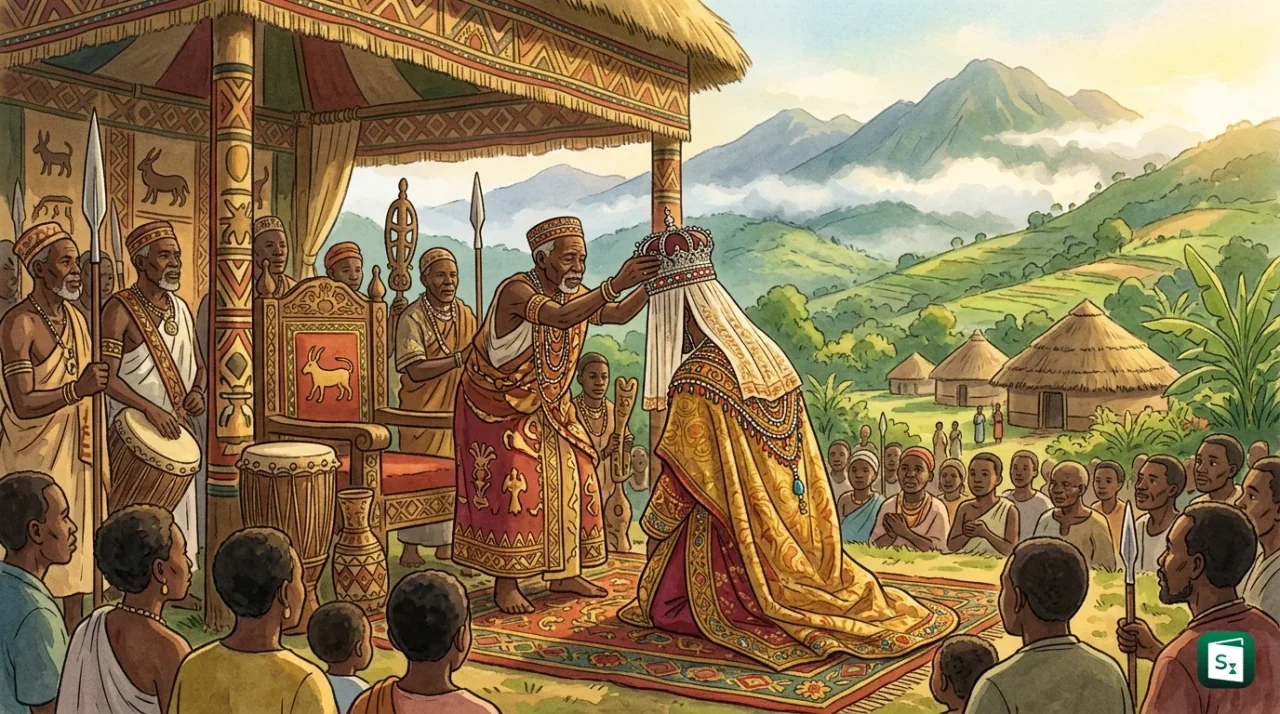
Edward Rukidi Kijanangoma, a 56-year-old former news anchor with the Uganda Broadcasting Corporation, was crowned as the 13th Omukama of Tooro on 29 September 2026 in Fort Portal. He succeeds his cousin King Oyo Nyimba Kabamba Iguru Rukidi IV, who died of aggressive cancer on 27 August 2026 at the age of 34. The midnight coronation ended a bitter succession dispute and put the spotlight back on Uganda’s powerful cultural kingdoms, which shape identity and daily life without holding formal political power.
Who Is the New Omukama of Tooro Now?
The new Omukama of Tooro is Edward Rukidi Kijanangoma Nyabongo I, a 56-year-old former television anchor and editor with the Uganda Broadcasting Corporation. The Babiito royal clan selected him on 9 September 2026 and crowned him on 29 September 2026 in Fort Portal as the 13th king.
Edward Rukidi Kijanangoma took the royal name Edward Rukidi Nyabongo I at his coronation. The name links him to an earlier Tooro ruler and signals continuity. Before the throne, he was a familiar public face in Uganda as a news anchor and editor with the state broadcaster Uganda Broadcasting Corporation (UBC). Colleagues describe him as humble and low key.
The new king belongs to the core royal line. He is the son of the late Prince Christopher Paul Kijanangoma and the grandson of Omukama Sir George David Rukidi III, the 11th king who ruled Tooro from 1928 to 1965. That makes him a first cousin once removed of the late King Oyo. Both men trace their descent from Rukidi III through different sons.
In his first address, the Tooro king pledged to protect culture, traditions, customs and good conduct among his people. The promise matters because the Omukama acts as the chief guardian of Batooro identity. He has no executive power, yet his voice carries weight on education, youth conduct, language and community unity.
Why Did the Tooro Throne Fall Vacant?
The Tooro throne fell vacant because King Oyo Nyimba Kabamba Iguru Rukidi IV died on 27 August 2026 in the United States while receiving treatment for angiosarcoma, a rare and aggressive cancer of the blood vessels. He was 34 years old. His death ended a 31 year reign that had begun when he was a toddler.
King Oyo was born on 16 April 1992 to King Patrick David Matthew Kaboyo Olimi III and Queen Mother Best Kemigisa. His father died suddenly on 26 August 1995. On 12 September 1995, three year old Oyo was enthroned as Rukidi IV. Photographs of the small boy in full royal robes and an oversized crown drew global attention. He entered record books as the world’s youngest reigning monarch at the time.
Regents guided the kingdom until Oyo turned 18 in 2010, when he assumed full duties at a ceremony in Fort Portal. As an adult, he built a quiet but steady public profile. He championed youth empowerment, education, HIV awareness, tourism and environmental conservation. He once climbed the Margherita Peak in the Rwenzori Mountains to draw attention to melting glaciers and climate change.
His final illness was kept private. In early August 2026, the palace said he was abroad on engagements. Soon after, officials confirmed he was critically ill in the United States. President Yoweri Museveni later said the government had funded treatment first in Germany and then in the United States. Oyo died at about 10 p.m. local time on 27 August.
The kingdom observed nine days of mourning. Drums and royal spears at the palace were turned upside down, a sign of grief. His body returned to Uganda on 3 September 2026. Parliament held a moment of silence. He was buried on 12 September 2026 at the Karambi Royal Tombs near Fort Portal, beside his ancestors.
How Was the New King Chosen Amid a Succession Dispute?
The Tooro royal clan chose the new king through custom, not a public vote. The Babiito clan, which holds the Tooro royal bloodline, formed a 21 member Royal Succession Committee after Oyo’s death. The committee worked under the Omusuuga, the head of the clan, Charles Kayondo Kamurasi, who acts as kingmaker and holds all kingdom powers during an interregnum.
The choice was disputed from the start. Tooro Prime Minister Calvin Armstrong Rwomiire Akiiki announced at Oyo’s death that the late king had left behind a young prince as heir. Queen Mother Best Kemigisa and Princess Ruth Komuntale later said Oyo had a written will naming an undisclosed young son born outside marriage. The Babiito clan said no child had ever been presented to it for verification under custom. It insisted that succession was a clan matter governed by tradition.
The key dates in the transition show how quickly the clan moved to restore continuity.
| Date in 2026 | Event in Tooro succession |
|---|---|
| 27 August | King Oyo dies in the United States |
| 9 September | Babiito clan selects Prince Edward Rukidi Kijanangoma at Karuziika Palace |
| 12 September | King Oyo buried at Karambi Royal Tombs after nine day mourning |
| 15 September | Supreme Council (Orukurato) confirms Kijanangoma as king designate at Muchwa |
| 29 September | Coronation of Edward Rukidi Nyabongo I at Karuziika Palace in Fort Portal |
The Babiito announcement on 9 September named Kijanangoma as successor. Early reports said the committee had first considered another cousin, London based Prince George Desmond Kamurasi, who later stepped aside. The Supreme Council, the kingdom parliament known as Orukurato Rw’ensanju, endorsed Kijanangoma on 15 September at Rukurato Chambers in Muchwa. The sitting was chaired by Speaker Julius Mwirumubi. The council asked the clan to fix a coronation date.
Objections continued. The queen mother and the princess said the process ignored Oyo’s will. A petition was filed in the High Court seeking to halt the crowning. Senior national figures backed a quick coronation. Chief of Defence Forces Gen Muhoozi Kainerugaba publicly congratulated the king designate and called for a coronation date without court delays. The central government later confirmed it had received the clan and council resolutions and recognised the process as consistent with custom.
The coronation itself followed strict night ritual. On the evening of 28 September 2026, thousands gathered at Rwengoma Palace on Bwamba Road. At about 10 p.m., the king designate began a torchlit walk to Karuziika Palace on Karuziika Hill. The procession made nine traditional stopovers along the Fort Portal to Bundibugyo route. Between midnight and 3 a.m., he entered the main gate, known as Mugabante, where a mock battle between a rebel prince and the royal guard symbolised the fight for the crown.
Inside Karuziika, priests performed rites reserved for royalty. The rituals included the slaughter of a bull and the sprinkling of a hen’s blood, the sounding of the sacred Nyalebe drum and the restoration of spears and drums to their upright positions. The new Omukama received his first meal as king, millet dough, at about 4 a.m. On the morning of 29 September, he attended a blessing service at St. John’s Cathedral led by Bishop Reuben Kisembo. President Museveni, who holds the traditional title of crown bearer or Omujwara Kondo, attended as chief guest. Organisers expected more than 50,000 people at the palace grounds.
What Does Omukama Mean and How Is Tooro Ruled?
Omukama means king in the Rutooro and Runyoro languages. It is the official title of the rulers of Tooro and Bunyoro in western Uganda. The plural is Abakama. The Omukama is a cultural head and symbol of unity, with no executive political power.
The title carries deep history. It comes from the old Kitara Empire traditions and the later Babiito dynasty, which still provides the kings of both Tooro and Bunyoro. Subjects address the king as Rukirabasaija, a praise title that means the greatest. When a king dies, people say Omukama Atulize, which means the king has passed on, and Enkuba Etutire, which mourns the fallen shield.
The Tooro Kingdom works like a constitutional monarchy at the cultural level. The Omukama sits at the top as the unifying figure. Day to day administration runs through two bodies. The Supreme Council or Orukurato, based at Muchwa, acts as the kingdom parliament. It brings together clan representatives, county chiefs and ministers. The Omuhikirwa or Prime Minister, currently Calvin Armstrong Rwomiire Akiiki, leads the cabinet. The cabinet handles culture, health, education, agriculture, tourism and local mobilisation.
The royal seat is Karuziika Palace on Karuziika Hill overlooking Fort Portal. The first palace was built under Omukama Daudi Kasagama Kyebambe IV in the early 1900s and later expanded. The palace grounds host the annual Empango coronation anniversary, which draws thousands each year. The kingdom uses Rutooro as its working language alongside English. Its anthem is Agutamba. The flag, coat of arms and royal drums complete the symbols of state.
How Was Tooro Kingdom Formed?
Tooro Kingdom was formed around 1830 when Prince Kaboyo Olimi I, eldest son of Bunyoro King Kyebambe III, broke away and set up an independent state. The kingdom was absorbed by Bunyoro in 1876, regained independence in 1891, was abolished in 1967 and restored in 1993.
Tooro’s roots lie in the ancient Kitara Empire of the Great Lakes region. Oral tradition speaks of three early dynasties. The Batembuzi built the first organised leadership. The Bachwezi built the Kitara state. The Babiito, who arrived with Luo migration around the 14th century, still rule Bunyoro and Tooro today.
The direct founder was Rukirabasaija Kaboyo Omuhundwa Kasusunkwanzi Olimi I. He was the eldest son of Omukama Nyamutukura Kyebambe III of Bunyoro Kitara. Around 1830, Kaboyo seceded and declared an independent Tooro. The new state sat in the fertile hills west of the Rwenzori range, rich in lakes, forests and farmland.
The 19th century brought wars and shifting control. Bunyoro reabsorbed Tooro in 1876. Tooro won back independence in 1891 under Omukama Daudi Kasagama Kyebambe IV, with support from British colonial officials. Under colonial rule, Tooro signed protection treaties and kept its monarchy as a native institution.
After Uganda’s independence from Britain in 1962, politics turned against kingdoms. In 1967, President Milton Obote abolished all kingdoms under a new republican constitution. Palaces were seized. Kings went into exile. Tooro remained without a throne for 26 years.
In 1993, President Yoweri Museveni (as of October 2026) restored the traditional kingdoms as cultural institutions. The law gave them no executive power and barred them from party politics. Tooro crowned three year old Oyo in 1995. The restoration revived language teaching, clan meetings, tourism and the Empango festival.
How Big Is Tooro Kingdom?
Tooro Kingdom covers seven districts in western Uganda around Fort Portal City, its capital and cultural centre. The districts are Kabarole, Bunyangabu, Kamwenge, Kitagwenda, Kyenjojo, Kyegegwa and Ntoroko. The kingdom is home to more than two million Batooro and other communities.
The kingdom sits near the border with the Democratic Republic of Congo. It stretches from the Rwenzori foothills to crater lakes, tea estates and parts of Kibale Forest National Park. The land is fertile and densely settled. Fort Portal, now a city, serves as the main town, market hub and tourist gateway.
The native people are the Batooro, and their language is Rutooro, a Bantu tongue. Bakonzo, Bamba, Babwisi and Batuku communities also live inside the kingdom borders. Tooro counts about 70 clans, of which around 20 take active part in kingdom affairs. Each person also carries an Impaako, a traditional pet name such as Akiiki, Ateenyi or Apuuli, given at birth to mark kinship.
The table below gives a quick profile for ready reference.
| Feature of Tooro Kingdom | Detail |
|---|---|
| Capital and largest city | Fort Portal City in western Uganda |
| Royal seat | Karuziika Palace on Karuziika Hill |
| Districts covered | Kabarole, Bunyangabu, Kamwenge, Kitagwenda, Kyenjojo, Kyegegwa, Ntoroko |
| People and language | Batooro people, Rutooro language |
| Anthem | Agutamba |
| Government form | Constitutional monarchy for cultural affairs only |
| Currency and time zone | Ugandan shilling, East Africa Time (UTC plus 3) |
How Many Kingdoms Are in Uganda?
Uganda has five officially recognised traditional kingdoms: Buganda, Bunyoro Kitara, Busoga, Tooro and Rwenzururu, besides the Ankole heritage. Tooro is not an independent country. It is a cultural institution inside the Republic of Uganda with no separate sovereignty or army.
Uganda is a constitutional republic led by an elected president and parliament. The 1995 Constitution recognises traditional leaders but gives them no executive power. Kings cannot join party politics or run governments. Their strength lies in culture, land mobilisation, charity work and moral influence.
Tooro is often studied alongside its neighbours because all four old kingdoms share roots in Kitara.
| Kingdom | Traditional title | Centre and people |
|---|---|---|
| Buganda | Kabaka | Based at Mengo in Kampala, the largest and most influential kingdom of the Baganda |
| Bunyoro Kitara | Omukama | Based at Hoima, mother kingdom of Tooro, now led by Omukama Solomon Gafabusa Iguru I (as of October 2026) |
| Busoga | Kyabazinga | Based at Bugembe near Jinja in eastern Uganda |
| Tooro | Omukama | Based at Fort Portal in the west, founded after split from Bunyoro around 1830 |
| Rwenzururu | Omusinga | Based at Kasese in the Rwenzori foothills, home to the Bakonzo |
The Bunyoro link deserves special note. Tooro broke away from Bunyoro Kitara, once the most powerful state in the region from the 16th to the 19th century. Famous Bunyoro kings include Omukama Kabalega, who resisted colonial rule in the 1890s, and Omukama Kamurasi. The two kingdoms still share the Babiito dynasty, the Omukama title and many customs. This shared past explains why Tooro’s split, reunion and second split remain a standard lesson in Ugandan history.
Why the Tooro Succession Matters Beyond Uganda
The Tooro transition shows how a modern republic manages living monarchies. Uganda kept its kings after restoring them in 1993, but fenced them off from formal power. The model lets the state use royal networks for health drives, schooling, tourism and peace work while keeping elections and courts supreme. The dispute over a will, an undisclosed heir and clan custom tested that balance in full public view.
The story also carries a wider lesson on succession planning. King Oyo died young and unmarried, with no clear public heir. The gap forced clan elders, ministers, courts and the central government into the same debate. Tooro’s answer was speed and ritual. A 21 member clan committee named an adult successor within two weeks, the council endorsed him within three weeks, and a night coronation closed the interregnum within five weeks.
For India, which integrated more than 500 princely states after 1947 and retains cultural respect for erstwhile royal families without political privilege, the parallel is easy to grasp. Uganda’s kingdoms, like India’s former royalties, now thrive on heritage, charity and tourism rather than taxes or armies. The Fort Portal ceremony, attended by the president and watched across Africa, underlines Africa’s continuing interest in culture led development. It also keeps Uganda in the news at a time when Kampala is expanding oil, tourism and diaspora links.
Key Takeaways
- Edward Rukidi Kijanangoma Nyabongo I was crowned 13th Omukama of Tooro on 29 September 2026 at Karuziika Palace in Fort Portal.
- King Oyo Nyimba Kabamba Iguru Rukidi IV died of angiosarcoma on 27 August 2026 at age 34 after ruling Tooro for 31 years since 1995.
- A 21 member Babiito clan committee selected the new king on 9 September 2026, and the Supreme Council (Orukurato) endorsed him on 15 September 2026.
- Omukama means king in Rutooro and Runyoro, and it is the title of the rulers of Tooro and Bunyoro kingdoms.
- Tooro Kingdom was founded around 1830 by Kaboyo Olimi I after breaking away from Bunyoro Kitara, and it was restored in 1993 after abolition in 1967.
- Tooro covers seven districts around Fort Portal City and is one of five recognised kingdoms in Uganda alongside Buganda, Bunyoro, Busoga and Rwenzururu.