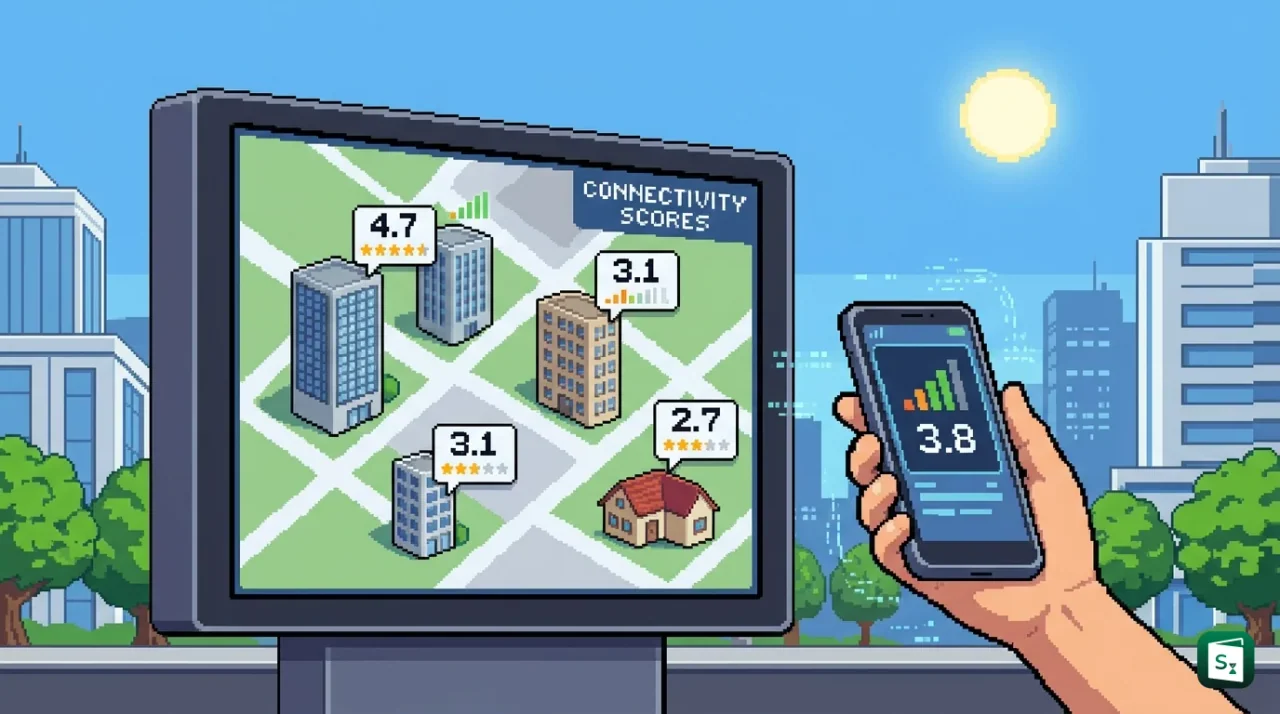
The Telecom Regulatory Authority of India (TRAI) launched the Digital Connectivity Rating (DCR) Platform on 25 September 2026 in New Delhi. The platform, available at dcrp.trai.gov.in, lets buyers and tenants search, view, compare and verify digital connectivity ratings of properties. It makes indoor mobile and internet quality a visible factor in home and office choices.
What Is TRAI?
The Telecom Regulatory Authority of India (TRAI) is the regulator for telecom and broadcasting services in India. TRAI was established on 20 February 1997 under Section 3 of the TRAI Act, 1997. TRAI is headquartered in New Delhi and functions under the Ministry of Communications.
TRAI was created by Parliament to regulate telecom services, including fixation of tariffs, a role earlier held directly by the Central Government. The TRAI Act was amended with effect from 24 January 2000 to set up the Telecom Disputes Settlement and Appellate Tribunal (TDSAT). TDSAT took over adjudicatory and dispute settlement functions, while TRAI retained regulatory and recommendation functions.
TRAI consists of a chairperson along with full time and part time members. The Chairperson of TRAI is Anil Kumar Lahoti (as of September 2026), an officer of the Indian Railway Service of Engineers of the 1984 batch who earlier served as Chairman and Chief Executive Officer of the Railway Board. TRAI works on quality of service standards, consumer protection, tariff orders, interconnection, broadcasting frameworks and new areas such as digital connectivity inside buildings.
What Is Digital Connectivity and Why Rate Properties?
Digital connectivity is the reliable availability of high speed voice and internet access inside a property through fibre, mobile networks, in-building systems and Wi-Fi. TRAI uses the term Digital Connectivity Infrastructure for elements such as ducts, fibre distribution frames, feeder cables, towers, antennas, base stations and in-building solutions.
The need for rating comes from a simple ground reality. A large share of mobile data use, often cited as 70 to 80 percent, happens indoors. Yet indoor coverage is often weak. Walls and modern building materials reduce signal strength, and the problem grows with higher frequency bands used for 5G and upcoming 6G services, which offer fast data rates but lose strength quickly indoors.
Buyers currently have no standard way to compare buildings on connectivity. Two flats in the same city can differ sharply in call drops, indoor signal and broadband readiness. The Digital Connectivity Rating framework gives a standard method to assess fibre readiness, mobile network availability, in-building solutions and Wi-Fi infrastructure, with benchmarks for different property categories. The aim is to push builders to plan this infrastructure at the design stage and to help residents judge connectivity before purchase or lease.
DCR Platform: Features for Consumers, Property Managers and Rating Agencies
The DCR Platform is an integrated digital system that brings three groups onto one interface. TRAI launched the platform on 25 September 2026, along with a mobile application for testing. TRAI Chairman Anil Kumar Lahoti said the platform creates a transparent and standardised system to judge how ready a property is for digital use, with ratings that the public can search and verify.
For consumers, the platform offers a public search page at dcrp.trai.gov.in. Any person can search rated properties by name, certificate identification number or location. Each listing shows the published rating and a digitally signed certificate. The authenticity of the certificate can be checked through the QR code printed on it. Users can also compare properties of interest side by side before taking a purchase or lease decision.
| User | What the DCR Platform Allows |
|---|---|
| Consumers and citizens | Search rated properties, view ratings, verify digitally signed certificates through QR code, compare properties |
| Property Managers | Register, add properties in public, government, commercial and private categories, upload documents, select a registered rating agency, pay fees online, track application status |
| Digital Connectivity Rating Agencies | Receive assigned applications, record assessments and test results, upload evidence, generate reports, issue certificates |
| Service providers and infrastructure providers | Join the assessment process where their network or in-building equipment is involved |
The platform handles the full digital workflow of assessment, report generation, certification and publication. It integrates eSign for signing and verification of documents and certificates. It supports online payment of rating fees, email and SMS alerts at each stage, and secure storage of property records, test results, certificates and audit logs. Data entered on the web portal and test data captured through the mobile application are synchronised in the platform.
How Property Digital Rating Works: End to End Process
The DCR Platform supports rating for both completed buildings and under-construction properties. A Property Manager starts by registering on the portal and creating a property profile. The manager then files a rating application, uploads prescribed information and documents, selects a registered Digital Connectivity Rating Agency working in that location, and pays the applicable fee online. The status of the application can be tracked on the dashboard through every stage.
Field assessment follows the method given in the Rating Manual. The authorised agency visits the property and records observations and measurements on fibre readiness, mobile signal availability from multiple operators, in-building solutions such as distributed antenna systems, Wi-Fi coverage, power backup for telecom equipment and monitoring arrangements. For large or restricted zones, the manual prescribes a sampling method for non-public areas. Service performance is checked through a TRAI designated testing application to keep results standard and comparable.
After testing, the agency uploads evidence, generates the assessment report and completes certification on the platform. The rating certificate is digitally signed and published for public viewing. If occupants later find the rating unsatisfactory, the framework provides a representation route that can lead to an audit. The platform keeps a full digital trail for transparency and future checks.
Role of Digital Connectivity Rating Agencies
A Digital Connectivity Rating Agency (DCRA) is an agency registered with TRAI to assess properties for digital connectivity. Only a registered DCRA can conduct a formal rating. TRAI publishes the list of registered agencies on its DCR portal.
The DCRA uses a dedicated mobile application for field work. Authorised personnel of the agency use the app to take in-building measurements as per the prescribed testing method. The app records test results in a standard format and syncs them to the main platform. This link between the app and the portal reduces manual errors and keeps assessment, reporting and certification in one chain.
Rating Regulations of 2024, Amendment in May 2026 and Rating Manual of June 2026
The legal base for the DCR Platform is the Telecom Regulatory Authority of India (Rating of Properties for Digital Connectivity) Regulations, 2024. TRAI notified these regulations on 25 October 2024 to solve indoor connectivity gaps through a collaborative and self sustaining approach. The regulations apply to Property Managers seeking rating or audit, rating agencies, in-building solution providers and service providers whose networks connect with the building infrastructure.
TRAI first issued a detailed Rating Manual on 13 August 2025 as a guide for fair and uniform assessment. After workshops and feedback from Property Managers, rating agencies and service providers, TRAI released a consultation paper on 27 February 2026 to review the 2024 framework. Stakeholders raised practical issues on rating levels, under-construction properties, property categories and the need for a pre-rating audit option for existing buildings.
| Date | Milestone |
|---|---|
| 25 October 2024 | TRAI notifies Rating of Properties for Digital Connectivity Regulations, 2024 |
| 13 August 2025 | TRAI releases first Rating Manual for assessment |
| 27 February 2026 | TRAI releases consultation paper to review the 2024 regulations |
| 13 May 2026 | TRAI notifies Rating of Properties for Digital Connectivity (Amendment) Regulations, 2026 |
| 9 June 2026 | TRAI issues amended Rating Manual 2026, effective immediately |
| 25 September 2026 | TRAI launches DCR Platform and testing application at dcrp.trai.gov.in |
The amendment expanded the rating scale from five levels to nine levels by adding half star steps, which allows finer distinction between properties. It created a structured multi-stage assessment for under-construction properties so buyers can see the level of digital connectivity infrastructure planned during construction itself. It added provision for an optional Digital Connectivity Audit, which lets managers of existing properties test and improve infrastructure before applying for formal rating. Other changes allowed flexibility in power infrastructure assessment while keeping reliability, permitted centralised monitoring systems beyond conventional Building Management Systems, allowed both fibre and wireless backhaul in a technology neutral way, made service checks standard through a TRAI designated testing application, set a defined sampling method for non-public areas and aligned the manual with updated building construction standards.
TRAI Digital Platforms and Connectivity Testing Method
The DCR testing application is part of a wider set of TRAI digital tools. TRAI offers three main citizen applications on Android, with MySpeed and MyCall also on iOS. The DND 2.0 application manages Do Not Disturb preferences and spam reporting, MyCall collects voice call quality feedback on a five star scale, and the Channel Selector helps television viewers choose channels. These tools feed anonymised consumer data into quality monitoring.
The TRAI MySpeed application is the closest parallel to DCR testing. The revamped MySpeed framework, updated in February 2026, measures more than basic download and upload speed. It records latency, which is the delay in data transfer, jitter, which is variation in that delay, and packet loss, which is loss of data packets during transfer. The app adds video and browser tests that show how the network handles streaming and web use. It offers continuous tests during walk or drive runs, coverage tests for signal strength and scheduled tests that run automatically for long term trends. Results appear with history and map views, and the MySpeed portal lets users explore mobile data experience across India.
DCR assessment uses a stricter, agency led method. Only authorised DCRA personnel can use the dedicated DCRA mobile application for rating measurements. The application follows the fixed testing methodology in the Rating Manual 2026. It captures in-building signal readings, Wi-Fi performance and infrastructure checks in a uniform format. Property details from the portal and field data from the application are merged for scoring. This design keeps citizen speed tests useful for general oversight, while property ratings rest on controlled and auditable agency tests.
Significance and The Way Forward
The DCR Platform makes connectivity a market signal in real estate. Home buyers, tenants and businesses can weigh verified ratings along with price, location and floor space. A high rating can raise the appeal of a project, while a low rating puts pressure on managers to add fibre pathways, equipment rooms, duct space, in-building antennas and reliable power backup. For service providers, standard building readiness lowers deployment cost and disputes over access and wiring.
The framework also fits larger policy goals. It supports Digital India by extending quality access inside premises, not just to the street or tower. It prepares buildings for dense 5G small cells and future high frequency use, which need fibre backhaul and shared in-building networks. Early registration numbers remain small, with initial reports pointing to about 11 property managers and around seven properties on board at launch, so wider adoption will depend on awareness, reasonable fees and visible buyer demand.
The next steps are clear from the official rollout. TRAI will onboard more rating agencies across locations, publish rated properties for public search, and use audits and occupant feedback to keep ratings honest. Builders of new projects are expected to seek staged certification during construction, while managers of existing commercial complexes, residential societies and public buildings can first use the optional audit to find gaps and then apply for rating.
Key Takeaways
- TRAI launched the Digital Connectivity Rating Platform on 25 September 2026, accessible at dcrp.trai.gov.in.
- The platform implements the Rating of Properties for Digital Connectivity Regulations, 2024, amended on 13 May 2026, and the Rating Manual 2026 issued on 9 June 2026.
- Properties are judged on fibre readiness, mobile availability, in-building solutions and Wi-Fi, with ratings verifiable through QR code certificates.
- Only a registered Digital Connectivity Rating Agency can conduct formal assessment using the dedicated mobile testing application.
- TRAI was established on 20 February 1997 under the TRAI Act, 1997 and is headquartered in New Delhi.