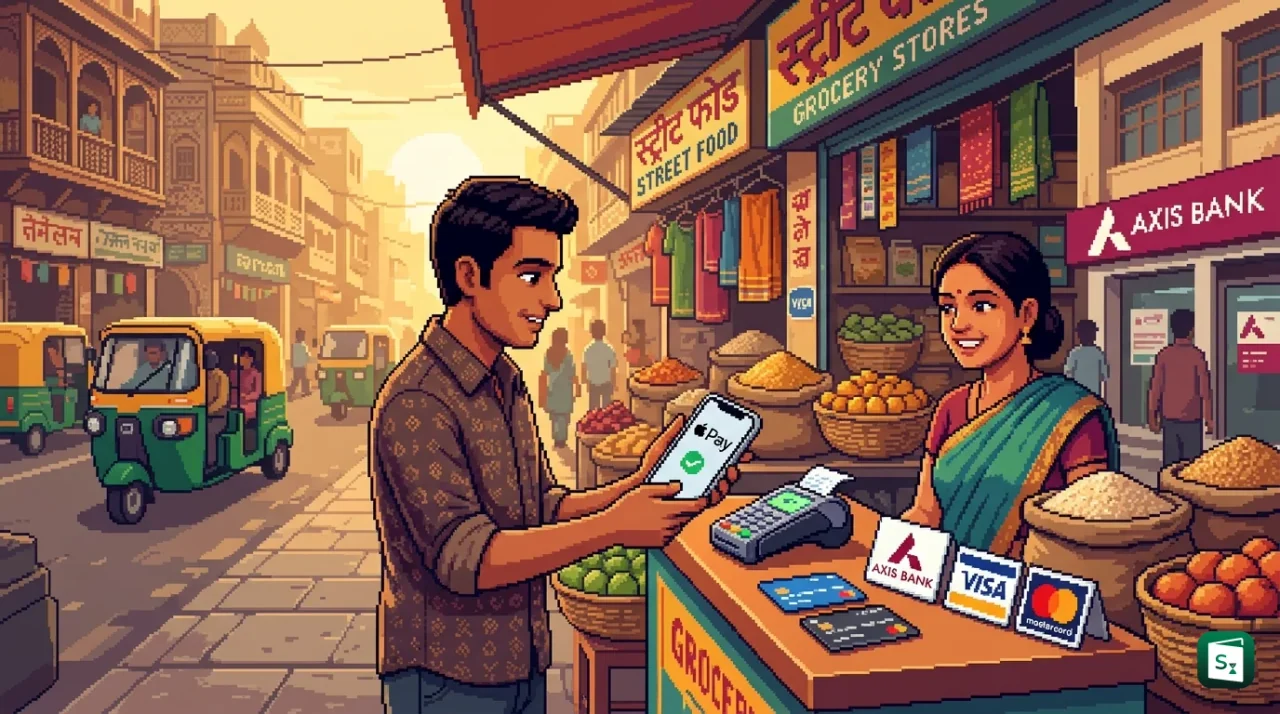
Apple launched Apple Pay in India on 30 September 2026 with Axis Bank as its first banking partner. At launch, only Axis Bank issued Visa and Mastercard credit cards can be added to Apple Wallet for tap to pay in stores, in apps and on the web. The entry brings global card based contactless payments to a market dominated by UPI, while card coverage remains limited to one bank.
Is Apple Pay Available in India?
Yes, Apple Pay is now available in India from 30 September 2026 for customers holding Axis Bank issued Visa and Mastercard credit cards. These users can add their eligible cards to Apple Wallet and pay at contactless terminals, in mobile apps and on websites without entering a PIN or one time password at checkout. Axis Bank has become the first Indian bank to offer the service, and wider bank support is expected through separate bank by bank agreements.
The launch ends a long wait. Apple Pay already works in more than 90 countries and regions with over 11,000 bank and network partners worldwide, but India stayed out for years. Two barriers explain the delay. First, Indian card rules earlier required SMS based one time passwords for most transactions, which did not fit Apple Pay tap and authenticate model using Face ID or Touch ID. The Reserve Bank of India clarified the path through its Authentication Mechanisms for Digital Payment Transactions Directions, 2025, issued in September 2025, which allows device native biometrics as a factor of authentication. Second, commercial terms had to be settled with each card issuer individually. Reports indicate Apple sought a fee of about 0.2% per transaction from issuers, a point still under discussion with larger card issuers such as HDFC Bank, ICICI Bank and SBI Card.
What Is Apple Pay and How Does It Work?
Apple Pay is a digital wallet and contactless payment service from Apple Inc. that lets users store card details on iPhone, Apple Watch and iPad and pay by tapping the device or checking out online. It works with Apple Wallet, the pre installed app that holds credit cards, debit cards, boarding passes and tickets in one place. In stores, Apple Pay uses Near Field Communication (NFC), a short range wireless technology that exchanges payment data when the device is held near a contactless reader.
Apple Pay does not store the real card number on the device or on Apple servers, and it does not share the real number with the shop. When a user adds a card, the card network creates a Device Account Number, a unique digital stand in for the card, and stores it in the Secure Element, a certified chip built into the device for payment data. This process is called tokenisation, which means replacing sensitive card details with a unique token for each card, device and merchant setup. During payment, the device sends this token plus a one time dynamic security code. The bank then maps the token back to the real card and approves the payment.
Authentication happens on the device itself. The user double clicks the side button, confirms with Face ID, Touch ID or device passcode, and holds the device near the reader. Apple states it does not track what users buy or store transaction details that can identify the user. If the device is lost, the user can use the Find My app to locate the device, lock it or suspend payments remotely. Users also keep the same rewards, cashback and benefits linked to their underlying credit cards.
Apple Pay India Launch: Supported Cards, Banks and Devices
Apple Pay in India works only with Axis Bank credit cards on the Visa and Mastercard networks at launch. RuPay cards, debit cards and prepaid cards are not supported in this first phase. Axis Bank, earlier known as UTI Bank and operating since 1994 with headquarters in Mumbai, is the third largest private sector bank in India and held about 16.3 million credit cards in August 2026 out of an industry base of about 124 million cards. The bank has confirmed that eligible customers will be enabled over the next few weeks and will continue to earn existing card rewards on Apple Pay transactions.
Device coverage is broad but has clear cut offs. Apple requires iPhone XR or later running iOS 18 or later for Apple Pay in India. On watches, support starts with Apple Watch Series 6 or later running watchOS 11 or later, paired with a compatible iPhone. iPad users can pay in apps and on the web, while support for Mac is coming soon. The limited issuer base reflects Apple practice of signing direct agreements with each bank, so HDFC Bank, ICICI Bank and SBI Card are expected to join only after commercial terms are finalised.
| Category | What Is Supported at Launch | What Is Not Supported Yet |
|---|---|---|
| Issuer | Axis Bank credit cards | HDFC Bank, ICICI Bank, SBI Card and other issuers |
| Network | Visa and Mastercard | RuPay |
| Card type | Credit cards | Debit cards and prepaid cards |
| Devices | iPhone XR and later, Watch Series 6 and later, iPad | Mac (support coming soon) |
| Channel | In store NFC tap, in app and web checkout | UPI linked payments |
How to Set Up and Use Apple Pay in India
Apple Pay is easy to set up in India through two routes. Customers can open the latest version of the Axis Bank mobile banking app and add an eligible card directly to Apple Wallet, or open the Wallet app on iPhone, tap the plus sign and follow the on screen steps to add the card. The issuer verifies the card once with additional authentication, then generates the token for that device. After that the card is ready for immediate use.
In stores, the user double clicks the side button or Home button, authenticates if asked, and holds the top of the iPhone or the display of the Watch near the contactless reader. For apps and websites on iPhone and iPad, the user selects Apple Pay at checkout and confirms, without retyping card, contact or shipping details. At launch Apple lists acceptance at millions of contactless points, including Apple Store locations, Blinkit, Zomato, Croma, Tata 1mg, Ixigo, Chaayos and Reliance brands. On the backend, Apple has worked with payment providers such as Cashfree, JusPay, Mswipe, Paytm, PayU, Pine Labs, Razorpay and Worldline to enable merchant acceptance, with more merchants to be added over time.
Apple Pay vs UPI: Key Differences and Impact
Apple Pay does not work with Unified Payments Interface (UPI). UPI is an instant bank to bank system developed by the National Payments Corporation of India (NPCI), launched in 2016, that moves money directly between bank accounts using QR codes, phone numbers or UPI IDs. Apple Pay is card based. It stores a tokenised credit card and pays through the Visa or Mastercard network at NFC terminals. A user needs an eligible credit card, a compatible Apple device and an enabled merchant terminal for Apple Pay, while UPI works on most smartphones, including basic models through UPI 123PAY, and needs only a bank account.
The scale gap is large. In July 2026 UPI processed 2,365.8 crore transactions worth ₹29.87 lakh crore across 741 live banks. UPI accounts for about 83% of digital payment volumes in India in 2024 and about 49% of global real time payment volumes, a position recognised by the International Monetary Fund (IMF) in its June 2025 report on retail digital payments as the world’s largest retail fast payment system by volume. UPI is now accepted in 11 countries for cross border person to merchant payments and remittances. India had only about 124 million credit cards in August 2026, so Apple Pay addresses a smaller, largely urban and premium card user base at present.
| Feature | Apple Pay in India | UPI |
|---|---|---|
| Operated by | Apple with banks and card networks | NPCI with member banks |
| Funding source | Visa or Mastercard credit card | Direct bank account, RuPay credit card link or credit line in some cases |
| Technology | NFC tap plus Face ID or Touch ID | QR scan, UPI ID, phone number, NFC in limited pilots |
| Device need | iPhone XR and later, Watch Series 6 and later, iPad | Any UPI app on Android or iOS, plus feature phones via UPI 123PAY |
| Authentication | Device biometrics plus tokenised card | UPI PIN plus device binding |
| Merchant need | NFC enabled terminal or integrated app | Printed QR code is enough |
| Current reach | Thousands to millions of enabled merchants, one issuer | Accepted by crores of merchants across India |
For banks, the impact is commercial as well as competitive. Apple is reported to seek about 0.2% of each transaction as a fee, from a payments margin of roughly 0.4% to 0.5%. Large issuers are weighing this cost against the pull of premium iPhone users, who are more likely to hold high spend credit cards. Apple share of the Indian smartphone market has doubled to about 8% since 2022, a small slice that still represents affluent customers banks compete for. If Apple Pay improves card usage at department stores, food apps, travel apps and lifestyle brands, other banks may join despite the fee pressure.
Significance for India’s Digital Payments Landscape
The launch fits a clear regulatory shift. The Reserve Bank of India (RBI), the central bank and payment system regulator established under the RBI Act, 1934 and headquartered in Mumbai, barred merchants and payment aggregators from storing actual card data from 1 October 2022 and pushed the ecosystem toward token based storage. Under its card tokenisation framework, first allowed for devices in 2019 and extended to card on file tokenisation in September 2021, only card issuers and card networks can act as Token Service Providers. Apple Pay builds directly on this model, since the merchant never sees the real card number. The 2025 authentication directions then allowed device native biometrics as a valid factor, which lets Face ID or Touch ID replace SMS OTP in defined cases.
For consumers, the gain is convenience with stronger privacy. No PIN or OTP typing at the till reduces failed transactions from delayed messages. Token plus dynamic code limits damage from merchant database breaches. For merchants already equipped with NFC readers, especially in metros and organised retail, Apple Pay adds a fast checkout option without new QR stands. For the wider system, the launch tests whether global card wallets can grow alongside UPI. UPI dominates by volume, but credit cards still lead card payments by value, and RuPay credit cards linked to UPI are already expanding card use on UPI rails. Apple Pay adds a parallel card rail for premium in store and in app spends.
The way forward will depend on issuer expansion. Apple has said coverage will widen over time, though it has not named dates or banks. Inclusion of more large issuers, debit cards and wider merchant enablement through existing payment aggregators will decide if Apple Pay stays niche or becomes a routine choice at Indian tills. Close tracking points are new bank tie ups, Mac support rollout and any change in fee sharing between Apple, networks and issuers.
Key Takeaways
- Apple Pay launched in India on 30 September 2026 with Axis Bank as the first Indian banking partner.
- At launch only Axis Bank issued Visa and Mastercard credit cards are supported, with no support for RuPay, debit or prepaid cards.
- Apple Pay requires iPhone XR or later with iOS 18 or later and Watch Series 6 or later with watchOS 11 or later, while Mac support is coming soon.
- Apple Pay uses tokenisation with a Device Account Number stored in the Secure Element and confirms payments with Face ID or Touch ID without sharing the real card number.
- UPI, developed by NPCI and launched in 2016, processed 2,365.8 crore transactions worth ₹29.87 lakh crore in July 2026 and does not work through Apple Pay at launch.