

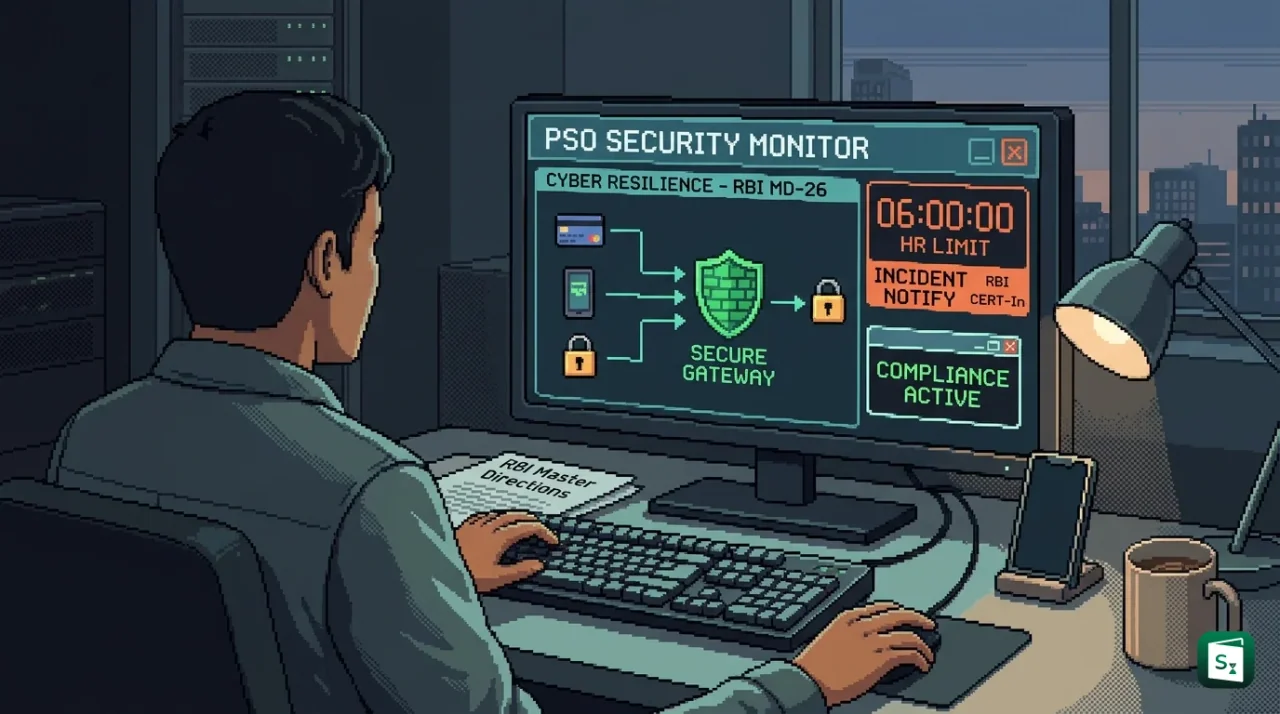
The Reserve Bank of India placed its consolidated Master Directions on Cyber Resilience and Digital Payment Security Controls for non-bank Payment System Operators on its website on 5 November 2026. The Directions apply immediately to large and medium non-bank operators, while small operators must comply by 1 April 2028. They require every covered operator to report unusual incidents to the Reserve Bank within 6 hours of detection and to report cyber security incidents to CERT-In as well.
What Is Cyber Resilience and Why Is It Important for Digital Payments?
The Reserve Bank of India treats cyber resilience as the ability of a payment system to prepare for, respond to and recover from cyber attacks while continuing to provide safe payment services. The concept covers prevention, detection, response and recovery, and not only protection of computers and networks. For digital payments, cyber resilience matters because a single outage, data leak or fraud can halt transactions for crores of users and shake trust in the payment system.
Cyber security focuses on defending systems from attack through tools such as firewalls, encryption and access controls. Cyber resilience starts where defence stops. It assumes that some attack will succeed and asks how fast the operator can limit damage, keep critical payments running and restore full services without loss of data.
| Aspect | Cyber Security | Cyber Resilience |
|---|---|---|
| Main goal | Prevent unauthorised access and attacks | Continue and quickly restore payment services during and after attacks |
| Core actions | Firewalls, patching, encryption, access control | Crisis plan, backup systems, disaster recovery drills, forensic analysis |
| Success test | Fewer breaches | Low downtime, near-zero data loss and fast recovery |
Operational resilience is a wider idea. It includes cyber events plus non-cyber disruptions such as floods, power failure, staff errors and vendor failure. Cyber resilience is the cyber part of operational resilience.
Who Are Non-Bank Payment System Operators?
A Payment System Operator is an entity authorised by the Reserve Bank of India to operate a system that enables payment between a payer and a beneficiary through clearing, payment or settlement. The Payment and Settlement Systems Act, 2007 designates the Reserve Bank as the regulator for payment systems in India. No person other than the Reserve Bank can operate a payment system without its authorisation. Bank-operated systems such as RTGS (Real Time Gross Settlement) and NEFT (National Electronic Funds Transfer) sit outside this order, which covers only authorised non-bank operators.
Non-bank operators run much of the retail payment chain that citizens use daily. The group includes the National Payments Corporation of India (NPCI), which operates UPI (Unified Payments Interface), IMPS (Immediate Payment Service) and NACH (National Automated Clearing House), along with NPCI Bharat Bill Pay, card networks, non-bank ATM networks, White Label ATM Operators (WLAOs), large PPI (Prepaid Payment Instrument) issuers such as wallet providers, TReDS (Trade Receivables Discounting System) operators, BBPOUs (Bharat Bill Payment Operating Units) and Payment Aggregators.
The 2026 Directions divide these operators into three classes for phased compliance:
| Category | Operators covered | Compliance date under 2026 Directions |
|---|---|---|
| Large non-bank PSOs | NPCI, NPCI Bharat Bill Pay, card networks, non-bank ATM networks, WLAOs, large PPI issuers, TReDS operators, BBPOUs, Payment Aggregators | 5 November 2026, the day the Directions were placed on the Reserve Bank website |
| Medium non-bank PSOs | In-bound cross-border money transfer operators under MTSS (Money Transfer Service Scheme) and medium PPI issuers | 5 November 2026 |
| Small non-bank PSOs | Small PPI issuers and instant money transfer operators | 1 April 2028 |
The Directions also reach beyond the licensed operator. Many operators depend on unregulated partners such as payment gateways, vendors, service providers and third party ATM switch application providers. The Reserve Bank requires each operator to ensure that these linked entities follow the same controls through mutual agreement, backed by a Board approved outsourcing policy. If a small PPI issuer grows into a higher category, the timeline of the new category applies.
What the RBI Master Directions Require on Governance and System Protection
The Reserve Bank issued the Directions under Section 10(2) read with Section 18 of the Payment and Settlement Systems Act, 2007. The 2026 order consolidates the earlier Master Directions of 30 July 2024 with two older instructions on cyber security controls for third party ATM switch providers of December 2019 and on system audit scope of January 2020. It creates a single reference for governance, baseline security and digital payment controls. Existing rules on card, PPI and mobile banking security continue to apply, and the Master Directions prevail where there is any overlap.
Governance starts with the Board of Directors. The Board of each operator remains responsible for oversight of information security risk, including cyber risk and cyber resilience. The Board may delegate day to day oversight to a sub-committee headed by a member with experience in information or cyber security, and that sub-committee must meet at least once every quarter. The operator must adopt a Board approved Information Security policy, reviewed every year, and a separate Board approved Cyber Crisis Management Plan to detect, contain, respond to and recover from attacks. Guidance from CERT-In, the National Critical Information Infrastructure Protection Centre and the Institute for Development and Research in Banking Technology can be used for the plan.
Accountability is fixed on a senior executive with expertise in information security, such as the Chief Information Security Officer (CISO). The operator must define Key Risk Indicators to spot potential events and Key Performance Indicators to test whether controls work, and the Board sub-committee must track them continuously. System audit reports and vulnerability assessment and penetration testing reports must be placed before the sub-committee in the meeting held immediately after the report is ready. A fresh cyber risk assessment is required before launching any new product or technology or making major changes to existing systems.
Baseline technology controls every operator must build
The Directions list minimum controls for daily technology operations. Identity and access management must be based on need to have, need to know and least privilege. All users must have a unique digital identity, default passwords must be changed before systems go live, and privileged accounts must use multi-factor authentication with tight monitoring and rotation.
Network protection requires a Security Operations Centre for central monitoring, a Security Information and Event Management system to link alerts across business units, and controls that allow only devices meeting security standards to join the network. Application security must follow a secure by design method such as secure software development life cycle, with a multi-tier design that separates the database layer from other layers. Procured applications must meet the same standards, with access to source code or an escrow arrangement for critical applications.
Security testing must cover all applications at least once a year in authenticated mode through source code review, vulnerability assessment and penetration testing by qualified professionals. Any new or redeployed critical service must pass such audits before it goes live. Vendor risk must follow the Reserve Bank outsourcing framework of 3 August 2021, with controls to block infiltration from vendor networks and independent assurance on vendors handling critical processes. Data protection requires a data leak prevention policy, an Information Security Management System based on recognised standards, encryption of data in transit and at rest, PCI-DSS (Payment Card Industry Data Security Standard) certification for card data storage, and half-yearly testing of backups to ensure recovery without loss of transactions.
How Non-Bank PSOs Must Report Incidents and Ensure Recovery Within 6 Hours
The Reserve Bank requires every operator to have a Board approved incident response mechanism that alerts senior management, staff, regulators and relevant public authorities without delay. The plan must prepare for different scenarios, keep communication lines ready and set out coordination with stakeholders. After any event, the operator must carry out post-incident analysis, including forensic analysis where needed, to find the root cause and stop a repeat.
Unusual incidents such as cyber attacks, outage of critical systems, internal fraud and settlement delay must be reported to the Reserve Bank in the prescribed Incident Reporting Format within 6 hours of detection. Any cyber security incident must also be reported to CERT-In. The six hour clock runs from detection, so operators need clear internal rules on what counts as detection and who can start the clock. The reporting duty sits alongside the CERT-In Directions of 28 April 2022 issued under Section 70B of the Information Technology Act, 2000, which already require service providers, intermediaries, data centres and body corporates to report defined cyber incidents to CERT-In within 6 hours.
CERT-In functions as the national agency for cyber incident response. CERT-In operates under the Ministry of Electronics and Information Technology from New Delhi and has been operational since January 2004, with statutory backing under Section 70B of the Information Technology Act. It collects and analyses incident data, issues alerts and guidelines, coordinates response and runs a 24 hour helpdesk. Failure to report to CERT-In can attract action under the law.
Business continuity and system audit rules
The Directions demand a Business Continuity Plan based on extreme but plausible cyber scenarios, reviewed at least once a year. The plan must set a Recovery Time Objective for resuming services and a Recovery Point Objective for data loss, with a goal of near-zero data loss. The operator must maintain a Disaster Recovery facility in a different seismic zone from the primary data centre, with a clear method to reconcile data so that no transaction is lost. Recovery drills must be held at least twice a year, and any gap from the set objectives must be fixed urgently.
Patch management and change control support the same goal. Security patches must be applied within a set time, with critical patches for known attacks applied immediately after testing in non-production systems. System audit is annual and independent. Each operator must submit a System Audit Report through auditors empanelled by CERT-In or holding CISA (Certified Information Systems Auditor) or DISA (Diploma in Information System Audit) qualification, within two months of the close of the financial year. The audit firm must not have provided other services to the operator in the previous two years. Auditors must test controls for both design and operating effectiveness, and open observations must be closed with time-bound action, generally within three months, and reported to the Reserve Bank.
What Digital Payment Security Controls Apply to Mobile, Card and PPI Payments?
The Reserve Bank requires multi-factor authentication for all electronic debits, including bank account, card and PPI debits and cash withdrawals, except where it has explicitly permitted relaxation. Operators must run a real time or near real time fraud monitoring system that flags suspicious behaviour and generates alerts. A manned facility must work round the clock on all days to help customers report unauthorised transactions quickly and to respond to law enforcement agencies. Audit logs must be captured systematically, must identify the user and action for each entry, and must be preserved for at least five years.
Customer alerts must be clear and safe. Account and card numbers must be masked in SMS and email alerts. Payment alerts must show the merchant name and amount, and fund transfer alerts must show the beneficiary name taken from the beneficiary bank system and the debit amount. Where OTP (One Time Password) is a factor of authentication, the OTP must appear at the end of the message with reference to the specific transaction. The operator must provide a facility on its app or website for customers to mark a transaction as fraudulent after authentication, for instant notice to the issuer.
Mobile, card and wallet specific safeguards
For mobile payments, the operator and its participants must keep the mobile app free from unintended behaviour, keep the authenticated session and its encryption intact, and end the session if it is disturbed or the customer closes the app. Device binding or fingerprinting with the device and SIM is required, with fresh binding if the app stays unused beyond a set period. Inactive sessions must auto-terminate, failed login attempts must be capped with secure reactivation and immediate customer notice, remote access apps must block payment access while active, and a change in registered mobile number or email must trigger a cooling period of at least 12 hours before online payments are allowed.
For card payments, terminals that capture card data must meet PCI-P2PE standards, and PIN entry terminals must meet PCI-PTS approval. Card networks must set transaction limits at card, BIN (Bank Identification Number) and issuer level on their own switches, run a 24 hour alert system to issuers on suspicious events, store card details only in encrypted form and process readable card data only in a secure manner.
For Prepaid Payment Instruments, issuers are encouraged to send OTP and transaction alerts in the user language of choice, including vernacular languages. Both bank and non-bank PPI issuers must apply a suitable cooling period for fund transfer and cash withdrawal after funds are loaded electronically onto the instrument.
How the 2026 Directions Fit into RBI Payments Vision 2028
The 2026 Directions build on a longer regulatory arc. The Reserve Bank first announced this framework in its monetary policy statement of 8 April 2022, released a draft on 2 June 2023 for public comments and issued final Directions on 30 July 2024 with phased deadlines of 1 April 2025 for large operators, 1 April 2026 for medium operators and 1 April 2028 for small operators. A separate Master Direction on Digital Payment Security Controls of 18 February 2021 had already set minimum security standards for banks, small finance banks, payments banks and credit card issuing non-bank finance companies. The November 2026 consolidation brings non-bank operators under a single updated text without changing the small operator deadline.
The move aligns with Payments Vision 2028, released on 27 March 2026 with the theme Shaping the Payment Frontier for the period up to December 2028. The Vision lists 15 initiatives focused on user empowerment, fraud safeguards, cross-border efficiency and ease of doing business. One initiative is a Cyber Key Risk Indicators framework for non-bank operators to allow data driven, continuous supervision and early warning of technology risks. Other initiatives include a switch facility to enable or disable digital payment modes, a shared responsibility framework for fraud liability between payer and beneficiary banks, and stronger research and training capacity for digital payments.
Tighter cyber rules also respond to scale. India now ranks among the world leaders in real time digital payments, with UPI, IMPS, NACH, card networks, wallets and payment aggregators handling crores of daily transactions. The Directions therefore treat resilience as a system property. A failure at NPCI, a large card network or a major aggregator could affect many banks and merchants at once. Central monitoring, annual audits, half-yearly backup tests, disaster recovery in a separate seismic zone and six hour reporting are designed to keep such system level risks visible and to restore services fast when defences fail.
Key Takeaways
- The Reserve Bank placed the consolidated Master Directions on Cyber Resilience and Digital Payment Security Controls for non-bank PSOs on its website on 5 November 2026.
- Large and medium non-bank operators must comply from 5 November 2026, while small PPI issuers and instant money transfer operators must comply by 1 April 2028.
- Unusual incidents must be reported to the Reserve Bank within 6 hours of detection, and all cyber security incidents must also be reported to CERT-In.
- The Directions are issued under Section 10(2) read with Section 18 of the Payment and Settlement Systems Act, 2007, which makes the Reserve Bank the regulator for payment systems.
- Every operator must run a Security Operations Centre, conduct annual security testing, hold disaster recovery in a different seismic zone and preserve audit logs for at least five years.