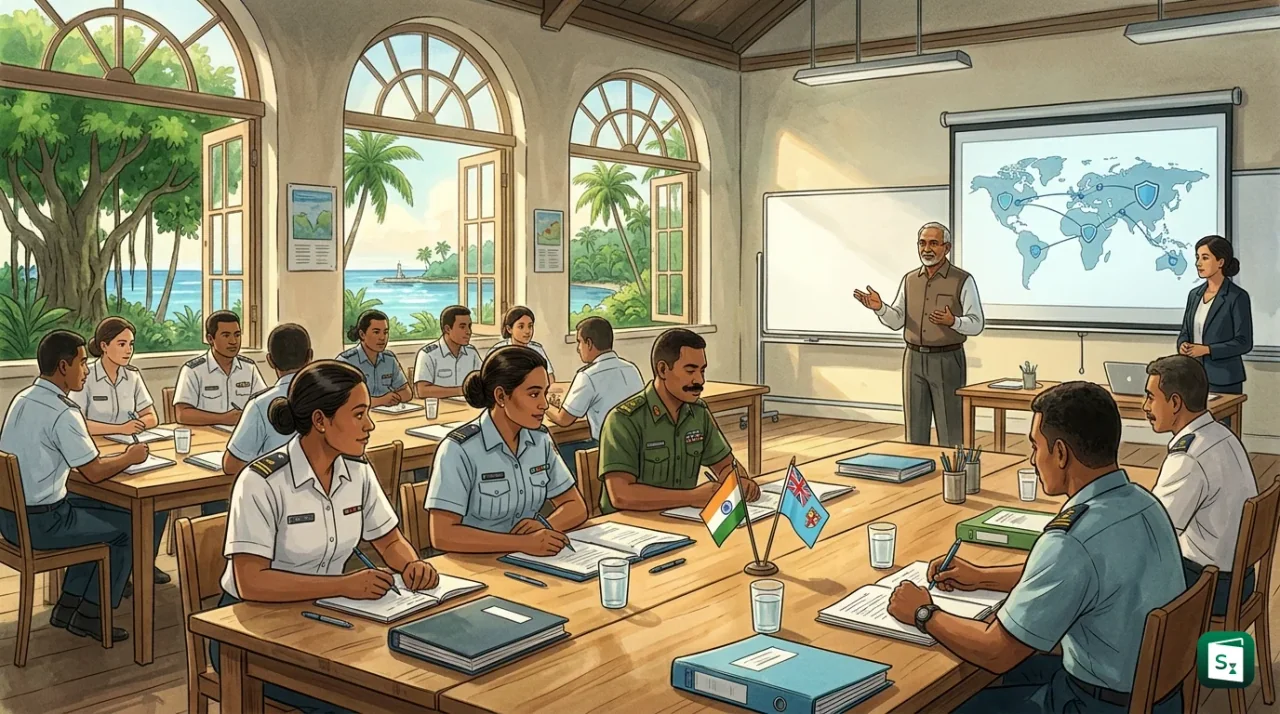
The Defence Headquarters Training Institute (DHTI) under the Ministry of Defence launched its first Global Leadership Programme in Defence Governance and Public Administration for officers of Fiji’s Ministry of Defence on 16 November 2026 in Suva. Fiji’s Minister for Defence and Veteran Affairs Pio Tikoduadua inaugurated the course, while High Commissioner of India to Fiji Suneet Mehta described it as a sign of the close partnership. The programme marks the first time DHTI has conducted a leadership course abroad for foreign civilian defence officers.
What Is the Global Leadership Programme for Fiji Officers?
The Global Leadership Programme in Defence Governance and Public Administration for Emerging Leaders is DHTI’s first international course designed for civilian officers of Fiji’s Ministry of Defence. Defence governance means the system of rules, institutions and oversight that guides how a defence ministry takes decisions, spends money and manages people. Defence management is the day to day running of those decisions through planning, procurement, finance, human resources and audit.
The programme runs in two phases. The first phase takes place in Suva from 16 to 27 November 2026 and was inaugurated by Fiji’s Minister for Defence and Veteran Affairs Pio Tikoduadua. The second phase will take place in New Delhi for two weeks in the first quarter of 2027. The full programme is described as a four week course. High Commissioner of India to Fiji Suneet Mehta said the initiative reflects the close and growing partnership between the two countries, while Minister Tikoduadua said it would help strengthen institutional capacity in Fiji.
What Will Officers Study in the Suva Phase?
The Suva phase focuses on the practical skills a civilian defence ministry needs to run policy, money and people with accountability. The subjects combine Indian administrative experience with tools that Fiji can apply to its own reform agenda.
| Subject | What It Covers in Simple Terms |
|---|---|
| Good governance and citizen centric governance | How ministries frame clear policies, deliver services on time and keep citizens at the centre of decisions |
| Defence procurement | How ministries plan purchases, select vendors fairly and manage contracts for equipment and services |
| Ethics in governance and administrative law | Rules for honest conduct and the legal limits within which officers use official power |
| Talent management and capacity building | How ministries recruit, train and retain staff and plan for future leadership |
| Modernisation of the audit framework in defence | How audit systems track defence spending, check waste and improve financial control |
| AI for digital transformation | How artificial intelligence and digital files speed up records, analysis and decision making |
| Purpose driven leadership, strategic communication and emotional intelligence | How leaders set a clear purpose, explain decisions well and manage teams under stress |
Defence procurement and defence audit matter most for Fiji because both decide whether limited funds turn into real capability. Better procurement rules reduce delays and cost overruns. A stronger audit system shows parliament and the public that defence money is used correctly. Together with AI tools and leadership training, these skills support Fiji’s push for sound laws, clear mandates and professional education rather than new equipment alone.
What Is DHTI and How Does It Train Civilian Defence Staff?
DHTI stands for the Defence Headquarters Training Institute. The institute functions under the Ministry of Defence through the Office of the Joint Secretary and Chief Administrative Officer and operates from New Delhi, with offices at R K Puram and Dara Shukoh Road. The institute trains civilian officers of the Armed Forces Headquarters and other defence establishments in administration, rules, finance and office management.
DHTI secured Ati Utkrishth grading with four stars in March 2026 under the National Standards for Civil Services Training Institutions (NSCSTI) framework. The grading marked a clear rise from its earlier Uttam rating with one star two years earlier. A four member NSCSTI team assessed records, infrastructure, governance systems and academic processes on 10 and 11 March 2026 before awarding the higher grade.
The institute works within Mission Karmayogi, the National Programme for Civil Services Capacity Building approved by the Union Cabinet in September 2020. Mission Karmayogi aims to move training from a rules based approach to a roles based approach and supports continuous learning through the iGOT Karmayogi digital platform. The Capacity Building Commission, set up in April 2021, guides standards for central training institutions. In November 2025 DHTI signed memorandums of understanding with the National Academy of Direct Taxes (NADT) in Nagpur and the V V Giri National Labour Institute (VVGNLI) in Noida to share faculty, curriculum and research. These steps explain why DHTI was chosen to lead India’s first defence governance course for Fiji.
Why Fiji Needs Stronger Defence Governance Now
Fiji’s Ministry of Defence and Veteran Affairs, based in Suva, advises the government on strategy and policy and oversees the Republic of Fiji Military Forces (RFMF). The ministry also handles public order support, response to national emergencies, aerial surveillance and search and rescue. The current minister is Pio Tikoduadua, a former lieutenant colonel who served for 26 years and held UN related duties in Lebanon, Egypt, East Timor and the Solomon Islands.
The RFMF traces its origin to 1920 and has about 6,500 active personnel and about 6,200 reservists, with headquarters in Suva. The President of Fiji is the ex officio commander in chief, while the present commander is Major General Jone Kalouniwai. Two regular battalions of the Fiji Infantry Regiment traditionally serve abroad on peacekeeping duties in Lebanon and Sinai. Income from peacekeeping has long supported Fiji’s forces, which makes training, logistics and welfare systems critical.
In July 2026 Minister Tikoduadua told Fiji’s parliament that the military must never become a substitute for civilian policy. The government started a broad security sector reform plan that includes a review of RFMF laws, a maritime security strategy, Fiji’s first national peacekeeping strategy, a stronger search and rescue framework and a defence cyber security strategy. The plan also created a Joint Logistics Command and an automated logistics management system to improve stores and readiness. The minister said lasting security depends on sound laws, clear mandates, professional education and accountable institutions. The DHTI course directly supports this reform focus on institutions and skills.
How the Programme Deepens India Fiji Defence Cooperation
India and Fiji signed a memorandum of understanding on defence cooperation in 2017. The second India Fiji Bilateral Joint Working Group meeting took place in New Delhi on 28 September 2026. The meeting was co chaired by Amitabh Prasad, Joint Secretary for International Cooperation in India’s Ministry of Defence, and Mason Smith, Permanent Secretary for Defence and Veterans Affairs of Fiji. The two sides discussed military training and capacity building, service to service contacts, maritime security, cyber training and defence industry collaboration. The Fijian team then visited Kochi on 29 and 30 September 2026 to study training facilities at the Southern Naval Command.
The DHTI programme follows the joint statement issued during Fiji Prime Minister Sitiveni Rabuka’s visit to India from 24 to 26 August 2025. The statement, framed in the spirit of Veilomani Dosti, recorded cooperation in UN peacekeeping operations, military medicine, White Shipping Information Exchange and capacity building for the RFMF. India announced the gifting of two ambulances to the RFMF, the setting up of a defence wing in the High Commission of India in Suva and a Cyber Security Training Cell in Fiji. Fiji welcomed support for the security of its Exclusive Economic Zone and a planned port call by an Indian naval ship.
The wider setting is the Indo Pacific. India sees Fiji as a hub in its Act East Policy and in the Forum for India Pacific Islands Cooperation (FIPIC), launched in Suva in November 2014. Fiji expressed interest in joining the Indo Pacific Oceans Initiative (IPOI) during the August 2025 visit and promotes the Ocean of Peace idea for a stable Pacific. The link is also human. Indian labourers were brought to Fiji under the indenture system between 1879 and 1916, with about 60,553 arrivals, and persons of Indian origin now form about one third of Fiji’s population. Hindi is an official language of Fiji. Training of civilian defence officers therefore builds on deep historical ties and a shared interest in a free, open, secure and inclusive Indo Pacific.
Key Takeaways
- DHTI launched its first Global Leadership Programme in Defence Governance and Public Administration for Fiji’s Ministry of Defence officers on 16 November 2026 in Suva.
- The first phase runs in Suva from 16 to 27 November 2026 and the second phase will run in New Delhi for two weeks in early 2027.
- The Suva curriculum covers defence procurement, administrative law, defence audit modernisation, AI for digital transformation and leadership skills.
- DHTI functions under India’s Ministry of Defence and earned Ati Utkrishth four star grading under NSCSTI in March 2026.
- The course follows the 2017 defence cooperation MoU and the second Joint Working Group meeting held in New Delhi on 28 September 2026.