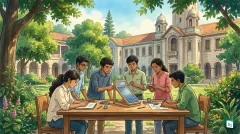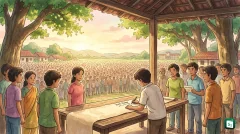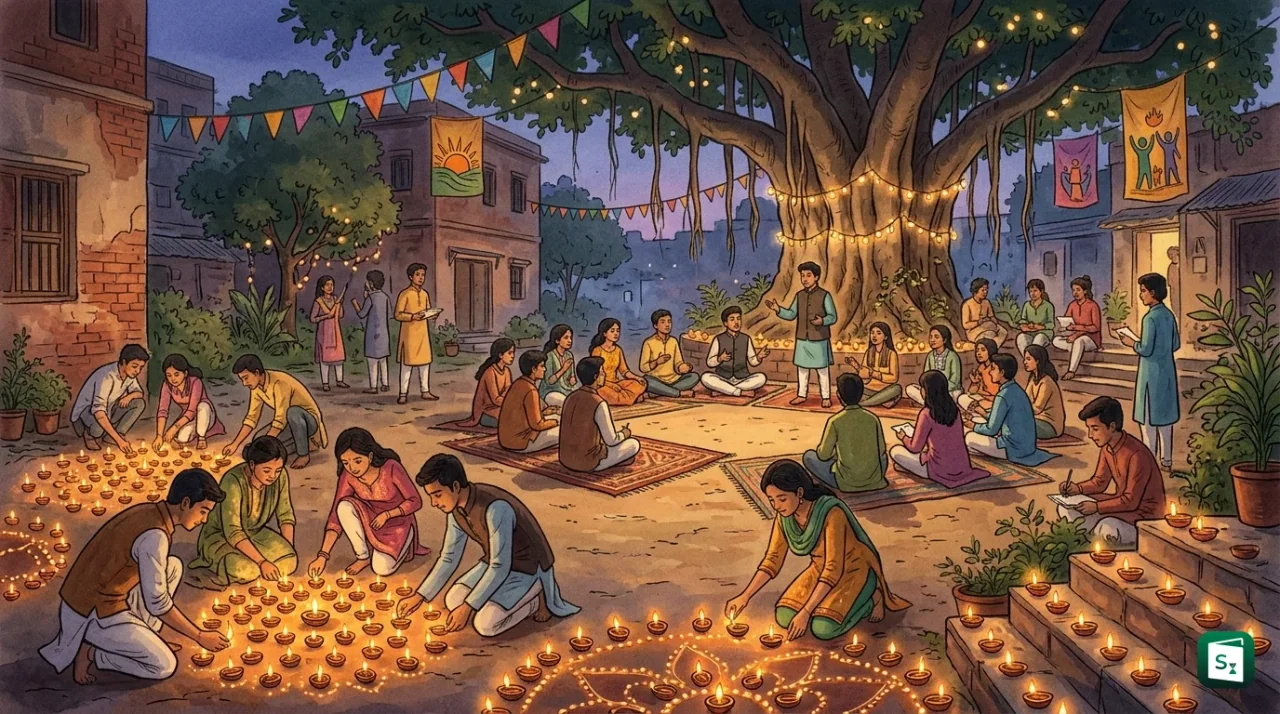
Mera Yuva Bharat organised nationwide Deepotsav celebrations and Neighbourhood Youth Parliaments on 6 and 7 November 2026 as part of Week 8 of the 100-week Nasha Mukt Yuva for Viksit Bharat campaign. More than 1.19 lakh young people and citizens across 30 States and Union Territories joined the two programmes and took pledges for a drug-free India. The events linked Diwali festivities with structured youth discussions on substance abuse and prevention.
What Is Nasha Mukt Yuva for Viksit Bharat?
The Nasha Mukt Yuva for Viksit Bharat Sankalp Abhiyan is a 100-week national youth movement against substance abuse launched by Prime Minister Narendra Modi on 2 August 2026 through video conferencing. The campaign organises public activities every Sunday for 100 weeks to spread awareness and encourage community participation for a drug-free India. It connects students, MY Bharat volunteers, National Service Scheme (NSS) members, youth clubs, colleges, industry bodies, civil society groups and spiritual organisations on one platform.
The Prime Minister described the coming 100 Sundays as 100 strong steps toward a completely drug-free India. The idea began as a pilot project in Kashi in 2025, where youth groups, educational institutions and youth wings of industry associations worked with more than 125 spiritual organisations and non-governmental organisations. Their joint roadmap, called the Kashi Declaration, became the base for the national campaign.
The Abhiyan is designed as a Jan Bhagidari movement, which means a movement led by people themselves with government support. Its work is grouped under four pillars of Prevent, Protect, Recover and Lead. Weekly themes include sports meets, walkathons, meditation sessions, cultural programmes, nukkad nataks, discussion forums, art competitions and community service. Youth take the Nasha Mukt pledge to stay away from drugs and to carry the message to schools, colleges and neighbourhoods.
The campaign links de-addiction directly to the vision of Viksit Bharat 2047, which is the national goal to make India a developed nation by 2047, the 100th year of Independence. The core argument is simple. India has nearly 40 crore people in the age group of 15 to 29 years, and about 65 percent of the population is below 35 years. If this large young workforce remains healthy and free from addiction, it can drive economic growth, innovation and nation building.
What Is Nasha Mukt Bharat Abhiyan?
The Nasha Mukt Bharat Abhiyan (NMBA) is the parent national awareness programme against substance abuse in India. The Ministry of Social Justice and Empowerment launched NMBA on 15 August 2020 in 272 districts identified as most vulnerable to drug use. The selection was based on inputs from the Narcotics Control Bureau (NCB) and the findings of the first Comprehensive National Survey on Extent and Pattern of Substance Use conducted in 2018.
NMBA is the flagship awareness component of the National Action Plan for Drug Demand Reduction (NAPDDR), which supports prevention, treatment and rehabilitation. The coverage was expanded to 372 districts in August 2022 and to all districts of the country from 15 August 2023. The 2026 note on six years of the Abhiyan describes its shift from a government programme to a peoples movement with participation from schools, colleges, youth groups and local bodies.
The newer Nasha Mukt Yuva for Viksit Bharat campaign works under the Ministry of Youth Affairs and Sports and strengthens NMBA by adding sustained youth mobilisation. While NMBA provides the treatment and prevention framework through Nasha Mukti Kendras (de-addiction centres), counselling and district level outreach, the 100-week youth campaign provides weekly volunteer energy and local action. There is no separate law that fixes a single year as the drug-free India year. Official statements link the drug-free goal to the broader Viksit Bharat 2047 timeline and call for continuous reduction in demand and supply.
Mera Yuva Bharat Portal and Neighbourhood Youth Parliaments
Mera Yuva Bharat (MY Bharat) is an autonomous body under the Department of Youth Affairs in the Ministry of Youth Affairs and Sports. The Union Cabinet approved its creation on 11 October 2023, and Prime Minister Narendra Modi launched the MY Bharat portal (mybharat.gov.in) on 31 October 2023 at Kartavya Path in New Delhi on National Unity Day, which marks the birth anniversary of Sardar Vallabhbhai Patel.
MY Bharat is a phygital platform, which means it combines physical activities with digital connection. Youth in the age group of 15 to 29 years, the definition of youth under the National Youth Policy, can register on the portal and join volunteering, experiential learning, skill building and leadership programmes. Adolescent focused components cover ages 10 to 19 years. The portal acts as a one-stop shop for youth and ministries, creates a centralised youth database, and helps youth act as Yuva Setu, or bridges between government programmes and local communities. The Ministry is headed by Cabinet Minister Mansukh Mandaviya, with Minister of State Raksha Nikhil Khadse.
Neighbourhood Youth Parliaments (NYPs) are block level discussion forums run through the MY Bharat network, earlier anchored by the Nehru Yuva Kendra Sangathan. Each parliament is designed for about 80 youth per block in the age group of 15 to 29 years, all registered on the MY Bharat portal. Participants learn parliamentary procedure, debate local issues, and learn about government initiatives. Under the current campaign, NYPs use the theme Nasha Mukt Yuva and hold four structured sessions on the portal, on understanding substance abuse, on tools to move from awareness to action, and on stories of recovery, followed by slogan writing, street plays and pledge taking.
How Week 8 Combined Deepotsav Lights With Youth Discussions
Week 8 activities were held on 6 and 7 November 2026 around Diwali under two titles. The first was Nasha Mukt Yuva Deepotsav: Ek Diya Sankalp Ka, which means one lamp of resolve. The second was Nasha Mukt Yuva Par Paricharcha, or discussion on drug-free youth, held through Neighbourhood Youth Parliaments. Together they mobilised more than 1.19 lakh youth and citizens across 30 States and Union Territories.
| Programme | Programmes Held | Activities Held | Participation |
|---|---|---|---|
| Nasha Mukt Yuva Deepotsav: Ek Diya Sankalp Ka | 435 | 568 | 1,10,101 people |
| Nasha Mukt Yuva Par Paricharcha through NYPs | 85 | 298 | 9,526 people |
| Week 8 total | 520 | 866 | more than 1.19 lakh people |
Nasha Mukt Yuva Deepotsav: Ek Diya Sankalp Ka
The Deepotsav leg was the larger part of Week 8. Youth lit diyas, made rangoli, distributed sweets and fruits, and held awareness talks on the harm caused by drugs. MY Bharat volunteers who had worked in earlier weeks were felicitated in several places. Partner organisations including the Brahma Kumaris, the Education Promotion Society for India (EPSI) and Heartfulness joined the outreach.
Local examples show the range of activities. In Uttar Pradesh, volunteers organised celebrations in Lucknow, distributed sweets and fruits at an old-age home in Banda, and held awareness drives in Rampur. In Chhattisgarh, Deepotsav and rangoli events were organised in Mungeli and Dhamtari. In Himachal Pradesh, celebrations and sweets distribution were organised at an old-age home in Kangra. Similar events were reported from Yavatmal in Maharashtra, Yanam in Puducherry, and districts in Jammu and Kashmir. This MY Bharat Deepotsav was separate from the large Ayodhya Deepotsav, where the Uttar Pradesh government lit more than 30 lakh lamps on 7 November 2026.
Nasha Mukt Yuva Par Paricharcha Through Youth Parliaments
The Paricharcha leg recorded 85 block level programmes with 9,526 participants. Each parliament held four sessions. The first introduced the MY Bharat portal and its benefits. The second explained substance abuse and the challenges before youth. The third focused on practical tools to convert awareness into action. The fourth screened Stories of Change, an audio-visual presentation on the journey toward a drug-free India.
The format kept discussion interactive. Youth wrote slogans, created rangoli on anti-drug themes, staged street plays, and took the Nasha Mukt pledge in Hindi and English to remain drug free and to guide others. Programmes were reported from Bhuna block in Fatehabad district in Haryana, Latur in Maharashtra, East Delhi, and Dongargarh block in Chhattisgarh. The emphasis was on last mile reach, with debates held in the language of the local community.
Why Substance Abuse Remains a Major Challenge for Youth
The 2018 national survey on substance use, led by the National Drug Dependence Treatment Centre (NDDTC) at the All India Institute of Medical Sciences (AIIMS), New Delhi for the Ministry of Social Justice and Empowerment, covered more than 2 lakh households and 4.73 lakh people. It found that alcohol is the most widely used substance, followed by cannabis and opioids. The estimates help explain why sustained campaigns are needed.
Alcohol was used by about 14.6 percent of people aged 10 to 75 years, or about 16 crore persons. Cannabis was used by about 3.1 crore persons, and opioids by about 2.26 crore persons, including heroin, opium and pharmaceutical opioids used without prescription. About 1.18 crore persons used sedatives without medical advice. Inhalants showed a worrying pattern among children, with use among children and adolescents higher than among adults.
The survey also measured harmful and dependent use, which is the share of users who need professional help. About 5.7 crore persons needed help for alcohol, about 77 lakh persons for opioids, and lakhs more for sedatives and inhalants. Men accounted for most of the burden, but all population groups were affected. Officials have noted wide differences across States, with higher prevalence of alcohol use in Chhattisgarh, Tripura, Punjab, Arunachal Pradesh and Goa, and higher opioid use in several north eastern States along with Punjab, Haryana and Delhi.
Key Takeaways
- The Nasha Mukt Yuva for Viksit Bharat Sankalp Abhiyan was launched by Prime Minister Narendra Modi on 2 August 2026 as a 100-week campaign with activities every Sunday.
- Week 8 events titled Ek Diya Sankalp Ka and Par Paricharcha were held on 6 and 7 November 2026 and engaged more than 1.19 lakh people across 30 States and Union Territories.
- Mera Yuva Bharat (MY Bharat) was approved on 11 October 2023 and launched on 31 October 2023 as an autonomous phygital platform under the Ministry of Youth Affairs and Sports for youth aged 15 to 29 years.
- The parent Nasha Mukt Bharat Abhiyan was launched by the Ministry of Social Justice and Empowerment on 15 August 2020 in 272 districts and now covers all districts.
- The 2018 national survey estimated about 16 crore alcohol users, 3.1 crore cannabis users and 2.26 crore opioid users in India, showing the scale of substance use.