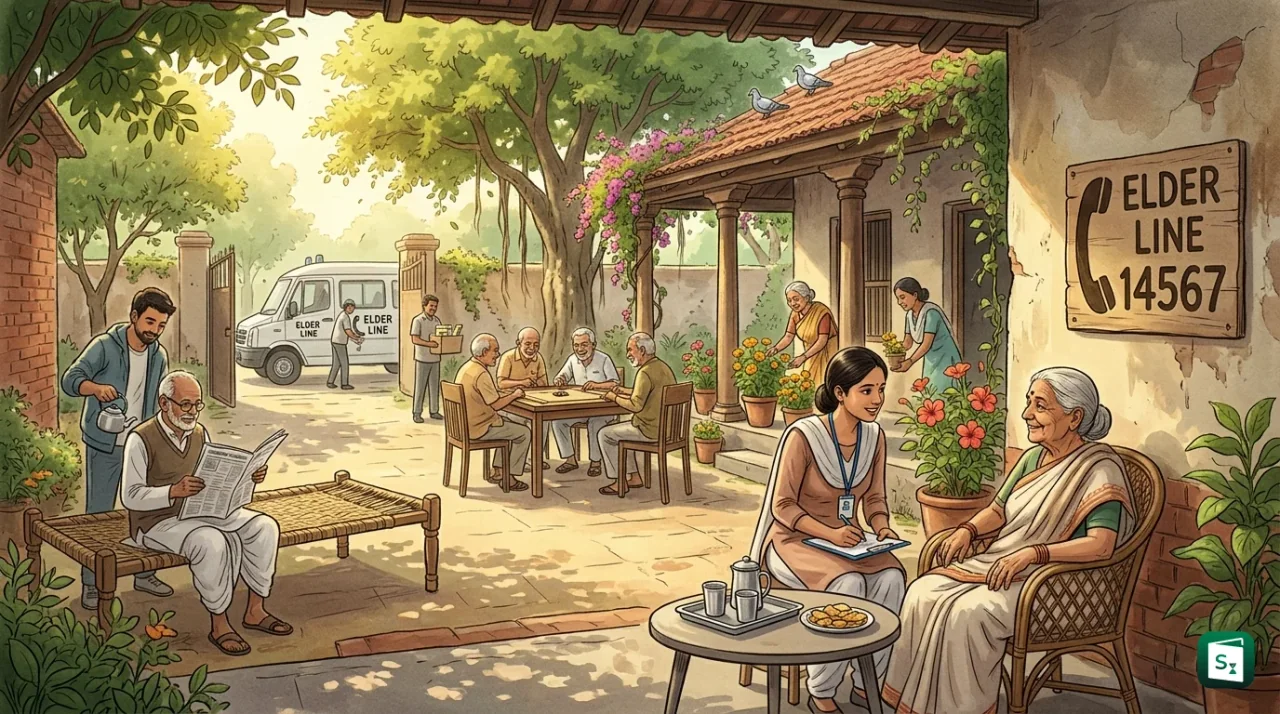
The Central Government has released Rs 77.98 crore as Grant-in-Aid to 755 projects under the Integrated Programme for Senior Citizens (IPSrC) for the quarter ending 30 September 2026, covering July to September of FY27. The IPSrC is the shelter and care arm of the Atal Vayo Abhyuday Yojana (AVYAY), the umbrella scheme for senior citizen welfare run by the Ministry of Social Justice and Empowerment. The funds sustain free food, shelter, medical care and recreation for indigent elders at a time when Indians aged 60 and above number more than 16 crore.
What Is Atal Vayo Abhyuday Yojana?
The Atal Vayo Abhyuday Yojana (AVYAY) is the Central Government umbrella scheme for the welfare of senior citizens, implemented by the Ministry of Social Justice and Empowerment since 2021. The scheme was formed by recasting the earlier National Action Plan for Senior Citizens (NAPSrC). Its stated aim is to improve quality of life for elders through shelter, food, health care, protection of life and property, active ageing and income support for productive engagement.
AVYAY covers the full arc of ageing needs, from homes for destitute elders to assistive devices and start ups for elder care products. The Ministry releases funds to states, voluntary organisations, local bodies and specialised agencies. The seven working components are listed below.
| Component | What It Does |
|---|---|
| Integrated Programme for Senior Citizens (IPSrC) | Funds running and maintenance of senior citizen homes and continuous care homes through voluntary organisations |
| State Action Plan for Senior Citizens (SAPSrC) | Gives grants to states and Union Territories for awareness, sensitisation, cataract operations and state specific activities |
| Rashtriya Vayoshri Yojana (RVY) | Provides free assisted living devices to low income elders with age related disability |
| Elderline, National Helpline for Senior Citizens | Runs toll free helpline 14567 for information, guidance, emotional support and field rescue |
| Seniorcare Ageing Growth Engine (SAGE) | Supports start ups that build products and services for elders, with government equity up to 49 percent of a firm |
| Training of Geriatric Caregivers | Trains professional caregivers to meet rising demand for home and institutional elder care |
| Other initiatives for healthy and productive ageing | Funds research, advocacy, capacity building and pilot projects through the National Institute of Social Defence (NISD) |
How the Integrated Programme for Senior Citizens Funds Old Age Homes
The Integrated Programme for Senior Citizens gives Grant-in-Aid for running and maintenance, not for construction of buildings. The money goes mainly to Non-Governmental Organisations and Voluntary Organisations, and also to state governments, Panchayati Raj Institutions, local bodies, charitable hospitals and recognised educational and youth bodies. Homes must provide shelter, nutrition, medical care and entertainment free of cost to indigent elders, meaning elders aged 60 and above without sufficient means to support themselves.
Under IPSrC, the Ministry supports distinct project types based on local need. A district survey maps existing homes. Districts with no home or with insufficient capacity are notified as gap districts under Section 19 of the Maintenance and Welfare of Parents and Senior Citizens Act, 2007, and new homes there get priority.
| Project Type | Intake and Purpose |
|---|---|
| Senior citizen home for 25 residents | Food, care and shelter for 25 destitute elders, including homes under Sansad Adarsh Gram Yojana |
| Senior citizen home for 50 residents | Larger mixed home for 50 elders, with higher building rent and extra cook and support staff |
| Senior citizen home for 50 elderly women | Dedicated home for 50 older women, in view of high poverty among single older women |
| Continuous care and dementia home for 20 residents | Round the clock nursing for seriously ill elders and elders with Alzheimer disease or dementia, run by agencies with hospital or nursing experience |
| Mobile Medicare Unit and physiotherapy clinic | Ongoing medical outreach and therapy support, with only existing units renewed and no new mobile units sanctioned |
The Central Government bears up to 90 percent of the approved project cost. Projects run by states, Union Territories, Panchayati Raj Institutions and local bodies, and programmes run by schools, colleges, the Nehru Yuva Kendra Sangathan and the National Service Scheme, can receive up to 100 percent support. Recurring grants are linked to daily attendance recorded through a contactless system and uploaded to the e-Anudaan portal. The total annual grant is normally released in two equal half yearly instalments, after district verification and utilisation proof for the earlier release.
What Services Does Elder Line 14567 Provide?
The National Helpline for Senior Citizens, called Elder Line, works on the toll free number 14567. The Ministry of Social Justice and Empowerment operates the helpline with state governments and the National Institute of Social Defence. The helpline was dedicated to the nation on 1 October 2021, observed as the International Day of Older Persons. It functions from 8 am to 8 pm on all seven days, with call centres in each state working in the local language.
Elder Line offers four kinds of help. Information covers doctors, hospitals, old age homes, day care centres, caregivers and elder friendly products. Guidance covers pension, life certificate, property and family disputes, and claims under the Maintenance and Welfare of Parents and Senior Citizens Act, 2007. Emotional support addresses loneliness, anxiety and family conflict through trained counsellors. Field intervention is the most distinctive part. A local team reaches the elder in cases of abuse, neglect, abandonment or cheating, rescues homeless elders and helps reunite them with family or place them in a home, in coordination with police, health staff and legal services authorities.
The latest fund release underlines why such a support net matters. India had 10.38 crore people aged 60 and above in Census 2011, about 8.6 percent of the population. Projections place the share at about 11.5 percent in 2026 and 14.9 percent by 2036, or about 23 crore elders. The rise is uneven across states, with Kerala, Goa, Himachal Pradesh and Tamil Nadu ageing faster. Longer life and smaller families have increased demand for institutional care, home nursing and grievance redress.
Legal Backing and Other Support for Senior Citizens
The Maintenance and Welfare of Parents and Senior Citizens Act, 2007 is the legal anchor for elder welfare. The Act defines a senior citizen as an Indian citizen aged 60 years and above. It allows a parent or grandparent who cannot support himself to claim monthly maintenance from children who are not minors, and it allows a childless elder to claim maintenance from a relative who holds or will inherit his property. Maintenance covers food, clothing, residence and medical care. Claims are decided by a Maintenance Tribunal headed by an officer of the rank of Sub Divisional Officer, with appeal to an Appellate Tribunal headed by the District Magistrate. The Act also lets the Tribunal declare void a gift of property made on the promise of care, if the recipient fails to provide it. It requires states to set up at least one old age home in each district and to ensure beds, queues and geriatric facilities in public hospitals. Abandonment of an elder is punishable with jail up to three months or fine up to Rs 5,000 or both.
The Rashtriya Vayoshri Yojana, launched on 1 April 2017 and now part of AVYAY, gives physical aids and assisted living devices free of cost. It covers low vision, hearing loss, loss of teeth and locomotor disability. Devices include walking sticks, crutches, walkers, tripods, hearing aids, wheelchairs, dentures and spectacles. Elders with monthly income up to Rs 15,000 are eligible, with 30 percent of beneficiaries in each state to be women. The Artificial Limbs Manufacturing Corporation of India (ALIMCO), a public sector undertaking under the Ministry, is the sole implementing agency and provides one year free maintenance of devices.
Key Takeaways
- The Centre released Rs 77.98 crore to 755 projects under IPSrC for the quarter ending 30 September 2026 in FY27.
- AVYAY, launched in 2021 by the Ministry of Social Justice and Empowerment, is the umbrella scheme for senior citizen welfare.
- IPSrC funds running and maintenance of senior citizen homes and continuous care homes, with up to 90 percent central support.
- Elder Line 14567, launched on 1 October 2021, works from 8 am to 8 pm daily for information, guidance, emotional support and field rescue.
- The Maintenance and Welfare of Parents and Senior Citizens Act, 2007 defines a senior citizen as aged 60 years and above and mandates maintenance tribunals.