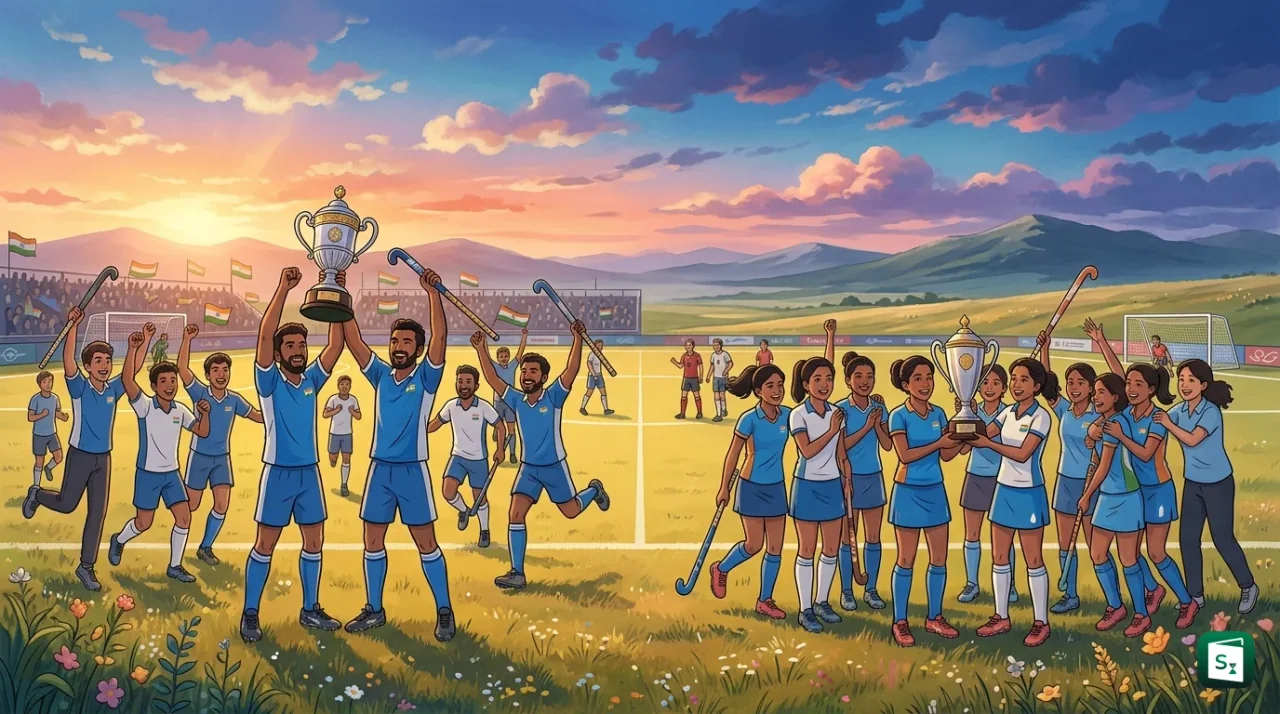
India completed a historic double at the Junior Hockey Asia Cup 2026 in Moqi, Hulunbuir City, China, on 13 September 2026, winning both the men’s and women’s titles on the same day. The men beat South Korea 4-1 to lift a record sixth crown, while the women edged hosts China 1-0 for their third straight title. Both victories also secured India’s qualification for the Junior Hockey World Cup.
What Is Junior Hockey and How the Junior Asia Cup Works?
Junior hockey in field hockey means under-21 hockey for both men and women. Players must be under 21 years of age as on 31 December of the year before the tournament, which means only players born on or after 1 January 2006 were eligible for the Junior Asia Cup 2026 cycle leading to the 2027 World Cup.
The Junior Hockey Asia Cup is the continental championship for Asia in this age group. The Asian Hockey Federation (AHF), the governing body for field hockey in Asia, organises the men’s and women’s editions separately. Both tournaments also work as qualifiers for the FIH Junior Hockey World Cup, which is organised by the International Hockey Federation (FIH), the world governing body for hockey.
The 2026 edition of both tournaments was held together from 4 to 13 September 2026 at the Moqi Training Base in Hulunbuir City, in the Inner Mongolia region of China. The men’s event was the 11th edition of the Men’s Junior Asia Cup, first held in 1988. The women’s event was the 10th edition of the Women’s Junior Asia Cup, first held in 1992.
Men’s Final: India vs South Korea 4-1 Breakdown
India defended the men’s title with a commanding 4-1 win over South Korea in the gold medal match at Moqi on 13 September 2026. India started with strong attacking intent and took control early in the game. The team led 3-0 at half time and never allowed South Korea to return to the contest.
Ajeet Yadav opened the scoring in the 9th minute with a deflection. Captain Anmol Ekka made it 2-0 in the 13th minute. Prabhdeep Singh added the third goal in the 21st minute with a clean finish. India continued to press in the second half. Ashu Maurya scored from a penalty corner in the 50th minute to extend the lead to 4-0. A penalty corner is a set piece awarded for a foul inside the shooting circle, and it is a major scoring chance in hockey. South Korea captain Lee Minhyeok pulled one goal back from a penalty stroke in the 54th minute, but India closed out the match with disciplined defence.
The result gave India its sixth men’s junior continental title, after wins in 2004, 2008, 2015, 2023, 2024 and 2026. It was also India’s fourth consecutive title in this event. No other team has won the men’s junior event four times in a row. India remains the most successful team in the history of the Men’s Junior Asia Cup.
The star of the tournament was India captain and drag flicker Anmol Ekka, who finished as the top scorer with 17 goals. A drag flicker is a specialist who takes powerful flick shots during penalty corners. Ekka scored twice in the 3-1 semi-final win over Malaysia on 11 September, which took his tally to 16 goals before the final. Goalkeeper Vivek Lakra also played a key role in that semi-final with a series of saves, including stopping a penalty stroke. India had topped its group with three wins and one draw. South Korea had reached the final after beating Pakistan 4-1 in the other semi-final. Pakistan later beat Malaysia 4-2 to win the bronze medal.
Women’s Final: India vs China 1-0 Breakdown
India retained the women’s title with a hard fought 1-0 win over hosts China in the final at Moqi on 13 September 2026. The match was played hours before the men’s final. India stayed unbeaten through the tournament and showed strong defensive discipline against the home team.
Sanika Chandrakant Mane scored the only goal of the match in the 17th minute. She moved smartly behind a Chinese defender about five metres from goal and deflected a long slap push into the circle past Chinese goalkeeper Xu Mengjiao. India almost doubled the lead just before half time, but captain Khaidem Shileima Chanu saw her shot saved.
China enjoyed more possession in phases and earned the only penalty corner of the match. The Chinese effort was disallowed because the ball entered the goal above the allowed backboard height. India defended with compact structure in the third and fourth quarters and cut out a dangerous Chinese pass from the baseline. India held the 1-0 lead till the final whistle.
This was India’s third consecutive Women’s Junior Asia Cup title, after maiden success in 2023 followed by wins in 2024 and 2026. India beat South Korea 2-1 in the 2023 final in Kakamigahara, Japan, to win its first women’s junior crown. Before India’s run, South Korea and China had shared the honours in the early editions of the women’s junior event.
Sanika Chandrakant Mane finished as the joint-highest scorer of the women’s tournament with 7 goals. China’s Wei Qixiao was named the Most Valuable Player of the tournament. The award recognises the best overall performer across all matches.
Schedule, Venue and Road to the Finals
The Junior Hockey Asia Cup 2026 schedule ran from 4 to 13 September 2026 at a single venue, the Moqi Training Base in Hulunbuir. Both the men’s and women’s tournaments followed the same pattern of group stage matches followed by semi-finals and medal matches. India topped its group in both events and entered the knockouts as the defending champion.
The women’s team, led by captain Khaidem Shileima Chanu and coached by Tim White, built its campaign on heavy scoring before a tight final. India started with a 4-1 win over South Korea, with goals from Sanika Chandrakant Mane, Purnima Yadav, Puja Sahoo and Madhu Sidar. India then beat Malaysia 11-1 and Japan 7-0, before a 0-0 draw with China in the Elite Pool stage. In the quarter-final, India beat Pakistan 19-0. In the semi-final on 12 September, India beat South Korea 5-1, with drag flick specialist Supriya scoring a hat-trick of penalty corners.
The men’s team, led by Anmol Ekka and coached by Frederic Soyez, also stayed unbeaten. India opened Pool A against Indonesia on 5 September, then faced Japan, South Korea and Chinese Taipei in the group stage. India finished top of the group with three wins and one draw, one point ahead of South Korea. The team had prepared with an exposure tour of Belgium against under-21 sides from Austria, Belgium, Germany and the Netherlands, home friendlies against Malaysia under-21 in Bengaluru, and a three match series against China in Dalian, including an 8-2 win. The preparation helped India adjust to playing conditions in China before arriving in Moqi.
| Stage | Men’s Result | Women’s Result |
|---|---|---|
| Group opener | Campaign started on 5 September in Pool A | Beat South Korea 4-1 on 5 September |
| Group stage | Topped group with 3 wins and 1 draw | Finished top of Elite Pool, unbeaten with 3 wins and 1 draw |
| Quarter-final | Knockout stage after group phase | Beat Pakistan 19-0 |
| Semi-final | Beat Malaysia 3-1 on 11 September | Beat South Korea 5-1 on 12 September |
| Final on 13 September | Beat South Korea 4-1 | Beat China 1-0 |
Hockey Asia Cup Winners List and Title History
The Hockey Asia Cup winners list shows India’s growing dominance at junior level. In men’s junior hockey, only four teams have won the title so far. India now has six titles, followed by Pakistan with three, while Malaysia and South Korea have one each. The 2021 edition, planned for Dhaka, was cancelled.
| Year | Host | Men’s Junior Champion |
|---|---|---|
| 1988 | Karachi, Pakistan | Pakistan |
| 1992 | Kuala Lumpur, Malaysia | Pakistan |
| 1996 | Singapore | Pakistan |
| 2000 | Kuala Lumpur, Malaysia | South Korea |
| 2004 | Karachi, Pakistan | India |
| 2008 | Hyderabad, India | India |
| 2012 | Malacca, Malaysia | Malaysia |
| 2015 | Kuantan, Malaysia | India |
| 2023 | Salalah, Oman | India |
| 2024 | Muscat, Oman | India |
| 2026 | Moqi, China | India |
The women’s junior event has a shorter history. India won its first title only in 2023. South Korea had won four of the early editions and China had won three before that. India’s three straight wins in 2023, 2024 and 2026 have therefore changed the continental balance. India is now chasing the overall tallies of South Korea and China in the women’s junior roll of honour.
This junior success is different from the senior Asia Cup. In senior men’s hockey, South Korea has won five titles and India has won four, including the 2025 edition in Rajgir. In senior women’s hockey, South Korea, Japan, China and India have shared titles over the years. The junior results matter because they show the strength of the next generation of players who will move to the senior teams.
Qualification Link to the Junior Hockey World Cup
Both titles carried direct qualification for the FIH Junior Hockey World Cup 2027 for men and women. The Junior World Cup is the global championship for under-21 teams. The 2027 edition will feature 24 teams in each of the men’s and women’s events.
Under the qualification system, national teams must play in their continental junior championship to qualify. From Asia, the top three teams in the Junior Asia Cup 2026 qualify for the Junior World Cup. By reaching the finals and winning the titles, India’s men and women confirmed their places at the global event. The system uses the same model across Africa, Asia, Europe, Pan America and Oceania, with the remaining places filled through continental quotas based on the FIH Junior World Rankings.
For India, qualification continues a strong junior cycle. The men’s team will enter the World Cup as six time Asian champions. The women’s team will enter as unbeaten Asian champions with a settled core built around its title winning squads of 2023, 2024 and 2026.
Recognition and What Comes Next
Hockey India, the national governing body for hockey in India, announced cash awards for both winning squads. Each player in the men’s and women’s title winning teams will receive ₹3 lakh. Each member of the support staff will receive ₹1.5 lakh. The announcement recognises the rare feat of winning both continental crowns on the same day in China.
The President and the Prime Minister congratulated both teams and praised their discipline and teamwork. The Union Sports Minister described the results as a sign of India’s dominance in Asian hockey. The focus for both squads will now shift to preparation for the Junior Hockey World Cup, where India will face stronger competition from Europe, Pan America, Oceania and Africa. The challenge will be to convert continental success into a deep run at the global level.
Key Takeaways
- India won both titles at the Junior Hockey Asia Cup 2026 at the Moqi Training Base in Hulunbuir, China, on 13 September 2026.
- The Men’s Junior Asia Cup 2026 was the 11th edition, and India beat South Korea 4-1 to win its sixth title and fourth consecutive crown.
- Anmol Ekka, India’s captain, was the men’s top scorer with 17 goals.
- The Women’s Junior Asia Cup 2026 was the 10th edition, and India beat China 1-0 to win its third consecutive title.
- Sanika Chandrakant Mane was the women’s joint-highest scorer with 7 goals, while Wei Qixiao of China was named Most Valuable Player.
- Both Indian teams qualified for the FIH Junior Hockey World Cup 2027 after the wins.
- Hockey India announced ₹3 lakh for each player and ₹1.5 lakh for each support staff member of both winning teams.