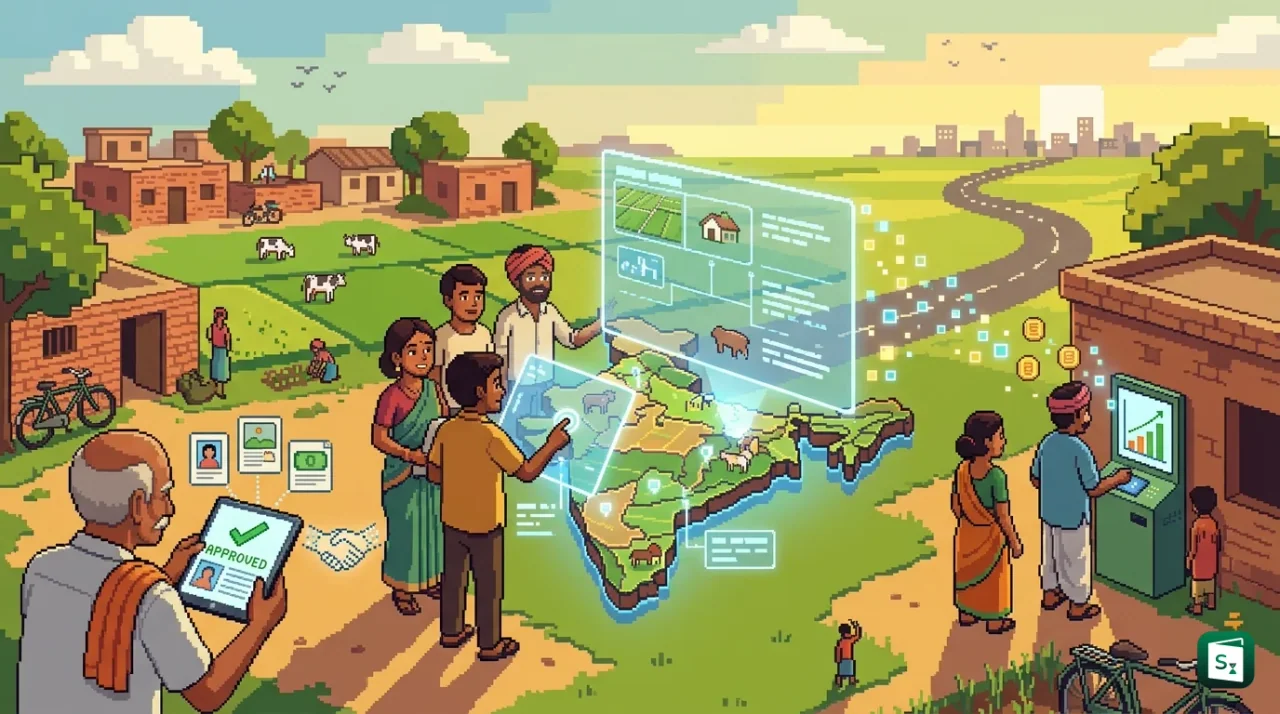
The Department of Land Resources (DoLR) has initiated talks with the Reserve Bank Innovation Hub (RBIH) to link India’s digital land governance systems with the Unified Lending Interface (ULI), aiming to transform how farmers and rural citizens access institutional credit. The meeting, chaired by DoLR Secretary Narendra Bhooshan and RBIH CEO Sahil Kini, explored how authenticated digital land records can serve as a trusted foundation for faster and more transparent lending. If realised, this integration could turn every verified land parcel into a digital asset that unlocks formal credit without paperwork delays.
What Was Discussed: Bridging Land and Credit
The high-level meeting brought together senior officials from both organisations. From DoLR, Joint Secretary Parikipandla Narahari and Directors Shyam Kumar and Amit Kumar Singh attended. RBIH was represented by Chief Product Officer Abhishek Poddar, Vice President Arun Seethamraju, and Assistant General Manager Aditi Dubey.
The central idea was to create synergies between DoLR’s digital land governance platforms and the Unified Lending Interface (ULI). The discussions covered five priority areas: enabling secure and standardised access to authenticated digital land records, accelerating the digital delivery of Kisan Credit Cards (KCC) and other agricultural loans, reducing transaction costs and improving loan processing time, strengthening risk management through mortgage information and flag-marking mechanisms to prevent multiple financing against the same land parcel, and promoting financial inclusion by transforming land into a trusted digital asset for formal credit.
The meeting also stressed the importance of adopting common data standards, ensuring API interoperability, and expanding the use of the Unique Land Parcel Identification Number (ULPIN), popularly called Bhu-Aadhaar.
Digital Land Governance: DoLR’s Reform Journey
The Department of Land Resources, established under the Ministry of Rural Development, is the nodal agency for land policy, land records modernisation, and watershed development in India. Over the past decade, DoLR has driven a series of digital reforms to move India’s land administration from fragmented, paper-based systems to an integrated digital framework.
DILRMP: Digitising Land Records
The flagship reform is the Digital India Land Record Modernisation Programme (DILRMP), launched in 2008 as a centrally sponsored scheme. DILRMP merged two earlier projects: the Computerisation of Land Records (CLR) and the Strengthening of Revenue Administration and Updating of Land Records (SRVAULP). The programme aims to develop a modern, transparent land record management system with government-guaranteed titles, moving India from a system of presumptive title (where the recorded owner is presumed to hold title but the government does not guarantee it) towards conclusive titling (where the state guarantees the title).
Under DILRMP, states have digitised over 90% of their land records and cadastral maps, creating a massive repository of spatial and textual data on land parcels across the country.
Land Stack and Bhu-Aadhaar
Building on DILRMP, DoLR launched the Land Stack pilot on 31 December 2025 in the Union Territory of Chandigarh and Tamil Nadu. Land Stack is an integrated, GIS-based digital platform that provides single-window access to land and property information from multiple departments. Citizens can view cadastral maps alongside ownership details, encumbrances, land use plans, and litigation status in one place.
The Unique Land Parcel Identification Number (ULPIN), or Bhu-Aadhaar, is a 14-digit alphanumeric unique ID assigned to every land parcel based on its spatial coordinates. Like Aadhaar for individuals, ULPIN provides a permanent, unique identity for each plot of land, enabling accurate identification across states and departments. This is essential for interoperability in a country where land records differ widely in format and language across states.
RBI Innovation Hub and the Unified Lending Interface
The Reserve Bank Innovation Hub (RBIH) was inaugurated on 24 March 2022 in Bengaluru, Karnataka as a wholly owned subsidiary of the Reserve Bank of India. It was set up to promote and facilitate innovation across the financial sector by building prototypes, proofs of concept, and digital public goods. Its mandate includes collaborating with government ministries, academia, and industry to identify problem statements and develop technology-driven solutions, particularly for underserved segments.
RBIH’s flagship product is the Unified Lending Interface (ULI), first announced by RBI Governor Shaktikanta Das in August 2024. ULI is a consent-based digital platform that facilitates the seamless flow of borrower data from multiple sources directly to lenders, enabling faster credit appraisal and disbursal. It integrates an open architecture with standardised APIs, allowing financial institutions to connect in a plug-and-play model. ULI is currently in its pilot phase, with gradual national expansion planned.
The platform already connects data streams from Aadhaar e-KYC, PAN validation, state government land records, account aggregators, credit information companies, dairy federations, and the Ministry of Rural Development’s Self-Help Group data under the National Rural Livelihoods Mission (NRLM). As of mid-2026, land records from 11 states including Madhya Pradesh, Uttar Pradesh, Maharashtra, Tamil Nadu, Andhra Pradesh, Odisha, Tripura, Chhattisgarh, Assam, Gujarat, and Karnataka are live on ULI.
The Proposed Land-Credit Ecosystem: Key Features
The proposed integration between DoLR’s digital platforms and RBIH’s ULI would create an end-to-end digital land-credit ecosystem. Here are the key features being explored:
| Feature | How It Would Work |
|---|---|
| Authenticated Land Record Access | Lenders would fetch verified land ownership and parcel data directly from state land record databases via ULI, removing the need for physical documents |
| Digital KCC Delivery | Farmers could apply for Kisan Credit Cards online with land records pre-validated against government databases, reducing approval time from weeks to days |
| Mortgage Flag-Marking | A central mechanism would flag land parcels that are already mortgaged, preventing borrowers from securing multiple loans against the same plot |
| Consent-Based Data Sharing | Borrowers would give digital consent for lenders to access their land records, following the same framework used in India’s account aggregator system |
| Common Data Standards | Adopting uniform formats and API standards across states would make land records interoperable regardless of the state of origin |
| ULPIN Integration | Every land parcel’s 14-digit Bhu-Aadhaar ID would serve as the permanent identifier, eliminating confusion from different local naming conventions |
Significance: Why This Matters for Rural Credit
Access to institutional credit remains a persistent challenge in rural India despite decades of policy attention. Land is the most common asset that rural households own, yet it has historically been underutilised as collateral because of poor record quality, unclear titles, and fragmented databases spread across multiple state departments.
The link between land records and credit access is well documented. When a farmer cannot produce clear, government-verified proof of land ownership, banks demand physical inspections, multiple affidavits, and lengthy manual verification. This drives up transaction costs, delays disbursals, and pushes many small and marginal farmers toward informal moneylenders who charge high interest rates. A digitised, interoperable land-credit system directly addresses this bottleneck by giving lenders instant access to authenticated records.
The proposed integration also strengthens risk management for banks. The flag-marking mechanism against multiple financing is particularly important. In the current system, a borrower can theoretically mortgage the same land to multiple banks across different districts because there is no central registry of encumbrances. A unified digital system would close this loophole.
For financial inclusion, the impact could be significant. Farmers who currently lack formal credit histories would have their land ownership data act as a verifiable asset, enabling them to enter the formal banking system. The Kisan Credit Card scheme, which was launched in 1998 to provide short-term credit for agricultural operations, covers cultivation, post-harvest expenses, and consumption needs. With digital land record integration, KCC approval could become almost instantaneous, with loan limits calculated automatically based on verified land holdings and crop patterns.
From a policy perspective, this initiative aligns with the government’s broader Digital Public Infrastructure (DPI) approach. India has already built world-scale DPIs such as Aadhaar (digital identity), UPI (payments), and DigiLocker (documents). The land-credit integration adds another layer to this stack, one that directly addresses the real economy by unlocking the productive value of land assets for millions of rural citizens.
Key Takeaways
- The Department of Land Resources (DoLR) under the Ministry of Rural Development held a meeting with the Reserve Bank Innovation Hub (RBIH) to explore integrating Digital Public Infrastructure (DPI) for land governance and digital lending.
- The proposed system would link DoLR’s digital land records with the Unified Lending Interface (ULI), a consent-based lending platform developed by RBIH and first announced in August 2024.
- The Digital India Land Record Modernisation Programme (DILRMP), launched in 2008, has digitised more than 90% of land records and cadastral maps across India.
- The Land Stack, a GIS-based single-window digital platform, was launched as a pilot in Chandigarh and Tamil Nadu on 31 December 2025.
- The Unique Land Parcel Identification Number (ULPIN) or Bhu-Aadhaar is a 14-digit alphanumeric ID assigned to each land parcel based on spatial coordinates for nationwide interoperability.
- The RBI Innovation Hub was inaugurated on 24 March 2022 in Bengaluru as a wholly owned subsidiary of the Reserve Bank of India.