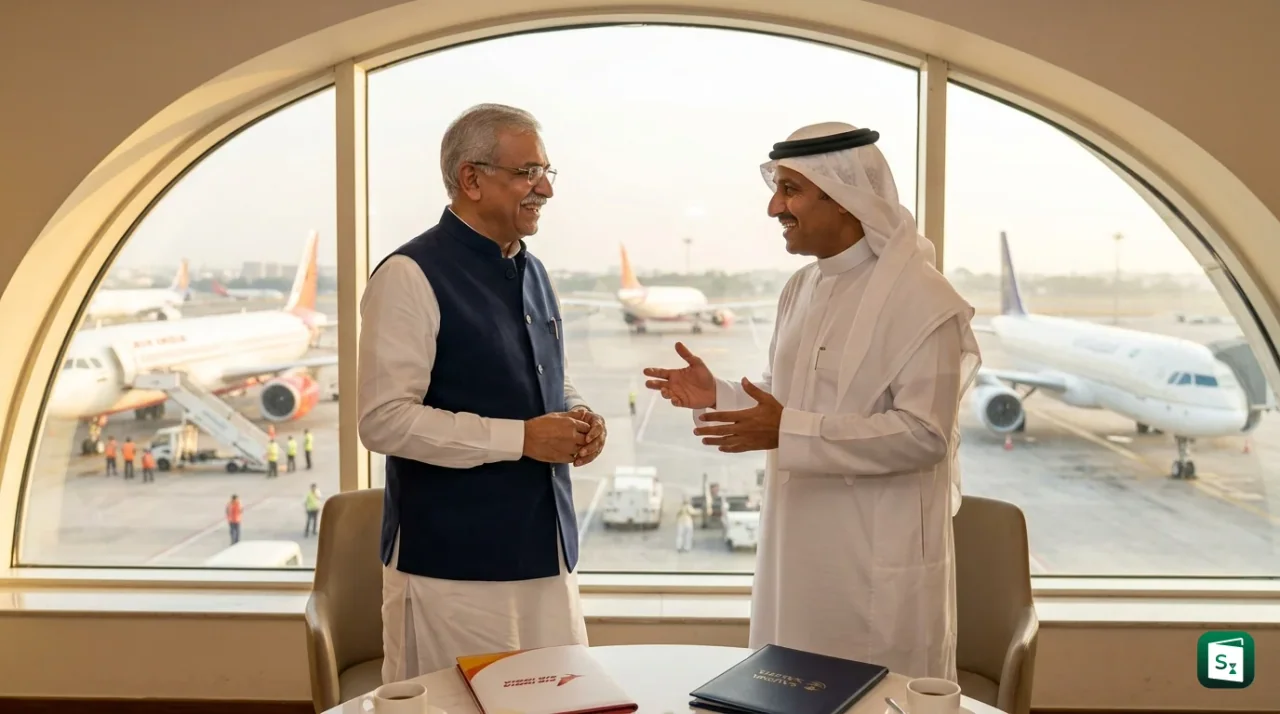
Air India and Saudia, the national flag carrier of Saudi Arabia, signed a Memorandum of Understanding (MoU) on 23 July 2026 to deepen their strategic partnership. The agreement was signed by Campbell Wilson, Chief Executive Officer and Managing Director of Air India, and H.E. Engr. Ibrahim Al-Omar, Director General of Saudia Group. The MoU builds on an existing codeshare arrangement between the two carriers and sets the stage for broader commercial and operational collaboration.
What Does the MoU Cover?
The MoU adopts a phased approach to expanding the partnership. Both airlines will work on expanding their existing codeshare agreement to offer passengers more routes and seamless travel options. They will also explore terminal co-location at key airports, which would allow passengers to transfer between flights more conveniently.
Beyond connectivity, the agreement includes plans for cooperation between the loyalty programmes of both carriers. The two sides will also examine opportunities to extend the partnership to other airlines within their respective groups, including Air India Express (Air India’s low-cost subsidiary) and flyadeal (Saudia’s low-cost carrier). This would broaden the reach of the partnership beyond full-service flights to include budget travel as well.
Building on an Existing Codeshare Foundation
The new MoU is not the first instance of cooperation between the two airlines. Air India and Saudia signed a codeshare agreement in January 2026, which took effect from February 2026. That agreement allowed passengers to book a single itinerary covering flights operated by both airlines, with streamlined check-in and baggage transfer.
Under the codeshare arrangement, Saudia’s passengers gained access to major Indian cities including Mumbai, Delhi, Ahmedabad, Bengaluru, Kolkata, Kochi, and Hyderabad via the airline’s hubs in Jeddah and Riyadh. Similarly, Air India’s passengers could reach multiple destinations across Saudi Arabia and beyond through Saudia’s network. The new MoU now seeks to deepen this relationship further by adding more routes, loyalty integration, and operational efficiencies.
The Airlines at a Glance
Air India is the flag carrier of India, headquartered in Gurugram, Haryana, with its primary hub at Indira Gandhi International Airport in Delhi. Originally founded in 1932 by J.R.D. Tata as Tata Airlines, it was nationalised in 1953 and returned to the Tata Group in January 2022 after a landmark privatisation. The Tata Group now holds a majority stake of 74.9%, while Singapore Airlines holds the remaining 25.1%. Since privatisation, Air India has aggressively expanded its global network and now operates 25 codeshare partnerships and more than 120 interline agreements, providing access to over 1,000 destinations worldwide through partner carriers.
Saudia (formerly Saudi Arabian Airlines) is the national flag carrier of Saudi Arabia, established in 1945. The airline is headquartered in Jeddah, with its primary hub at King Abdulaziz International Airport in Jeddah and a secondary hub at King Khalid International Airport in Riyadh. Saudia is wholly owned by the Government of Saudi Arabia and is one of the largest airlines in the Middle East. It also operates flyadeal, a low-cost subsidiary founded in 2016.
The Broader India-Saudi Arabia Relationship
The Air India-Saudia MoU must be viewed against the backdrop of rapidly deepening bilateral ties between India and Saudi Arabia. Diplomatic relations between the two countries were established in 1947, and the relationship was elevated to a Strategic Partnership in 2010.
India is the second-largest trading partner of Saudi Arabia, while Saudi Arabia is India’s fifth-largest trading partner. Bilateral trade stood at $41.88 billion in FY 2024-25, with Indian exports of $11.76 billion and imports of $30.12 billion, primarily crude oil and petroleum products. Saudi Arabia’s Public Investment Fund (PIF) and other Saudi entities have invested approximately $10 billion in India across sectors such as energy, steel, renewable energy, and chemicals.
The two countries established a Strategic Partnership Council (SPC) in 2019, which was expanded in April 2025 to include four Ministerial Committees covering political and security cooperation, defence, economy and investment, and tourism and culture. Saudi Arabia’s Vision 2030 programme, aimed at diversifying its economy beyond oil, creates significant opportunities for collaboration with India in sectors such as tourism, technology, and renewable energy.
Significance for Aviation and Passengers
India-Saudi Arabia aviation ties have grown steadily, driven by several factors. Saudi Arabia hosts an estimated 2.74 million Indians, one of the largest Indian diaspora communities in the world. Additionally, the annual Hajj and Umrah pilgrimages bring large numbers of Indian travellers to the Kingdom each year. Saudi Arabia’s annual Hajj quota for India stands at 175,025 pilgrims, while around 1.5 million Indians perform Umrah annually.
The enhanced partnership between Air India and Saudia will benefit passengers through a wider choice of routes, simplified booking processes, and smoother connections. By potentially extending the partnership to low-cost carriers Air India Express and flyadeal, the agreement also targets budget-conscious travellers, making air travel between the two countries more accessible.
Since its return to the Tata Group, Air India has pursued an aggressive strategy of global partnerships. The airline has signed codeshare agreements with carriers including Lufthansa Group, Singapore Airlines, and Kenya Airways, among others. The Saudia partnership is a key component of this strategy, strengthening Air India’s presence in the Middle East, a critical market for India.
Key Takeaways
- Air India and Saudia signed an MoU on 23 July 2026 to expand strategic cooperation, building on their codeshare agreement that took effect in February 2026.
- The MoU covers expansion of the codeshare, network connectivity, terminal co-location, loyalty programme cooperation, and potential inclusion of Air India Express and flyadeal.
- Air India, the flag carrier of India headquartered in Gurugram, was returned to the Tata Group in January 2022 and now operates 25 codeshare and 120+ interline partnerships.
- Saudia, the national flag carrier of Saudi Arabia headquartered in Jeddah, was established in 1945 and is wholly owned by the Saudi government.
- India is the second-largest trading partner of Saudi Arabia with bilateral trade of $41.88 billion in FY 2024-25, and the two countries established a Strategic Partnership Council in 2019.
- The Indian diaspora in Saudi Arabia numbers approximately 2.74 million, and the annual Hajj quota for India is 175,025 pilgrims.