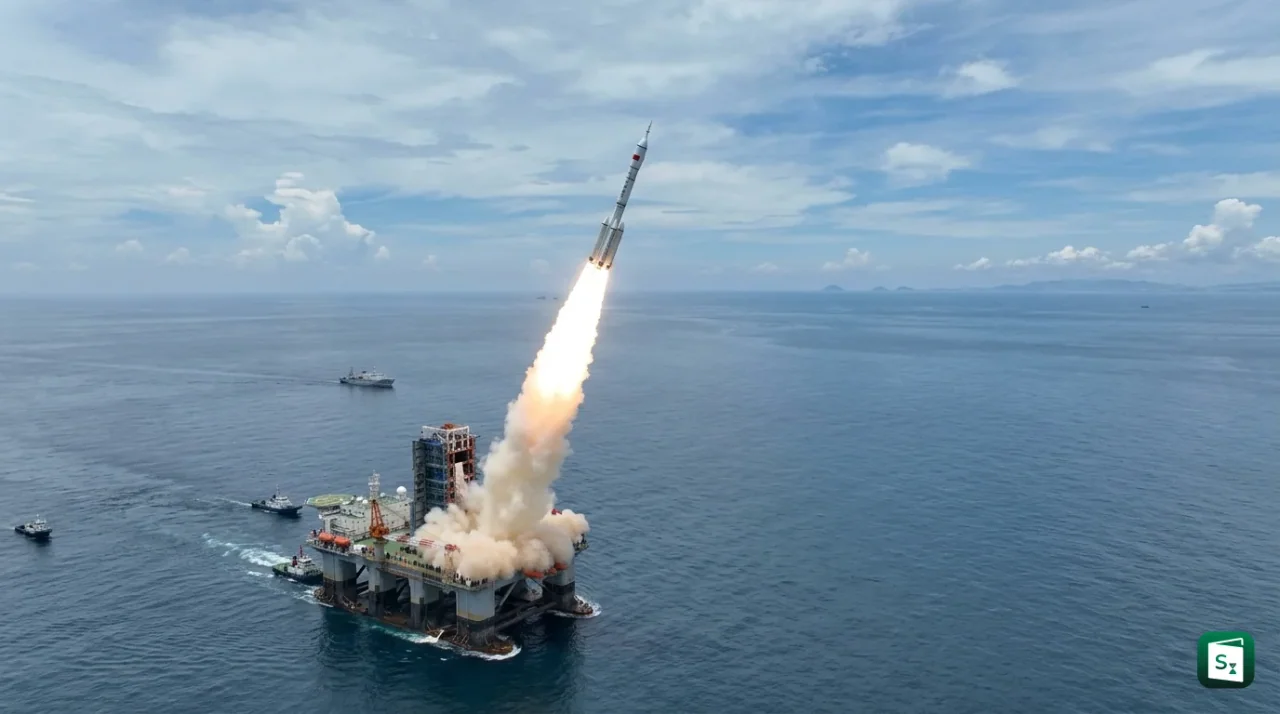
Orienspace, a private Chinese aerospace company, launched its Gravity-1 Y4 carrier rocket from a sea-based platform in the East China Sea on July 22, 2026, successfully placing nine satellites into their intended orbits. This was the third flight of the Gravity-1 rocket and its first long-range sea launch, marking a significant step in Orienspace’s transition to scaled commercial operations. The mission also set a record for the heaviest mass launched by a commercial space enterprise in China.
Orienspace and the Gravity-1 Rocket
Orienspace Technology (Shandong) Co., Ltd, founded in June 2020 and headquartered in Yantai, Shandong province, is one of China’s leading private aerospace companies. The company designs and manufactures the Gravity series of launch vehicles and Force series of rocket engines. Its CEO, Yao Song, previously founded the semiconductor firm Shenjian Technology.
The Gravity-1 (also called YinLi-1) is a solid-propellant, expendable medium-lift launch vehicle. It stands 30 meters tall, has a take-off weight of 405 tonnes, and generates 600 tonnes of thrust at liftoff. The rocket uses seven solid rocket motors in total: four side-mounted boosters that ignite on the ground and three core stages that ignite in sequence during ascent.
Gravity-1 can carry 6,500 kg of payload to low Earth orbit (LEO) or 4,200 kg to a 500 km sun-synchronous orbit (SSO). This makes it the most powerful solid-fuel rocket in the world. Its first flight took place on January 11, 2024, from a converted barge off the coast of Haiyang in the Yellow Sea, setting records as both the world’s largest solid-fuel carrier rocket and China’s most powerful commercial launch vehicle at the time.
What Made This Launch Different
The Y4 mission was Orienspace’s first long-range (deep-sea) launch. While the earlier two flights took place from coastal waters near Haiyang port in the Yellow Sea, this launch was conducted approximately 170 kilometers east of Shanghai in the East China Sea, from a converted barge named Dong Fang Hang Tian Gang (Oriental Space Port).
Orienspace cited several strategic advantages for deep-sea launches over land-based or coastal launches. First-stage safety is easier to ensure because there are no populated areas downrange. Debris impact zones can be managed by selecting mobile launch positions. More importantly, offshore launch and landing capability is a necessary step toward future liquid rocket recovery and reuse, which Orienspace is pursuing with its next-generation Gravity-2 rocket.
Another critical factor is orbital inclination requirements. China’s four existing land-based launch sites cannot provide a direct southward launch path for low-orbit satellite internet constellations. Sea-based launches overcome this geographical limitation, making them essential for deploying large-scale constellations.
The deep-sea environment also presented challenges. The rocket was exposed to salt spray and humidity for several days during the voyage, requiring enhanced protective measures for sensitive components.
The Diverse Payload Manifest
The mission carried nine satellites for multiple customers, demonstrating Gravity-1’s rideshare capability.
Six Dongpo Satellites for the Huantian Constellation
The primary payload consisted of six Dongpo-series Earth observation satellites (Dongpo-13, 14, 17, 18, 19, and 20), built by MinoSpace under an approximately $111 million contract awarded in 2025. These satellites are part of the Huantian Constellation, a remote sensing network that provides optical and radar imaging capabilities.
Among these, two are optical satellites equipped with AI payloads for onboard target recognition, intelligent analysis, and faster processing. They can image at a resolution of 0.5 meters. The remaining four are synthetic aperture radar (SAR) satellites capable of formation flying to provide millimeter-level surface deformation monitoring. This combination allows all-weather, day-and-night imaging regardless of cloud cover.
All six satellites were manufactured at a new factory in Wuxi, Jiangsu province, which has a planned production capacity of 150 satellites per year.
Other Payloads
| Satellite | Developer | Purpose |
|---|---|---|
| Xiguang-2 (01) | Xi’an CAS Xiguang Aerospace Technology Group | Hyperspectral and full-color optical imaging with onboard AI processing |
| Tianyi-49 (BUPT-4) | Spacety (in partnership with Beijing University of Posts and Telecommunications) | Remote sensing and Earth observation technology verification |
| Zidingxiang-3 (Lilac-3) | Harbin Institute of Technology and Beijing Taikonlink Technology | Ultra-flat disk satellite for thermal, mechanical, and attitude control experiments |
China’s Expanding Commercial Space Sector
This launch was China’s 49th orbital launch attempt of 2026, including three failures. China appears set to launch more than 100 times in 2026, which would eclipse its national record of 92 launches set in 2025. The Gravity-1 Y4 mission also marked a scaling up of Orienspace’s operations, reducing the gap between flights from 21 months (between Y1 and Y2) to just 9 months (between Y2 and Y4, with Y3 having received regulatory approval after Y4).
China’s commercial space industry has expanded rapidly. The country now has more than 600 commercial space companies, with annual financing reaching 18.6 billion yuan in 2025, up 32 percent year on year. Orienspace confirmed two financing rounds in 2026 and plans a shareholding system reform ahead of a potential capital markets listing.
What Comes Next
Orienspace plans three additional batch launches in 2026, including a large-scale satellite internet constellation deployment mission with hardware already prepared. The company’s next-generation Gravity-2 rocket, a partially recoverable liquid-propellant launch vehicle, is in pre-flight ground testing. Gravity-2 will be 60 meters tall, powered by nine Yuanli-85 engines using liquid oxygen and kerosene, and capable of delivering 25.6 tonnes to LEO and 19.1 tonnes to SSO. Its first flight is targeted for Q4 2026.
Beyond Gravity-2, the company has also outlined plans for Gravity-3, which would use three Gravity-2 core stages strapped together to enable payload capacities of over 30 tonnes to LEO, supporting lunar exploration missions.
Key Takeaways
- Orienspace Technology (Shandong) Co., Ltd, founded in June 2020 and headquartered in Yantai, Shandong, launched its third Gravity-1 rocket from a sea-based platform in the East China Sea on July 22, 2026.
- The Gravity-1 is the world’s most powerful solid-fuel rocket, standing 30 meters tall with a take-off weight of 405 tonnes and a payload capacity of 6,500 kg to LEO.
- This mission was the first long-range (deep-sea) launch for Orienspace, conducted approximately 170 km east of Shanghai, and deployed nine satellites into orbit.
- The payload included six Dongpo satellites for the Huantian Constellation, featuring two optical satellites with AI and four SAR satellites for millimeter-level surface deformation monitoring.
- China has more than 600 commercial space companies, and the Gravity-1 launch was the country’s 49th orbital attempt of 2026.
- Orienspace is developing Gravity-2, a 60-meter-tall partially recoverable liquid rocket targeting a first flight in Q4 2026, with a payload capacity of 25.6 tonnes to LEO.