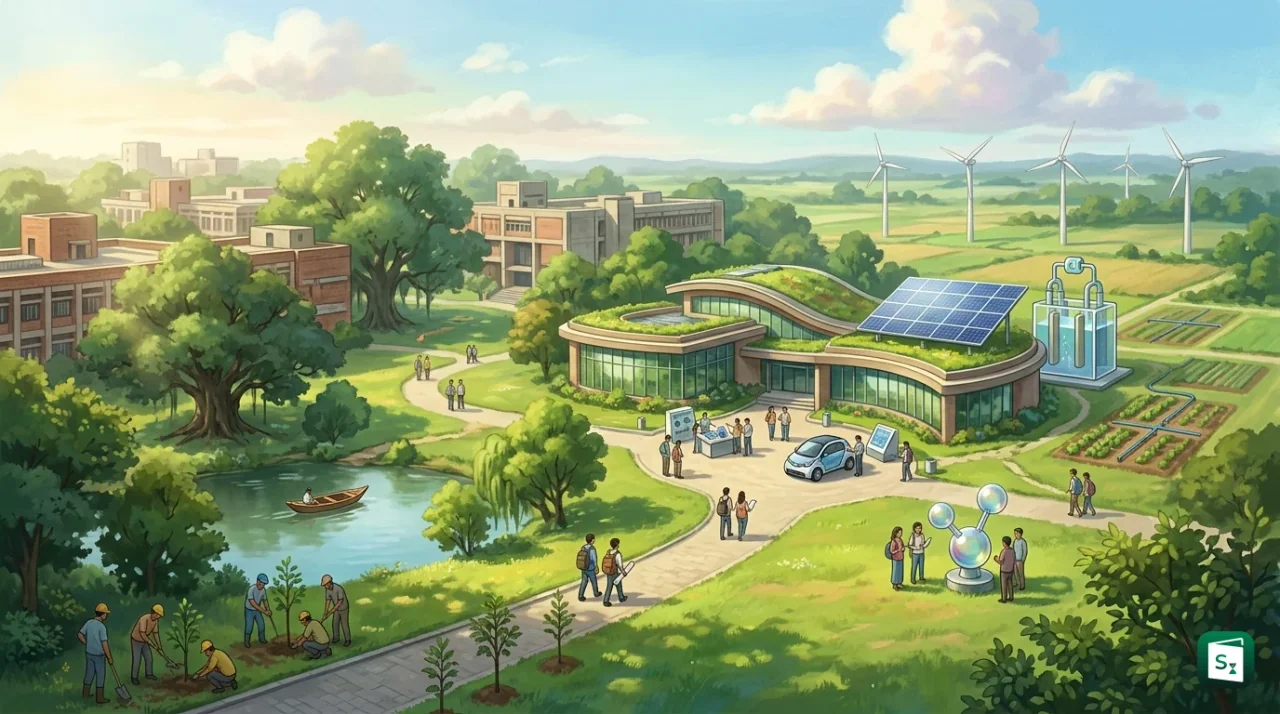
The Indian Institute of Technology Kanpur (IIT Kanpur) has established a Centre of Excellence (CoE) on Innovative and Integrated Ecosystem for Green Hydrogen (ECOGEN), sanctioned by the Uttar Pradesh New and Renewable Energy Development Agency (UPNEDA) under the UP Green Hydrogen Policy 2024. Led by Dr Prabodh Bajpai of the Department of Sustainable Energy Engineering, the centre will conduct interdisciplinary research across the complete green hydrogen value chain from generation to utilisation. The initiative positions Uttar Pradesh as a key player in India’s clean energy transition while supporting the national goal of building a self-reliant green hydrogen economy.
What Is Green Hydrogen and Why Does It Matter?
Green hydrogen is produced by splitting water into hydrogen and oxygen using electricity generated from renewable sources such as solar or wind. This process, called electrolysis, takes place in a device known as an electrolyser. Unlike grey hydrogen, which is produced from natural gas and releases carbon dioxide, green hydrogen emits zero carbon during production.
Hydrogen itself is a versatile energy carrier. It can be used as a fuel for heavy transport, as a feedstock in fertiliser and refinery industries, and as a substitute for coal in steel manufacturing. Sectors such as steel, cement, petroleum refining, and ammonia production are considered hard to abate because their industrial processes generate emissions that are difficult to eliminate through electrification alone. Green hydrogen offers a practical solution for decarbonising these sectors.
India currently consumes around 0.9 million metric tonnes per annum (MMTPA) of hydrogen, mostly in fertiliser and refinery sectors, and nearly all of it is grey hydrogen. Shifting this demand to green hydrogen would cut millions of tonnes of carbon emissions every year while reducing India’s dependence on imported fossil fuels.
The UP Green Hydrogen Policy 2024: The Policy Backdrop
The Uttar Pradesh cabinet approved the UP Green Hydrogen Policy 2024 in March 2024 with an outlay of ₹5,040 crore. The policy aims to transform the state into a manufacturing hub for green hydrogen and green ammonia, targeting a production capacity of 1 million metric tonnes per year by 2028.
Key Provisions of the Policy
| Incentive Type | Details |
|---|---|
| Capital Subsidy | Up to 30% for standard projects; first five projects get up to 40% (maximum ₹225 crore) |
| Land Allotment | ₹15,000 per acre per year for private developers; ₹1 per acre per year for public sector entities |
| Stamp Duty | 100% exemption on stamp duty |
| Electricity Duty | 100% exemption for the first 10 years or project life, whichever is earlier |
| Wheeling Charges | 100% exemption on intra-state wheeling, transmission, and cross-subsidy surcharges for 10 years |
| Banking Facility | Monthly banking of renewable energy allowed for 25 years or project life |
The policy also exempts green hydrogen projects from pollution control clearances by classifying them under the White Category, the most environmentally friendly classification for industries. A dedicated single-window portal facilitates investment approvals.
Crucially, the policy mandates the establishment of four Centres of Excellence (CoEs) to conduct research, development, and technological innovation. ECOGEN at IIT Kanpur is one such CoE, along with another at IIT BHU in partnership with Madan Mohan Malaviya University of Technology, Gorakhpur.
What ECOGEN Will Do: Research Focus and Objectives
The ECOGEN (Innovative and Integrated Ecosystem for Green Hydrogen) Centre of Excellence has been approved by a committee constituted by the Uttar Pradesh government and sanctioned by UPNEDA, the state nodal agency. UPNEDA, established in 1982, is the primary agency under the Department of Additional Sources of Energy, Government of Uttar Pradesh, responsible for promoting renewable energy across the state.
Core Research Areas
The CoE will focus on advancing research and development across four interconnected pillars of the green hydrogen ecosystem. The first is hydrogen generation, which involves improving electrolyser technologies to increase efficiency and reduce the cost of green hydrogen production. The second is storage, where researchers will develop safe and cost-effective methods for storing hydrogen, a low-density gas that requires specialised containment. The third is utilisation, covering applications for green hydrogen in industry, transport, and power generation. The fourth is system integration, which focuses on building complete systems that connect generation, storage, and end use into a seamless value chain.
The single most important objective is reducing the production cost of green hydrogen. As of 2026, green hydrogen production in India costs between ₹397 and ₹560 per kilogram, compared to grey hydrogen at ₹150 to ₹200 per kilogram. Bringing this cost down is essential for green hydrogen to compete with fossil fuels without subsidies.
The Research Team
Dr Prabodh Bajpai, a professor in the Department of Sustainable Energy Engineering at IIT Kanpur, will lead ECOGEN as Principal Investigator. His research expertise spans renewable energy systems, power systems, and microgrids. The investigative team includes members with interdisciplinary backgrounds covering electrical engineering, chemical engineering, materials science, and mechanical engineering, enabling end-to-end collaborative research. The centre also has strong collaborations with leading industrial organisations, ensuring that laboratory research translates into commercial applications.
IIT Kanpur itself, established in 1959 and recognised as an Institute of National Importance, has a sprawling 1,050-acre campus with 21 departments, 27 centres, and over 9,500 students. Its existing strengths in energy research make it a natural home for a green hydrogen CoE.
Aligning with India’s National Green Hydrogen Mission
The ECOGEN initiative at IIT Kanpur aligns directly with India’s National Green Hydrogen Mission, which was approved by the Union Cabinet in January 2023 with a total outlay of ₹19,744 crore. The Mission is coordinated by the Ministry of New and Renewable Energy (MNRE) and aims to make India a global hub for green hydrogen production and export.
National Mission Targets by 2030
| Metric | Target |
|---|---|
| Green hydrogen production capacity | 5 million metric tonnes per year |
| Renewable energy capacity addition | 125 GW |
| Projected investment attracted | ₹8 lakh crore |
| Jobs created | 6 lakh |
| Annual emissions reduction | 50 million tonnes |
The Mission follows a phased approach. Phase I (2022-2026) focuses on creating demand and scaling up domestic electrolyser manufacturing capacity, targeting refineries, fertiliser plants, and city gas distribution. Phase II (2026-2030) aims to scale production as green hydrogen becomes more cost competitive, extending into commercial projects across steel, mobility, and shipping.
Under the Mission’s SIGHT (Strategic Interventions for Green Hydrogen Transition) programme, ₹17,490 crore has been allocated for production and manufacturing incentives. As of May 2025, 19 companies had secured SIGHT allocations totalling 862,000 tonnes per year of green hydrogen production capacity, and 15 firms had been awarded a combined 3,000 MW per year of electrolyser manufacturing capacity.
Uttar Pradesh was among the first states to notify a dedicated green hydrogen policy, and ECOGEN will serve as the state’s primary research vehicle for advancing the technological frontier of the Mission.
Significance of the ECOGEN Initiative
The establishment of ECOGEN carries strategic importance at multiple levels.
For Uttar Pradesh
Uttar Pradesh aims to meet at least 50% of its green hydrogen consumption through local production. The state’s current hydrogen demand of 0.9 MMTPA comes predominantly from fertiliser plants in and around the Jhansi and Kanpur industrial belts and from two major refineries at Mathura (IOCL) and Barauni. A local research centre means that production technologies can be tailored to the state’s specific industrial mix.
The CoE will also function as a nodal technical body, providing advisory inputs to government departments, industries, startups, and academic institutions on implementing green hydrogen projects. This includes assisting in policy formulation and helping create a pipeline of skilled manpower for the emerging green hydrogen industry.
For India’s Energy Independence
India imports nearly 85% of its crude oil and around 50% of its natural gas requirements. Green hydrogen offers a pathway to replace imported fossil fuels in sectors where electrification is not feasible. The National Hydrogen Mission projects that green hydrogen could lead to a cumulative reduction of ₹1 lakh crore in fossil fuel imports by 2030.
Research centres like ECOGEN are critical for solving the technology bottlenecks, particularly the high cost of electrolysers, that currently prevent green hydrogen from becoming commercially viable at scale.
Key Takeaways
- IIT Kanpur has established the ECOGEN Centre of Excellence (CoE) for green hydrogen, sanctioned by UPNEDA under the UP Green Hydrogen Policy 2024.
- The UP Green Hydrogen Policy 2024 targets 1 million metric tonnes of green hydrogen production per year by 2028 and provides capital subsidy of up to 30%.
- Dr Prabodh Bajpai, Professor in the Department of Sustainable Energy Engineering at IIT Kanpur, has been appointed as the Principal Investigator of ECOGEN.
- The CoE will research the complete green hydrogen value chain: generation, storage, utilisation, and system integration, with the primary goal of reducing production costs.
- The National Green Hydrogen Mission (2023), coordinated by MNRE, targets 5 million metric tonnes of green hydrogen production annually by 2030 with a total outlay of ₹19,744 crore.
- UPNEDA, the sanctioning agency, was established in 1982 and serves as Uttar Pradesh’s nodal agency for promoting renewable energy under the Department of Additional Sources of Energy.