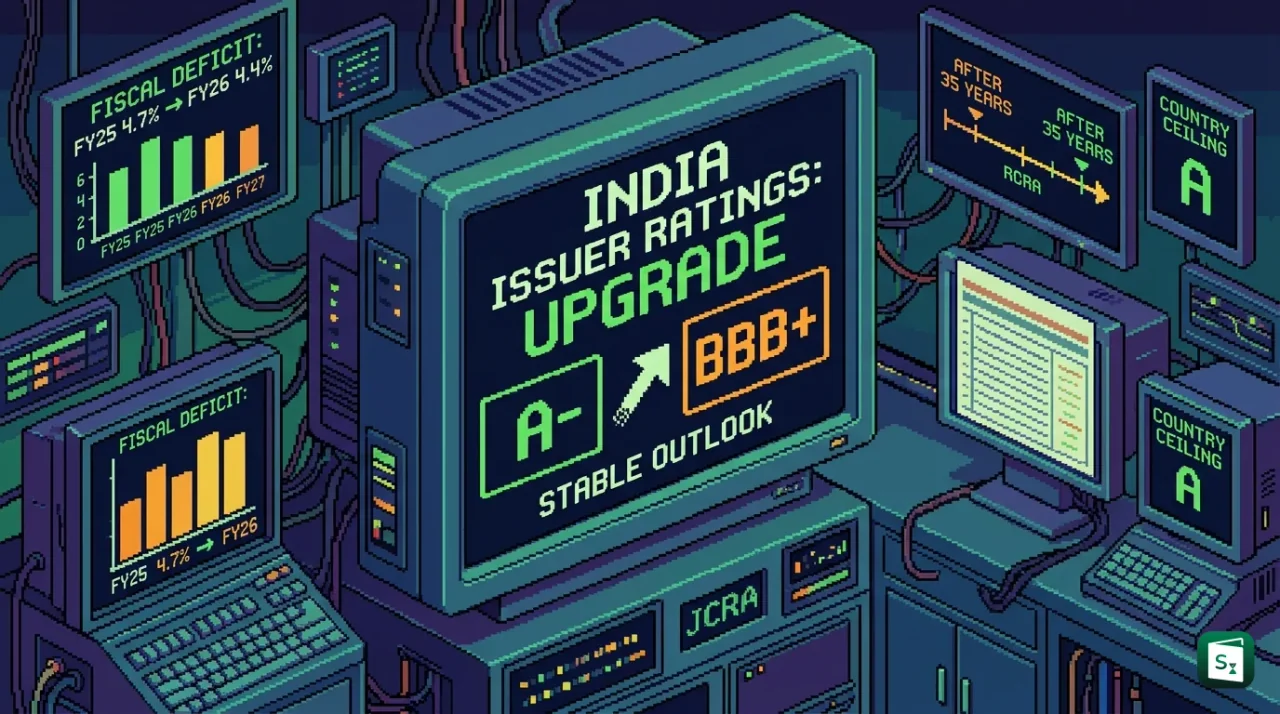
The Japan Credit Rating Agency (JCR) upgraded India’s sovereign credit rating to A- from BBB+ on 28 August 2026, with a stable outlook for both foreign currency and local currency borrowings. The agency also raised India’s country ceiling to A and noted that the central government’s fiscal deficit fell to 4.4% of GDP in FY26 from 4.7% in FY25. The move brings India back into the A category after 35 years and signals stronger global confidence in its growth, public finances and banking system.
What Did the Japan Credit Rating Agency Announce?
JCR raised India’s Foreign Currency Long-term Issuer Rating and Local Currency Long-term Issuer Rating by one notch, from BBB+ to A-, and kept the outlook stable. An issuer rating is the agency’s view on the ability of a borrower, in this case the Government of India, to repay its long term debt on time. The foreign currency rating covers debt raised in foreign money such as dollars, while the local currency rating covers debt raised in rupees.
JCR also raised India’s country ceiling to A. A country ceiling is the highest rating that can normally be given to any company or bank in a country for its foreign currency borrowings. It reflects the risk that the government may place limits on changing rupees into foreign money or sending foreign money abroad during a crisis. In most cases the ceiling stays one to three steps above the sovereign rating, so an A ceiling with an A- sovereign rating follows the normal pattern.
JCR assigned the new ratings on 28 August 2026. JCR, or the Japan Credit Rating Agency, Ltd., was set up on 1 April 1985 and is based in Ginza, Tokyo. It rates most large Japanese companies and financial firms and is recognised in Japan, the United States, Europe and several Asian markets for use under bank capital rules.
What Is a Sovereign Rating and What Does A- Mean?
A sovereign credit rating is an independent grade given to a national government. It shows how likely the government is to repay its loans in full and on time. Investors use it to decide the interest rate they will charge the government and whether they should buy its bonds.
Ratings are placed in two broad groups. Investment grade means the borrower carries low to moderate risk of default. Speculative grade, often called junk, means the risk is high. For JCR and most other agencies, every rating from BBB- upwards, including BBB, BBB+, A-, A and AAA, sits inside investment grade. India was already investment grade at BBB+. The move to A- places it one step higher inside the same safe group, but with stronger credit quality.
The letter grades have a clear meaning. In the BBB group, the capacity to repay is seen as adequate, but it can weaken if the economy faces stress. In the A group, the capacity to repay is seen as strong, though it can still be affected by very bad economic conditions. A plus or minus sign shows the relative position inside a group, so BBB+ is the top of the BBB group and A- is the entry level of the A group. A stable outlook means the agency does not expect to change the rating in the near future.
| Rating Group | Example Grades | What It Signals |
|---|---|---|
| High quality | AAA, AA+, AA | Lowest risk of default |
| Upper medium grade | A+, A, A- | Strong capacity to repay, India is now here with JCR |
| Medium grade | BBB+, BBB, BBB- | Adequate capacity to repay, more exposed to shocks |
| Speculative grade | BB+, BB, B, CCC, D | High risk, also called non investment grade |
A higher rating usually helps a country borrow at lower interest rates and attracts long term investors such as pension funds and insurance companies, many of which can hold only investment grade debt.
Why Did JCR Upgrade India? Growth, Fiscal Path and Financial Health
JCR gave three main reasons for the upgrade. These are solid economic growth, policies that build long term strength, and a much healthier financial system. Together, these factors improved India’s ability to handle shocks without missing debt payments.
India has kept growth near 7% for several years, supported by strong household spending and public investment. Real Gross Domestic Product (GDP), which is the total value of goods and services produced after removing the effect of price rises, grew by 7.7% in FY26. Here FY means financial year, which runs from April to March, so FY26 covers April 2025 to March 2026. Growth stayed strong in the April to June quarter of FY27 at 7.8%, helped by manufacturing, construction and services such as finance, real estate and public administration. JCR expects growth to stay above 6% in FY27. India now has a population of more than 1.4 billion and a nominal GDP of about 3.9 trillion dollars, which makes it one of the world’s largest economies.
Policy support played a clear role. Private spending stayed strong after cuts in personal income tax and reductions in rates under the Goods and Services Tax (GST). GST, launched in 2017, is India’s single national tax on most goods and services and replaced many central and state taxes. JCR also pointed to digital public infrastructure, which means open digital systems for identity, payments and data sharing such as Aadhaar, the Unified Payments Interface (UPI) and Direct Benefit Transfers. These systems widened access to banking, made subsidies reach people directly and improved tax collection.
Inflation has risen since early 2026 due to high food prices after poor weather and higher energy prices linked to tension in the Middle East. Even so, inflation stayed within the Reserve Bank of India (RBI) target range. The RBI, India’s central bank set up in 1935 and based in Mumbai, aims to keep consumer inflation at 4% within a band of 2% to 6%.
Stronger Banks and a Healthier Financial System
The health of banks was a central reason for the upgrade. The gross bad loan ratio of banks, which measures loans where borrowers have stopped paying, fell to 1.8% at the end of March 2026 from very high levels a few years ago. Capital levels and profits of banks stayed sound.
JCR linked this recovery to the Insolvency and Bankruptcy Code (IBC), introduced in 2016 to speed up the closure or revival of failed companies, along with capital support from the government to public sector banks and closer supervision by the RBI. Asset quality and capital strength also improved for non banking financial companies (NBFCs), which are firms that give loans like banks but do not hold a banking licence. This broad clean up reduced the risk that stress in the financial sector could spill over to government finances.
Better Quality of Government Spending and Lower Fiscal Deficit
Fiscal deficit is the gap between what the government spends and what it earns from taxes and other income, without counting borrowings. It is shown as a share of GDP. A lower deficit means the government needs to borrow less.
The central government’s fiscal deficit fell to 4.4% of GDP in FY26, equal to about ₹15.19 lakh crore, from 4.7% in FY25. JCR said the quality of spending improved because the government controlled day to day spending, including subsidies, while keeping capital expenditure high. Capital expenditure is spending on long life assets such as roads, railways, ports and power lines. This type of spending can raise future growth, unlike revenue spending on salaries, interest and subsidies.
Central government debt stood at 56.1% of GDP at the end of FY26 and is expected to fall slowly. JCR warned that total general government debt, which adds state government borrowings, remains high along with the interest burden. It also pointed to lasting fiscal pressures from Centre State relations, transfers meant to reduce gaps between states, and spending cycles linked to elections. JCR said it will watch whether public capital spending pulls in more private investment so growth does not depend too heavily on the government.
India’s external position also supported the upgrade. The current account deficit, which is the gap between what India earns from the world and what it pays to the world for trade and services, stayed contained. A persistent goods trade deficit was balanced by a surplus in services exports. Foreign exchange reserves touched a record of about 729.33 billion dollars in August 2026, well above short term foreign debt. Large reserves give India a cushion against sudden outflows or oil price shocks.
How Does the JCR Upgrade Compare With Other Agencies?
JCR is now more positive on India than the three large global agencies, which are S and P Global Ratings, Moody’s Ratings and Fitch Ratings. Its move follows a series of upgrades in 2025 and 2026 that ended a long period without any change in India’s rating.
S and P raised India to BBB with stable outlook in August 2025, up from BBB-. This was its first upgrade of India in 18 years, since 2007. Morningstar DBRS raised India to BBB in May 2025. Rating and Investment Information (R and I), another Japanese agency based in Tokyo, raised India to BBB+ with stable outlook in September 2025. The Finance Ministry welcomed that step as proof of strong growth and careful fiscal management.
Moody’s and Fitch have stayed cautious. Moody’s kept India at Baa3 with stable outlook in September 2025. Baa3 is Moody’s lowest investment grade, equal to BBB-. Fitch also kept India at BBB- with stable outlook in August 2025. Both agencies praised growth and external strength but flagged high public debt and weak debt affordability, which means a large share of government income goes to interest payments.
| Agency | India Rating Before JCR Move | Outlook |
|---|---|---|
| JCR | A- (upgraded from BBB+ in August 2026) | Stable |
| R and I (Japan) | BBB+ (upgraded from BBB in September 2025) | Stable |
| S and P | BBB (upgraded from BBB- in August 2025) | Stable |
| Moody’s | Baa3 (lowest investment grade) | Stable |
| Fitch | BBB- (lowest investment grade) | Stable |
JCR had kept India at BBB+ with stable outlook since August 2007. Its history tables show the rating unchanged through the global financial crisis, the pandemic and the recent recovery, before the 2026 upgrade.
Why the Return to A After 35 Years Matters for India
India last held an A level rating in 1988, when Moody’s rated it A2. That status was lost during the 1990 to 1991 balance of payments crisis, when low foreign reserves forced India to pledge gold and seek support from the International Monetary Fund (IMF). The IMF, set up in 1944 and based in Washington D C, lends to countries facing external payment stress. Returning to the A group after more than three decades therefore carries strong symbolic value. It marks the distance covered from near default to steady growth with large reserves.
A higher sovereign rating can lower borrowing costs over time. When the government’s rating rises, Indian companies and banks that borrow abroad can also find it easier to raise funds, because the country ceiling acts as a cap on their foreign currency ratings. The upgrade may widen the pool of buyers for Indian bonds, especially among long term investors that prefer higher rated debt. It can also support the rupee bond market by narrowing the gap between Indian and American bond yields, which lowers interest costs across the economy.
The Finance Ministry has said the upgrade reflects growth momentum, stable prices and deep structural reforms, along with cooperation between the Centre and states. The chairman of the Fifteenth Finance Commission, which advises on sharing taxes between the Centre and states, described the return to A as recognition of reforms and macro stability.
The task ahead is to keep the gains. The government met its FY26 deficit goal through careful spending control even as tax cuts on income and GST reduced revenue in the short term. It now aims to keep central debt on a falling path to about 50% of GDP by March 2031 under its fiscal framework. The Fiscal Responsibility and Budget Management (FRBM) Act, 2003 requires the Centre to control deficits and manage debt in a transparent manner. Economists note that total liabilities of the Centre and states together still stand near 80% of GDP, and interest payments take up a large share of revenue. Sustained private investment, better tax collection, steady capital spending by states and control over food, fertiliser and fuel subsidies during oil shocks will decide whether India can climb further inside the A group.
Key Takeaways
- JCR upgraded India’s Foreign and Local Currency Long-term Issuer Ratings to A- from BBB+ with a stable outlook on 28 August 2026.
- India’s country ceiling was raised to A, the maximum normal limit for foreign currency ratings of Indian companies and banks.
- The central fiscal deficit fell to 4.4% of GDP in FY26 from 4.7% in FY25, while central debt stood at 56.1% of GDP.
- Real GDP grew 7.7% in FY26 and 7.8% in the April to June quarter of FY27, with growth above 6% expected in FY27.
- The banking sector’s gross bad loan ratio fell to 1.8% at end March 2026, helped by the IBC of 2016 and stronger supervision by the RBI.
- India returned to the A category after 35 years, having last held an A level rating with Moody’s A2 in 1988 before the 1990 to 1991 payments crisis.