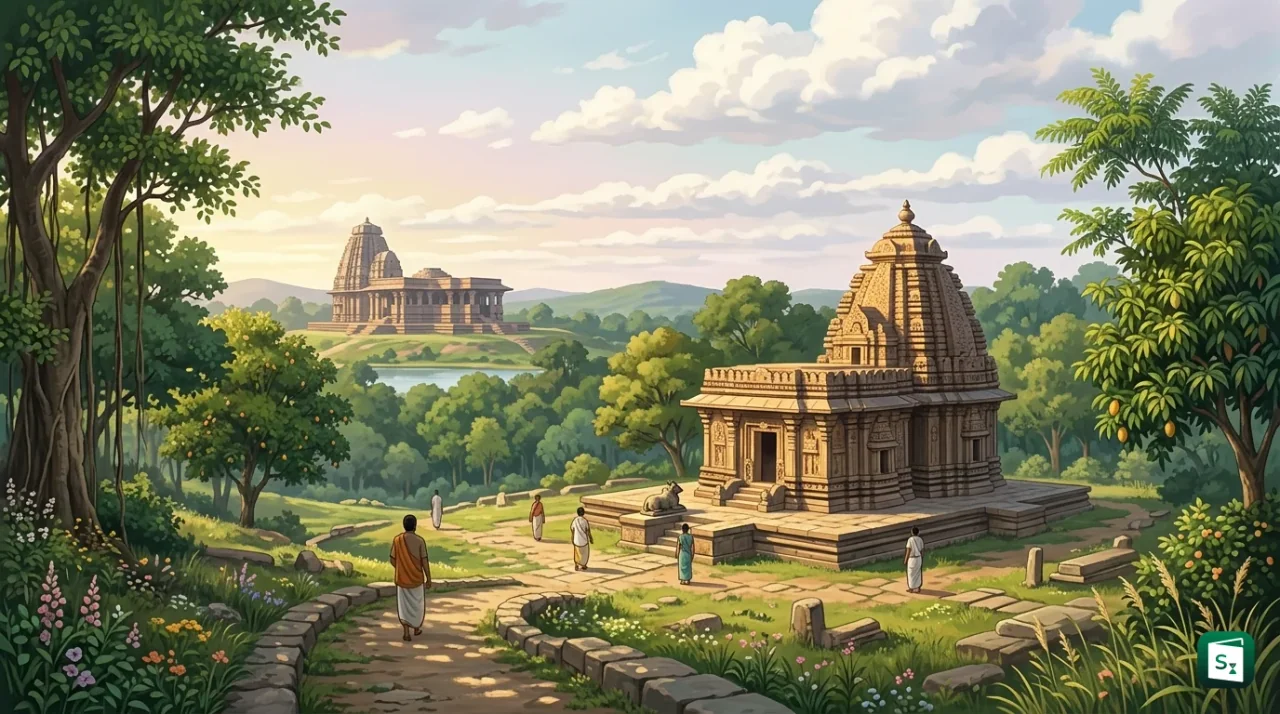
The Archaeological Survey of India (ASI) has declared the 13th century Gollala Gudi Temple at Palampet in Mulugu district, Telangana as a Monument of National Importance through Gazette Notification S.O. 4802(E) dated 31 August 2026. Located just southwest of the Kakatiya Rudreshwara Temple, popularly known as the Ramappa Temple and inscribed as a UNESCO World Heritage Site in 2021, the shrine becomes the 10th centrally protected monument in Telangana. With this addition, India now has 3,693 centrally protected monuments and archaeological sites under ASI protection.
What Is a Monument of National Importance?
A Monument of National Importance is an ancient monument, archaeological site or remains that the central government has declared to be of historical, archaeological or artistic importance for the nation. The declaration is made by the Central Government on the recommendation of the Archaeological Survey of India (ASI), and the monument then becomes a Centrally Protected Monument. Once notified, the site is protected and maintained directly by the ASI, with strict controls on construction, mining, encroachment and other activities around it.
The concept is rooted in the Constitution of India. Article 49, under the Directive Principles of State Policy, directs the State to protect monuments and places of artistic or historic interest declared to be of national importance. Article 51A(f), which lists the Fundamental Duties of citizens, calls upon every citizen to value and preserve the rich heritage of the country. The legal process for such protection is laid down in the Ancient Monuments and Archaeological Sites and Remains (AMASR) Act, 1958 and the AMASR Rules, 1959.
It is useful to distinguish three categories that are often confused. A Centrally Protected Monument is notified by the ASI under the AMASR Act and conserved with central funds. A State Protected Monument is notified by a state government under its own law and maintained by the state archaeology department. A UNESCO World Heritage Site is a separate international recognition given by the United Nations Educational, Scientific and Cultural Organization (UNESCO), headquartered in Paris, France, under the World Heritage Convention, 1972. A site can be a centrally protected monument and also a UNESCO site, as in the case of the Ramappa Temple, but many centrally protected monuments are not UNESCO sites.
| Category | Notified By | Governing Law | Examples |
|---|---|---|---|
| Monument of National Importance / Centrally Protected Monument | Central Government on ASI proposal | AMASR Act, 1958 | Gollala Gudi, Ramappa Temple, Charminar, Taj Mahal, Red Fort |
| State Protected Monument | State Government | State archaeological laws | Over 300 sites in Telangana maintained by the State Department of Archaeology |
| UNESCO World Heritage Site | UNESCO World Heritage Committee | World Heritage Convention, 1972 | Ramappa Temple (2021), Taj Mahal (1983), Qutb Minar (1993) |
Gollala Gudi Temple Declared a Monument of National Importance
The ASI issued the final notification for Gollala Gudi in early September 2026, following a Gazette Notification S.O. 4802(E) dated 31 August 2026 under Section 4(3) of the AMASR Act, 1958. The notification was widely reported on 2 September 2026. This completed the statutory process that began with a preliminary notification and a two month period for objections from the public. No objections sufficient to withhold the proposal were received, so the Central Government confirmed the protection.
With this status, Gollala Gudi comes under the full conservation, maintenance and access control framework of the ASI. The agency will now be responsible for its structural stability, repair, documentation and long term upkeep, and any construction or mining activity around it will be regulated under the prohibited area (0 to 100 metres) and regulated area (100 to 200 metres) provisions of the amended AMASR Act.
Where Is Gollala Gudi Located?
Gollala Gudi is located in Palampet village, Mulugu district, Telangana. It lies on the southwest side of the Kakatiya Rudreshwara Temple, also called the Ramappa Temple, within the same cultural landscape and at a distance of about 200 metres from the main shrine. Palampet is about 15 km from Mulugu, about 66 km from Warangal which was the capital of the Kakatiya dynasty, and about 200 km northeast of Hyderabad, the capital of Telangana. The wider region forms part of the Warangal heritage circuit, which includes the Thousand Pillar Temple, Ghanpur group of temples and Warangal Fort.
How Was the Declaration Made?
Adding a site to the central list follows five clear steps. First, the ASI circle assesses and proposes a site based on historical and architectural value. Second, a preliminary notification under Section 4(1) of the AMASR Act is published in the Gazette of India. Third, the public is given two months to file objections. Fourth, those objections are evaluated by the Central Government. Fifth, a final notification under Section 4(3) is issued, and the monument is entered in the list of centrally protected monuments.
In the case of Gollala Gudi and the nearby Shiva Temple at Palampet, the ASI Hyderabad Circle proposed both temples for protection earlier in 2026 to protect the setting of the UNESCO listed Ramappa Temple. The Shiva Temple was notified first, in July 2026, while Gollala Gudi followed in late August 2026. The Mulugu district administration has handed over nearly 16 acres of land to the ASI around the three temples, and officials have completed fencing and demarcation. The plan, as stated by Nikhil Das, Superintending Archaeologist, ASI Hyderabad Circle, is to create a single unified complex where the Ramappa Temple, the Palampet Shiva Temple and Gollala Gudi are accessed through one entrance.
Architectural Significance of Gollala Gudi
Gollala Gudi is a 13th century temple built during the Kakatiya period, which lasted from 1123 to 1323 CE. Historians link it to the reign of Kakatiya ruler Ganapati Deva and his general Recharla Rudra, who also commissioned the Ramappa Temple and the large reservoir next to it. The temple shares the same building language, material and craftsmanship as Ramappa, which helps date it to the same era.
The temple is a Trikutalaya, which means it has three shrines. The layout consists of an east facing mandapa, which is a pillared hall, surrounded by three garbhagrihas, or sanctums, on the other three sides. The mandapa is the central space for gathering and ritual, while each garbhagriha would have housed a deity. Such three shrine plans are common in Kakatiya temple groups, where a main temple is accompanied by smaller subsidiary shrines that allowed different communities and sects to worship within the same complex.
Its artistic features are notable. The parapet carries finely carved sculptures, while the entablature and doorways show rows of hamsas, or swans, and delicate jali, or lattice work. The shrine preserves images of Vishnu, Lakshmi, Ganesha and Mahishasuramardini, along with carved dvarapalas, or door guardians, near two detached shrines. Like Ramappa, the temple is built with grey green schist and dolerite stone blocks laid without any binding mortar, a technique sometimes described as sangam construction. The dry stone method gives the structure flexibility and has helped many Kakatiya temples survive seismic activity, but it also requires careful maintenance.
At the time of notification, the temple was in a very dilapidated state. The ASI reported damage from the foundation to the shikhara, or tower. Documentation using Lidar, which is Light Detection and Ranging for 3D mapping, has been completed to assess the condition. Scaffolding and fencing have been erected to prevent further collapse. According to ASI officials, about 60 percent of the stones are intact while the rest are damaged. The conservation plan involves carefully dismantling the structure stone by stone and reconstructing it in the original plan, reusing the intact blocks and replacing missing elements with matching material.
The Kakatiya Rudreshwara Temple and Its UNESCO Context
The Kakatiya Rudreshwara Temple, popularly called the Ramappa Temple, is the main Shiva temple in a walled complex at Palampet. It was built in 1213 CE by Recharla Rudra, a general serving the Kakatiya rulers Rudradeva and Ganapati Deva, and took about 40 years to complete. Uniquely in India, the temple is named not after its presiding deity Rudreshwara, a form of Shiva, nor after its patron, but after its chief sculptor Ramappa. It lies beside the large Ramappa Cheruvu, or reservoir, also built by Recharla Rudra, which reflects the Kakatiya concept of Tank, Township and Temple, where water management, settlement and sacred architecture were planned together.
The Kakatiya dynasty ruled much of present day Telangana and parts of Andhra Pradesh, Chhattisgarh, Odisha and Maharashtra after breaking free from Chalukyan overlordship. Their period, from 1123 to 1323 CE, is often described as a golden era for Telugu culture, marked by strong irrigation systems, fortified towns and distinctive temple architecture.
Architecturally, Ramappa is a masterpiece of Kakatiya style. It stands on a raised platform and uses a combination of red sandstone, granite and dolerite, with a pyramidal vimana, or stepped tower, made of lightweight porous bricks, often called floating bricks, which reduce the weight of the roof and help make the structure earthquake resistant. The foundations were laid using a sandbox technique, where sand was filled below the base to absorb seismic shocks. The walls, pillars and beams carry intricate carvings of gods, goddesses, animals and regional dance forms, carved with a metallic finish from hard dolerite that retains its lustre even after about 800 years.
UNESCO inscribed the temple as a World Heritage Site on 25 July 2021 at its 44th extended session in Fuzhou, China (held online), under Criterion (i) for a masterpiece of human creative genius and Criterion (iii) for exceptional testimony to the Kakatiya civilisation. It is the first UNESCO World Heritage Site in Telangana. The inscription noted the temple as a harmonious ensemble of architecture, sculpture, dance, ritual and natural setting.
A key condition for inscription was that the temple should not be seen in isolation. The World Heritage Committee asked India to protect the wider cultural landscape, including smaller temples, tanks and cultivated land around the main shrine, and to prepare an Integrated Conservation Management Plan and boundary modification to include these elements in the buffer zone. The notification of the Palampet Shiva Temple in July 2026 and Gollala Gudi in August 2026 directly fulfils that recommendation. Other requests from UNESCO have included completing the reassembly and conservation of the Kameshwara Temple, clarifying the role of the Palampet Special Area Development Authority, involving local and religious communities in management, and undertaking Heritage Impact Assessments for any new development that could affect the Outstanding Universal Value of the property.
How Many Centrally Protected Monuments Are There in India and Telangana?
With the addition of Gollala Gudi, Telangana now has 10 centrally protected monuments and sites. Until mid 2026, the Hyderabad Circle of the ASI, which covers Telangana, listed 8 such monuments. The Palampet Shiva Temple became the ninth in July 2026, and Gollala Gudi is now the tenth. Nationally, the government notes 3,693 centrally protected monuments and archaeological sites of national importance across India. Other official lists cite slightly different totals, such as 3,679 or 3,757, because the ASI periodically delisted 18 monuments in 2024 that had been lost to urbanisation or submergence and adds a few new ones each year.
Telangana is a relatively small part of this national list, but the sites are of high historic value. They span prehistoric mounds, Deccan sultanate forts and Kakatiya temples.
| Sl. No. | Monument | Location | District |
|---|---|---|---|
| 1 | Charminar | Hyderabad | Hyderabad |
| 2 | Golkonda Fort and Fortifications | Hyderabad | Hyderabad |
| 3 | Alampur Temples (Navabrahma Group) | Alampur | Jogulamba Gadwal |
| 4 | Thousand Pillar Temple | Hanamkonda | Warangal |
| 5 | Kakatiya Rudreshwara (Ramappa) Temple | Palampet | Mulugu |
| 6 | Warangal Fort and Gateways | Warangal | Warangal |
| 7 | Ancient Mound, Kondapur | Kondapur | Sangareddy |
| 8 | Prehistoric Site, Janapet | Janapet | Yadadri Bhuvanagiri |
| 9 | Pillalamarri Temple | Pillalamarri | Suryapet |
| 10 | Palampet Shiva Temple | Palampet | Mulugu |
| 11 | Gollala Gudi Temple | Palampet | Mulugu |
Note: The table shows 11 names because earlier lists numbered 8 or 9 depending on whether Alampur is counted as one group or multiple temples, but the ASI Hyderabad Circle now officially counts 10 distinct centrally protected entries in Telangana after the two 2026 notifications in Palampet. The Palampet cluster alone now has three centrally protected temples within a few hundred metres of each other.
By contrast, State Protected Monuments in Telangana number about 323, inherited from the undivided Andhra Pradesh list of about 500 sites when Telangana was formed on 2 June 2014. These are maintained by the State Department of Archaeology. A centrally protected tag brings higher funding, scientific conservation standards and legal protection under central law.
Who Is the Archaeological Survey of India?
The Archaeological Survey of India (ASI) is the premier central agency for archaeological research and for the protection of cultural heritage. It functions under the Ministry of Culture, Government of India, and is headed by a Director General. Its headquarters is at Dharohar Bhawan, 24 Tilak Marg, New Delhi.
The ASI was established in December 1861 by Sir Alexander Cunningham, who became its first Archaeological Surveyor. Cunningham is often called the father of Indian archaeology for his surveys tracing the route of the Chinese pilgrim Xuan Zang and identifying many ancient cities. The origins of organised antiquarian study go back to 15 January 1784, when Sir William Jones founded the Asiatic Society in Calcutta and started the journal Asiatick Researches in 1788. The Survey was revived as a separate department in 1871 after a brief abolition in 1866, and it grew under Sir John Marshall, when the Indus Valley Civilisation was discovered and a separate law to protect monuments was enacted.
Today the ASI administers its work through 24 Circles and one Mini Circle at Leh, along with specialised branches for excavation, epigraphy, science, horticulture, prehistory and temple survey. Its core duties include survey and excavation, conservation and preservation of centrally protected monuments, regulation of archaeological activities under the AMASR Act, 1958, administration of the Antiquities and Art Treasure Act, 1972, management of archaeological museums, training through the Institute of Archaeology established in 1985 (which grew out of the School of Archaeology, 1959), and publication of research reports.
The ASI also acts as the custodian of many of India’s UNESCO World Heritage Properties. Of the 43 World Heritage Sites in India as of 2024, a large share are centrally protected monuments maintained by the ASI. The agency evaluates proposals for national importance, publishes preliminary and final Gazette notifications, demarcates prohibited and regulated areas, and prepares annual conservation plans for each monument.
Legal Framework: The Ancient Monuments and Archaeological Sites and Remains Act, 1958
The central law that gives statutory protection to Monuments of National Importance is the Ancient Monuments and Archaeological Sites and Remains (AMASR) Act, 1958. The Act, along with the AMASR Rules, 1959, empowers the Central Government to declare any ancient monument, archaeological site or remains to be of national importance if it is of historical, archaeological or artistic interest and has existed for not less than 100 years. The AMASR (Amendment and Validation) Act, 2010 strengthened the regime by creating clear prohibited and regulated zones and by setting up new authorities.
Key features of the framework include the declaration process, zoning controls and enforcement bodies. Under Section 4, a preliminary notification is issued under Section 4(1) and published in the Gazette of India. After two months for objections under Section 4(2), the government may confirm the declaration under Section 4(3), which is the provision used for Gollala Gudi.
The 2010 amendment defines a prohibited area of 0 to 100 metres around the monument where no construction is permitted, and a regulated area of 100 to 200 metres where construction requires prior permission. This zoning helps prevent encroachment, mining and unplanned building that can damage foundations and sightlines.
The National Monuments Authority (NMA), set up under the 2010 amendment and located in New Delhi, examines applications for construction or repair in regulated areas and makes recommendations. The Competent Authority grants or refuses permissions based on those recommendations.
The ASI also enforces the Antiquities and Art Treasure Act, 1972, which regulates the export, sale and handling of antiquities to prevent illicit trade. Damaging, destroying, misusing or illegally constructing near a protected monument can attract imprisonment and fines under the Act.
Once a site is declared, the ASI takes direct charge of conservation, maintenance and regulated public access. It can acquire land, remove encroachments, carry out scientific repairs and control visitor movement to prevent wear to fragile carvings.
Why Does This Declaration Matter?
The protection of Gollala Gudi is important for several linked reasons.
First, it secures the cultural landscape of the Ramappa World Heritage Site. UNESCO specifically asked India not to treat Ramappa as a single temple but as a wider complex of tanks, subsidiary shrines and historic settlements. Notifying the two subsidiary shrines next to Ramappa shows compliance with that advice and strengthens India’s record on heritage management before future periodic reports to the World Heritage Committee.
Second, it protects a distinct example of Kakatiya architecture. Gollala Gudi displays the same dry stone construction without mortar, intricate sculpture and Trikutalaya plan that define Kakatiya craft. Saving it preserves knowledge of medieval Indian engineering, including the use of local schist and dolerite, sandbox foundations and lightweight bricks that still interest modern engineers.
Third, it ensures timely conservation. The temple was highly vulnerable, with fencing and scaffolding only as temporary support. Central protection brings a dedicated annual conservation plan, scientific documentation with Lidar 3D mapping, and funds for careful dismantling and reconstruction. Without this, the structure would have continued to deteriorate.
Fourth, it improves visitor management and tourism. With 16 acres now under ASI control, the three temples can be linked through one common entrance, with a defined prohibited and regulated boundary starting from the Shivalayam. This will allow better crowd control, clearer signage, ticketing if needed, and protection of sightlines around the World Heritage core. Telangana’s Warangal heritage circuit, including the Thousand Pillar Temple and Warangal Fort, is expected to benefit from more integrated promotion.
Fifth, it shows coordination between the Central and State Governments. The Government of Telangana handed over land and supported demarcation, while the Ministry of Culture through the ASI completed notification and will fund conservation. This model of cooperation is often required to bring other neglected sites onto the central list, especially since the Comptroller and Auditor General (CAG) noted in 2013 and 2022 that no comprehensive survey had been done to identify all monuments deserving national status.
The Way Forward
The immediate next step is scientific conservation. The ASI Hyderabad Circle has already shared that a detailed project report for Gollala Gudi has been prepared. After review and approval by the Director General, ASI, the team will begin the stone by stone dismantling and reassembly, using laser scanned records to ensure the original orientation, joints and carvings are retained. Regular monitoring, chemical cleaning of stone and improved drainage around the foundation will follow.
The second priority is completing the unified heritage complex. Once land transfer, fencing and documentation are fully complete, the ASI, the Palampet Special Area Development Authority, the Telangana State Tourism Development Corporation and local village bodies will need to align on design of pathways, a single entry, parking away from the core, and controls on shops and construction in the regulated zone.
At the policy level, UNESCO has asked India to submit a finalised Integrated Conservation Management Plan, updated Tourism Development Plan and a boundary modification proposal that formally extends the World Heritage property and its buffer to include the surrounding temples and tanks. Completing these documents, along with routine Heritage Impact Assessments for any new roads, resorts or infrastructure near Palampet, will be essential to keep the World Heritage status in good standing.
For Telangana as a whole, heritage experts have suggested that many of the 323 State Protected Monuments could be assessed for central protection where they meet the 100 year criterion and show national significance. A systematic survey, along with continued National Mission on Monuments and Antiquities documentation, would help identify the next candidates without waiting for World Heritage linked triggers alone.
Key Takeaways
- Gollala Gudi Temple at Palampet, Mulugu district, Telangana was declared a Monument of National Importance through Gazette Notification S.O. 4802(E) dated 31 August 2026 under Section 4(3) of the AMASR Act, 1958.
- The temple lies southwest of the Kakatiya Rudreshwara (Ramappa) Temple, a UNESCO World Heritage Site inscribed in 2021, at a distance of about 200 metres.
- Gollala Gudi is a 13th century Trikutalaya with an east facing mandapa and three garbhagrihas, built in grey green schist without mortar and featuring images of Vishnu, Lakshmi, Ganesha and Mahishasuramardini, plus hamsa and jali work.
- With this notification, Telangana now has 10 centrally protected monuments, while India has 3,693 centrally protected monuments and archaeological sites under ASI care.
- The Ramappa Temple was built in 1213 CE by Recharla Rudra under Kakatiya rulers and was inscribed by UNESCO on 25 July 2021 at the 44th extended session in Fuzhou under Criteria (i) and (iii), unique for being named after sculptor Ramappa.
- The Archaeological Survey of India (ASI) was founded in December 1861 by Sir Alexander Cunningham, functions under the Ministry of Culture, is headquartered at Dharohar Bhawan, 24 Tilak Marg, New Delhi, and administers the AMASR Act, 1958 and Antiquities and Art Treasure Act, 1972 through 24 Circles.