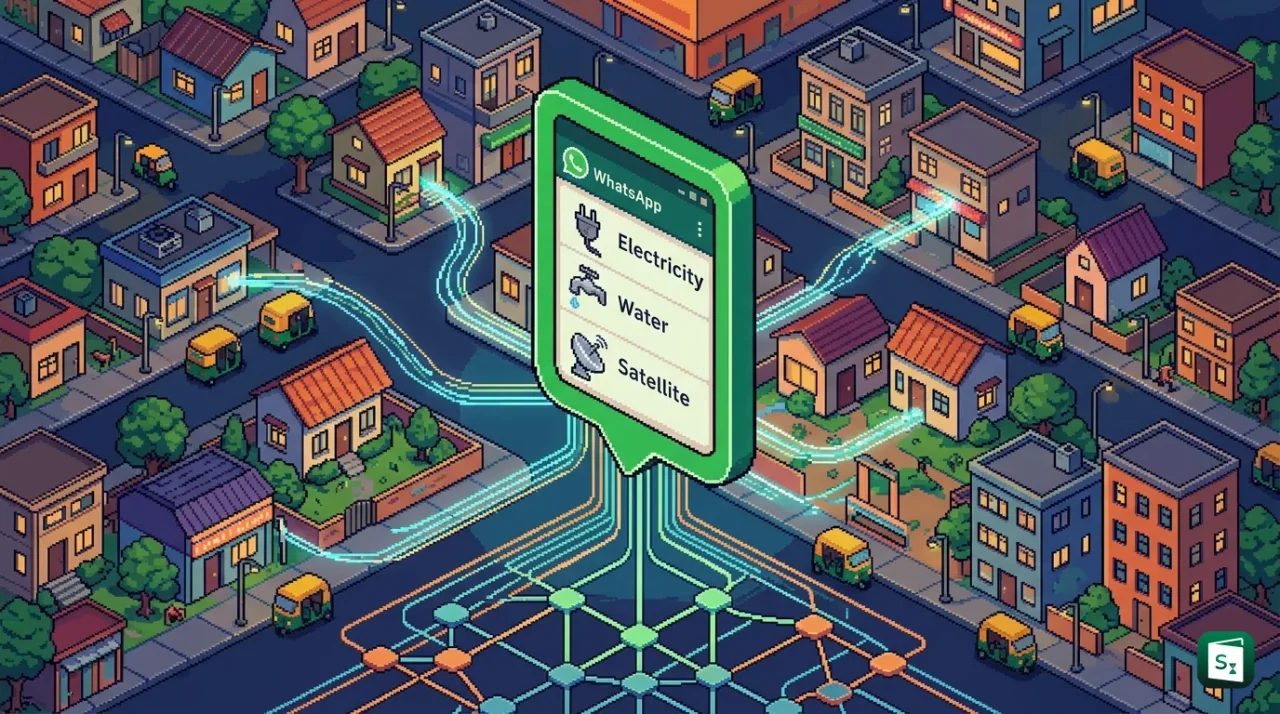
WhatsApp has rolled out a native bill payments feature in India that lets users discover, manage and pay household and utility bills without leaving the app. The service, which began rolling out on 3 September 2026 for Android and iOS users, is powered by the Bharat Connect network, formerly known as the Bharat Bill Payment System (BBPS). With access to 22,722 billers across 30 categories, the move positions WhatsApp as a full-stack payments channel in India’s largest messaging market.
What Is the New WhatsApp Bill Payments Feature?
WhatsApp’s new feature allows users to find, manage and pay everyday bills directly inside the chat application, without switching to a separate payments or banking app. It was announced by Meta India on 3 September 2026 and is being rolled out gradually to all users on Android and iOS over the coming weeks. The feature is accessed through the ₹ (rupee) icon at the top of the WhatsApp home screen.
The service covers a wide set of recurring household payments. The 30 categories include electricity, piped gas, water, LPG, broadband, DTH, mobile postpaid, FASTag recharge, insurance premiums, credit card bills, loan repayments, municipal taxes, education fees, housing society charges and subscriptions, among others. Users can pay using Unified Payments Interface (UPI), debit cards or credit cards, and can choose their preferred mode at the time of payment.
Beyond one-time payments, the feature brings discovery and management tools inside WhatsApp. Users can view past payments and upcoming bills, see a household bills summary with pre-fetched bill amounts, manage multiple accounts under a single biller for home, office and family, and get one-tap access to billers they have paid before on the Payments Home screen. Frequently used categories are surfaced automatically, while the full list can be browsed through the See All option. The design aim, as stated by Arun Srinivas, Managing Director and Country Head of Meta India, is to make paying a bill as simple as sending a message and to extend convenient digital payments to users in remote areas without juggling multiple apps or tracking due dates.
What Is Bharat Connect and How Does It Work?
Bharat Connect is the brand name for the Bharat Bill Payment System (BBPS), an integrated and interoperable bill payments platform conceptualised by the Reserve Bank of India (RBI) and operated by NPCI Bharat BillPay Ltd (NBBL). NBBL is a wholly owned subsidiary of the National Payments Corporation of India (NPCI) and functions as the Bharat Bill Payment Central Unit (BBPCU), the single authorised entity that sets operational, technical, business and settlement standards and carries out clearing and settlement for the system. The platform was rebranded from BBPS to Bharat Connect at the Global Fintech Fest in 2024, to reflect its expanded scope beyond traditional utility bills to categories such as business collections, cross-border bill payments and newer segments like Forex through FX-Retail.
The system provides anytime, anywhere access through both digital and physical channels. Customers can pay through mobile apps, bank websites, and also at more than 5 lakh physical agent outlets including bank branches and kirana stores, complemented by over 700 digital payment channels. It supports multiple payment modes including UPI, net banking, IMPS, NEFT, debit cards, credit cards, prepaid instruments and wallets, with instant confirmation via SMS or receipt. The platform operates round the clock with 24x7 availability and 99.87 percent uptime, and carries out settlements in multiple cycles each day, enabling fast fund transfers to billers.
As of mid 2026, the Bharat Connect ecosystem is large and growing. In July 2026, the network processed 270.72 million transactions, up from 262.14 million in June. In calendar year 2025, it handled about 3.05 billion transactions worth ₹14.84 lakh crore. The network connects 22,722 billers, 55 Biller Operating Units, 77 Customer Operating Units, about 1,160 agent institutions and 1,700 physical biller collection units, reaching roughly 70 to 80 million households every month. Average daily settlements exceed ₹700 crore, and the system tops up to 1.2 crore unique customers per month.
Participants in the Bharat Connect Ecosystem
The framework works on a tiered structure defined under the RBI Master Direction on Bharat Bill Payment System, 2024, which came into effect on 1 April 2024 and replaced the 2014 guidelines.
| Participant | Role |
|---|---|
| Bharat Bill Payment Central Unit (BBPCU) | NBBL is the only authorised BBPCU. It operates the central infrastructure, certifies participants, manages clearing and settlement, handles brand and marketing, and runs central complaint and dispute redressal. |
| Bharat Bill Payment Operating Units (BBPOUs) | Banks and authorised non-banks that operate the system. They function as Biller Operating Units (BOUs), which onboard and connect billers to the network, and Customer Operating Units (COUs), which provide the customer interface directly or through agent institutions. An entity can be both a BOU and a COU. |
| Agent Institutions | Entities certified by NBBL through a COU that offer the physical or digital interface where customers actually pay bills. WhatsApp India operates as an Agent Institution onboarded via an authorised COU under this framework. |
| Billers | Service providers such as electricity distribution companies, telecom firms, insurance companies, lenders and municipalities that are connected through a BOU to collect payments. |
| Technology Service Providers | Firms that provide technology solutions to billers, BOUs, COUs or agent institutions to integrate with the central unit. |
The flow is straightforward. When a customer initiates a payment, the request goes from the customer interface to the BBPCU, which routes it to the concerned biller through the respective operating units. The biller then confirms the bill amount, the customer pays using the chosen mode, and the biller updates the account and sends a confirmation. A centralised grievance redressal system allows customers to raise complaints about any supported bill on one platform, regardless of which app they used.
From GIRO to Bharat Connect: A Brief Timeline
The idea of a unified bill payments system in India traces back to the RBI’s Payments Systems Vision 2012-15. In 2013, the RBI set up the G. Padmanabhan Committee to study the feasibility of a GIRO based system, a credit push system where the payer initiates payment that moves through collecting, payer and payee banks to centralise collections. The committee estimated that more than 30,800 million bills worth ₹6,223 billion were generated each year in the top 20 cities alone, mostly paid in cash or cheque at biller counters.
The Giro Advisory Group chaired by Prof. Umesh Bellur of IIT Bombay submitted its report in March 2014, recommending a tiered structure with a central unit and operating units. Based on this, the RBI issued draft guidelines in August 2014 and final BBPS guidelines on 28 November 2014, authorising NPCI to function as the BBPCU. The system had a pilot in 2016, went live with select categories in 2017, was formally branded as Bharat BillPay in 2018, and expanded from five to more than 20 categories by 2019. On 10 December 2020, NPCI Bharat BillPay Ltd (NBBL) was incorporated as a separate subsidiary, and it became operational from 1 April 2021 to scale the platform. Cross border bill payments were launched in 2022, and in 2023 the platform crossed 100 million transactions in a single landmark period. The 2024 rebranding to Bharat Connect and the updated RBI Master Directions marked the next phase of expansion into merchant, business and internet banking payments.
How to Pay Bills on WhatsApp
The process is designed to stay inside WhatsApp from discovery to confirmation, and no separate registration on Bharat Connect is required. Customers can use existing bank credentials or any Bharat Connect partnered channel.
To make a payment, the user opens WhatsApp and taps the ₹ icon on the home screen to enter Bill Payments. The user then selects the relevant bill category, for example electricity, and chooses the specific biller from the list, such as the local power distribution company. After entering and confirming account details like consumer number or mobile number, WhatsApp fetches the live bill amount from the biller through Bharat Connect and displays it for review. The user can edit the payable amount if the biller allows partial payments, then selects a payment mode among UPI, debit card or credit card and confirms. Authentication is done through the UPI PIN or card credentials as applicable, and a receipt is generated instantly within WhatsApp and also by the payment app.
For subsequent payments, the app simplifies repeat use. Billers paid before appear on the Payments Home for one-tap access, and upcoming bills are pre-fetched and summarised. Users can manage several consumer numbers under the same provider and track both past and upcoming dues in one chat based view. From 1 July 2024, the RBI has also mandated that all credit card bill payments made through third party apps must be routed through BBPS, so WhatsApp’s credit card payment flow is already compliant with this requirement by design through Bharat Connect.
Why This Integration Matters
For customers, the change reduces friction in a high frequency task. India still generates billions of recurring bills each year for utilities, fees and loan repayments, and many households in smaller towns spend time and money travelling to physical counters to pay in cash. Bharat Connect solves this by offering a single interoperable window for all billers, with standardised processes, secure end to end encryption, and central dispute management. WhatsApp brings that window to where people already spend time. India is WhatsApp’s largest market, with more than 500 million to 850 million users depending on estimates, so embedding bill payments inside a familiar messaging interface lowers the barrier for digital adoption, especially for first time users who find dedicated banking apps complex.
For billers, the benefit is timely, low cost collections and reconciliation at scale. Instead of maintaining separate integrations with hundreds of banks and apps, a biller connects to one or two BOUs and instantly reaches customers across more than 700 digital channels and 5 lakh assisted outlets. Settlements happen in up to eight cycles a day with automated reconciliation and instant payment confirmation, which improves cash flow visibility. The platform also supports analytics through the biller dashboard and handles complaint management centrally.
For the wider payments ecosystem, the integration reflects two regulatory directions. First, the Payment and Settlement Systems Act, 2007 requires authorisation for any entity that operates a bill payment system outside BBPS, and the 2024 Master Directions formalise that Bharat Connect is the nationally mandated rail for interoperable recurring bill payments. Second, interoperability is being extended beyond bills. NBBL has been mandated to develop a unified internet banking and mobile banking platform (Banking Connect) and has expanded into Bharat Connect for Business for invoice exchange and B2B settlements, signalling that recurring collections across consumer, business and government segments will converge on the same connective tissue.
WhatsApp’s Growing Footprint in India’s Digital Payments Space
WhatsApp’s bill payments launch is an extension of its steady expansion in UPI based services in India. WhatsApp Pay, which runs on BHIM UPI and is processed through partner banks, allows peer to peer transfers, QR code payments and earlier use cases such as mobile recharges. After a long period of capped rollout under RBI and National Payments Corporation of India (NPCI) approvals, the service secured scale permissions and its usage has grown sharply.
In July 2026, WhatsApp Pay processed more than 167 million UPI transactions worth ₹12,957 crore, compared with 74.6 million transactions worth ₹5,412.58 crore in July 2025, moving from eleventh to eighth among UPI apps. Another data point from June 2026 placed WhatsApp Pay at about 150 million transactions, rising from about 37 million in June 2024, with its share of overall UPI volumes rising from 0.27 percent to about 0.7 percent in two years. The bill payments feature therefore adds a recurring, high retention use case to this trajectory and complements existing utilities already offered on WhatsApp in India, including mobile recharges, metro ticket booking and citizen service chatbots.
The parent organisation behind the service is Meta Platforms Inc., formerly Facebook, headquartered in Menlo Park, California, which acquired WhatsApp in 2014. In India, operations are led by Meta India. The underlying bill payments infrastructure remains with NPCI, which was established in 2008 as an umbrella organisation for retail payments under the guidance of the RBI and the Indian Banks’ Association, and is headquartered in Mumbai. Its subsidiary NBBL, incorporated on 10 December 2020 and headed by Managing Director and CEO Noopur Chaturvedi since August 2021, is headquartered in Mumbai as well and operates Bharat Connect as the central unit.
Key Takeaways
- WhatsApp rolled out native bill payments in India on 3 September 2026 for Android and iOS, allowing in-app discovery and payment of bills via the ₹ icon.
- The feature is powered by Bharat Connect, formerly Bharat Bill Payment System (BBPS), operated by NPCI Bharat BillPay Ltd (NBBL) as the Bharat Bill Payment Central Unit (BBPCU).
- It provides access to 22,722 billers across 30 categories including electricity, gas, water, FASTag, insurance, credit card and loan repayments.
- Payments can be made using UPI, debit cards and credit cards, with bills pre-fetched, multiple accounts per biller supported, and one-tap access for previously paid billers.
- From 1 July 2024, the RBI mandates that all credit card bill payments via third party apps must be routed through Bharat Connect (BBPS), making the integration compliant by design.
- NBBL was incorporated on 10 December 2020 as a wholly owned subsidiary of NPCI (established in 2008, headquarters Mumbai) and rebranded BBPS to Bharat Connect in 2024.