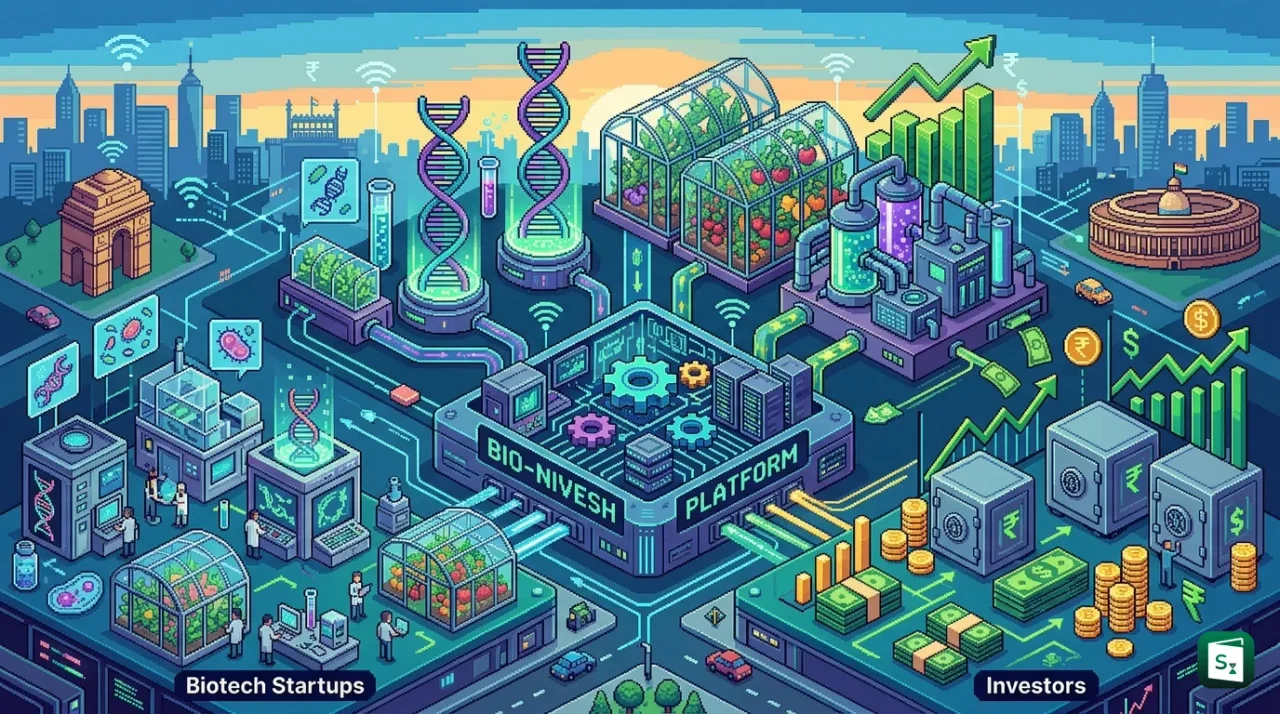
Union Minister of State (Independent Charge) for Science and Technology Jitendra Singh launched the BIO-NIVESH platform in New Delhi on 3 September 2026 to connect biotechnology startups directly with private investors. The platform links innovators who have technologies ready for scale-up and commercialisation with investors who can provide capital, manufacturing support and market access. It is designed to speed up startup funding in biotechnology and strengthen India’s fast growing bioeconomy.
What Is the BIO-NIVESH Platform?
BIO-NIVESH is the biotechnology investment platform launched by Union Minister Jitendra Singh in New Delhi on 3 September 2026 to connect biotechnology startups with private investors for scale-up and commercialisation. Nivesh means investment in Hindi, so the name denotes investment in biology based innovation through BIRAC and DBT facilitation. It is not a new grant or equity fund. It is an engagement system to help promising research move from the laboratory to the market.
Biotechnology is the use of living systems such as genes, microbes, cells and enzymes to create useful products and processes. These products include vaccines, diagnostic kits, improved seeds, biofuels, enzymes for industry and methods to clean waste and capture carbon. Commercialisation means converting such a lab discovery into a product that can be made, approved and sold. Scale-up means shifting production from small laboratory batches to large pilot and commercial volumes.
The Department of Biotechnology (DBT), which works under the Ministry of Science and Technology, guided the initiative. The Biotechnology Industry Research Assistance Council (BIRAC) organised it on the ground. BIRAC is a Section 8 not-for-profit public sector company set up by DBT in 2012. It acts as the bridge between industry and academic research and supports startups through funding, incubation, intellectual property help and mentoring.
How the First Roundtable in New Delhi Worked
The first edition of BIO-NIVESH took place in New Delhi on 3 September 2026 during a joint roundtable of startups and investors. It brought together 20 selected biotechnology and deep-tech startups and around 50 investors. Senior officials attended the event, including DBT Secretary Rajesh S. Gokhale, who also heads BIRAC as Chairman, and BIRAC Managing Director Dhananjay Tiwary, along with investor representatives such as Accel India founding partner Prashant Prakash.
The programme ran in two sessions. The first session hosted direct startup investor meetings where founders presented their technologies and investors asked questions on science, safety, approvals and business plans. The second session was an interactive discussion led by Jitendra Singh with both groups on access to capital, commercialisation hurdles, scale-up needs and steps to support growth driven by innovation.
The design goes beyond a regular pitch event. Startups get a clear view of what investors expect before they commit money. Investors get a clear view of the long testing periods, approval steps and manufacturing challenges that are common in biotechnology. The government has said success will be judged not by the number of meetings but by partnerships formed, investments mobilised, technologies scaled and products that reach the market.
How Startups Were Selected and Assessed
Organisers picked the 20 startups on five clear filters, which were innovation, development stage, market potential, scalability and regulatory readiness. Jitendra Singh urged investors to look beyond the next funding round and judge ventures on technology strength, intellectual property, development pathway, market size and the ability to build globally competitive companies from India. He also asked startups to meet investors early, because investors can offer more than money, including strategic advice, manufacturing links, market access and global networks.
Why Private Capital Matters for Biotechnology Scale-Up
Biotechnology startups need large and patient funding. Lab research takes years, trials take more time, and building pilot plants and clean manufacturing units costs heavily. Public grants can start the journey and reduce early risk, but they are not enough to build factories, run large trials and reach customers across India and abroad. Private capital fills this gap and helps a proven idea grow into a full business.
At the launch, Jitendra Singh said innovation remains incomplete without investment and investment cannot sustain itself without innovation. The government can create supportive rules and take the first risk, but private companies must carry technologies to scale. He called for stronger participation from the corporate sector and pointed to the space and nuclear sectors, where opening to private players quickly drew investor interest, as examples of how clear policy can pull in capital.
He also floated a Big Five in Five Years idea for discussion. The suggestion is that the biotech ecosystem should try to build a few large anchor companies within five years through focused support. Such anchors can create supply chains, train skilled workers and pull smaller startups up with them, similar to what large firms did in information technology and space services.
The RDI Fund and BIRAC Link
A key support behind BIO-NIVESH is the Research, Development and Innovation (RDI) Fund. The Union Cabinet approved this ₹1 lakh crore scheme on 1 July 2025 to increase private sector research in deep-tech and sunrise sectors. The fund is held in a Special Purpose Fund under the Anusandhan National Research Foundation (ANRF), with the Department of Science and Technology (DST) as the nodal department. It provides long term loans at low or nil interest, equity support and contributions to deep-tech funds. It can cover up to 50 percent of a project cost for projects at Technology Readiness Level 4 and above, which means the technology has moved beyond basic idea and lab proof and is ready for testing and scale-up.
BIRAC has been approved as a Second-Level Fund Manager for biotechnology and allied areas under this fund, along with the Technology Development Board (TDB) for wider strategic sectors. As a fund manager, BIRAC designs funding calls, checks proposals and channels money to eligible Indian startups and companies. It received ₹2,000 crore in the first allocation and issued its first national call for proposals in February 2026. This money is meant as patient capital for translation, scale-up and manufacturing in areas such as biopharma, bio-industrial production, bioenergy and allied deep-tech.
India’s Bioeconomy and the BioE3 Policy Background
The bioeconomy means the part of the economy that uses biological resources and biotechnology to create products, jobs and income. This includes vaccines and medicines, farm biotech, ethanol and biofuels, enzymes, diagnostics and waste to value products. India’s bioeconomy crossed $150 billion in 2023, two years ahead of its earlier target, and reached $195.3 billion in 2025, with an 18 percent rise over the previous year. The number of registered biotech startups crossed 11,850, and the BIRAC BioNEST network of more than 90 incubators now supports thousands of startups with lab space, mentoring and funding links.
The BioE3 Policy, which stands for Biotechnology for Economy, Environment and Employment, provides the larger policy frame for this push. The Union Cabinet approved it on 24 August 2024 to promote high performance biomanufacturing. It focuses on bio based chemicals and enzymes, smart proteins, precision biotherapeutics such as cell and gene therapies, climate resilient agriculture, carbon capture and use, and marine and space applications. It plans biofoundries, biomanufacturing hubs and Bio-AI hubs that combine biology with artificial intelligence to move ideas from discovery to pilot production. Together, BioE3, the RDI Fund and platforms like BIO-NIVESH aim to take India toward a $300 billion bioeconomy by 2030 and a $1 trillion bioeconomy by 2047.
The Way Forward
BIO-NIVESH is planned as a recurring platform, with future editions in different cities to link regional biotech clusters with investment networks. This matters because many new biotech startups now come from smaller cities and need direct access to capital, pilot facilities and regulatory guidance. Regular city editions can widen the pool beyond the first Delhi group and bring local universities, hospitals, farms and industries into the same room as investors.
For lasting impact, three links must work together. First, incubators and biofoundries must give startups affordable pilot and regulatory grade space for testing. Second, the BIRAC managed RDI money must reach projects ready for translation without long delays. Third, states, central ministries and regulators must coordinate on approvals, standards and procurement so that a safe and effective product can reach hospitals, farms and markets faster. If these links hold, BIO-NIVESH can help Indian biotechnology move from research papers to factories, jobs and exports.
Key Takeaways
- BIO-NIVESH was launched on 3 September 2026 in New Delhi by Minister Jitendra Singh to link biotech startups with private investors.
- The first edition brought together 20 biotechnology startups and around 50 investors in two sessions on direct connect and policy discussion.
- BIRAC, set up in 2012 by the Department of Biotechnology, organised the platform as an engagement system, not a grant fund.
- BIRAC is a Second-Level Fund Manager for the ₹1 lakh crore RDI Fund and received ₹2,000 crore in the first allocation for biotech scale-up.
- The BioE3 Policy was approved on 24 August 2024 to promote high performance biomanufacturing for economy, environment and employment.
- India’s bioeconomy reached $195.3 billion in 2025, with targets of $300 billion by 2030 and $1 trillion by 2047.