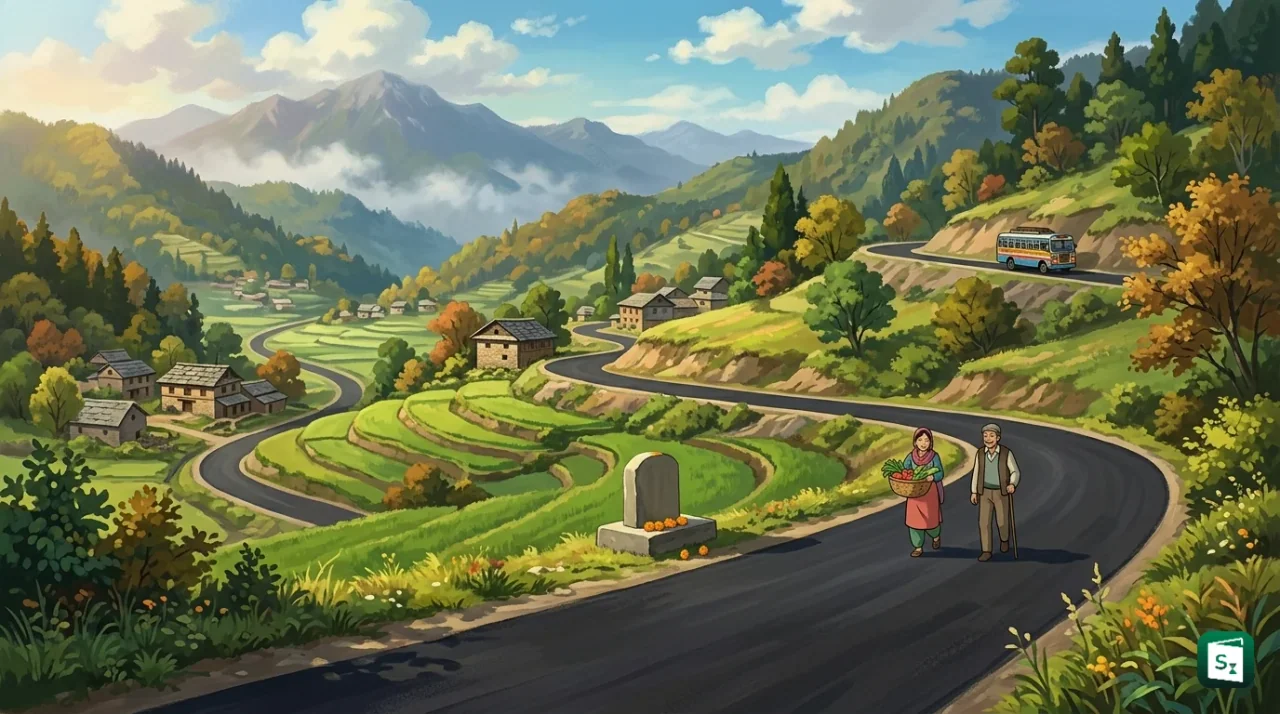
Union Minister Jitendra Singh laid the foundation stone for 110 rural roads worth ₹1,503.53 crore under Pradhan Mantri Gram Sadak Yojana Phase IV (PMGSY-IV), Batch 1 of 2026-27, in Jammu on 29 August 2026 for the Udhampur-Kathua-Doda-Kishtwar parliamentary constituency. The projects will together cover 598.455 km of all-weather roads and are expected to benefit 46,972 people across five districts of Jammu and Kashmir. With Udhampur consistently ranking among the top three districts in the country for PMGSY implementation, the package marks the latest push to take last mile connectivity to remote, hilly habitations that were long cut off during rains and winter.
What Is Pradhan Mantri Gram Sadak Yojana (PMGSY)?
The Pradhan Mantri Gram Sadak Yojana (PMGSY), which means Prime Minister’s Village Road Scheme, is the central government’s flagship programme for rural road connectivity. It was announced on 15 August 2000 and formally launched on 25 December 2000 by Prime Minister Atal Bihari Vajpayee. The nodal ministry is the Ministry of Rural Development (MoRD), implemented through its Department of Rural Development (DoRD). At the national level, the National Rural Infrastructure Development Agency (NRIDA), earlier called the National Rural Roads Development Agency (NRRDA), provides technical and management support. At the state level, State Rural Roads Development Agencies (SRRDAs), such as the Jammu and Kashmir Rural Roads Development Agency (JKRRDA), execute the work through Programme Implementation Units (PIUs).
The core idea of PMGSY is simple. It builds a single all-weather road, which is a road usable in all seasons including monsoon, to each eligible unconnected habitation. A habitation is a cluster of households living together, smaller than a revenue village. By linking these habitations to the nearest major road or market, the scheme aims to give rural families reliable access to schools, health centres, markets and jobs. Since its start, PMGSY has sanctioned about 8,38,592 km of road length using new and green technologies and has completed about 7,83,795 km till August 2025. More than 1.62 lakh habitations have been connected so far.
Road construction under PMGSY comes with a clear maintenance system. Every road is built with a design life of at least 10 years and a five year maintenance contract with the same contractor is signed along with the construction contract. After that, the state government must maintain the road for another five years, including periodic renewal and emergency repairs. Monitoring is done online through the Online Management, Monitoring and Accounting System (OMMAS), developed by the Centre for Development of Advanced Computing (C-DAC), Pune, and the electronic Maintenance of Rural Roads (eMARG) platform.
How Has PMGSY Evolved Through Four Phases?
PMGSY has grown in stages, with each phase addressing a different gap in rural connectivity.
| Phase | Launch Year | Main Objective | Target |
|---|---|---|---|
| PMGSY-I | 2000 | Provide new all-weather connectivity to eligible unconnected habitations | 1,63,339 habitations sanctioned, 99.7 percent connected by July 2025 |
| PMGSY-II | 2013 | Upgrade selected Through Routes and Major Rural Links to strengthen existing network | 50,000 km of existing rural roads for upgradation |
| RCPLWEA | 2016 | Road Connectivity Project for Left Wing Extremism Affected Areas in 44 worst affected districts across 9 states | Improve access for both security operations and socio-economic development |
| PMGSY-III | 2019 | Consolidate Through Routes and Major Rural Links connecting habitations to Gramin Agricultural Markets (GrAMs), higher secondary schools and hospitals | 1,25,000 km to be upgraded, about 1,22,393 km sanctioned and 1,01,623 km built by December 2025 |
| PMGSY-IV | 2024 | Provide connectivity to 25,000 newly eligible unconnected habitations that grew in population as per Census 2011 | 62,500 km of new roads during 2024-25 to 2028-29 |
PMGSY-IV was announced by Finance Minister Nirmala Sitharaman in the Budget Speech on 23 July 2024 and approved by the Union Cabinet on 11 September 2024. It has a total outlay of ₹70,125 crore, with a central share of ₹49,087.50 crore and state share of ₹21,037.50 crore. The implementation period is FY 2024-25 to 2028-29.
Eligibility under PMGSY-IV is based on Census 2011 population. Habitations with 500 and above population in plain areas, 250 and above in Hill States and Union Territories, North Eastern Region and Special Category Areas (which includes Tribal Schedule V Areas, Desert Areas, and Aspirational Blocks and Districts), and 100 and above in Left Wing Extremism affected districts notified by the Ministry of Home Affairs are covered. The scheme also builds required bridges along the alignment. Prioritisation gives importance to tribal villages under the Dharti Aaba Janjatiya Gram Utkarsh Abhiyan and convergence with other central schemes, and district inputs on security are also considered.
Funding Pattern Under PMGSY-IV
Funding is shared between the Centre and states. For general states and Union Territories with legislature except North Eastern and Himalayan states, the ratio is 60 percent Centre and 40 percent State. For the Union Territory of Jammu and Kashmir, North Eastern and Himalayan states, and Union Territories with legislature, it is 90 percent Centre and 10 percent State. For Union Territories without legislature, funding is 100 percent central. Cost of maintenance for 10 years is fully borne by the state or Union Territory. Funds are released through the SNA SPARSH model as per Department of Expenditure guidelines.
What Does the New 110-Road Package Cover?
The foundation stone was laid at an event in Jammu, with a gathering also held at Hiranagar in Kathua district. Union Minister Jitendra Singh, who represents the Udhampur Lok Sabha constituency and holds charge as Union Minister of State (Independent Charge) for Science and Technology and Earth Sciences and Minister of State in the Prime Minister’s Office, Personnel, Public Grievances and Pensions, Atomic Energy and Space, thanked Prime Minister Narendra Modi for giving sustained priority to the constituency over the last 12 years. Deputy Chief Minister of Jammu and Kashmir Surinder Choudhary was also present and stressed that there would be no compromise on quality and that contractors must work to prescribed standards.
The package belongs to PMGSY-IV, Batch 1 of 2026-27. It covers 110 roads with a total length of 598.455 km and a sanctioned cost of ₹1,503.53 crore. The roads are spread over five districts that form part of the Udhampur parliamentary constituency and adjoining hill areas. The beneficiaries are estimated at 46,972 people living in far-flung habitations that till now had poor or seasonal access.
The district wise distribution shows the focus on the most scattered and hill terrain:
| District | Number of Roads | Road Length | Sanctioned Cost |
|---|---|---|---|
| Udhampur | 44 | 235.040 km | ₹554.90 crore |
| Kathua | 24 | 128.925 km | ₹307.12 crore |
| Kishtwar | 16 | 83.950 km | ₹224.88 crore |
| Doda | 13 | 90.180 km | ₹260.66 crore |
| Ramban | 13 | 60.360 km | ₹154.97 crore |
| Total | 110 | 598.455 km | ₹1,503.53 crore |
Udhampur gets the largest share, with 44 roads and nearly 40 percent of the total length, followed by Kathua with 24 roads. Kishtwar, Doda and Ramban, which include some of the most remote valleys and steep slopes in the Pir Panjal and Chenab region, together account for 42 roads and about 234 km. This spread ensures last mile links across the entire Udhampur-Kathua-Doda-Kishtwar corridor, from the plains of Kathua to the high hills of Kishtwar and Doda.
A notable feature noted in the project statement is the use of waste plastics in construction for a large number of roads in this batch. This combines rural connectivity with sustainable construction practices, using non biodegradable waste as part of the road mix to improve durability while reducing environmental load.
Why Is This Package Significant for Jammu and Kashmir?
The new roads address more than just travel. In a parliamentary constituency where many villages sit on steep, remote and geographically difficult slopes, poor roads have long meant hardship, especially in the rainy season. The government has linked this package to improved ease of living and ease of travel, with direct gains for everyday life.
For students and senior citizens, all-weather roads reduce missed school days and allow safer access to health centres and workplaces. For women in remote villages, better links mean easier reach to schools, hospitals, markets and workplaces, creating a new mobility network for families in hilly terrain. For farmers and small producers, connectivity to nearby roads and market hubs helps in getting better prices and timely transport.
There is also a security dimension. Some of the hilly and remote pockets in this region have been vulnerable to movement by militants and have posed difficulties for security operations. Improved road networks allow faster movement of security forces and better delivery of administrative services, while development reaches the same habitations at the same time.
The broader progress in Jammu and Kashmir helps put this package in context. Till July 2026, out of 3,437 roads sanctioned under PMGSY-I, II and III, 3,332 roads have been completed, an achievement of 96.9 percent. Against a sanctioned length of 20,801.43 km, 19,865.36 km has been finished, and 260 Long Span Bridges out of 305 sanctioned have been built, with cumulative spending of over ₹13,526 crore. Under PMGSY-IV, the first two batches together will build 646 roads covering 3,381 km at ₹7,790 crore to connect 792 habitations. Batch 1 of 2025-26 had 316 roads over 1,781 km at ₹4,224 crore, with 235 works already started, while Batch 1 of 2026-27 of 330 roads has been technically sanctioned and tendered. The present 110-road package forms part of this second batch and takes the momentum forward.
In May 2026, the constituency had already received a major allocation under PMGSY-IV Batch 2. Out of ₹3,566 crore approved for rural roads in Jammu and Kashmir, ₹1,524.46 crore, or about 43 percent, was earmarked for the Udhampur-Kathua-Doda constituency to build 121 roads covering 652.51 km for 138 habitations. The Minister has noted that Udhampur continues to figure among the top three districts nationally in PMGSY projects, which shows the continued attention to this hilly belt that had remained neglected for decades.
How Will PMGSY Roads Be Built and Maintained?
Identification of roads starts with a Core Network and a Comprehensive New Connectivity Priority List (CNCPL), prepared block and district wise. Habitations are grouped by population priority. Under PMGSY-IV, the order is habitations with 500 and above population and 50 percent or more Scheduled Tribe population under Dharti Aaba Janjatiya Gram Utkarsh Abhiyan first, then habitations covered under convergence schemes, then 1000 and above, 500 to 999, 250 to 499, and 100 to 249. Inputs from the Home Department on security priority are also considered.
Detailed Project Reports are prepared through the Jammu and Kashmir Rural Roads Development Agency and uploaded on OMMAS. They are checked by State Technical Agencies (STAs) and Principal Technical Agencies (PTAs) and by NRIDA before being placed before the Empowered Committee of the Ministry of Rural Development. Once sanctioned, the standard bidding document requires the contractor to maintain the road for five years. Monitoring of construction quality uses a three tier quality mechanism, with national and state quality monitors and checks for use of new and green technologies such as waste plastics, cold mix technology and chemical stabilisation. Maintenance after construction is tracked through eMARG, and the budget for rural roads in 2026-27 is ₹19,000 crore, a rise of 73 percent over the revised estimates of ₹11,000 crore in 2025-26, within the overall Ministry of Rural Development allocation of ₹1,97,023 crore.
Key Takeaways
- 110 roads covering 598.455 km at a sanctioned cost of ₹1,503.53 crore under PMGSY-IV, Batch 1 of 2026-27 had their foundation stone laid by Union Minister Jitendra Singh on 29 August 2026 for the Udhampur-Kathua-Doda-Kishtwar constituency, benefiting 46,972 people.
- District wise share is Udhampur 44 roads (235.040 km, ₹554.90 crore), Kathua 24 roads (128.925 km, ₹307.12 crore), Kishtwar 16 roads (83.950 km, ₹224.88 crore), Doda 13 roads (90.180 km, ₹260.66 crore) and Ramban 13 roads (60.360 km, ₹154.97 crore).
- PMGSY was launched on 25 December 2000 by Prime Minister Atal Bihari Vajpayee and is implemented by the Ministry of Rural Development through NRIDA and state agencies like JKRRDA, with monitoring on OMMAS and eMARG.
- PMGSY-IV was announced on 23 July 2024 and approved on 11 September 2024 to connect 25,000 unconnected habitations with 62,500 km of all-weather roads during 2024-25 to 2028-29 at a total outlay of ₹70,125 crore.
- Funding under PMGSY-IV for Jammu and Kashmir and other North Eastern and Himalayan states is 90 percent Centre and 10 percent State, and eligibility is 500 and above in plains, 250 and above in hill areas and 100 and above in Left Wing Extremism affected districts as per Census 2011.
- Udhampur consistently figures among the top three districts in the country for PMGSY implementation and the constituency received about 43 percent of Jammu and Kashmir’s ₹3,566 crore PMGSY allocation in May 2026, amounting to ₹1,524 crore.