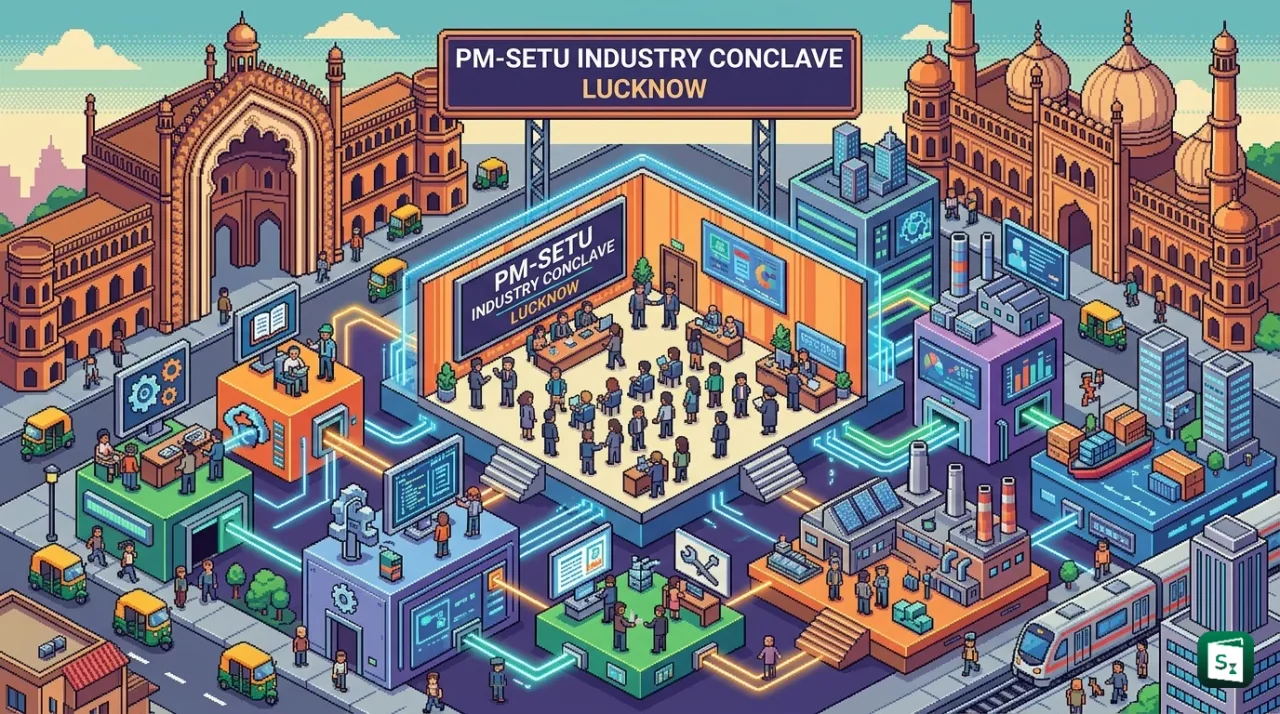
The Ministry of Skill Development and Entrepreneurship (MSDE), in collaboration with the Government of Uttar Pradesh, organised the PM-SETU Industry Conclave in Lucknow on 30 August 2026. Defence Minister Rajnath Singh attended the conclave along with Minister of State for Skill Development and Entrepreneurship Jayant Chaudhary. The conclave aimed to mobilise industry, especially defence manufacturing firms, to become partners in upgrading Industrial Training Institutes (ITIs) under the Pradhan Mantri Skilling and Employability Transformation through Upgraded ITIs (PM-SETU) scheme.
What Is PM-SETU? Full Form, Objectives and Nodal Ministry
PM-SETU stands for Pradhan Mantri Skilling and Employability Transformation through Upgraded ITIs. It is a Centrally Sponsored Scheme aimed at completely modernising India’s vocational training ecosystem through upgraded infrastructure, industry aligned curriculum and employment linked training. The scheme was launched by Prime Minister Narendra Modi on 4 October 2025 at Vigyan Bhawan, New Delhi, together with youth focused initiatives worth more than ₹62,000 crore, and received Cabinet approval on 7 May 2025. It flows from two successive Union Budget announcements, the Budget 2024-25 proposal to upgrade ITIs and National Skill Training Institutes (NSTIs) and the Budget 2025-26 announcement to establish five National Centres of Excellence (NCoEs) for Skilling with global partnerships.
The nodal ministry is the Ministry of Skill Development and Entrepreneurship (MSDE), which was created as a separate ministry on 9 November 2014 to coordinate all skill development efforts across the country. MSDE works through its key arms, the Directorate General of Training (DGT), which implements the Craftsmen Training Scheme (CTS) through the nationwide ITI network, the National Council for Vocational Education and Training (NCVET), which regulates qualifications, the National Skill Development Corporation (NSDC) and the National Skill Development Fund (NSDF). At present, 169 trades aligned to the National Skills Qualification Framework (NSQF) are offered under CTS. ITIs themselves remain under the administrative and financial control of state governments, while DGT sets standards, curriculum and affiliation norms.
The scheme has a total financial outlay of ₹60,000 crore over five years. This is shared as ₹30,000 crore by the Centre, ₹20,000 crore by states and ₹10,000 crore by industry. The central share is co-financed to the extent of 50 percent by the Asian Development Bank (ADB) and the World Bank equally as a results based loan. In the Union Budget 2026-27, PM-SETU received an allocation of ₹6,000 crore, making it the largest scheme of MSDE which has an overall budget of about ₹9,800 crore.
PM-SETU has five clear objectives. First, to improve the quality of training delivery in ITIs and NSTIs. Second, to modernise infrastructure and equipment as per industry standards. Third, to introduce industry aligned long term and short term courses, especially in new and emerging sectors. Fourth, to strengthen industry linkage for demand driven skilling and better employment outcomes. Fifth, to enhance the capacity of NSTIs for training of trainers. The overarching goal is to reimagine 1,000 Government ITIs as aspirational, employment outcome focused institutions and to augment five NSTIs as centres of excellence, in line with the vision of Viksit Bharat by 2047.
It is important not to confuse PM-SETU with other schemes that use the word Setu, such as Setu Bharatam, which was launched in 2016 by the Ministry of Road Transport and Highways to make national highways free of railway level crossings by building overbridges and underbridges.
The Hub and Spoke Model, Funding Pattern and Two Components
PM-SETU is structured in two components. Component I covers the upgradation of 1,000 Government ITIs in a Hub and Spoke model, with 200 Hub ITIs and 800 Spoke ITIs. Component II covers the capacity augmentation of five NSTIs located at Bhubaneswar, Chennai, Hyderabad, Kanpur and Ludhiana and the setting up of a National Centre of Excellence within each of these five institutes.
Under Component I, every Hub ITI is linked on average to four Spoke ITIs, forming a cluster. The cluster is the basic unit of investment and management. All ITIs in the cluster are to be equipped with state of the art infrastructure, machinery, smart classrooms, digital content and new trades. For a cluster, the investment ceiling is up to ₹241 crore, broadly comprising up to ₹81 crore for the Hub ITI and up to ₹40 crore for each Spoke ITI over five years. The overall allocation for Component I is about ₹56,900 crore of the total ₹60,000 crore.
How is the Scheme Funded?
Funding follows a cost sharing pattern. For most states, the Centre bears 50 percent, states bear 33 percent and industry contributes 17 percent as mandatory co-funding. For North Eastern and Himalayan states and some Union Territories, the central contribution can go up to 83 percent to account for limited fiscal capacity. For Component II, the pattern is 80 percent Centre and 20 percent industry, with a minimum committed industry investment of ₹40 crore per NSTI over five years. Companies are allowed to use Corporate Social Responsibility (CSR) funds to meet their share. Any cost beyond the prescribed ceiling is not covered by the Centre beyond 50 percent of that ceiling.
| Feature | Component I: 1,000 ITIs | Component II: 5 NSTIs |
|---|---|---|
| Number of institutions | 200 Hub + 800 Spoke ITIs | 5 NSTIs at Bhubaneswar, Chennai, Hyderabad, Kanpur, Ludhiana |
| Model | Hub and Spoke cluster, one Hub with about four Spokes | Five sector specific NCoEs inside NSTIs |
| Investment ceiling | Up to ₹81 crore per Hub, up to ₹40 crore per Spoke, up to ₹241 crore per cluster | At least ₹40 crore industry commitment per NSTI |
| Funding pattern | Centre 50 percent, State 33 percent, Industry 17 percent (up to 83 percent Centre for NE and Himalayan states) | Centre 80 percent, Industry 20 percent |
| Focus | Modern infrastructure, new trades, industry managed training | Advanced training of trainers with global partnerships, curriculum development |
What is Meant by Hub and Spoke and Who Manages It?
The Hub and Spoke arrangement is a cluster management idea borrowed from aviation and logistics. The Hub ITI acts as the anchor institution of the cluster. It houses centres of innovation, training of trainers facilities, production units, incubation facilities and placement cells. The Spoke ITIs are linked to the Hub and focus on expanding access, while drawing on the Hub’s advanced equipment, faculty support and industry linkages. This allows scale, hub level specialisation and spoke level reach without duplicating expensive infrastructure everywhere.
The most distinctive feature of PM-SETU is that ITIs remain government owned but industry managed. Each cluster is managed by a Special Purpose Vehicle (SPV). Two models are available. In the industry led SPV model, the Anchor Industry Partner (AIP) holds 51 percent equity and the Centre and state governments hold 49 percent together. A tripartite Shareholders Agreement and License Agreement is signed among the Government of India, the state government and the AIP, and the Hub and Spoke ITIs are licensed to the SPV for management. In the state led SPV model, used where no credible AIP is available, the state takes the lead role.
The SPV has full autonomy over course offerings and curriculum design, trainer recruitment and training, financial operations and revenue generation, administration and infrastructure improvement. It prepares a Strategic Investment Plan (SIP) and an Annual Operational Plan (AOP) for the cluster, which must be approved by the State Steering Committee (SSC) and finally by the National Steering Committee (NSC) chaired by the Secretary, MSDE. Once the SIP is approved, the SPV is responsible for project execution, financial management, delivery of outcome based training and achievement of Key Performance Indicators (KPIs). The scheme does not impose uniform national placement targets. Instead, each cluster or NSTI defines its own KPIs through the SIP and AOP mechanism. Implementation is phased. The first phase will cover 20 to 25 clusters with 100 to 125 ITIs to validate the model before scaling to all 1,000 ITIs.
The Directorate General of Training has already introduced 32 new age courses under the Craftsmen Training Scheme to support this modernisation. Based on stakeholder consultations with states, industries, Sector Skill Councils (SSCs), NSTIs and experts, curricula are being revised to include Industry 4.0 applications, Artificial Intelligence (AI), Internet of Things (IoT), automation, green and renewable energy technologies, electric mobility, digital skills, entrepreneurship, workplace safety and sustainability.
What Happened at the PM-SETU Industry Conclave in Lucknow
The PM-SETU Industry Conclave was organised on 30 August 2026 in Lucknow by MSDE in collaboration with the Government of Uttar Pradesh. It brought together senior representatives from central and state governments, the Directorate General of Training, the Ministry of Defence, Defence Public Sector Undertakings (DPSUs), defence and manufacturing industries, multilateral institutions such as the World Bank and ADB, sector skill councils and skilling stakeholders. The objective was to strengthen industry participation in vocational education and to deliberate on how ITIs can be transformed into modern, industry aligned centres of excellence under PM-SETU.
The conclave was attended by Defence Minister Rajnath Singh, who is also the Member of Parliament from Lucknow, Minister of State (Independent Charge) for Skill Development and Entrepreneurship and Minister of State for Education Jayant Chaudhary, Uttar Pradesh Deputy Chief Minister Brajesh Pathak and Uttar Pradesh Minister of State (Independent Charge) for Vocational Education, Skill Development and Entrepreneurship Kapil Dev Agarwal. Senior officials from MSDE, DGT and the Government of Uttar Pradesh, along with industry leaders, participated in the discussions.
Key Messages from Rajnath Singh and Other Leaders
Defence Minister Rajnath Singh said that India’s ambition to become a global manufacturing and technology powerhouse, particularly in defence manufacturing, aerospace, electronics, drones, robotics, precision engineering and automation, depends on the availability of highly skilled and future ready manpower. He pointed out that these sectors are witnessing rapid technological change and require workers who can handle advanced systems.
He called for an aatmanirbhar talent pipeline to support an aatmanirbhar defence industry, and urged DPSUs and leading defence companies to come forward as Anchor Industry Partners under PM-SETU. He told industry that participation should not remain limited to conventional support. Instead, companies should identify future skill needs, shape curricula, modernise equipment, train instructors, offer apprenticeships and create clear pathways to employment. In his words, industries should not merely support ITIs but should actively participate in shaping them, and the success of PM-SETU should be measured not by machines installed but by employment opportunities created and lives positively impacted. He also stressed that skill certificates hold value only when they lead to meaningful employment.
Rajnath Singh highlighted the opportunity to align PM-SETU with the Uttar Pradesh Defence Industrial Corridor (UP DIC). The corridor, announced in 2018 and spread across six nodes namely Lucknow, Kanpur, Jhansi, Agra, Aligarh and Chitrakoot, is being developed to build a domestic defence manufacturing ecosystem. He suggested that selected PM-SETU Hub ITIs in the state could develop specialised capabilities in precision manufacturing, aerospace, electronics and unmanned systems to serve the corridor’s requirements.
Jayant Chaudhary described PM-SETU as a new partnership model between government, industry and training institutions. He said the scheme is designed to bridge the gap between training and employment by giving industry an active role in the governance and operation of ITI clusters through SPVs. He underlined the need to go beyond CSR driven support and to take ownership of ITIs, with focus on industry aligned training, modern infrastructure, apprenticeship opportunities, trainer development and entrepreneurship pathways. He also noted that the defence sector’s reliance on technology makes the timing of the scheme especially relevant.
Kapil Dev Agarwal said Uttar Pradesh is committed to strengthening its skilling ecosystem in line with its expanding industrial base. Dilip Kumar, Director General of Training, highlighted that the involvement of Anchor Industry Partners can create deeper and more structured engagement between industry and the skilling system and keep institutional outcomes closely aligned with industry needs.
The Uttar Pradesh Picture and Parallel Developments
In Uttar Pradesh, 32 Government ITIs across eight clusters have already been identified under PM-SETU, and seven clusters are still open for industry collaboration. This makes the state one of the larger implementation sites for the scheme. Conclave participants were informed that approved industry partnership proposals under PM-SETU nationally now represent more than ₹1,500 crore of committed industry led investment across seven clusters in five states, with more proposals under consideration.
Separately, six Strategic Investment Plans had earlier been approved by the National Steering Committee, comprising three clusters from Telangana, one from Andhra Pradesh, one from Odisha and one from Gujarat, and later a seventh from Rajasthan. Examples include a Visakhapatnam cluster in Andhra Pradesh, a Keonjhar Barbil cluster in Odisha anchored by Jindal group, a Surat cluster in Gujarat anchored by ArcelorMittal Nippon Steel, and three clusters in Telangana anchored by Apollo Medskills, with investments of about ₹240 crore per cluster. At its fourth meeting on 7 July 2026, the NSC approved a nationwide rollout beyond the initial pilot to all 200 hubs, allowing states and Union Territories to proceed based on industry readiness and implementation capacity.
Discussions at Lucknow focused on emerging workforce needs across defence manufacturing, aerospace, electronics, renewable energy, automotive, advanced engineering, automation and digital technologies. Representatives from DPSUs and strategic industries highlighted demand for technicians in aerospace systems, shipbuilding, electronics manufacturing, precision engineering, advanced welding, mechatronics and drone technologies. They also stressed that the benefits of industry led skilling should flow not only to large enterprises but also to the wider vendor and MSME ecosystem that underpins defence and manufacturing supply chains.
During the conclave, the National Skill Development Corporation (NSDC) and the Lucknow Cantonment Board signed a Memorandum of Understanding (MoU) to establish the Shaurya Academy, an initiative to prepare youth for careers in the armed forces, police and other uniformed services.
Why PM-SETU and the Lucknow Push Matter
India has the world’s largest youth population, but a persistent gap exists between formal certificates and actual employability. Many ITIs have operated with outdated machines, old trades and weak links to nearby industry. PM-SETU directly addresses this by making industry a co owner and manager, not just an advisory partner. The Lucknow conclave was important because it moved the scheme from files to factories, by asking companies to put money, people and curriculum expertise into ITIs.
For the defence sector, the timing is critical. India is expanding domestic production of aircraft components, ships, electronics, drones and precision weapons, and the UP Defence Industrial Corridor is central to that plan. These industries need technicians skilled in computer numerical control (CNC) machining, advanced welding, mechatronics, avionics, electronics assembly and drone maintenance, trades that traditional ITIs rarely offered. If Hub ITIs in Lucknow, Kanpur or Aligarh specialise in these areas, they can supply ready talent to DPSUs like Hindustan Aeronautics Limited (HAL), Bharat Electronics Limited (BEL) and Mazagon Dock Shipbuilders, as well as to their MSME vendors.
For Uttar Pradesh, the stakes are high. The state has a large youth population, a growing industrial base and the corridor’s six nodes. A well run PM-SETU network can integrate three ecosystems, skill, defence manufacturing and MSMEs, and position the state as a model for Skill Defence MSME integration. Better apprenticeships also mean learners spend real time on shop floors, which improves retention and wages.
Nationally, the scheme supports the Skill India Mission, launched in 2015, and the broader National Education Policy 2020 emphasis on vocational education. By linking the National Skills Qualification Framework, NCVET standards and industry designed SIPs, PM-SETU tries to ensure that training leads to jobs, self employment or apprenticeships, not just certificates.
How PM-SETU Is Being Implemented and What Comes Next
PM-SETU is being rolled out in phases over five years. The first phase covering 20 to 25 clusters is being used to test the SPV model and implementation framework. Learnings from this pilot will guide corrections before scaling to all 1,000 ITIs. The National Steering Committee, chaired by the Secretary of MSDE, approves Strategic Investment Plans on a first come, first served basis after technical and financial evaluation, so there is no state wise quota. States and Union Territories decide which Government ITIs to include in a cluster in consultation with industry, based on local industrial potential and emerging skill needs.
Several states have already moved ahead. Madhya Pradesh has identified 20 clusters with 20 Hub and 81 Spoke ITIs, Maharashtra has identified three clusters at Nagpur, Chhatrapati Sambhajinagar and Pune, and Dadra and Nagar Haveli and Daman and Diu has identified one cluster. States invite industry participation through an Expression of Interest (EoI) and Request for Proposal (RFP), and shortlisted proposals are forwarded to the NSC. Uttar Pradesh has floated its RFPs and, as noted at Lucknow, seven of its eight clusters are still open for Anchor Industry Partners.
Training of trainers is also underway. Between the Cabinet approval on 7 May 2025 and early August 2026, 1,136 candidates have been trained under the capacity building component of PM-SETU, including 46 from Government ITIs of Madhya Pradesh. For NSTIs, an EoI has been floated to bring global partners into the five NCoEs.
The road ahead will be judged not by buildings and machines but by measurable employment outcomes. Key indicators will include the placement rate of graduates, the share absorbed as apprentices in partner industries, the alignment of new trades with local demand such as semiconductors and green energy, and the ability of SPVs to retain trainers and update curriculum continuously. The 4 July 2026 decision to open the scheme to all 200 hubs nationally means momentum will now depend on how quickly credible Anchor Industry Partners come forward, especially PSUs that were directly exhorted at Lucknow, and how effectively states ensure SPV autonomy without bureaucratic hurdles.
Key Takeaways
- PM-SETU stands for Pradhan Mantri Skilling and Employability Transformation through Upgraded ITIs, a Centrally Sponsored Scheme launched on 4 October 2025 and approved by Cabinet on 7 May 2025.
- The scheme has a total outlay of ₹60,000 crore over five years, shared as Centre ₹30,000 crore, States ₹20,000 crore and Industry ₹10,000 crore, with 50 percent of the central share co-financed by the World Bank and Asian Development Bank.
- Component I will upgrade 1,000 Government ITIs as 200 Hub and 800 Spoke ITIs in a Hub and Spoke cluster model, while Component II will augment five NSTIs at Bhubaneswar, Chennai, Hyderabad, Kanpur and Ludhiana with National Centres of Excellence.
- Each cluster can attract up to ₹241 crore, with up to ₹81 crore for a Hub and up to ₹40 crore per Spoke, and is managed by an industry led SPV where the Anchor Industry Partner holds 51 percent equity.
- The PM-SETU Industry Conclave was organised in Lucknow on 30 August 2026 by MSDE with the Government of Uttar Pradesh and was attended by Defence Minister Rajnath Singh and Jayant Chaudhary.
- At Lucknow, Rajnath Singh urged DPSUs to become Anchor Industry Partners and link PM-SETU with the Uttar Pradesh Defence Industrial Corridor for skills in precision manufacturing, aerospace, electronics and unmanned systems.
- In Uttar Pradesh, 32 ITIs across eight clusters have been identified, with seven clusters still open for industry collaboration, while nationally more than ₹1,500 crore of industry investment across seven clusters in five states has been committed.