The United Nations Development Programme (UNDP) in India and Hindustan Unilever Limited (HUL) have launched the next phase of their seven-year partnership to build an inclusive circular economy for plastics across India. Announced on 24 August 2026, the initiative aims to support 50,000 Safai Mitras, or waste workers, and strengthen end-to-end waste management systems across 50 cities and Urban Local Bodies (ULBs) by 2028. It links better livelihoods for frontline waste workers with stronger city systems to keep plastics in use and out of landfills.
What Is the Next Phase of the UNDP-HUL Partnership?
The new phase builds on seven years of collaboration between UNDP India and HUL on plastic waste management. It moves beyond pilots to scale, with a clear target to formalise livelihoods and build city-wide systems that can be replicated by other Urban Local Bodies.
The partnership focuses on four interconnected priorities. First, social inclusion, which aims to formalise and improve the livelihoods of 50,000 Safai Mitras with a specific focus on women. Second, urban systems, which will strengthen circular economy infrastructure across 50 cities and ULBs to enable efficient, decentralised and resilient waste management at scale. Third, improving recycling efficiency by strengthening waste segregation at source and building circular practices across the entire value chain, from collection and sorting to recovery, recycling and reintegration of materials. Fourth, knowledge transfer through open-source and practical toolkits for adoption by government bodies, partners and research institutions.
The initiative sits within HUL’s Project Circular Bharat (PCB), the company’s flagship platform to advance plastic circularity through financially viable, end-to-end recycling models. UNDP acts as the institutional partner, supporting policy alignment, systems strengthening and implementation at scale. The approach is aligned with the Ministry of Social Justice and Empowerment and is being implemented in coordination with the Ministry of Housing and Urban Affairs (MoHUA).
At the centre of the design is Project Utthaan, UNDP’s social inclusion initiative for Safai Mitras. It focuses on dignity, occupational safety and social security, including linkages to government welfare schemes, identity documents, bank accounts and health protections. UNDP has noted that women form a large share of Safai Mitras reached so far, which makes the gender focus critical.
HUL Executive Director and Chief People, Transformation and Sustainability Officer B. P. Biddappa said the collaboration is focused on advancing inclusive circularity and building scalable models for cities. UNDP India Resident Representative Angela Lusigi said Safai Mitras are at the centre of urban waste systems and the partnership aims to ensure that frontline workers are not left behind in the transition to circular systems.
What Is an Inclusive Circular Economy for Plastics?
A circular economy is a systems approach where materials never become waste and nature is regenerated. Products and materials are kept in circulation through maintenance, reuse, refurbishment, remanufacture, recycling and composting. It is built on three principles, driven by design, to eliminate waste and pollution, circulate products and materials at their highest value, and regenerate nature. This is the opposite of a linear economy, the take-make-waste model where resources are extracted, turned into products, used briefly and then thrown away.
An inclusive circular economy adds a social dimension to this technical loop. It ensures that the people who make circularity possible, especially informal waste workers, gain secure incomes, safe working conditions and access to social protection. In India, where a large share of collection and sorting is done by informal workers, inclusion means formalisation, recognition and welfare linkages.
For plastics, circularity means keeping all kinds of plastics in use for as long as possible. This starts with segregation at source in households, followed by collection, sorting at Material Recovery Facilities (MRFs), also called Swachhata Kendras, and then recycling or responsible end-of-life use. In the technical cycle, reuse and repair sit in the inner loops and retain more value than recycling, which is the outer loop but still essential when reuse is not possible.
In India, the shift matters for three reasons. It reduces pressure on landfills, it cuts pollution and greenhouse gas emissions linked to virgin plastic production, and it creates livelihood opportunities when value chains are organised efficiently.
Who Are Safai Mitras and Why Is Project Utthaan Central?
Safai Mitra is the term used for waste workers who collect, sort and recover waste, including plastics. Earlier referred to as Safai Saathis in UNDP’s communications, these workers, many of them women, form the backbone of urban waste systems yet often work in informal conditions with low pay, high occupational risk and limited access to social security.
Project Utthaan was created to address these gaps. It focuses on dignity, safety and social security and helps workers access government schemes such as Pradhan Mantri Suraksha Bima Yojana, Pradhan Mantri Jeevan Jyoti Bima Yojana, SHRAM card and Jan Dhan accounts. Earlier field experience showed that lack of identity documents limited uptake, so the project created local community cadres to mobilise workers, run camps and support applications through door-to-door campaigns.
The scale of need is large. A socio-economic survey of about 9,300 Safai Saathis conducted by UNDP highlighted the highly informal nature of the work and identified priorities such as formalisation, skill training, work diversification, education of children and exploration of alternate livelihoods. The new phase aims to more than double the reach from 24,000 Safai Mitras supported so far to 50,000 by 2028, with a continued focus on women.
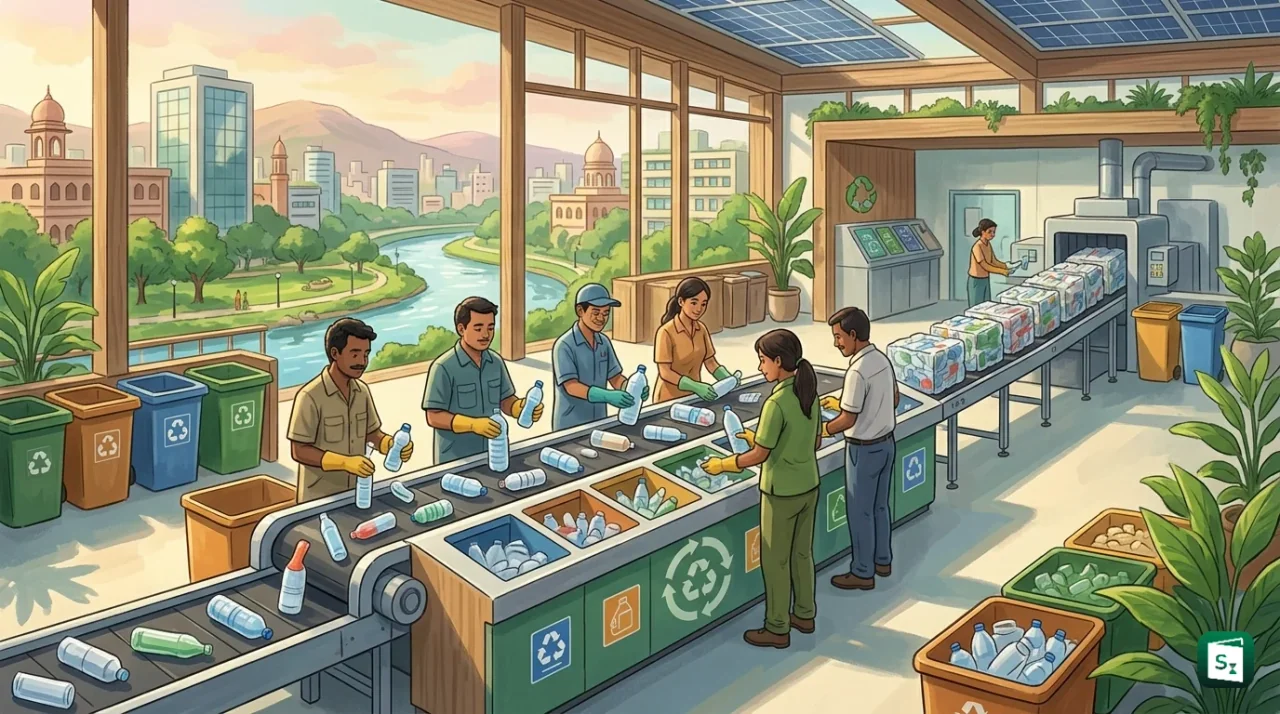
In operational terms, inclusion also means better infrastructure at the workplace. Swachhata Kendras provide designated spaces with sorting bays, safety gear, wash and rest areas and digital traceability for material flows. Field partners provide training on segregation, handling of hazardous fractions and use of tools that reduce health risks.
How Will Urban Waste Systems Across 50 Cities Be Strengthened?
Cities and Urban Local Bodies are the second pillar of the partnership. The plan is to help 50 cities and ULBs build efficient, decentralised and resilient end-to-end waste management systems. These systems cover the full value chain, from behaviour change in households to collection, recovery, recycling and reintegration of recycled materials into the economy.
Household-level work centres on segregation at source. The UNDP-HUL programme has already enabled waste segregation across 120,000 households through more than 20 partners across five states. Scaling this further is critical because source segregation raises recovery rates, improves quality of recyclables and reduces contamination that makes recycling uneconomic.
Mid-stream, the focus is on city infrastructure. This includes support for MRFs or Swachhata Kendras, collection fleets, sorting lines, baling and storage, and linkages to recyclers and end markets. By placing MRFs closer to generation points, cities can cut transport costs and make decentralised processing viable, which also aligns with the goal of creating replicable models for other towns.
Downstream, the partnership aims to improve recycling efficiency across value chains. That includes building circular practices so that recovered plastics, from rigid containers to flexible pouches and multi-layered packaging, are channelled to the right processors. It also includes knowledge tools that help ULBs choose technologies suited to local waste composition.
Progress will be supported by knowledge transfer. UNDP and HUL plan to develop open-source toolkits that municipal officials, partners and research institutions can adopt. These toolkits are expected to codify standard operating procedures, cost models, training modules and digital monitoring approaches tested over seven years.
Policy Backing: Plastic Waste Management Rules and Extended Producer Responsibility
India’s statutory framework for plastics is anchored in the Plastic Waste Management Rules, 2016, notified by the Ministry of Environment, Forest and Climate Change (MoEFCC) under the Environment (Protection) Act, 1986. The rules were issued on 18 March 2016 and replaced the earlier Plastic Waste (Management and Handling) Rules, 2011. They apply to waste generators, local bodies, gram panchayats, manufacturers, importers, producers and brand owners.
A defining concept in the rules is Extended Producer Responsibility (EPR). It makes producers, importers and brand owners responsible for the environmentally sound management of plastic packaging until the end of its life. The Plastic Waste Management (Amendment) Rules, 2022, notified on 16 February 2022, inserted Schedule II with detailed EPR guidelines. This created a target-driven compliance mechanism with category-wise classification of plastic packaging, annual collection and recycling targets, mandatory use of recycled content and reuse obligations.
Key features of the EPR framework include:
| Element | What It Means |
|---|---|
| Obligated entities | Producers, Importers and Brand Owners (PIBOs) and Plastic Waste Processors must register and meet targets |
| Categories | Four categories, including rigid plastic packaging, flexible single or multi-layer packaging and carry bags, multi-layered packaging with non-plastic layers, and carry bags made of compostable plastics |
| Portal | Centralised EPR Portal developed by the Central Pollution Control Board (CPCB) for registration, action plans and annual returns |
| Targets | Annual EPR targets, minimum recycling levels and mandatory recycled content obligations, with reuse targets for rigid packaging |
| Market mechanism | EPR certificates can be generated by processors and traded by PIBOs to meet shortfalls, creating a market signal for recovery |
| Enforcement | Environmental Compensation for non-compliance, levied by CPCB or State Pollution Control Boards based on the polluter pays principle |
The new UNDP-HUL phase complements this regulatory push. While EPR creates demand for collection and recycling, city systems and Safai Mitra formalisation ensure the supply side works fairly and efficiently.
About UNDP and Hindustan Unilever in the Partnership
The United Nations Development Programme (UNDP) is the lead development agency of the United Nations. It was established on 22 November 1965 through UN General Assembly Resolution 2029, which merged the Expanded Programme of Technical Assistance, created in 1949, with the United Nations Special Fund, set up in 1958. UNDP works in about 170 countries and territories and is headquartered at One United Nations Plaza, New York, USA. In India, UNDP partners with central ministries, state governments, ULBs and the private sector to advance the Sustainable Development Goals (SDGs), including SDG 11 (Sustainable Cities and Communities) and SDG 12 (Responsible Consumption and Production).
Hindustan Unilever Limited (HUL) is India’s largest fast-moving consumer goods company, headquartered in Mumbai, Maharashtra. Its origins trace to 1931 with Hindustan Vanaspati Manufacturing Company, followed by Lever Brothers India Limited (1933) and United Traders Limited (1935), which merged in November 1956 to form Hindustan Lever Limited. The company was renamed Hindustan Unilever Limited in 2007 and is a subsidiary of Unilever, which holds a majority stake. HUL reaches a large share of Indian households through foods, beverages, cleaning and personal care brands, and has anchored sustainability platforms such as the Unilever Sustainable Living Plan and local initiatives like Project Shakti.
In this partnership, HUL brings Project Circular Bharat and its experience in testing financially viable recycling models, while UNDP brings policy alignment, systems design and the social inclusion focus of Project Utthaan. Together they combine corporate value-chain knowledge with development implementation at scale.
Why This Model Matters for India
India generates a large volume of plastic waste each year and only a fraction is recycled at present due to gaps in collection, segregation and processing systems. Urban waste composition typically shows 40 to 60 percent organic fraction and 20 to 30 percent recyclable fraction, with the rest being non-recyclable or refuse. Without source segregation and decentralised MRFs, a significant share ends up in dumpsites.
The UNDP-HUL approach addresses both ends of the problem. It improves supply by changing household behaviour and strengthening ULB infrastructure, and it respects the social contract by formalising the workforce that keeps the system running. The model also contributes to Swachh Bharat Mission-Urban 2.0, launched on 1 October 2021 with a budget outlay of ₹1,41,600 crore and the goal of making all cities Garbage Free, as well as to India’s Single-Use Plastic restrictions notified in 2021 and the EPR guidelines in force since February 2022.
If scaled, the toolkit approach can help smaller cities replicate processes, from standard operating procedures to cost calculators and digital traceability. While the direct targets are 50,000 Safai Mitras and 50 cities by 2028, the larger significance lies in demonstrating how inclusive circularity can link environmental outcomes with measurable social gains, especially for women in the waste workforce.
What Comes Next
The next two years will test implementation. Priority tasks include expanding MRFs in the selected cities, deepening household segregation outreach, linking more Safai Mitras to identity and social protection, and publishing open toolkits for ULBs. Regular reporting through the CPCB’s EPR Portal and city-level monitoring will be important to track material flows, recycling rates and livelihood outcomes. Success will depend on coordination among ULBs, state pollution control boards, recyclers and resident communities, with consistent support from the nodal ministries.
Key Takeaways
- UNDP India and Hindustan Unilever Limited (HUL) announced the next phase of their 7-year partnership on 24 August 2026 to scale an inclusive circular economy for plastics.
- The initiative targets 50,000 Safai Mitras and waste management systems across 50 cities and Urban Local Bodies (ULBs) by 2028.
- The four priorities are social inclusion of Safai Mitras, urban systems strengthening, improving recycling efficiency and knowledge transfer through open-source toolkits.
- The programme is anchored in HUL’s Project Circular Bharat and UNDP’s Project Utthaan, aligned with the Ministry of Social Justice and Empowerment and coordinated with the Ministry of Housing and Urban Affairs.
- So far the partnership has supported 24,000 Safai Mitras and enabled waste segregation across 120,000 households through more than 20 partners across five states.
- The initiative contributes to Swachh Bharat Mission-Urban 2.0 and aligns with SDG 11 and SDG 12, complementing the Plastic Waste Management Rules, 2016 and the EPR guidelines notified on 16 February 2022.