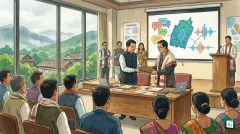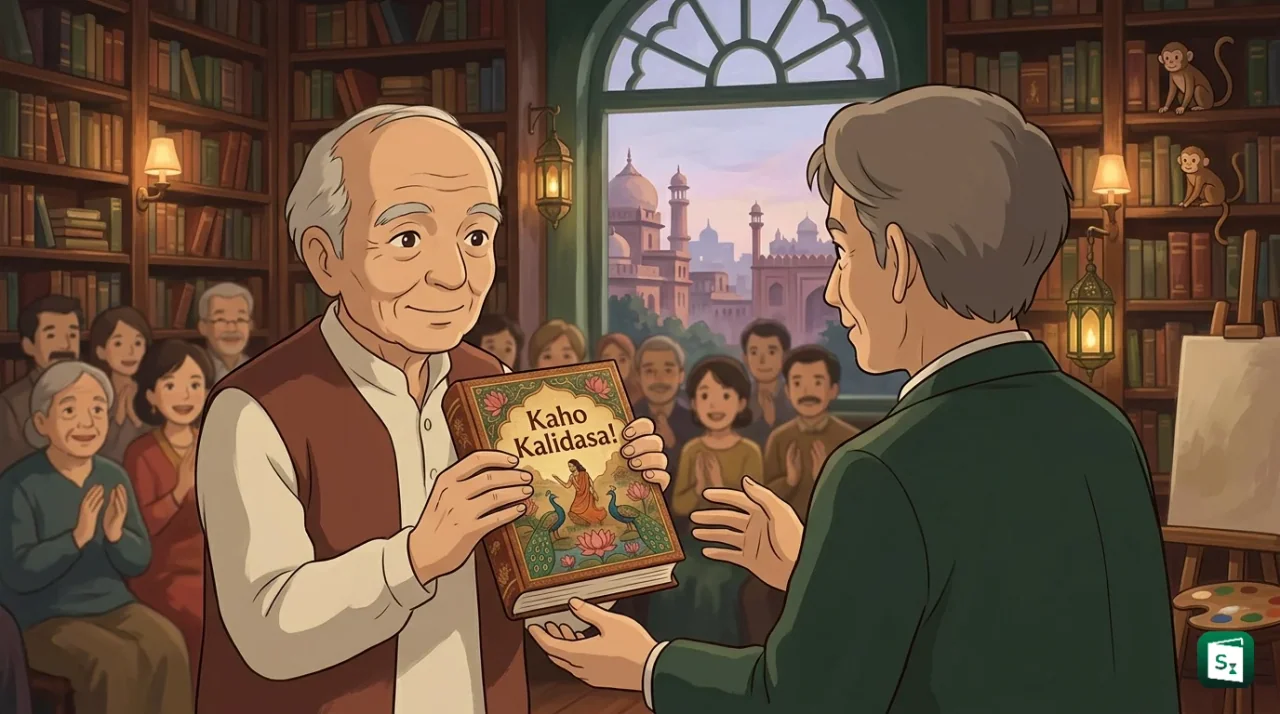
Union Minister for Culture and Tourism Gajendra Singh Shekhawat launched the biographical novel Kaho Kalidasa! by author Yugul Joshi at the Indira Gandhi National Centre for the Arts (IGNCA) in New Delhi on 25 August 2026. Published by Manjul Publishing House, the book reimagines the largely unknown life of Mahakavi Kalidasa, often called ancient India’s greatest Sanskrit poet and dramatist, through five love stories drawn from his seven timeless classics. The launch turned a routine book release into a wider cultural conversation on why Kalidasa’s ideas of love, nature and dignity still speak to young readers more than 1,600 years later.
What Is Kaho Kalidasa! About?
Kaho Kalidasa! is not a conventional biography that lists dates and lineage. It is a biographical novel, a literary form that blends known facts, legends and creative imagination to reconstruct a life where historical records are thin. Since there is no universally accepted account of Kalidasa’s birth, residence or personal struggles, author Yugul Joshi approaches the silence not as a gap but as an opening for interpretation.
The novel traces a journey from adolescence to the height of poetic fame, following youth and love, marriage and courtly entanglements, ideals clashing with power, the ache of exile and the closing chapter of a final love. This arc is woven together through five interlinked love stories set against the social and political currents of Kalidasa’s time. Rather than offering a scholarly commentary, Joshi draws directly from the emotions, images and subtle hints embedded in Kalidasa’s own writings to imagine the experiences that may have shaped the poet.
The larger purpose, as the author has explained, is to make Kalidasa accessible to a new, younger readership. Many students know his name but have never read his verses in the original Sanskrit or in translation. By presenting his world as a flowing narrative rather than an academic study, the novel invites contemporary readers to meet Kalidasa as a feeling, conflicted human being and not merely as a distant classical icon. The book is written in Hindi and seeks to bring classical Sanskrit literature into everyday reading.
The Launch Event at IGNCA New Delhi
The book was launched at the Samvet Auditorium of the Indira Gandhi National Centre for the Arts (IGNCA) in New Delhi. The programme was organised by the Kala Nidhi Division, which functions as the centre’s vast repository of reference material on the arts and humanities and supports research, documentation and preservation of India’s cultural heritage. Established in 1985 and located on Janpath, IGNCA operates as an autonomous institution under the Ministry of Culture.
Union Minister Gajendra Singh Shekhawat, who holds the portfolios of Culture and Tourism since 9 June 2024, attended as Chief Guest. The event was presided over by Ram Bahadur Rai, Chairman of the IGNCA Trust. Dr Joram Aniya, Member of NITI Aayog, was Guest of Honour. Prof K. Anil Kumar, Head of Kala Nidhi, delivered the welcome address, while Sushant Jha of Manjul Publishing House and anchor Manjeet Thakur conducted the proceedings. The gathering included writers, scholars, artists, journalists, publishers and a large number of students.
Speaking at the event, Shekhawat described the evening as more than a book launch. He called it an effort to give voice to the historical silence surrounding Kalidasa, a poet whose literary stature is beyond doubt but whose personal life remains undocumented. While history asks what happened, when and where, literature asks what went on inside the human mind, he observed, and that is how imagination can help explore what history has left unexplored. He also singled out Joshi’s skill in characterisation and expression as a strength of the novel.
A central strand of his address focused on women in Kalidasa’s works. Shekhawat noted that women are not merely subjects of beauty in Kalidasa’s universe. Instead, they appear as embodiments of consciousness, dignity, emotional depth and love, a portrayal that continues to invite fresh reading today.
Author Yugul Joshi recalled the German poet Johann Wolfgang von Goethe’s famous admiration for Abhijnana Shakuntalam, noting Goethe’s remark that if one wishes to see heaven and earth together, it can be found in Shakuntalam. Joshi also pointed out how Kalidasa is claimed with affection by many regions, including Mithila, Ujjain and Uttarakhand, yet ultimately belongs to the cultural heritage of the whole country. His aim, he said, was to let readers understand Kalidasa afresh through the literature he left behind.
Who Is Mahakavi Kalidasa?
Kalidasa, whose name in Sanskrit means servant of Goddess Kali, is regarded as the greatest Classical Sanskrit poet and playwright. He wrote in Sanskrit and Prakrit, drawing his themes largely from the Puranas and philosophy. Almost nothing verifiable is known about his personal life except what can be inferred from his poetry and plays. Even his exact dates remain debated, though most scholars place him in the 4th to 5th century CE during the Gupta Empire, often described as India’s Golden Age.
The most widely accepted view links Kalidasa to the reign of Chandragupta II Vikramaditya (reigned circa 380 to 415 CE), a celebrated patron of art and learning. Tradition counts him among the Navaratna, or nine gems, at the court of Vikramaditya in Ujjain, a city he describes with deep affection in his poetry. An early reference to his influence appears in an inscription at Mandsaur dated about 473 CE, whose verses echo the Meghaduta, while his name alongside poet Bharavi is recorded in the Aihole inscription of 634 CE in present-day Karnataka.
The Gupta era’s stability, prosperity and refinement are reflected in Kalidasa’s world of courtly elegance, ideals of dharma or righteous duty, and deep harmony with nature. Some later legends, such as the popular tale of Vidyottama, portray him as an initially unlearned man blessed by Goddess Kali who transforms into a scholar. While culturally powerful, such stories are considered legends rather than history.
His title Mahakavi, or Great Poet, rests on the judgment that no other Sanskrit writer has combined poetic beauty, dramatic craft and emotional insight with such consistency. The British scholar Sir William Jones first translated Shakuntalam into English in 1789, which introduced Kalidasa to Europe. Soon after, his work was translated into German and other languages, earning him the popular comparison of Indian Shakespeare.
Why Kalidasa Matters for Cultural Heritage
Kalidasa did more than entertain a court. He helped weave the older ritual Sanskrit tradition into a new, confident secular culture of the Gupta period. His plays were performed before elite audiences, yet his themes of love and separation, duty and compassion, and the beauty of the natural world continue to resonate across centuries, languages and regions. That is why central cultural bodies such as IGNCA and the Ministry of Culture continue to revisit his legacy as a living heritage rather than a closed chapter of the past.
What Did Kalidasa Write? His Seven Celebrated Works
Scholars credit seven works as authentically by Kalidasa. They fall into three groups, three plays, two epics and two lyric poems. Together they showcase his mastery of kavya, or strophic poetry, and Sanskrit drama.
| Category | Work | Nature and Theme |
|---|---|---|
| Plays (Nataka) | Abhijnana Shakuntalam (The Recognition of Shakuntala) | Seven-act masterpiece based on a Mahabharata episode. King Dushyanta and Shakuntala, the foster daughter of sage Kanva and daughter of Vishvamitra and Menaka, marry in a forest hermitage. A curse by sage Durvasa makes the king forget her until he sees the signet ring he gave her. Lost in a river and later found by a fisherman in a fish, the ring restores memory and leads to reunion with wife and son Bharata, ancestor of the Bharata lineage. |
| Vikramorvashiyam (Urvashi Won by Valour) | Five-act play on the love of mortal king Pururavas and celestial nymph Urvashi. Saved from demons by the king’s valour, Urvashi is torn between heaven and earth, cursed and transformed, and finally reunited with Pururavas. The fourth act, with the distraught king’s soliloquy and Prakrit verses, is especially famous. | |
| Malavikagnimitram (Malavika and Agnimitra) | Five-act comedy of court intrigue. King Agnimitra of the Shunga dynasty falls in love with the handmaiden Malavika, later revealed to be a princess of royal birth. The play also mentions the Rajasuya sacrifice of King Pushyamitra ( circa 185 BCE, founder of the Shunga dynasty). | |
| Epics (Mahakavya) | Raghuvamsha (Dynasty of Raghu) | Epic in 19 cantos, tracing the solar line from Dilipa and Raghu through Aja, Dasharatha and Rama and his descendants to Agnivarna. Praised as Kalidasa’s most majestic narrative, it presents ideals of kingship and the message that power without responsibility can destroy a lineage built over generations. |
| Kumarasambhavam (Birth of Kumara) | Epic in 17 cantos ( traditionally read as eight) on the love of Shiva and Parvati, the burning of Kamadeva, Parvati’s penance, Shiva’s test in the disguise of a young scholar, their marriage and the birth of Kumara Kartikeya who vanquishes the demon Taraka. | |
| Lyric Poems (Khandakavya) | Meghaduta (Cloud Messenger) | Lyric in about 120 stanzas, divided into Purva Megha and Uttara Megha. A Yaksha, servant of Kubera and exiled for a year to central India, asks a passing cloud to carry a message of love to his wife in Alaka on Mount Kailasa. The cloud’s northward journey becomes a luminous tour of rivers, mountains and cities, shaped in the lyrical mandakranta metre. |
| Ritusamhara (Gathering of Seasons) | Early lyric of 144 stanzas in six cantos describing India’s six seasons. Written in metres such as vamshastha, vasantatilaka and upendravajra, it is often seen as a youthful work. It was notably the first book printed in Sanskrit in Bengal in 1792. |
Kalidasa set much of his poetry to intricate metres and adorned it with upama, or similes, and vivid nature imagery. His characters move between hermitage and palace, human and divine, and his nature is never a backdrop but a participant in human feeling.
Who Is Author Yugul Joshi?
Yugul Joshi, also spelled Yugal Joshi, is an author and serving officer with wide experience in government and public policy. He is an Indian Railway Personnel Service (IRPS) officer and has served as Programme Director and later Member at NITI Aayog, handling portfolios including Water and Land Resources, Information Technology and Telecom, Culture and Tourism, and Communication. He has also been associated with national missions such as the Swachh Bharat Mission and Jal Jeevan Mission, and with PM Gati Shakti in the Railway Board.
An alumnus of IIT Delhi and the National University of Singapore (NUS), he grew up in a village in Uttarakhand. His earlier books include The Singapore Water Story (co-authored on urban water management), Creating Shared Values, Boons and Curses: Legends of the Mythological Mother, Women Warriors in Indian History, Ram: The Soul of Time and the award-winning novel Agnikal, along with the Hindi short story collection Yayavari published in 2025 and several translations and research papers.
With Kaho Kalidasa!, Joshi extends his long engagement with history and mythology into classical Sanskrit literature, seeking to bring its emotional world to readers who may not approach it through formal study.
Who Published the Book and Who Was Involved?
The novel is published by Manjul Publishing House, a leading Hindi and English publisher headquartered in Bhopal with a strong presence in New Delhi. The house is known for translations and original Hindi literature and was represented at the launch by Sushant Jha.
The initiative was anchored by IGNCA’s Kala Nidhi Division, headed by Prof K. Anil Kumar, which invited reflection on how contemporary writing can reopen questions about figures whose biographies have been shaped more by legend than by archival record. The discussion also referenced the continuing relevance of Kalidasa’s translators and interpreters, from Chandra Rajan’s well known translation The Loom of Time to modern stage and screen adaptations, including films such as Mahakavi Kalidasa and Kaviratna Kalidasa.
Why Is This Book in the News Now?
The launch on 25 August 2026 places classical literature back in public focus at a time when institutions are seeking to connect young Indians with Sanskrit heritage through accessible storytelling rather than textbook excerpts alone. By choosing a biographical novel in Hindi that reads like five intertwined love stories, the project tries to lower the barrier between a 1,600 year old poet and today’s reader.
At the same time, the event signals the role of cultural institutions such as IGNCA and the Ministry of Culture in presenting literary heritage as contemporary culture, not only as conservation. For readers, the book offers a convenient entry point to revise core facts, what Kalidasa wrote, when he likely lived, what his most famous works are about, and why he is called the Indian Shakespeare.
Key Takeaways
- Union Minister Gajendra Singh Shekhawat launched the biographical novel Kaho Kalidasa! by Yugul Joshi at IGNCA’s Samvet Auditorium in New Delhi on 25 August 2026.
- The novel is published by Manjul Publishing House and is organised as five love stories inspired by Kalidasa’s seven classics.
- Mahakavi Kalidasa probably lived in the 4th to 5th century CE during the Gupta period, most often linked to Chandragupta II Vikramaditya’s court in Ujjain.
- Kalidasa’s seven authentic works are Abhijnana Shakuntalam, Vikramorvashiyam, Malavikagnimitram, Raghuvamsha, Kumarasambhavam, Meghaduta and Ritusamhara.
- Abhijnana Shakuntalam, his seven-act masterpiece, was first translated into English by Sir William Jones in 1789 and later admired by Goethe, earning Kalidasa the title Indian Shakespeare.
- The launch was hosted by IGNCA’s Kala Nidhi Division, and speakers highlighted that in Kalidasa’s works women appear as embodiments of consciousness, dignity and love, not merely beauty.