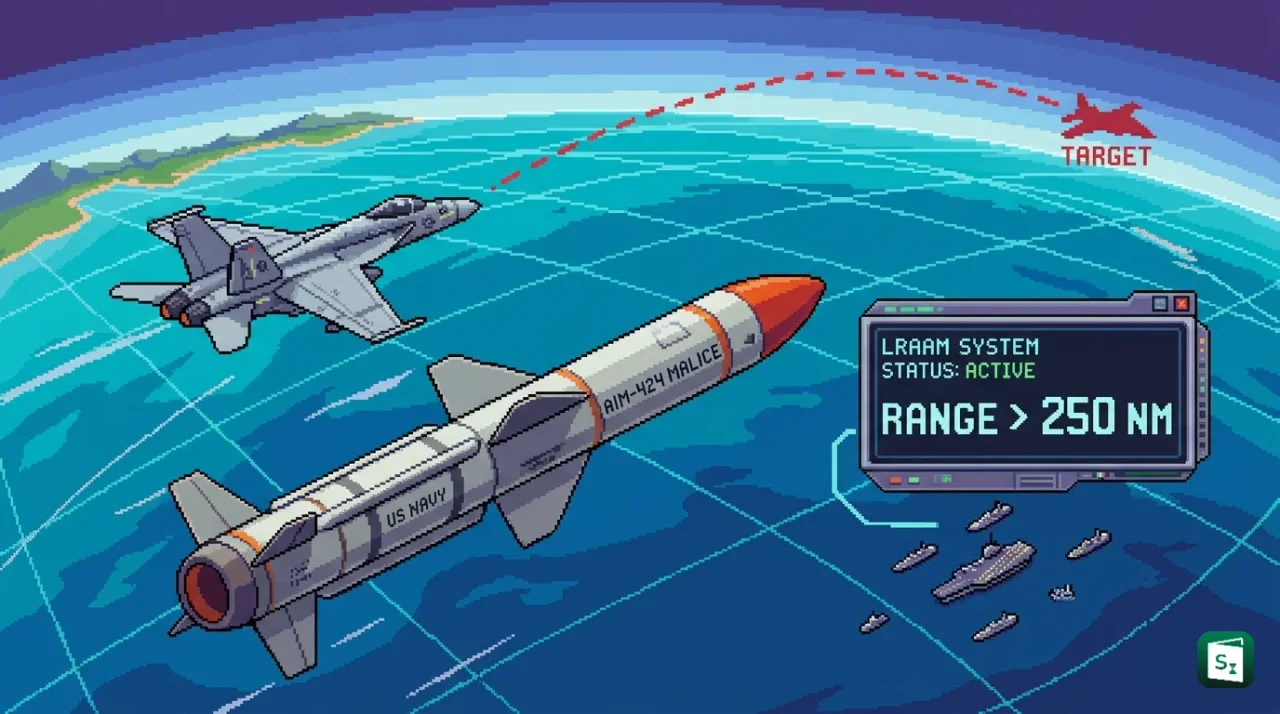
The US Navy has unveiled its next-generation Long Range Air-to-Air Missile (LRAAM), designated Air Intercept Missile (AIM)-424 Malice, with the service confirming a strike range in excess of 250 nautical miles (463 km). Developed by Raytheon, a business of RTX Corporation, the weapon is now in flight testing and is designed for current and future naval fighters. The disclosure signals a major leap in American air dominance at very long range.
What Is the AIM-424 Malice LRAAM?
The AIM-424 Malice is a Long Range Air-to-Air Missile (LRAAM), a class of very long range air-to-air missile intended to engage hostile aircraft far beyond traditional engagement distances. The name AIM stands for Air Intercept Missile, the standard tri-service designation for US air-to-air missiles. Malice is the official service nickname, while LRAAM describes its mission profile as a long-range interceptor.
The weapon belongs to the Beyond Visual Range (BVR) family. A BVR missile is an air-to-air missile whose engagement zone extends beyond the pilot’s visual field, typically starting around 40 km and requiring aircraft radar, data links and mid-course updates to find and track targets. Unlike short-range heat-seeking missiles, BVR weapons rely on inertial guidance with mid-course updates and active radar homing in the terminal phase. This allows a pilot to launch, turn away, and let the missile guide itself, a concept often described as fire and forget.
The Navy describes Malice as a next-generation system to strengthen fleet defence and maintain decisive air domain overmatch. Its stated purpose is to give US Navy and US Marine Corps aviators greater reach, survivability and tactical flexibility, and to support integrated deterrence by increasing lethality and combat effectiveness for forces defending fleets and national interests.
Key Specifications and Features of AIM-424 Malice
Official Navy fact-file details released on 22 August 2026 confirm the missile’s physical dimensions, propulsion and intended platforms. Further performance details such as seeker type, maximum speed and production timelines remain classified.
| Parameter | Details |
|---|---|
| Full designation | AIM-424 Long Range Air-to-Air Missile (LRAAM) Malice |
| Developer | Raytheon, Advanced Technology division, a business of RTX Corporation |
| Length | 13.5 feet (4.11 metres) |
| Diameter | 13.5 inches (0.34 metres) |
| Wingspan | 26.2 inches (0.67 metres) |
| Weight | 1,500 pounds (about 680 kg) |
| Propulsion | Two-stage solid-propellant rocket motor |
| Warhead | Blast fragmentation |
| Operational range | More than 250 nautical miles (463 km, about 288 miles) |
| Launch platforms | F/A-18E/F Super Hornet, F-35C Lightning II, future F/A-XX sixth-generation fighter |
| Generation compatibility | Designed for 4th, 5th and 6th generation aircraft |
The missile’s 13.5 inch diameter and slender aerodynamic profile are optimised for range and sustained speed. Reports indicate a possible solid-fuel dual-mode ramjet inlet configuration to maintain thrust over very long distances, though the Navy has not officially confirmed the propulsion architecture beyond solid propellant.
What Makes Malice Different: Stealth Bay Compatibility and Size Advantage
The most significant design advance is internal weapons bay compatibility. A single instrumented AIM-424 has been photographed fitted inside the internal weapons bay of an F-35C Lightning II, while four rounds were shown loaded externally on an F/A-18E Super Hornet from Air Test and Evaluation Squadron VX-23 (VX-23) during a test event.
This matters because the Navy’s other very long-range weapon, the AIM-174B Gunslinger, is a derivative of the ship-launched RIM-174 Standard Missile-6 (SM-6). The AIM-174B is larger and heavier, with a length of about 15.5 feet (4.72 metres) and a wingspan of about 62 inches (1.57 metres), and at 1,900 pounds (860 kg) it can be carried only by the F/A-18E/F. It cannot fit inside the F-35C’s stealth bays, which limits its use on low-observable platforms.
By contrast, Malice is slightly shorter and lighter with a much smaller wingspan, allowing stealth fighters to carry a very long-range missile internally without compromising their radar signature. This preserves first look, first shot, first kill capability while retaining stealth.
When and Where Was AIM-424 Malice Unveiled?
The missile was publicly revealed at the Tailhook Symposium in Reno, Nevada, on 22 August 2026, the annual gathering of the US naval aviation community. The disclosure was first reported by specialist aviation media, after which the Navy published its official weapons portfolio overview and fact file confirming the designation, contractor and key dimensions.
Photographs released through official channels included the April 2026 image of four AIM-424s on an F/A-18E Super Hornet for a test event and an August image of a missile secured inside an F-35C weapons bay. Raytheon President Phil Jasper confirmed development, stating that the missile delivers a generational leap in long-range air-to-air combat capability and can outrange any threat, with emphasis on increased range, lethality and combat effectiveness for naval forces.
The Navy stated that further details on capabilities and deployment timelines remain classified for operational security. The US Air Force has said it is closely following the programme, indicating joint interest.
Why the US Navy Needs a 463 km Missile: Strategic Context
For decades, the backbone of Western air combat has been the AIM-120 Advanced Medium-Range Air-to-Air Missile (AMRAAM), a combat-proven BVR weapon with latest variant AIM-120D range estimated at 130 to 160 km (70 to 86 nautical miles) and operational speed up to Mach 4. While highly capable, its range has been increasingly challenged by peer competitors fielding extreme-range missiles.
China has invested heavily in long-range systems such as the PL-15 with estimated domestic range of 200 to 300 km and the secretive PL-17 believed to exceed that, while Russia fields the R-37M (AA-13 Axehead) with claimed range up to 300 to 400 km and extensive use observed in recent conflicts. These weapons are designed not only to target fighters but also to hold high-value enablers at risk, including Airborne Early Warning and Control (AEW&C) aircraft, aerial refuelling tankers, intelligence and electronic warfare platforms, and maritime patrol aircraft.
In the Pacific, Chinese kill webs built around long-range sensors, datalinks and missiles aim to threaten carrier strike groups at distance. A missile that exceeds 250 nautical miles allows carrier air wings to create outer-layer fleet defence, intercepting missile-carrier aircraft and surveillance platforms well before they reach their own anti-ship weapon launch positions. This extends defensive depth, improves aviator survivability, and restores reach parity.
The disclosure itself is also a signal. By assigning an official designation, publishing a minimum range figure, and showing integration testing, the Navy has chosen to make the capability visible, communicating deterrence as clearly as operational utility.
How Malice Compares: AIM-424 vs AIM-120, AIM-260, AIM-174B and Global Rivals
The Pentagon is pursuing a layered inventory rather than a single replacement. Malice is distinct from two other very long-range programmes.
The AIM-260 Joint Advanced Tactical Missile (JATM), developed by Lockheed Martin since 2017, is a highly classified joint Air Force and Navy programme intended to replace or supplement the AIM-120. It is designed to fit inside the internal bays of F-22 Raptor and F-35 Lightning II, with similar dimensions to the AIM-120, solid-propellant propulsion, multimode seeker and classified range expected to substantially exceed the AIM-120. Official renderings show four compact rear fins and no mid-body wings for reduced drag. Testing began around 2020, with production reported from 2024 onwards.
The AIM-174B Gunslinger, developed by Raytheon as the air-launched configuration of the SM-6, is confirmed to have a range of at least 130 nautical miles (240 km) with estimates of 220 to 260 nautical miles (400 to 480 km) when air-launched at speed and altitude, using lofted trajectories.
| Missile | Developer | Country | Estimated Operational Range | Propulsion | Key Feature | Platform Compatibility |
|---|---|---|---|---|---|---|
| AIM-424 Malice | Raytheon (RTX) | US | More than 250 nmi (463 km) | Two-stage solid propellant | Internal bay compatible with F-35C, very long range | F/A-18E/F, F-35C, F/A-XX |
| AIM-174B Gunslinger | Raytheon | US | At least 130 nmi (240 km), estimated up to 260 nmi (480 km) | Solid rocket (SM-6 derivative) | Massive warhead 140 pounds (64 kg), SM-6 heritage | F/A-18E/F only |
| AIM-260 JATM | Lockheed Martin | US | Classified, designed to significantly exceed AIM-120D | Solid propellant, classified | Stealth-optimised size, advanced countermeasure resistance | F-22, F-35, F/A-18, F-15EX |
| AIM-120D AMRAAM | Raytheon | US | 70 to 86 nmi (130 to 160 km) | Solid rocket | Combat proven, active radar homing, widely deployed | F-15, F-16, F/A-18, F-22, F-35 |
| Meteor | MBDA | Europe (UK, Germany, Italy, France, Spain, Sweden) | More than 100 km, 60 km no-escape zone | Throttleable ramjet sustainer | Thrust until intercept, largest no-escape zone | Rafale, Eurofighter Typhoon, Gripen |
| PL-15 | China Airborne Missile Academy | China | 200 to 300 km domestic, about 145 km export PL-15E | Solid rocket with dual pulse | Targets AEW&C and tankers, AESA fighter integration | J-20, J-16, JF-17 Block III |
| R-37M | Vympel | Russia | 300 to 400 km | Solid rocket | Very long range, high speed Mach 6 | MiG-31, Su-35, Su-57 |
| Astra Mk1 / Mk2 / Mk3 | DRDO / Bharat Dynamics | India | Mk1 about 110 km, Mk2 about 160 to 220 km, Mk3 SFDR in development | Solid rocket, Mk3 Solid Fuel Ducted Ramjet | Indigenous, Mk3 ramjet similar to Meteor | Su-30MKI, Tejas, future platforms |
The table shows a clear shift toward very long-range engagements. European Meteor, in service with the Indian Air Force Rafale fleet, remains the benchmark for sustained propulsion because its ramjet provides thrust all the way to intercept, giving exceptional terminal energy. American solid-rocket designs seek to achieve similar effect through high-energy propellants, dual-pulse motors and efficient flight profiles, while preserving compact size for stealth carriage.
What Is Raytheon RTX and Its Role in US Air Dominance
Raytheon is a major US defence contractor specialising in integrated air and missile defence, advanced sensors, hypersonics and effectors. The company traces its origins to 1922 as the American Appliance Company in Cambridge, Massachusetts, founded by Vannevar Bush, Laurence Marshall and Charles Smith. It began guided missile production in 1948, developing the AIM-7 Sparrow and MIM-23 Hawk.
In April 2020, Raytheon Company merged with United Technologies Corporation (UTC) to form Raytheon Technologies. In July 2023, the group rebranded as RTX Corporation, traded on the New York Stock Exchange under ticker RTX and headquartered in Arlington, Virginia. RTX operates three businesses, Collins Aerospace, Pratt and Whitney and Raytheon.
Raytheon’s missile heritage includes the AIM-54 Phoenix, AIM-120 AMRAAM, AIM-9X Sidewinder, Patriot and SM-6 families, with AMRAAM integrated on F-16, F-15, F/A-18, F-22, Eurofighter Typhoon and others and produced in more than 14,000 units. The AMRAAM unit cost for the AIM-120D is about $1.09 million in 2019 fiscal terms. The company’s latest work includes the AIM-120D-3 under the Form Fit Function Refresh (F3R) programme and collaboration with the US Department of War on expanding interceptor production, including SM-3 and Tomahawk scale-up initiatives.
For Malice, Raytheon’s Advanced Technology division is the prime developer, emphasising rapid prototyping for fleet defence against emerging long-range threats.
Significance for Naval Aviation and Future Platforms
The Navy states that Malice sustains the first look, first shot, first kill advantage. For carrier aviation, greater reach means greater tactical flexibility. Crews can engage at extended standoff while remaining outside the threat envelope of adversary fighters and surface-to-air systems, which improves survivability and mission success in contested environments such as the Indo-Pacific.
Integration across 4th, 5th and 6th generation platforms ensures relevance across the transition to the future air wing. The F/A-18E/F Block III Super Hornet provides immediate capacity, the F-35C Lightning II with TR-3 / Block 4 upgrades provides stealth penetration with internal carriage, and the planned F/A-XX sixth-generation carrier fighter is intended to carry the weapon from inception. The F/A-XX programme aims to deliver a next-generation air dominance platform for the 2030s, and Malice is explicitly sized for that vision.
Operationally, the missile is expected to target fighters, bombers, AEW&C, aerial refuelling tankers, maritime patrol, electronic warfare and command and control aircraft. Its retained manoeuvrability also suggests relevance against agile fighter-class targets at very long range, though effective use at 463 km will depend as much on networked sensors, secure datalinks and mid-course guidance as on motor performance alone. Very long-range shots require off-board targeting and resilient communications to maintain track quality until the active seeker can acquire.
Questions of unit cost, annual production volume and allied availability remain unanswered, as does the exact initial operational capability date. Whether Malice complements or eventually replaces Gunslinger will also depend on inventory, cost and concept of operations. What is clear is that the Navy now fields two distinct very long-range options, Malice for stealth-integrated reach and Gunslinger for mass and warhead weight, alongside the joint AIM-260 and upgraded AMRAAM for layered lethality.
Key Takeaways
- The US Navy unveiled the AIM-424 Malice LRAAM on 22 August 2026 at the Tailhook Symposium in Reno, Nevada, as a next-generation long-range air-to-air missile.
- Malice is developed by Raytheon, a business of RTX Corporation formed by the 2020 merger of Raytheon Company and United Technologies and renamed RTX in July 2023.
- The missile has an operational range of more than 250 nautical miles (463 km), with dimensions of 13.5 feet length, 13.5 inches diameter and 26.2 inches wingspan.
- Malice weighs about 1,500 pounds (680 kg), uses a two-stage solid-propellant rocket motor and carries a blast fragmentation warhead.
- The weapon is designed for F/A-18E/F Super Hornet, F-35C Lightning II internal weapons bay and future F/A-XX sixth-generation fighter.
- AIM stands for Air Intercept Missile, and Malice is classified as a Beyond Visual Range (BVR) missile with range beginning beyond about 40 km.
- Compared with AIM-120D AMRAAM (130 to 160 km) and AIM-174B Gunslinger (at least 240 km), Malice offers the longest officially acknowledged range in the current US inventory.