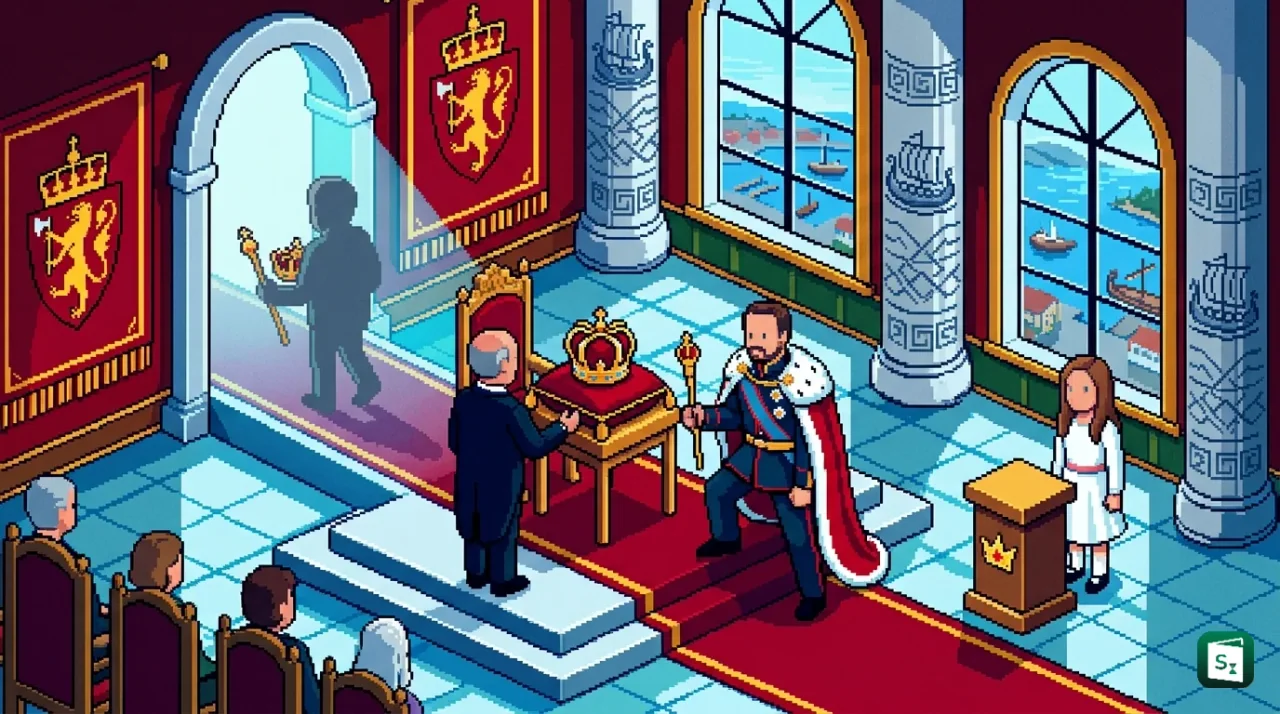
King Harald V of Norway died peacefully on 28 August 2026 at Oslo University Hospital Rikshospitalet at the age of 89, after a brief hospitalisation for haemolytic anaemia. As Norway cannot be without a head of state, his only son Crown Prince Haakon, aged 53, immediately succeeded to the throne as King Haakon VIII. With that succession, Haakon’s elder child Princess Ingrid Alexandra, aged 22, has become Crown Princess and heir apparent to the Norwegian throne.
Who Was King Harald V?
King Harald V was Norway’s third king since the country regained full independence in 1905 after the dissolution of its union with Sweden, and the first Norwegian-born monarch since Olav IV in the 14th century. Born on 21 February 1937 at the Skaugum estate in Asker near Oslo, he was the youngest child and only son of Crown Prince Olav (later Olav V) and Princess Martha of Sweden, and grandson of King Haakon VII and Queen Maud, daughter of Britain’s King Edward VII. Through both lines, the family belongs to the House of Glucksburg (Glücksburg), the Danish-German royal house that has provided Norway’s kings since 1905.
Harald’s early childhood was shaped by the Second World War. When Nazi Germany invaded and occupied Norway in April 1940, the three-year-old prince fled with his mother and two older sisters, Princess Ragnhild and Princess Astrid, first to Sweden and then to the United States, where they lived in exile in Washington D.C. His father and grandfather remained with the Norwegian government-in-exile in London. The family was reunited in Oslo in June 1945 after the liberation of Norway.
Harald completed his schooling at Oslo Cathedral School, studied at the University of Oslo, trained at the Cavalry Officers’ Candidate School at Trandum and graduated from the Norwegian Military Academy in 1959. From 1960 to 1962 he studied social science, history and economics at Balliol College, Oxford. On the death of his grandfather Haakon VII on 21 September 1957, Harald became Crown Prince at age 20. He took the oath to the Constitution of Norway on 21 February 1958 and first attended the Council of State (Statsradet) in the same year.
A defining personal episode was his marriage to commoner Sonja Haraldsen, daughter of a businessman, whom he had dated for nine years. Harald insisted he would remain unmarried if he could not marry her, and his father finally gave consent. They wed in Oslo Cathedral on 29 August 1968, a union that was celebrated widely and helped modernise the image of the monarchy. They had two children, Princess Martha Louise born in 1971 and Prince Haakon born in 1973.
When King Olav V fell ill in 1990, Crown Prince Harald served as regent from 1 June 1990 to 17 January 1991. On Olav’s death on 17 January 1991, Harald ascended the throne. He was consecrated with Queen Sonja at Nidaros Cathedral in Trondheim on 23 June 1991, continuing the tradition of royal benediction. He adopted the historic royal motto Alt for Norge (All for Norway), used by his father and grandfather.
A 35-Year Reign
Harald’s reign from 1991 to 2026 lasted more than 35 years, covering Norway’s oil and gas driven prosperity, its deepening integration with Europe through the European Economic Area, and recurring debates about the role of a largely symbolic monarchy. The monarch in Norway is head of state under a constitutional monarchy and parliamentary democracy. Executive power is formally vested in the King under the Constitution of 17 May 1814, often called the Grunnloven, but in practice it is exercised by the Council of State led by the Prime Minister, while legislative power rests with the Storting, Norway’s parliament.
Harald was widely described as a low key, approachable and unifying figure. He modernised court practices, opened the Royal Palace in Oslo to public tours from 2002, and was a visible presence at national moments of grief, notably after the 22 July 2011 attacks in Oslo and Utoya. He was also an accomplished sailor who represented Norway in Olympic sailing in 1964, 1968 and 1972 and won world and European championship medals.
Health issues marked his later years. He had surgery for bladder cancer in 2003, heart valve surgery in 2005 and 2020, a pacemaker fitted in 2024, and several hospitalisations for infections. In recent weeks he was treated with cortisone for haemolytic anaemia, a condition in which red blood cells are destroyed faster than the body can replace them, leading to fatigue, shortness of breath and strain on the heart. Fluid retention from the treatment required admission to Rikshospitalet on 17 August 2026, where he developed a bacterial infection of the bloodstream. The Royal Court described his condition as extremely serious on 27 August, and he died the next morning at 6:35 AM with his family present.
How Succession Works in Norway
Norway is a limited and hereditary monarchy under Article 1 of the Constitution. The rules of succession are set out in Article 6, most recently amended in 1990 to introduce absolute primogeniture.
The current system works as follows. Succession is lineal, only a child born in lawful wedlock of the King or Queen, or of a person entitled to succession, may succeed, with the nearer line taking precedence over the more distant and the elder over the younger. An unborn child is also included and takes its proper place at birth. For those born before 1971, the older rule of agnatic primogeniture, succession only through the male line, still applies, which is why Harald’s elder sisters Princess Ragnhild and Princess Astrid and their descendants are not in the line. For those born between 1971 and 1990, male-preference cognatic primogeniture applies, so a son takes precedence over an older daughter. For those born in or after 1990, absolute primogeniture applies, so the eldest child inherits regardless of sex.
Because Princess Martha Louise was born in 1971 and Prince Haakon in 1973, both fall under the 1971 to 1990 rule. Haakon therefore remained heir apparent ahead of his older sister even after the 1990 reform, which was not applied retroactively. For Haakon’s own children, both born after 1990, the new rule governs the order fully.
Other constitutional requirements include that a Prince or Princess entitled to succeed may not marry without the consent of the King under Article 36, and may not accept another crown or government without the consent of both the King and the Storting, with two thirds of votes required, or they and their descendants lose the right to the throne. If there is no eligible heir, the King may propose a successor to the Storting under Article 7, and if the royal line dies out entirely, the Storting elects a new King or Queen under Article 48. On accession, the new monarch must take an oath before the Storting under Article 9, promising to govern in accordance with the Constitution and laws. There is no coronation in modern Norway, the constitutional article requiring coronation at Nidaros Cathedral was repealed in 1908, and monarchs since King Olav V in 1957 have instead received a benediction in that cathedral.
When Harald died, succession was automatic. Norway has no interregnum, the next in line becomes monarch immediately.
The New King: Haakon VIII
King Haakon VIII, born Haakon Magnus on 20 July 1973 at the National Hospital (Rikshospitalet) in Oslo, is the only son of Harald and Sonja and represents the fourth generation of the House of Glucksburg on the Norwegian throne. He became Crown Prince on 17 January 1991 when his father became king.
Haakon had a deliberately broad education for a modern heir. After military training he earned a Bachelor of Arts in political science from the University of California, Berkeley in 1999 and a Master of Science in development studies from the London School of Economics in 2000. He also trained with the Royal Norwegian Naval Academy and served with the Norwegian Armed Forces, holding the honorary ranks of general in the Army and Air Force and admiral in the Navy. Since the early 2000s he served repeatedly as regent, including periods in 2003 to 2004, 2005, 2020, 2024 and 18 to 28 August 2026, gaining extensive experience chairing the Council of State when the King was indisposed or abroad.
In 2001 he married Mette-Marit Tjessem Hoiby, a commoner and single mother, in Oslo Cathedral on 25 August 2001. Their marriage, like his parents’ marriage, broadened the monarchy’s popular appeal. They have two children together, Princess Ingrid Alexandra born 21 January 2004 and Prince Sverre Magnus born 3 December 2005, and Haakon is stepfather to Marius Borg Hoiby, born in 1997, who holds no royal title or place in the succession.
As king, Haakon adopted the same motto, Alt for Norge, and on the morning of 28 August 2026 he presided over an extraordinary Council of State at the Royal Palace in Oslo, formally announcing his father’s death and his regnal name. His wife Mette-Marit becomes Queen of Norway, while the late king’s widow Queen Sonja retains her title as queen dowager. The couple’s official residence remains the Skaugum Estate in Asker, while the King’s official residence is the Royal Palace in Oslo, built between 1824 and 1849 for King Charles III John (Karl Johan) and first permanently occupied by King Haakon VII in 1905.
Haakon takes the throne at a sensitive moment. The Royal Court has acknowledged recent controversies that have affected public support, including scrutiny of past contacts between members of the family and convicted financier Jeffrey Epstein, and criminal cases involving Marius Borg Hoiby. Restoring trust and demonstrating the monarchy’s continued relevance in a country where republican proposals are regularly raised in the Storting, though consistently rejected by large majorities, will be an early test.
The New Heir: Crown Princess Ingrid Alexandra
Crown Princess Ingrid Alexandra, born 21 January 2004 at Rikshospitalet in Oslo at 09:13, is the elder child of King Haakon VIII and Queen Mette-Marit and granddaughter of the late King Harald V and Queen Sonja. She is now heir apparent and first in the line of succession.
Her position is historic on two counts. Under Norway’s absolute primogeniture rule, she is now the first female Crown Princess in Norway’s history and is in line to become Norway’s first queen regnant since Queen Margaret I, who ruled over the Kalmar Union including Norway from 1388 to 1412, a gap of more than 600 years. When she eventually succeeds, she will also be the first monarch entitled under equal inheritance to inherit ahead of a younger brother, Prince Sverre Magnus, who is now second in line.
Ingrid Alexandra’s upbringing has been kept as ordinary as possible by design. She attended Janslokka Elementary School in Asker from 2010, transferred to the Oslo International School in 2014 to strengthen English, completed lower secondary at Uranienborg School, and finished upper secondary at Elvebakken Upper Secondary School in Oslo, graduating in June 2023. She worked for a year as a school assistant and environmental worker at Uranienborg. She was baptised in the Royal Chapel of the Royal Palace on 17 April 2004, with godparents including King Frederik X of Denmark (then Crown Prince), Crown Princess Victoria of Sweden and King Felipe VI of Spain (then Prince of Asturias), and was confirmed in the Palace Chapel on 31 August 2019.
Like other Norwegian royals, she undertook national service. On 17 January 2024 she began 15 months of compulsory military service as a conscript with the Engineer Battalion, Brigade Nord at Skjold Camp in Inner Troms, extended from 12 months, serving as a gunner on a CV90 infantry fighting vehicle. During service she was known as Private Alexandra. She completed service on 4 April 2025.
For higher education she enrolled in August 2025 at the University of Sydney in Australia for a three-year Bachelor of Arts focusing on international relations and political economy, and for the autumn semester of 2026 she is on exchange at the University of Oslo studying comparative politics and conflict resolution.
The current line of succession after the accession is:
| Position | Name | Born | Note |
|---|---|---|---|
| 1 | Crown Princess Ingrid Alexandra | 2004 | Heir apparent to King Haakon VIII |
| 2 | Prince Sverre Magnus | 2005 | Younger brother of Ingrid Alexandra |
| 3 | Princess Martha Louise | 1971 | Elder sister of King Haakon VIII |
| 4 | Maud Angelica Behn | 2003 | Daughter of Princess Martha Louise |
| 5 | Leah Isadora Behn | 2005 | Daughter of Princess Martha Louise |
| 6 | Emma Tallulah Behn | 2008 | Daughter of Princess Martha Louise |
Only legitimate descendants of the reigning monarch and the monarch’s siblings and their legitimate descendants who meet the constitutional requirements are included.
Norway’s Monarchy in Context
Understanding the succession also requires a brief view of Norway as a state. Norway is a Nordic country in Northern Europe on the Scandinavian Peninsula, capital Oslo, population about 5.5 million. It adopted its Constitution at Eidsvoll on 17 May 1814, now the second oldest written constitution still in force, and celebrates 17 May as Constitution Day (Grunnlovsdagen). After a brief period under Christian Frederik, Norway entered a personal union with Sweden under the Convention of Moss later in 1814, which lasted until a peaceful dissolution in 1905. In two plebiscites that year, Norwegians first voted to end the union and then by nearly 79 percent voted to keep a monarchy rather than establish a republic.
The Storting then offered the throne to Prince Carl of Denmark, grandson of King Christian IX of Denmark and son-in-law of King Edward VII of the United Kingdom. He accepted and took the Old Norse name Haakon, becoming King Haakon VII, reigning from 1905 to 1957, followed by his son King Olav V (1957 to 1991) and grandson King Harald V (1991 to 2026). Each contributed to defining the modern constitutional role, the King as a non political head of state who opens the Storting, chairs the Council of State at the Royal Palace, formally signs laws and represents Norway abroad, while day to day government is accountable to parliament.
Norway’s monarchy remains broadly popular, though support is periodically tested. The Storting regularly receives proposals to abolish the monarchy, largely from the Socialist Left Party, but they have consistently been defeated by large majorities. The Royal Court’s work today spans ceremonial duties, patronage of science, culture and sport, and support for defence and humanitarian causes, with the King as commander-in-chief of the Armed Forces in a symbolic capacity.
What Happens Next
Following the death on 28 August, Norway entered a period of mourning. The immediate constitutional steps were completed the same morning with the extraordinary Council of State. Next will be ceremonial and practical observances. The late King lay in rest in the Royal Chapel (Slottskapellet) at the Royal Palace, allowing the public to pay respects, ahead of a state funeral expected at Oslo Cathedral. No coronation will follow for King Haakon VIII, as Norway has not held a coronation since 1906. Instead, he will take his formal oath before the Storting under Article 9 when parliament next convenes, and a benediction service at Nidaros Cathedral in Trondheim is anticipated, as held for his father and grandfather.
International reaction reflected Harald’s long standing ties. Norway’s Prime Minister Jonas Gahr Store said a whole nation was in mourning and paid tribute to more than three decades of service, while foreign heads of state including Britain’s King Charles III, who described Harald as a much loved kinsman, Spain’s King Felipe VI and NATO Secretary General Mark Rutte acknowledged his dedication and military roots.
For the new reign, attention will turn to how King Haakon VIII and Crown Princess Ingrid Alexandra balance continuity and modernisation, sustaining Harald’s much noted warmth and sense of duty while adapting the institution to contemporary expectations of transparency and service.
Key Takeaways
- King Harald V died on 28 August 2026 at Oslo University Hospital Rikshospitalet at age 89 after reigning from 17 January 1991 to 28 August 2026.
- His only son immediately became King Haakon VIII, born Haakon Magnus on 20 July 1973, who adopted the motto Alt for Norge (All for Norway).
- Princess Ingrid Alexandra, born 21 January 2004 in Oslo, became Crown Princess and heir apparent, the first female heir in Norway’s history.
- She is in line to become Norway’s first queen regnant since Queen Margaret I (1388 to 1412), more than 600 years ago, under absolute primogeniture introduced in 1990.
- Succession is governed by Article 6 of the Constitution of 17 May 1814 (Grunnloven), which sets absolute primogeniture for those born in or after 1990 and male preference for those born 1971 to 1990.
- Norway is a constitutional monarchy and parliamentary democracy with capital Oslo, where legislative power rests with the Storting and the King chairs the Council of State at the Royal Palace in Oslo.