The Unified Payments Interface (UPI), developed by the National Payments Corporation of India (NPCI), has completed 10 years since its launch in 2016. In FY26, it processed 24,162 crore transactions worth about ₹314 lakh crore and accounted for 84% of India’s digital payments. The milestone marks a journey from 1.78 crore transactions in its first year to becoming the world’s largest real-time payment system by volume.
What Is Unified Payments Interface (UPI) and How Does It Work?
Unified Payments Interface (UPI) stands for a real time, interoperable payment system that lets users instantly transfer money between any two bank accounts using a single mobile application. It was developed by NPCI and operates on top of the Immediate Payment Service (IMPS), which provides the underlying real time settlement engine. UPI is regulated by the Reserve Bank of India (RBI) and works 24 hours a day, 7 days a week, including holidays.
The full form of UPI is Unified Payments Interface, and the full form of NPCI is National Payments Corporation of India. The full form of BHIM is Bharat Interface for Money, the common UPI app launched by NPCI in December 2016.
UPI merges several bank accounts into one app and allows both push (sending money) and pull (requesting money) transactions. Instead of needing the recipient’s account number and IFSC, a user needs only a Virtual Payment Address (VPA) also called a UPI ID, a mobile number linked to the bank, or a QR code. Each transaction is secured with two factor authentication, which combines device binding (the mobile number registered with the bank) and a UPI PIN that only the user knows.
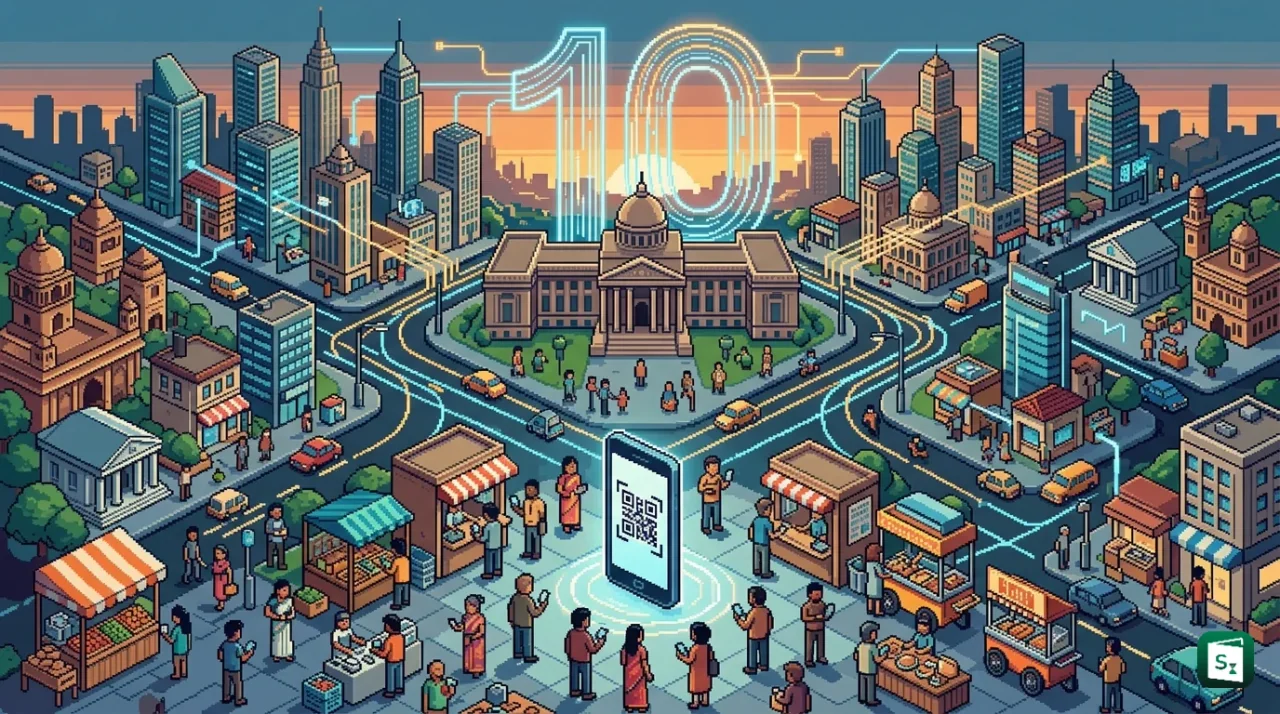
The power of UPI lies in its open and interoperable design. A customer using one app, such as PhonePe, Google Pay, Paytm, Navi or BHIM, can pay a merchant using a different app and a different bank without any friction. At the street level, this design is visible as a printed UPI QR code. A small shop, tea stall or vegetable vendor does not need an expensive point of sale machine, a QR code is enough to accept digital money instantly.
National Payments Corporation of India: The Institution Behind UPI
NPCI is the umbrella organisation for retail payments in India. It was incorporated on 19 December 2008 as a not for profit company under Section 8 of the Companies Act, 2013 (earlier Section 25 of the 1956 Act), and is an initiative of the Reserve Bank of India and the Indian Banks’ Association (IBA) under the Payment and Settlement Systems Act, 2007. It is headquartered in Mumbai, and is headed by the Non-Executive Chairman and Managing Director and Chief Executive Officer Dilip Asbe.
RBI authorised NPCI to operate several payment systems, including the National Financial Switch (NFS), Immediate Payment Service (IMPS) launched in 2010, RuPay card network, Aadhaar Enabled Payment System (AePS), Bharat Bill Payment System (BBPS), National Automated Clearing House (NACH) and National Electronic Toll Collection (NETC). UPI is one of its flagship products.
NPCI took over the NFS from the Institute for Development and Research in Banking Technology (IDRBT) in December 2009 and began formal operations in 2010. The organisation was initially promoted by ten banks, including the State Bank of India, Punjab National Bank, Canara Bank, Bank of Baroda, Bank of India, ICICI Bank, HDFC Bank, HSBC and Citibank, with a second round of shareholding expanded to 56 banks by 2016. Its light, asset efficient model and continuous switching infrastructure helped it become self sustaining from the early years.
From Pilot to National Habit: 10 Year Journey Since 2016
The idea for UPI came from the need to expand the use of IMPS. IMPS had enabled 24x7 real time transfers, but it was not designed for simple merchant payments or for third party apps to easily participate. Under the guidance of founding advisor Nandan Nilekani and technology architect Pramod Verma, and under founding CEO A P Hota, NPCI redesigned the system as a decentralised, open API based protocol that resolves payment addresses in real time across banks. The design retained the proven IMPS settlement engine but added interoperability and third party participation.
The pilot was inaugurated on 11 April 2016 by RBI Governor Raghuram Rajan in Mumbai with 21 banks participating. Public launch followed on 25 August 2016 when banks made UPI enabled apps available on the app stores. The government launched the BHIM app in December 2016 to give every bank a common branded app and to push adoption, especially after demonetisation in late 2016 and later during the COVID-19 pandemic when contactless payments became essential.
Adoption was gradual at first. UPI processed only about 90,000 transactions in August 2016 and about 374 transactions on day one, according to NPCI. It crossed 1 billion transactions in a month for the first time in October 2019. Today, UPI processes more than 66 crore transactions daily and is used by about 55.49 crore users and 65 million merchants, as per data shared in Parliament for mid 2026. Top third party apps by usage include PhonePe, Google Pay and Paytm, along with BHIM.
Decade in Numbers: Record Volume, Value and Reach in FY26
The numbers released by the Ministry of Finance and NPCI for UPI’s 10th year show extraordinary scale. Annual volume rose from 1.78 crore transactions in FY17 to over 24,162 crore in FY26, an increase of almost 13,000 times. Value rose from ₹0.07 lakh crore to about ₹314 lakh crore during the same period, a rise of more than 4,000 times. This translates into a compounded annual growth rate (CAGR) of about 188% in volume and 155% in value.
Growth remained strong in the most recent year. Compared to FY25, volume grew by about 30% and value by about 21%. The platform’s share in India’s digital payments reached 84% in FY26, and globally it accounted for about 49% of real time payment transaction volumes in 2025, a fact recognised by the International Monetary Fund (IMF) as the world’s largest real time payment system by volume.
Monthly numbers also set new records in 2026. Transaction volume crossed 2,000 crore for the first time in 2025 and crossed 2,300 crore in 2026. May 2026 recorded about 2,320 crore transactions, and July 2026 set the all time monthly high of 2,366 crore transactions worth ₹29.88 lakh crore. In April 2026, UPI processed 22.35 billion transactions worth ₹29.03 lakh crore, showing continued momentum in FY27.
Bank participation has widened in parallel. Banks live on UPI increased from 44 in FY17 to 703 in FY26, and stood at 741 banks as of July 2026. This includes public sector banks, private banks, small finance banks, payments banks and cooperative banks, covering a large part of India’s banking geography. Each bank acts as a Remitter PSP or Beneficiary PSP, with NPCI monitoring performance standards.
| Indicator | FY17 (Launch Year) | FY26 (10th Year) |
|---|---|---|
| Annual transaction volume | 1.78 crore | 24,162 crore |
| Annual transaction value | ₹0.07 lakh crore | ~₹314 lakh crore |
| Daily average transactions | Very low (90,000 in Aug 2016) | ~66 crore |
| Banks live on UPI | 44 | 703 (741 by July 2026) |
| Share in India’s digital payments | Nascent | 84% |
| Share in global real time payments | Negligible | ~49% in 2025 |
Key Features Expanding the UPI Ecosystem
Over the past decade, NPCI has added several features to deepen utility beyond simple peer to peer transfers.
UPI Lite is an on device wallet for small value payments. Users load up to ₹5,000 and can pay up to ₹1,000 per transaction (often without PIN for very small amounts up to ₹500), with no need for separate KYC. An AutoPay auto top up feature refills the balance when it falls low. The earlier design allowed transactions up to ₹200 before limits were enhanced to ₹1,000.
UPI Lite X enables near offline payments where the debit happens offline and credit happens when connectivity returns, useful in areas with weak internet.
UPI 123PAY brings UPI to feature phones without internet, through IVR, missed call, app based or sound based solutions.
UPI AutoPay (e-Mandate) was launched on 22 July 2020 for recurring payments such as OTT subscriptions, utility bills, SIPs, insurance premiums, loan EMIs and credit card bills. Once a user approves a mandate with the UPI PIN, money is debited automatically on the chosen schedule (daily, weekly, monthly or annually). The general limit for auto debits is ₹15,000 per transaction without additional authentication, raised to ₹1 lakh for mutual funds, insurance and credit card bills.
UPI Circle (Delegate Payments) allows a primary UPI user to delegate payments to a secondary user, such as a family member without a bank account, with two options: partial delegation (approval needed each time) or full delegation up to ₹15,000 per month with limits, launched broadly from 2024.
Tap and Pay uses Near Field Communication (NFC) to let users tap a phone on a terminal instead of scanning a QR code. RuPay Credit Card on UPI and Credit Line on UPI let users link pre sanctioned credit to UPI for merchant payments. UPI One World offers a Prepaid Payment Instrument (PPI) wallet for foreigners and NRIs visiting India.
QR and Soundbox ecosystem, including UPI QR code generator and UPI Sound Box for merchants, provides instant audio confirmation of payment receipt, especially helpful for small retailers.
How Is UPI Different From IMPS, NEFT and Digital Rupee?
UPI is often confused with other transfer systems. The difference lies in what each system is and how it works.
IMPS (Immediate Payment Service) was launched in 2010 by NPCI. It was India’s first 24x7 real time interbank transfer system. It works through mobile banking, internet banking, ATMs and SMS, and uses account number plus IFSC or mobile number plus MMID as identifiers. It charges ₹1 to ₹25 per transaction depending on the bank and allows limits up to ₹5 lakh.
UPI, launched in 2016, was built on the IMPS rail but added a mobile first layer with UPI ID and QR code, support for both push and pull payments, and zero charge for individuals. Its standard limit is ₹1 lakh per transaction for peer to peer transfers, with enhanced limits of ₹5 lakh per transaction and ₹10 lakh per day for specific categories such as capital markets, insurance, credit card bills, government e-marketplaces, travel, hospitals, educational institutions, IPO applications and RBI Retail Direct since September 2025.
NEFT (National Electronic Funds Transfer), managed by RBI, works in batches and is useful for larger, non urgent transfers. RTGS is for high value settlement. UPI and IMPS are instant and available round the clock.
Digital Rupee (e₹) is different again. It is not a transfer method but money itself. The Central Bank Digital Currency (CBDC) is a digital form of sovereign currency issued by the RBI as legal tender, where 1 e₹ equals 1 rupee. UPI moves money that remains in bank accounts which can earn interest, while the Digital Rupee is stored in a separate CBDC wallet and is a direct claim on the central bank. The pilots for e₹ Wholesale started on 1 November 2022 and e₹ Retail on 1 December 2022, now covering about 17 to 19 banks. The government has made the two systems interoperable, so a CBDC wallet can scan a UPI QR code and vice versa.
| Feature | UPI | IMPS | Digital Rupee (e₹) |
|---|---|---|---|
| What it is | Payment interface | Fund transfer system | Digital currency |
| Launched by | NPCI in 2016 | NPCI in 2010 | RBI in 2022 |
| Identifier | UPI ID, QR code, mobile number | Account plus IFSC, mobile plus MMID | CBDC wallet address |
| Cost to user | Free for individuals | Nominal charge | Generally free |
| Limit | ₹1 lakh standard, up to ₹5 lakh for select merchants | Up to ₹5 lakh | As per wallet rules |
| Settlement | Bank to bank via NPCI | Bank to bank real time | Token moves wallet to wallet, instant |
RBI Digital Payments Index and the Zero MDR Framework
The rapid rise of UPI is captured in the Reserve Bank of India Digital Payments Index (RBI-DPI), a composite index launched on 1 January 2021 with March 2018 as base 100. The index tracks digitisation of payments through supply side infrastructure and performance. It stood at 493.22 in March 2025 against 465.33 in September 2024, showing steady growth.
A key policy decision behind UPI’s mass adoption was making it free. Since January 2020, UPI and RuPay debit cards have been under a zero Merchant Discount Rate (MDR) regime, following amendments to Section 10A of the Payment and Settlement Systems Act, 2007 and Section 269SU of the Income Tax Act, 1961. MDR is the fee a merchant pays to banks and payment providers for processing a digital transaction. For UPI, this fee is zero, so merchants receive the full amount and customers pay nothing extra.
Banks, NPCI and apps such as PhonePe, Google Pay and Paytm currently absorb the cost of infrastructure, cybersecurity, fraud detection and support. The government partly compensated this through the Incentive Scheme for Promotion of Low Value BHIM-UPI Transactions, with an outlay of ₹1,500 crore in FY25, giving 0.15% incentive for small merchant transactions up to ₹2,000. The scheme’s ₹2,000 threshold has often been discussed in public debate, but it is not an announced MDR limit. As of August 2026, the government has introduced the Taxation and Other Laws (Amendment) Bill, 2026 which would allow it to notify which electronic payment modes and thresholds may attract charges in future, while keeping person to person transfers and small merchants exempt. RBI Governor Sanjay Malhotra has said that the costs have to be paid by someone and that any discussion on MDR is still premature.
Going Global: UPI in 11 Countries and Cross Border Links
What began as a domestic platform is now part of India’s digital diplomacy. UPI is currently operational for merchant payments in 11 countries: UAE, France, Bhutan, Sri Lanka, Nepal, Singapore, Mauritius, Qatar, Cambodia, Greece and Maldives. Indian travellers can pay at UPI enabled merchants abroad by scanning QR codes through their home apps.
RBI has outlined three approaches for global expansion: linking UPI with fast payment systems of other countries for low cost remittances, enabling cross border QR based merchant payments, and helping partner nations build UPI like sovereign systems. The most advanced example is the UPI-PayNow linkage with Singapore, which allows instant cross border remittances between the two systems. This model is being studied for other corridors and for reducing friction in remittances, which is important given India’s large overseas diaspora.
Why UPI Matters for Financial Inclusion and the Digital Economy
UPI has become a core pillar of Digital Public Infrastructure (DPI) and the India Stack, which also includes Aadhaar, Jan Dhan accounts and mobile connectivity. Together with low cost smartphones and cheaper data, it allowed even micro merchants to join formal digital finance without heavy investment.
Three impacts stand out. First, breadth: more than 500 million consumers and 65 million merchants are now connected through interoperable rails, and UPI has helped bridge the divide between urban and rural and formal and informal sectors. Studies cited by NPCI indicate that about 63% of UPI volume is from merchant payments, and about 94% of small merchants surveyed accept UPI, with many reporting higher sales after adoption. Second, depth: UPI is now the single largest retail payment mode after cash, with about 86% of merchant payments below ₹500, showing its use for everyday micro transactions. Third, spillover: every digital transaction creates a trail that can help small enterprises with no collateral build a credit history and access formal loans, investments and insurance.
Prime Minister Narendra Modi, marking the anniversary, called UPI a major turning point in India’s digital payments journey and noted that its scale is a source of pride for every Indian. The platform also proved resilient during the COVID-19 pandemic by enabling contactless commerce when cash handling was risky.
What Are the Challenges for the Next Decade?
Scale has created new questions. Two stand out for the coming years.
First, sustainability. Processing more than 20 billion transactions a month involves high costs for servers, fraud prevention, compliance and technology upgrades. Industry estimates place the operating cost at ₹0.40 to ₹1 per transaction. With 24,162 crore transactions in FY26, this implies an annual system cost of roughly ₹9,664 crore to ₹24,161 crore. How to fund this while keeping payments free for most users is under active policy debate.
Second, safety and resilience. As UPI becomes deeply embedded in daily commerce, even short downtime affects millions. NPCI and banks invest heavily in cybersecurity, dispute redressal through the UPI Help portal (help.npci.org.in), and risk mitigation, but fraud, phishing and failed transaction refunds remain concerns. Features like UPI Safety Shield and user education campaigns such as UPI Chalega aim to improve awareness about PIN safety, VPA verification and scam reporting. The UPI transaction limit of ₹1 lakh per day and additional checks for high value mandates are also part of the safety design.
The Way Forward
The government has said the next phase of UPI will focus on bringing more users and merchants into the ecosystem through policy support and technology upgrades. Priorities include expanding UPI Lite and Lite X for low connectivity areas, growing credit on UPI to link payments with access to formal credit, strengthening AI based fraud detection, and deepening international linkages for remittances and travel.
For users, the roadmap means more use cases without changing the core promise: a single app to send or collect money instantly, whether paying a vegetable vendor, splitting rent, paying an electricity bill through Bharat Connect, subscribing to an OTT platform via AutoPay, or allowing a trusted family member to pay through UPI Circle. For the economy, the goal is to sustain the current momentum while ensuring the rails remain secure, inclusive and globally connected as India works toward its long term digital economy ambitions.
Key Takeaways
- UPI completed 10 years since its pilot on 11 April 2016 and public launch on 25 August 2016 by NPCI under RBI oversight.
- FY26 figures: 24,162 crore transactions worth ₹314 lakh crore, accounting for 84% of India’s digital payments.
- Growth from 1.78 crore transactions and ₹0.07 lakh crore in FY17 represents about 13,000 times rise in volume and 4,000 times rise in value, with CAGR of 188% and 155%.
- NPCI was incorporated on 19 December 2008 in Mumbai under the Payment and Settlement Systems Act, 2007 as a not for profit company promoted by RBI and IBA.
- UPI operates on IMPS, uses UPI ID or VPA, QR code and UPI PIN, and handled a record 2,366 crore transactions worth ₹29.88 lakh crore in July 2026 with 741 banks live.
- UPI accounts for about 49% of global real time payment volumes in 2025 as per IMF and is operational in 11 countries including UAE, Singapore and France, with UPI-PayNow link for remittances.