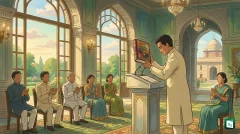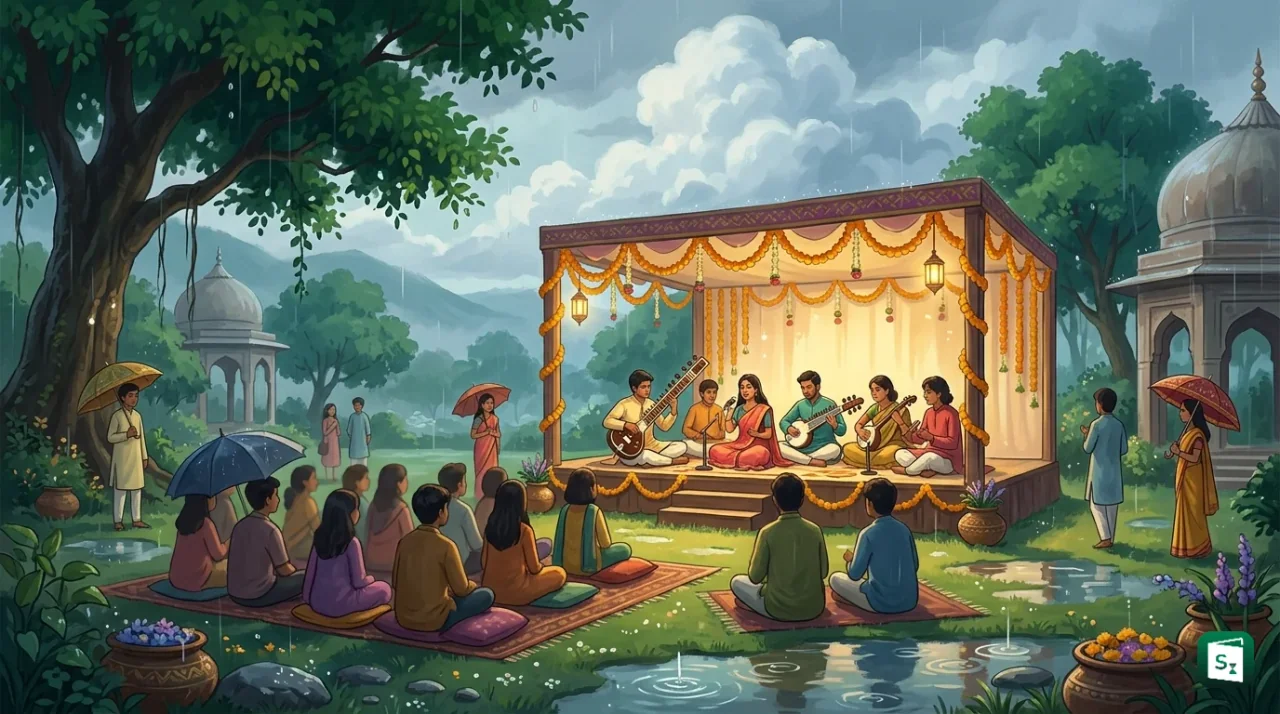
Vice President C. P. Radhakrishnan inaugurated MALHAR 2026 on 21 August 2026 at the Chinmaya HAMCO Auditorium in New Delhi, a youth-centric and monsoon-themed celebration of Indian classical music organised by Antar Hriday Connect. The festival places the Malhar Raga, the celebrated family of rain ragas tied to Varsha Ritu (the monsoon season), at the centre of its programme. With free concerts, classical performances and cultural dialogue for young audiences, the event seeks to bridge India’s centuries-old musical heritage with the aspirations of a new generation.
What Is MALHAR 2026?
MALHAR 2026 is a cultural festival with a clear youth focus. Its full theme is Connecting Youth with the Soul of Classical Music, and it is organised by Antar Hriday Connect, a cultural organisation that specialises in Indian classical music concerts, festivals and heritage outreach. The 2026 edition was held in association with ITC Ltd. at the Chinmaya HAMCO Auditorium in New Delhi and saw strong participation from young audiences.
Speaking at the inauguration, Vice President Radhakrishnan praised Antar Hriday Connect for creating opportunities for young people to experience India’s classical traditions, especially through free classical music concerts. He said that such initiatives help the younger generation connect with their civilisational roots and become custodians of timeless heritage, in line with the vision of Viksit Bharat 2047. He also noted that India’s classical music traditions have survived for centuries because they have continued to evolve while keeping their essence, and that music unites people across regions, languages and cultures.
The event was held under the patronage of Harsh Vardhan Shringla, Member of Parliament (Rajya Sabha) and Chief Patron of Antar Hriday Connect and former Foreign Secretary of India. Other dignitaries present included Anil Rajput, President of Corporate Affairs at ITC, Pradeep Kumar, Chairman of Galaxy and Sawasdee Group, and Saurav Sharma from Nepal, who was honoured at the event. Entry for the public was free on a pre-registration, first come, first served basis.
Two of India’s most respected maestros performed at the inaugural evening. Pandit Ulhas Kashalkar, one of the most distinguished exponents of Hindustani vocal music from the Jaipur Gwalior lineage, and Pandit Rajendra Gangani, an eminent Kathak dancer, led the artistic programme. They were accompanied by noted artistes including Pandit Yogesh Samsi and Fateh Singh on tabla, Ameya Bichu on harmonium, Sami Ullah Khan on vocals, Atul Shankar on flute, Yogesh Gangani on tabla, and Ojesh Pratap Singh and Adwait Keskar on tanpura.
A special international dimension marked the evening. Saurav Sharma from Nepal participated as Antar Hriday Youth Cultural Ambassador and was conferred the Antar Hriday Cultural Diplomacy Award and the Youth Cultural Goodwill Ambassador for India honour by the Vice President. The recognition highlighted the enduring cultural connect between India and Nepal and the role of music as soft cultural diplomacy. The Vice President also felicitated Pandit Ulhas Kashalkar and Pandit Rajendra Gangani for their outstanding contributions to Indian culture.
What Is Malhar Raga? The Monsoon Raga of India
A raga is a melodic framework in Indian classical music. It is not just a scale. It has defined rules about which notes to use, which notes to stress, how to move between notes, and what mood to create. A Varsha Ritu raga is a raga linked to the monsoon season, one of the six seasons in the traditional Indian calendar. Varsha corresponds to the months of Shravana and Bhadrapada, roughly July to September, when the southwest monsoon covers most of India.
Malhar is the defining raga family of the monsoon. The name is believed to come from the Sanskrit words mala and hari, meaning remover of uncleanliness, a reference to rain washing away the heat and dust of summer. Tradition holds that singing Malhar with mastery can summon rain, a legend that has given the raga its mystical stature.
There is not one Malhar but a family of more than 30 variants, all sharing a signature melodic phrase Ma Ma Re Re Pa that forms the soul of the Malhar anga or flavour. Scholars place the oldest forms such as Shuddha Malhar, Megh Malhar and Gaud Malhar in the period before the 15th century. Miyan ki Malhar, also called Miyan Malhar or Tansen ki Malhar, and later forms like Ramdasi Malhar, Sur Malhar, Nat Malhar and Dhulia Malhar emerged between the 15th and 18th centuries. More recent blends such as Des Malhar, Jayant Malhar and Gandhi Malhar, created by Pandit Kumar Gandharva as a tribute to Mahatma Gandhi, show that the family continues to grow.
Every Malhar paints a different picture of rain. Miyan ki Malhar is grand and deep and is said to evoke dark clouds breaking into a storm. Megh Malhar, where megh means cloud, is simpler and serene and is linked to the quiet gathering of clouds. Gaud Malhar combines Malhar with the extinct Gaud raga and carries a brighter, more playful tone. Surdasi Malhar, attributed to the blind poet saint Surdas, and Ramdasi Malhar, attributed to Sant Ramdas, have a gentle, devotional character and are often linked to dhrupad, the older, temple-rooted form of Hindustani singing. Meera ki Malhar, linked to Meerabai, is favoured by several women vocalists including Kishori Amonkar, Parveen Sultana and Kaushiki Chakraborty.
The tradition is deeply tied to the six primary ragas described in the 13th century treatise Sangita Ratnakara by Sharangadeva, where Megh is listed as one of the six root ragas. In the Guru Granth Sahib, the sacred scripture of Sikhism compiled from the 15th century onwards, Malhar also finds mention in the Ragamala section. In Hindustani music, Malhar is classified under the Kafi Thaat, one of the ten parent scales systematised by Pandit Vishnu Narayan Bhatkhande. It is generally sung during the monsoon season at any time, and outside the monsoon, in the second prahar of the night.
Is Malhar the Same as Megh Malhar?
Malhar is the larger family, while Megh Malhar is one specific member. Megh itself is an ancient, pentatonic raga built on five notes, Sa Re Ma Pa Ni, and is considered the king of monsoon ragas with a grand, expansive mood. Megh Malhar blends the austere Megh framework with Malhar phrases, and in performance it uses komal gandhar with a slow oscillation to create the feeling of gathering clouds. In short, every Megh Malhar is a Malhar, but not every Malhar is Megh Malhar.
The Tansen Legend: Miyan ki Malhar and Raga Deepak
Malhar is inseparable from Miyan Tansen, born Ramtanu Pandey around 1493 to 1506 near Behat in Gwalior, in present day Madhya Pradesh. He is counted among the greatest figures in Hindustani classical music and is widely called Sangeet Samrat, monarch of music.
Tansen trained under the devotional master Swami Haridas in Vrindavan and was also guided by the Sufi saint Muhammad Ghaus of Gwalior. He first served the ruler of Gwalior, Raja Man Singh Tomar, and then spent his most productive years in the court of Raja Ramchandra Singh of Rewa, where his fame spread across North India. In 1562, at about 60 years of age, he was summoned to the court of the Mughal Emperor Akbar, who honoured him with the title Mian, meaning learned master, and counted him among the Navaratnas, the nine jewels of the court. The chronicler Abul Fazl wrote in the Ain-i-Akbari that a singer like Tansen had not been heard in India for a thousand years. Tansen is credited with shaping enduring ragas such as Miyan ki Todi, Miyan ki Sarang, Darbari Kanada, which was composed for the royal court, and above all, Miyan ki Malhar.
Two legends linked to Tansen are central to the Malhar story. In the first, rivals at court persuaded Akbar to ask Tansen to sing Raga Deepak, the raga of fire, which was believed to generate intense heat in the singer and even light oil lamps. Tansen sang it with such purity that the lamps are said to have lit and his body burned with fever. In the second, he was saved when his daughter Saraswati in some versions, his wife Husseini in others, or his disciples Tana and Riri sang Raga Megh Malhar, which summoned clouds and rain to cool him. Historians treat these episodes as folklore rather than fact, but they reflect a deep cultural belief that a correctly sung raga carries real power over nature. Tansen is also said to be the founder of the Senia gharana, the parent lineage from which many later schools of Hindustani music trace their descent. He died around 1586 to 1589 in Gwalior, where his tomb beside that of Muhammad Ghaus remains a centre of tribute, honoured annually through the Tansen Samaroh held in Gwalior in December.
Role of Antar Hriday Connect and India-Nepal Cultural Diplomacy
MALHAR 2026 is more than a concert. It reflects the outreach model of Antar Hriday Connect, which organises Indian classical and fusion concerts, workshops on raga appreciation, rhythm and heritage education, and community programmes for corporates, institutions, universities and hotels. The organisation’s stated aim is to promote Indian arts through inclusive, high impact and sustainable events and to make classical music accessible beyond elite audiences.
Honouring Saurav Sharma, a young Nepali artiste who promotes Indian classical music among youth, gave MALHAR 2026 a cross border cultural dimension. India and Nepal share deep civilisational and musical links, from shared festivals and pilgrimage traditions to common reverence for figures like Tansen and the monsoon ragas themselves. By conferring a Cultural Diplomacy Award on a Nepali artiste, the festival positioned classical music as an instrument of cultural diplomacy, the use of culture to build goodwill between peoples. The Vice President described such youth engagement as vital for preserving heritage while building a modern, confident India.
Why Malhar 2026 Matters: Youth, Heritage and Varsha Ritu Tradition
The monsoon in India is not only weather. It is an economic, agricultural and emotional turning point after the intense summer heat. The Indian Meteorological Department divides the Indian climate into summer, monsoon, post monsoon and winter, while the traditional calendar marks Varsha Ritu as the season of rain, fertility and renewal.
Indian classical music mirrors this cycle by assigning ragas to seasons and hours of the day. Folk forms such as Kajri of Uttar Pradesh and Bihar, Sawan songs, Lavani of Maharashtra, and classical monsoon ragas all give voice to the arrival of clouds. In Carnatic music, Amritavarshini, meaning shower of nectar, created by Muthuswami Dikshitar, is famously tied to a legend that it brought rain to arid Ettayapuram in Tamil Nadu, while ragas such as Amritavarshini, Varunapriya and Megha Ranjini also evoke rain.
MALHAR 2026 matters for three reasons that directly connect to national life.
First, it addresses a gap in cultural transmission. Classical music, once nurtured in courts and temples, now competes with rapid digital entertainment. Free, youth focused festivals make ragas like Malhar accessible, turning abstract heritage into a live, shared experience rather than a textbook topic.
Second, it reinforces cultural identity and unity. Vice President Radhakrishnan noted that classical music and dance have survived by evolving while keeping their core, and that they bind India across language and region. A common seasonal vocabulary, the same Malhar heard from Amritsar to Mysore, strengthens that shared cultural memory.
Third, it links tradition to contemporary outreach. By holding the festival in the monsoon months, using the Malhar repertoire that is traditionally sung only in this season, and by involving a young foreign artiste, MALHAR 2026 shows how heritage can serve modern cultural diplomacy without losing its authenticity.
| Aspect | Detail |
|---|---|
| Event | MALHAR 2026 |
| Theme | Connecting Youth with the Soul of Classical Music, youth-centric and monsoon-themed celebration of Indian classical music |
| Organiser | Antar Hriday Connect in association with ITC Ltd. |
| Venue | Chinmaya HAMCO Auditorium, New Delhi |
| Date inaugurated | 21 August 2026 |
| Inaugurated by | Vice President C. P. Radhakrishnan, 15th Vice President of India |
| Chief Patron | Harsh Vardhan Shringla, Rajya Sabha MP and former Foreign Secretary |
| Leading performers | Pandit Ulhas Kashalkar (Hindustani vocal) and Pandit Rajendra Gangani (Kathak) with accompanists including Yogesh Samsi, Fateh Singh, Ameya Bichu |
| International honour | Saurav Sharma (Nepal) conferred Antar Hriday Cultural Diplomacy Award and Youth Cultural Goodwill Ambassador for India |
| Central idea | Celebration of the Malhar Raga family, associated with Varsha Ritu and the legend of Tansen and Miyan ki Malhar |
About Vice President C. P. Radhakrishnan
Chandrapuram Ponnusami Radhakrishnan assumed office as the 15th Vice President of India on 12 September 2025 and is also the ex officio Chairman of the Rajya Sabha. Born on 4 May 1957 in Tiruppur, Tamil Nadu, he graduated with a Bachelor of Business Administration from V. O. Chidambaram College, Thoothukudi, and worked as a garment exporter before entering public life.
He began his political journey with the Rashtriya Swayamsevak Sangh and the Bharatiya Jan Sangh, joining the Jan Sangh state executive committee in Tamil Nadu in 1974, and has been associated with the Bharatiya Janata Party since its founding in 1980. He was elected to the Lok Sabha from Coimbatore in 1998 and 1999, served as President of the BJP Tamil Nadu unit from 2003 to 2006, and undertook a 19,000 km Rath Yatra over 93 days across the state.
Before becoming Vice President, he served as Governor of Jharkhand from 18 February 2023 to 30 July 2024, with additional charge as Governor of Telangana and Lieutenant Governor of Puducherry in 2024, and as Governor of Maharashtra from 31 July 2024 to 11 September 2025. He succeeded Jagdeep Dhankhar after winning the vice presidential election on 9 September 2025 with 452 electoral votes. The Vice President is also the Chancellor of several central universities in his ex officio capacity.
Key Takeaways
- MALHAR 2026 was inaugurated on 21 August 2026 at the Chinmaya HAMCO Auditorium, New Delhi, by Vice President C. P. Radhakrishnan, the 15th Vice President of India.
- The festival was organised by Antar Hriday Connect in association with ITC Ltd. with the theme Connecting Youth with the Soul of Classical Music and a monsoon focus.
- The celebration is centred on the Malhar Raga family, the Hindustani ragas of Varsha Ritu, whose signature phrase is Ma Ma Re Re Pa and which is classified under Kafi Thaat.
- The most celebrated form, Miyan ki Malhar, is attributed to Miyan Tansen (born Ramtanu Pandey, c. 1500 to 1589), member of Akbar’s Navaratnas and founder of the Senia gharana.
- Nepali artiste Saurav Sharma received the Antar Hriday Cultural Diplomacy Award and Youth Cultural Goodwill Ambassador honour at MALHAR 2026, highlighting India-Nepal cultural diplomacy.