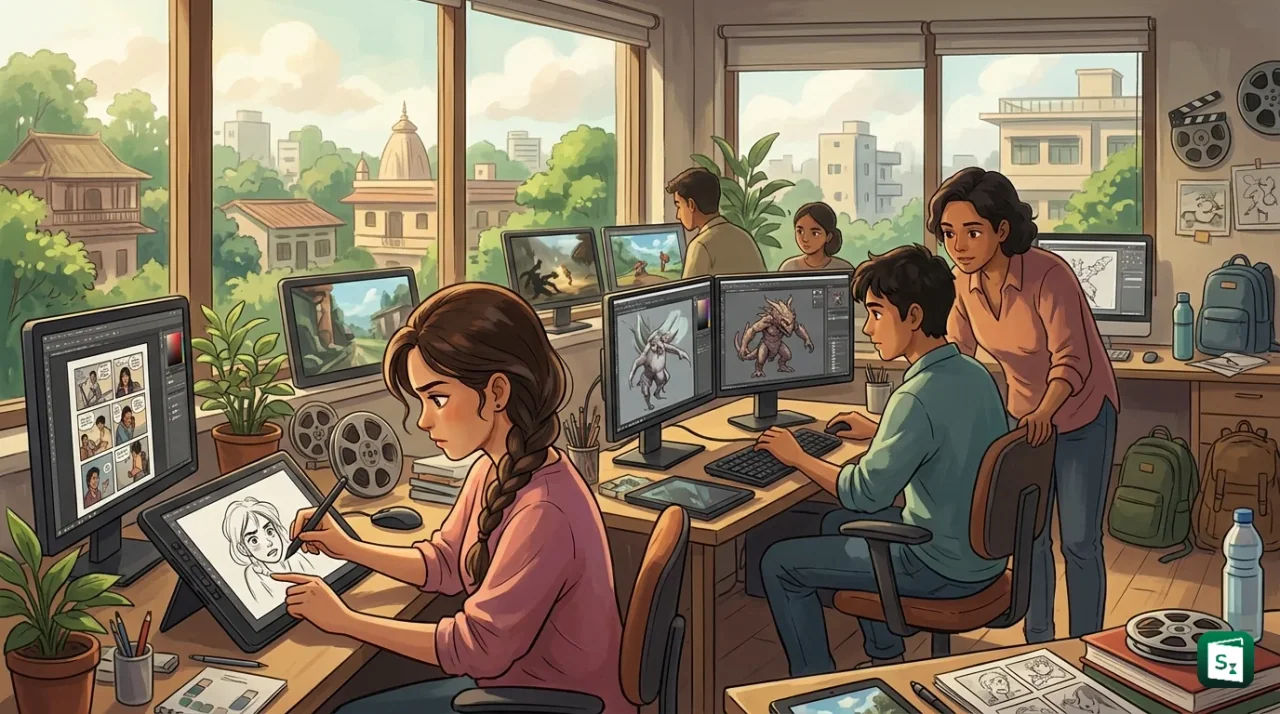
The Indian Institute of Creative Technologies (IICT) and Netflix have launched a joint scholarship initiative for 100 students and working professionals across India, offering financial support of 50% to 80% of programme fees across six professional programmes in the Animation, Visual Effects, Gaming and Comics (AVGC) ecosystem. Applications opened on 24 August 2026 and will close on 30 September 2026, with selections made through a multi-stage process that includes an online assessment, portfolio review and personal interview. The initiative is part of the Netflix India Storytelling Initiative and is supported by the Netflix Fund for Creative Equity, and seeks to build an industry-ready talent pipeline for India’s fast-growing Orange Economy.
What Is the IICT Netflix Scholarship Initiative?
The scholarship is a collaboration between IICT, India’s National Centre of Excellence for AVGC-XR (Extended Reality), and Netflix, the global streaming platform. It aims to widen access to high-end, industry-aligned training in creative technologies at a time when demand for skilled AVGC professionals is rising sharply.
Under the initiative, 100 scholarships will be awarded across six IICT programmes. The financial support ranges from 50% to 80% of the applicable programme fee, depending on the scholarship category awarded. The scheme is open to both full-time students and working professionals from across India, making it one of the first large-scale private sector supported scholarship programmes specifically for the AVGC-XR sector.
The initiative follows a meeting between Prime Minister Narendra Modi and Netflix Co-CEO Ted Sarandos on 5 August 2026. During the meeting, the focus was on India’s storytelling tradition, its large pool of creative talent and the potential to position India as a global hub for content creation. The Netflix India Storytelling Initiative was launched subsequently to invest in India’s creative talent pipeline and equip the next generation of storytellers with skills aligned to global industry requirements.
The scholarships are supported by the Netflix Fund for Creative Equity, a global fund created by Netflix to help underrepresented communities find pathways into the entertainment industry through training, mentorship and access.
Six Programmes Covered Under the Scholarship
The scholarships cover two one-year diploma programmes and four six-month certificate programmes offered by IICT. The curriculum for two of these programmes has been directly shaped with inputs from Netflix to reflect current industry workflows and global standards.
| Programme | Duration | Type | Focus Area |
|---|---|---|---|
| Interactive Comics and Sequential Arts | 12 months | Diploma | Visual storytelling, character design, comic creation and sequential narrative |
| Visual Effects Mastery | 12 months | Diploma | VFX production pipeline, compositing, CGI integration and cinematic effects (curriculum shaped by Netflix) |
| Virtual Art Department Content Creation | 6 months | Certificate | Real-time virtual production, digital environment creation for film, TV and immersive media |
| Media Tech Workflow | 6 months | Certificate | Media production workflows, asset management, post-production pipelines (curriculum shaped by Netflix) |
| Art of Character Animation | 6 months | Certificate | Principles of animation, acting for animation, movement and performance |
| E-Sports and Gaming Management | 6 months | Certificate | Business, operations and event management for the e-sports and gaming industry |
How Will Students Be Selected?
Selection will be based on a four-stage process designed to test both aptitude and creative potential:
- Application and eligibility review: All applications are checked for academic requirements, scholarship eligibility and programme-specific submissions. Only complete and eligible applications move forward.
- Online Multiple Choice Question (MCQ) assessment: Eligible candidates are invited to take an online MCQ test. Performance at this stage determines the shortlist for the next round.
- Portfolio or course-specific assessment: Shortlisted candidates undergo a programme-specific evaluation. This may involve a portfolio review or a course-related assessment conducted online or on site, depending on the programme.
- Personal interview: Candidates who clear the portfolio stage are called for an interview with IICT faculty and a member of the IICT-Netflix Scholarship Panel. Scores across all stages are combined to prepare the final ranking, after which candidates receive a scholarship offer, a waitlist status or an unsuccessful notification.
What Is IICT and Why Was It Created?
The Indian Institute of Creative Technologies (IICT) is India’s National Centre of Excellence (NCoE) for AVGC-XR, which covers Animation, Visual Effects, Gaming, Comics and Extended Reality. Extended Reality is an umbrella term that includes Virtual Reality (VR), Augmented Reality (AR) and Mixed Reality (MR), where digital and physical worlds are blended to create immersive experiences.
IICT was operationalised in 2025 and is modelled on the lines of the Indian Institutes of Technology (IITs) and Indian Institutes of Management (IIMs), but for the creative technologies sector. It was established by the Ministry of Information and Broadcasting (MIB) in partnership with the Government of Maharashtra through the Maharashtra Film, Stage and Cultural Development Corporation Ltd. (MFSCDCL), and industry bodies Federation of Indian Chambers of Commerce and Industry (FICCI) and Confederation of Indian Industry (CII).
The institute is incorporated as a Section 8 not-for-profit company under the Companies Act, 2013. The equity structure is Government of India 48%, Government of Maharashtra via MFSCDCL 14%, and FICCI and CII 26% combined. The central government allocated a one-time budgetary grant of ₹391.15 crore for infrastructure and initial operations, with the institute expected to become self-sustaining thereafter. The Maharashtra government has leased 10 acres of land at Dadasaheb Phalke Film City in Goregaon, Mumbai, for 30 years for IICT’s permanent campus.
At present, IICT operates from its interim campus at the National Film Development Corporation (NFDC) Complex on Pedder Road, Mumbai. The permanent campus at Film City, Goregaon is under development and will house state of the art facilities including gaming labs, animation labs, edit and sound suites, virtual production setups, immersive studios, preview theatres and smart classrooms. The institute currently offers 17 to 18 specialised programmes across gaming, post-production, animation, comics and XR.
Leadership of the institute includes Chanchal Kumar, Secretary, Ministry of Information and Broadcasting, as Chairman of the IICT Board, and Dr. Vishwas Deoskar as Chief Executive Officer (CEO). IICT also benefits from long-term collaborations with global technology partners including NVIDIA, Google, Apple, Microsoft, Meta, Star India and Adobe, who signed Letters of Intent at the World Audio Visual and Entertainment Summit (WAVES) 2025 held in Mumbai in May 2025.
The institute is built on four pillars: academics and talent development, policy and industry development, innovation and start-up incubation, and research and knowledge creation.
What Is the AVGC Sector and the Orange Economy?
AVGC stands for Animation, Visual Effects, Gaming and Comics. When Extended Reality (XR) is added, it becomes AVGC-XR. This sector is part of the larger Media and Entertainment (M&E) industry and is classified as a sunrise sector, meaning it is a new, fast-growing sector expected to drive future economic growth.
The sector creates the visual and interactive content seen in films, streaming shows, video games, comics, advertising and immersive experiences. Films such as Baahubali and RRR have shown how animation and VFX can transform storytelling in Indian cinema. Globally, demand for AVGC content has risen with the growth of Over-The-Top (OTT) platforms, online gaming and the metaverse, a collective virtual space where users interact through digital avatars.
The Orange Economy, also called the creative economy, is a term used for economic activities where value comes primarily from ideas, creativity, cultural knowledge and intellectual property rather than physical goods. It includes industries such as film, music, publishing, design, fashion, software and AVGC. The Economic Survey 2025-26 and the Union Budget 2026-27 both highlighted the Orange Economy as a key driver of jobs, urban services and tourism.
Policy Background: From AVGC Task Force to National Centre of Excellence
The government’s push for AVGC began with the announcement in the Union Budget 2022-23 by Finance Minister Nirmala Sitharaman to set up an AVGC Promotion Task Force. The task force was constituted in April 2022 under the chairmanship of the Secretary, Ministry of Information and Broadcasting, with members from industry and government including secretaries of the Ministry of Skill Development and Entrepreneurship, Department of Higher Education, Ministry of Electronics and Information Technology (MeitY) and Department for Promotion of Industry and Internal Trade (DPIIT), along with state governments of Karnataka, Maharashtra and Telangana, and bodies like All India Council for Technical Education (AICTE) and National Council of Educational Research and Training (NCERT).
The task force submitted its report in December 2022 with several major recommendations. These included creation of a National AVGC-XR Mission with a dedicated budget outlay, launch of a ‘Create in India’ campaign focused on content creation in India, for India and for the world, establishment of a National Centre of Excellence (CoE) for AVGC-XR as an international reference point for skilling, education, industry development and research, and setting up Regional Centres of Excellence in collaboration with states. Other recommendations covered leveraging the National Education Policy (NEP) 2020 to introduce AVGC content at school level, creating University Grants Commission (UGC) recognised AVGC degree courses, setting up AVGC accelerators and innovation hubs on the lines of Atal Tinkering Labs, democratising technology through subscription models for Micro, Small and Medium Enterprises (MSMEs) and start-ups, and setting up a dedicated Production Fund for domestic content.
The Indian Institute of Creative Technologies is the direct outcome of this recommendation. The Union Cabinet approved the National Centre of Excellence and it was operationalised as IICT. It was initially referred to as the Indian Institute for Immersive Creators (IIIC) in early government documents before being formalised as IICT.
Significance of the IICT Netflix Partnership
The partnership addresses a critical gap. India’s AVGC-XR market is currently valued at about $2.5 to $3 billion and employs around 2.6 lakh professionals, but India accounts for less than 1% of the global AVGC market despite its large talent pool. Industry projections estimate the market could reach nearly $26 billion by 2030 and require 20 lakh skilled professionals, or 2 million professionals by 2030 as cited in the Union Budget 2026-27. The shortage of formally trained, industry-ready talent is seen as the main bottleneck.
By combining financial access with industry-aligned curriculum, the IICT Netflix collaboration serves several goals.
First, it helps bridge the skill gap. Netflix’s inputs into the Visual Effects Mastery and Media Tech Workflow curricula bring global production standards, professional workflows and industry expectations directly into the classroom. This helps students learn tools and processes actually used in film, streaming and gaming production.
Second, it strengthens the Orange Economy. The Union Budget 2026-27 announced support for IICT to set up AVGC Content Creator Labs in 15,000 secondary schools and 500 colleges with an allocation of ₹250 crore. The broader WAVES 2025 initiative, including WAVES Bazaar, WaveX Startup Accelerator and Create in India Challenge, has already engaged more than one lakh creators from Tier 2 and Tier 3 cities. The scholarship adds a higher-education pathway to this school and college level push.
Third, it improves employability and global competitiveness. Trained talent can help India move from being mainly an offshore service provider for global studios to becoming a creator of original Intellectual Property (IP), including Indian characters and stories that can travel globally. This supports the ‘Create in India, Create for the World’ vision.
Finally, it promotes inclusive access. By covering up to 80% of fees and opening the scheme to working professionals, the partnership lowers the financial barrier for learners who may not have access to expensive private training in animation or gaming, which has traditionally been delivered by institutes like Arena Animation and MAAC.
For Netflix, the collaboration builds a pipeline of creators who can produce content for streaming platforms, while also deepening its engagement with India’s creative ecosystem under its global Creative Equity mandate.
The Bigger Picture: India’s Push to Become a Global AVGC Hub
India has designated audio-visual services as one of 12 Champion Service Sectors and sees AVGC as central to its soft power and export potential. Several states have already adopted their own AVGC policies, including Karnataka, which was the first state to launch an AVGC policy and has set up centres of excellence, and policies in Maharashtra, Telangana, Tamil Nadu, Kerala and Rajasthan.
At the 5th Global AVGC and Immersive Media Summit 2024 organised by CII, the Ministry of Information and Broadcasting indicated that the AVGC-XR Policy would be implemented alongside the National AVGC-XR Mission, with a focus on infrastructure, skill development, innovation and regulatory support. Proposals such as a hub and spoke model for infrastructure, where the National Centre of Excellence acts as the hub and regional centres function as spokes, are under consideration to take high-end technology to smaller cities and reduce costs through pay per use facilities.
If successful, the IICT model, now reinforced by the Netflix partnership, could become a template for how public institutions and global private players can jointly build talent for emerging sectors, similar to how IITs partnered with industry to build India’s information technology strength.
Key Takeaways
- The Indian Institute of Creative Technologies (IICT) and Netflix have launched 100 scholarships covering 50% to 80% of fees across six AVGC programmes for students and working professionals.
- Applications opened on 24 August 2026 and close on 30 September 2026, with a four-stage selection including online MCQ, portfolio review and personal interview.
- The two diploma programmes are Interactive Comics and Sequential Arts and Visual Effects Mastery, and the four certificate programmes are Virtual Art Department Content Creation, Media Tech Workflow, Art of Character Animation and E-Sports and Gaming Management.
- Netflix contributed to the curriculum of Visual Effects Mastery and Media Tech Workflow and supports the initiative through the Netflix Fund for Creative Equity under the Netflix India Storytelling Initiative launched after the Modi Sarandos meeting on 5 August 2026.
- IICT is India’s National Centre of Excellence for AVGC-XR, established by the Ministry of Information and Broadcasting with the Maharashtra government, FICCI and CII, operating from the NFDC Complex, Mumbai, with a 10-acre permanent campus at Film City, Goregaon and a grant of ₹391.15 crore.
- The AVGC Promotion Task Force was announced in the Union Budget 2022-23 and set up in April 2022 under the Secretary, MIB, leading to the creation of IICT as the National Centre of Excellence.
- India’s AVGC-XR market is valued at $2.5 to $3 billion with 2.6 lakh professionals, projected to reach $26 billion and need 20 lakh professionals by 2030, while the Union Budget 2026-27 pushed the Orange Economy with AVGC Content Creator Labs in 15,000 schools and 500 colleges backed by ₹250 crore.