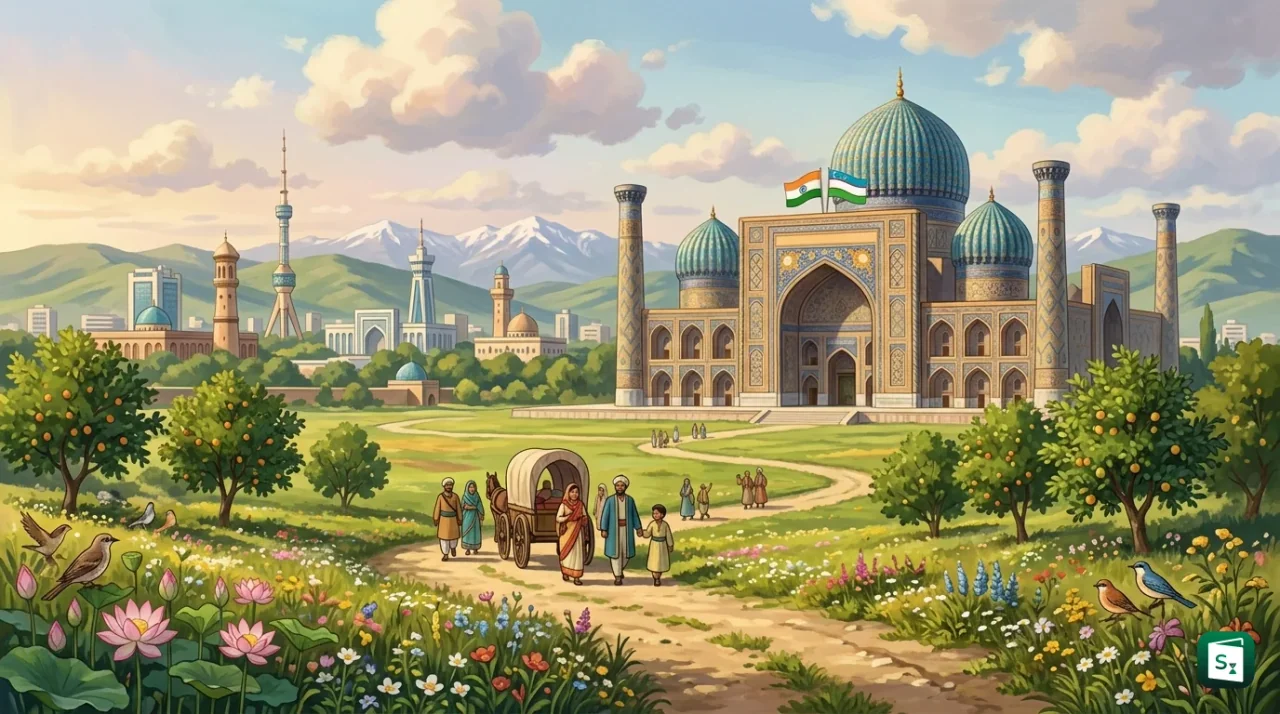
Prime Minister Narendra Modi visited Tashkent on 29 to 30 August 2026 at the invitation of President Shavkat Mirziyoyev, marking the 15th anniversary of the India-Uzbekistan Strategic Partnership and Uzbekistan’s 35th Independence Day on 1 September. During the two day state visit, his fourth to Uzbekistan, he was conferred Uzbekistan’s highest state honour for foreign leaders, the Order of Oliy Darajali Do’stlik (Order of Highest Friendship), and both sides elevated ties to a Comprehensive Strategic Partnership. The visit produced 11 memoranda of understanding and agreements, a roadmap to raise annual trade to $5 billion by 2030, and a new ICCR Sanskrit Chair at Tashkent State University of Oriental Studies to deepen cultural and educational links.
Why Was the Tashkent Visit Significant?
The visit took place on 29 and 30 August 2026 at the Kuksaroy Presidential Palace in Tashkent, where President Shavkat Mirziyoyev received Prime Minister Modi and presented a formal welcome. It was Modi’s fourth visit to Uzbekistan, after earlier visits in July 2015, June 2016 and September 2022 for the Shanghai Cooperation Organisation summit in Samarkand, which underlines the continuity of high level engagement. Secretary (West) in the Ministry of External Affairs, Sibi George, described the agenda as covering trade and investment, defence, digital connectivity, energy, education and people to people ties, with both leaders reviewing progress and setting goals for the next phase.
The timing gave the visit added weight. 2026 marks 15 years since India and Uzbekistan declared their Strategic Partnership in 2011, and it coincides with Uzbekistan’s 35th year of independence. Uzbekistan declared independence from the Soviet Union on 31 August 1991, and celebrates Independence Day on 1 September each year. Modi also laid a wreath at the Independence Monument in Yangi Uzbekiston Park and visited the Lal Bahadur Shastri Memorial and the Mahatma Gandhi Centre at Tashkent State University of Oriental Studies, linking modern diplomacy with shared history. From Tashkent, the Prime Minister travelled onward to Bishkek in the Kyrgyz Republic for the 26th SCO Summit on 31 August to 1 September 2026, which marks 25 years of the SCO, where India has been a full member since 2017.
From Strategic Partnership to Comprehensive Strategic Partnership
India was among the first countries to recognise Uzbekistan’s sovereignty after independence, and diplomatic relations were formally established through a protocol signed in Tashkent on 18 March 1992. Bilateral ties expanded steadily through meetings between leaders, including visits by Prime Minister P. V. Narasimha Rao in 1993 and Manmohan Singh in 2006, and by President Islam Karimov to India in 1991, 1994, 2000, 2005 and 2011. The relationship was elevated to a Strategic Partnership in 2011, which created regular dialogue mechanisms at political and official levels, including joint commissions, foreign office consultations and sectoral working groups.
On 30 August 2026, Modi and Mirziyoyev announced the upgrade to a Comprehensive Strategic Partnership (CSP), reflecting the wider scope and deeper content of cooperation today. Speaking at the joint press interaction, Modi said, “We are celebrating the 15th anniversary of our strategic partnership. On this special occasion, we have decided to elevate our relations to a Comprehensive Strategic Partnership.” He added that both sides would move forward by setting concrete goals within this new framework.
To steer the upgraded partnership, the two leaders agreed to establish a Coordination Council at the level of Foreign Ministers and to raise the existing India-Uzbekistan Inter-Governmental Commission from secretary level to ministerial level. They also agreed to hold a joint business summit with business leaders from both countries and to prepare sector specific roadmaps, with teams from each side visiting the other to define clear objectives. The joint statement underlined convergence on a free, open and rules based international order and reaffirmed commitment to the Central Asia-India format at heads of state and other levels, as well as cooperation at the United Nations, G20 and SCO.
What is the Oliy Darajali Do’stlik Order?
At the Kuksaroy Residence on 30 August 2026, President Mirziyoyev presented Prime Minister Modi with the Order of Oliy Darajali Do’stlik (Order of Highest Friendship), the highest state award of Uzbekistan for foreign leaders. The honour recognises exceptional contribution to strengthening friendship and cooperation between Uzbekistan and another country. Accepting it, Modi said it was a matter of great pride and dedicated the award to the 1.4 billion people of India and to the enduring bond between the two civilisations, noting that it brings added responsibility to work together as Global South partners.
The word Do’stlik means friendship in Uzbek, close to the Hindi and Urdu word dost, a point Modi highlighted when he said there is hardly a family in India where the word is not spoken many times each day. For the award itself, the name captures the sentiment at the heart of the partnership.
This was the 36th international honour conferred on Prime Minister Modi by a foreign state since 2014. Recent recipients of the same Uzbek order include President Kassym-Jomart Tokayev of Kazakhstan, President Serdar Berdimuhamedow of Turkmenistan, former President Gurbanguly Berdimuhamedow and United Nations Secretary General Antonio Guterres. Other honours received by Modi in recent years include the Legion of Merit from the United States in 2020, the Order of St. Andrew the Apostle from Russia in 2019, the Order of Zayed from the United Arab Emirates, the Grand Cross of the Legion of Honour from France, the Companion of the Order of Logohu from Papua New Guinea and the Order of the Nile from Egypt, among others.
Eleven Agreements Signed: What Was Decided in Tashkent?
After delegation level talks on the full range of the partnership, the two sides exchanged 11 memoranda of understanding and agreements and a Letter of Intent for heritage restoration. The talks covered trade and investment, innovation and start ups, digital public infrastructure and UPI, defence and security, healthcare and pharmaceuticals, critical minerals, agriculture, education, tourism, space and people to people exchanges.
The main outcomes announced jointly were:
| Area | Key Decision or Agreement |
|---|---|
| Overall Framework | Joint announcement elevating ties to Comprehensive Strategic Partnership with a Foreign Ministers led mechanism |
| Culture and Heritage | MoU for ICCR Sanskrit Chair at Tashkent State University of Oriental Studies, plus Letter of Intent for restoration of Fayaz Tepa and Kara Tepa Buddhist sites in Uzbekistan |
| Education and Language | Agreement on higher education and research, and announcement of 100 Lal Bahadur Shastri Scholarships for Hindi language for Uzbek students to mark the 60th anniversary of Lal Bahadur Shastri’s passing in Tashkent in 1966 |
| Digital Payments | Commercial agreement between NPCI International Payments Ltd (NIPL) and National Interbank Processing Centre JSC (NIPC), Uzbekistan to enable Indian UPI apps to scan the national QR code UZQR for merchant payments in Uzbekistan |
| Environment | Grant of $1 million for afforestation in the Aral Sea region linking India’s Ek Ped Maa Ke Naam (Plant a Tree in Mother’s Name) with Uzbekistan’s Yashil Makon (Green Nation) programme, and MoU on environment |
| Economic and Mining | MoUs on economic collaboration, mining and critical minerals, tourism, and creation of a Joint Working Group on non tariff barriers and investment barriers |
| Health and Traditional Systems | MoU on Ayurveda and traditional medicine |
| Institutional Links | MoUs on archives, capacity building and sister state and sister city relations with three new pairings to take ties beyond the capitals |
The two leaders also jointly planted a tree in the palace garden to underline the green partnership and directed officials to prepare detailed implementation roadmaps for each sector. Modi again invited President Mirziyoyev to India, with dates to be set through diplomatic channels.
Trade, Energy and Connectivity: The $5 Billion Roadmap
Bilateral trade remains well below its potential. According to Uzbek statistics cited by the Ministry of External Affairs, trade rose from about $235 million in 2017-18 to $442.6 million in 2020, $490.5 million in 2021, $690.5 million in 2022, $756.6 million in 2023 and $980.4 million in 2024, with estimates reaching $1.32 billion in 2025 when services are included. India is now among the top 10 trade partners of Uzbekistan. India’s main exports are pharmaceutical products, mechanical equipment, vehicle parts, optical instruments, mobile phones and frozen buffalo meat, while imports from Uzbekistan are led by fruit and vegetable products, fertilisers, juice products and lubricants. About 61 million dollars of cumulative Indian investment is present in sectors such as pharmaceuticals, amusement parks, auto components and hospitality, with more projects in textiles, agriculture, mining and healthcare under discussion.
To expand this base, the two leaders fixed a target to raise annual bilateral trade to $5 billion by 2030, more than a fivefold increase from current levels. They agreed to broaden the range of traded goods, remove non tariff barriers and promote industrial cooperation through the new Joint Working Group, and to strengthen support for small and medium enterprises through e commerce and digitalisation of trade procedures. They also recalled the completion of a Joint Feasibility Study for a Preferential Trade Agreement and directed ministries to explore next steps on a time bound basis. The Uzbek side welcomed India’s support for Uzbekistan’s accession to the World Trade Organization, and both sides pledged to uphold the WTO centred multilateral trading system, especially for developing countries.
Energy was another core pillar. Modi welcomed progress on a long term arrangement for the supply of uranium from Uzbekistan to India for civil nuclear cooperation. Uzbekistan is one of the world’s leading uranium producers, and a stable supply would support India’s programme to expand nuclear and other clean energy capacity. The leaders also agreed to deepen cooperation in critical minerals, mining, oil and gas, space, artificial intelligence and cybersecurity, making the partnership more future ready. They highlighted complementarity between Uzbekistan’s New Tashkent urban project and India’s GIFT City in Gujarat, and Modi invited an Uzbek team to visit GIFT City to study best practices in finance and technology governance.
On connectivity and finance, both sides will work to improve market access, banking links and payment systems. The NIPL NIPC agreement on UPI and UZQR will allow Indian travellers and businesses to make merchant payments in Uzbekistan by scanning the national QR code with Indian UPI apps, extending India’s Digital Public Infrastructure (DPI) model abroad. This follows similar DPI cooperation India is pursuing with several partner countries.
Defence and security cooperation also advanced. The leaders praised regular exchanges and the Joint Working Group on Military Cooperation, which is exploring defence industrial collaboration, and welcomed the latest joint exercise Dustlik held in the Namangan Region in April 2026. They agreed to promote direct linkages, co production and co development between defence industries and reaffirmed a shared resolve of zero tolerance against terrorism, extremism and separatism, which they described as serious challenges to the whole region.
Cultural and Educational Bridges: The New Sanskrit Chair in Tashkent
People to people ties drew on long civilisational links. Uzbekistan has nurtured Indology for decades. About six institutions in the country teach Hindi up to postgraduate level, and several universities offer courses in Sanskrit, Tamil and other Indian languages. Teachers such as Azad Shamatov and Sirojiddin Nurmatov have been recognised by India for promoting Hindi. The Lal Bahadur Shastri Centre for Indian Culture (LBSCIC) in Tashkent, first set up as the Indian Cultural Centre in 1995 and renamed in March 2005, runs regular classes in Hindi, Kathak dance, tabla and yoga, organises more than 40 programmes a year, and supports outreach to schools and universities across the provinces.
The Indian Council for Cultural Relations (ICCR) is the nodal body for India’s cultural diplomacy. It was founded in 1950 by Maulana Abul Kalam Azad and is headquartered in New Delhi. In consultation with Indian missions abroad, it establishes Chairs of Indian Studies and Indian Languages in foreign universities through memoranda of understanding. These Chairs, held by deputed Indian faculty for periods of one semester to two academic years, teach courses on Indian history, politics, economy, society and culture, guide research, hold seminars and build scholarly links.
In Uzbekistan, ICCR already runs an India Chair at the University of World Economy and Diplomacy (UWED) in Tashkent and has supported Hindi and Sanskrit teaching at other centres, including Samarkand State University, which has an Indian Studies Centre. On 30 August 2026, a new ICCR Sanskrit Chair at the Tashkent State University of Oriental Studies (TSUOS) was announced. Sanskrit is recognised as a Classical Language of India, and the Chair will promote teaching and research in the language and its literature, helping Uzbek students and scholars access original sources on philosophy, linguistics, science and art.
Other steps taken during the visit reinforce this bridge. To mark the 60th anniversary of the passing of Lal Bahadur Shastri in Tashkent on 11 January 1966, India announced 100 Lal Bahadur Shastri Scholarships for Hindi language for Uzbek students, in addition to existing ICCR scholarships that send two Uzbek students each year to the Kendriya Hindi Sansthan (Central Institute of Hindi) in Agra for a Master’s in Hindi. The two sides will also work together to conserve Uzbekistan’s Buddhist heritage sites at Fayaz Tepa and Kara Tepa near Termez, ancient monastic complexes that reflect the spread of Buddhism from India to Central Asia along the Silk Road. Four Indian universities now operate campuses in Uzbekistan, namely Amity University in Tashkent, Sharda University in Andijan, Sambhram University in Jizzakh and Acharya University in Bukhara. Discussions on a 30 day visa free arrangement and more direct flights are expected to boost tourism, student mobility and business travel. Modi also noted the popularity of yoga in Uzbekistan after attending a session organised by the Yoga Federation of Uzbekistan.
Why the Visit Matters for India and Central Asia
Uzbekistan lies at the heart of Central Asia and is central to India’s Connect Central Asia Policy launched in 2012. It is the most populous Central Asian state and the only one that borders all four other Central Asian countries plus Afghanistan, giving it a pivotal role in regional connectivity and stability. The region holds large reserves of uranium, natural gas, gold and critical minerals, and offers a gateway for India to reach wider Eurasian markets.
For India, the Tashkent outcomes bring clear gains. A long term uranium supply strengthens energy security and supports the expansion of nuclear power as a clean source to meet growing demand. The jump to $5 billion in trade by 2030 opens a larger market for pharmaceuticals, medical devices, information technology, auto components, textiles and food products, while giving Indian firms a base to engage with Central Asia. The spread of UPI and DPI cooperation shows how India’s public digital platforms can be adapted abroad and can make travel and business payments easier for Indians in Uzbekistan.
For Uzbekistan, closer ties with India bring access to affordable medicines, health technology, agricultural expertise, information technology services and education, as well as investment for industrial parks, infrastructure and mining. The alignment between Yangi Uzbekistan reforms and India’s Viksit Bharat 2047 vision, both of which place youth, innovation and inclusive growth at the centre, was highlighted by both leaders as a natural fit.
The visit also reinforces multilateral coordination. Both countries work together in the Shanghai Cooperation Organisation, which was founded in 2001, in the India Central Asia Summit format first held virtually on 27 January 2022, and at the United Nations. Regular mechanisms such as Foreign Office Consultations, last held in May 2022 in New Delhi and August 2024, keep the agenda on track. With the new Foreign Ministers Council, the upgraded Inter Governmental Commission and the planned business summit, the Tashkent decisions give a practical roadmap to turn a historic relationship into results for jobs, energy, education and culture in the years leading to 2030.
Key Takeaways
- Prime Minister Narendra Modi paid a State Visit to Tashkent on 29 and 30 August 2026 at the invitation of President Shavkat Mirziyoyev, marking the 15th anniversary of the India Uzbekistan Strategic Partnership of 2011 and the 35th anniversary of Uzbekistan’s independence on 31 August 1991.
- Modi was conferred Uzbekistan’s highest honour for foreign leaders, the Order of Oliy Darajali Do’stlik (Order of Highest Friendship) at the Kuksaroy Presidential Palace, his 36th international award since 2014.
- India and Uzbekistan upgraded ties to a Comprehensive Strategic Partnership and agreed to set up a Coordination Council at Foreign Ministers level and raise the Inter Governmental Commission on Trade, Economic, Scientific and Technological Cooperation to ministerial level.
- The two sides exchanged 11 MoUs and agreements and a Letter of Intent for Fayaz Tepa and Kara Tepa Buddhist sites, covering culture, education, archives, environment, tourism, mining, Ayurveda and sister state relations.
- A target to raise annual bilateral trade to $5 billion by 2030 was fixed, up from $980.4 million in 2024, with a Joint Working Group on non tariff barriers, a Business Summit and time bound steps toward a Preferential Trade Agreement.
- The ICCR Sanskrit Chair at Tashkent State University of Oriental Studies was announced, adding to the existing India Chair at the University of World Economy and Diplomacy, while India announced 100 Lal Bahadur Shastri Scholarships for Hindi and a $1 million grant for afforestation in the Aral Sea region linked to Ek Ped Maa Ke Naam and Yashil Makon.
- A commercial agreement between NPCI International Payments Ltd and National Interbank Processing Centre JSC of Uzbekistan will enable Indian UPI apps to scan UZQR for merchant payments in Uzbekistan, and progress was noted on a long term uranium supply arrangement for civil nuclear cooperation.